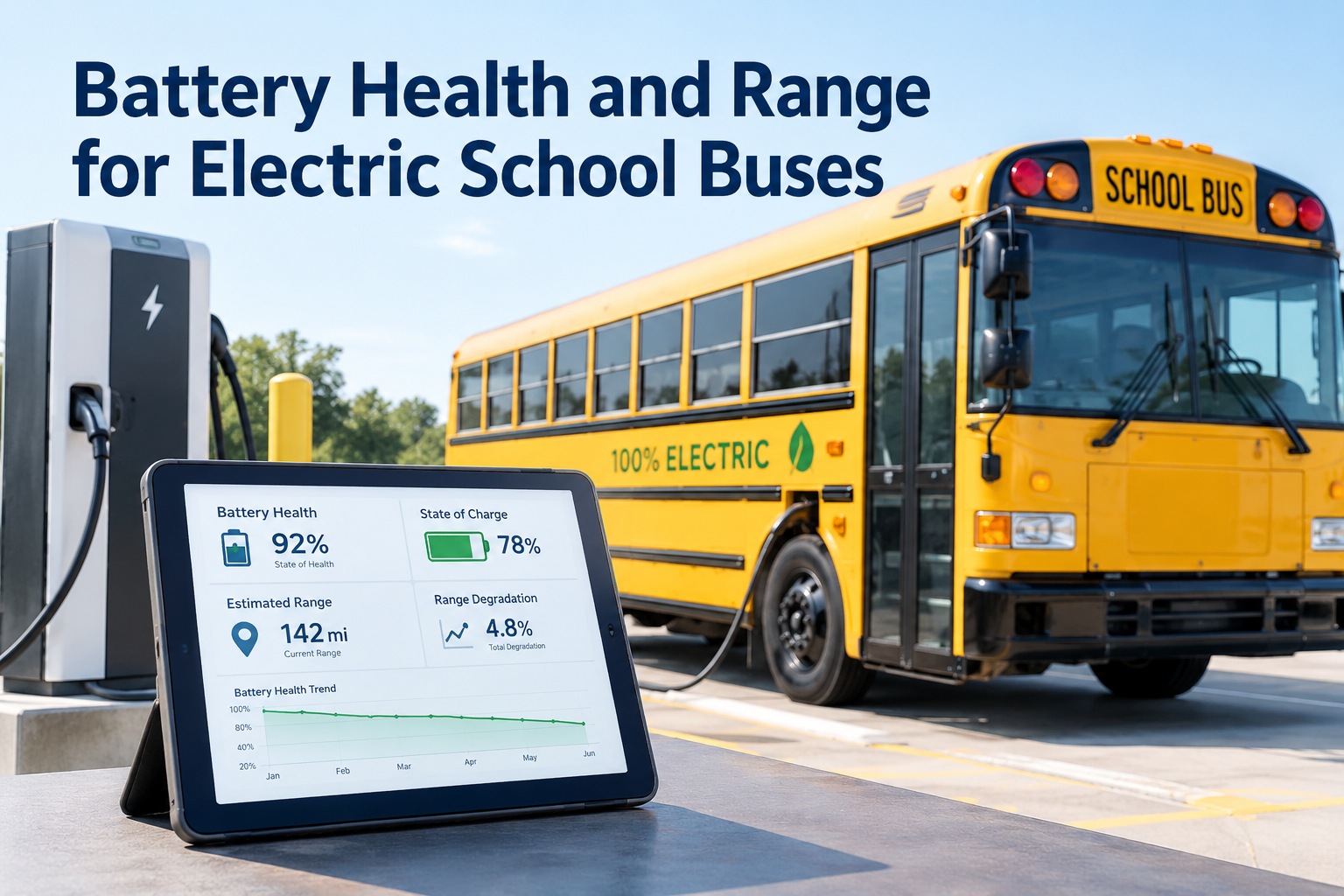
An electric school bus rated for 125 miles sounds like plenty of range for a 47-mile route — until January drops the temperature to 10°F, the cabin heater starts pulling from the same battery that powers the wheels, and that 125 miles quietly becomes closer to 90. Battery health and range for electric school buses isn't one number on a spec sheet. It's a moving target shaped by state of health, temperature, and how honestly a district plans routes against real-world range instead of the ideal-conditions figure on the brochure.
State of Health vs. State of Charge: Know the Difference
These two terms get used interchangeably and shouldn't be. Confusing them is how a fleet ends up surprised by a battery that's aged faster than expected.
A bus can show 100% state of charge and still have meaningfully less usable range than it did a year ago, because SOH has quietly declined underneath it. Sign up to track SOH trends across your electric fleet automatically.
Why Winter Changes the Math
Cold weather doesn't damage the battery, but it does eat into range in ways that catch fleets off guard if they only plan against the ideal-conditions number.
The battery thermal management system (BTMS) also draws energy to keep cells at their optimal operating temperature, which is part of why winter range dips even before the cabin heater is factored in.
Matching Routes to Real Range, Not Rated Range
The districts getting this right run their longest routes against winter-adjusted range with a safety buffer — not against the number on the sales sheet.
A 47-mile route fits that ceiling with room to spare. A route pushing 70+ miles in summer is the one worth a cold-weather test run before committing to it for winter. Book a demo to model this against your own route distances.
Expert Review: Catching a Fast-Degrading Battery Early
Here's how SOH tracking plays out over the life of a single electric bus — and where a fleet without it would have found out the hard way.
Without SOH tracking, this bus's declining range would have shown up as a missed pickup on a cold morning, not a data trend three months earlier. Sign up to catch battery degradation trends before they affect a route.
Battery Records Under 49 CFR 396.3 and District Fleet Policy
Battery health doesn't sit outside your standard maintenance recordkeeping — it's part of it. Section 396.3 requires a systematic record of inspection, repair, and maintenance for every vehicle you control, and for an electric bus that reasonably includes battery condition, charging system checks, and any thermal management service. Most districts layer their own charging and inspection cadence on top of that federal baseline. Sign up to log battery health alongside your standard maintenance records.
The goal isn't to treat an electric bus's battery as a mystery box that either works or doesn't. It's to track state of health the same way you'd track brake wear — predictably, with enough lead time to plan around it instead of reacting to it. Talk to our team about setting up battery health tracking for your fleet.
Frequently Asked Questions
What's the difference between state of charge and state of health?
State of charge (SOC) is how full the battery is right now, and it resets every time the bus charges. State of health (SOH) is how much usable capacity remains compared to when the battery was new, and it only declines over time. A bus at 100% SOC can still have reduced range if its SOH has dropped.
How much range do electric school buses lose in cold weather?
Range reductions of roughly 15% to 33% are typical in cold weather, driven mostly by cabin heating and the battery thermal management system drawing energy to keep cells at their optimal temperature. The exact loss depends on temperature, terrain, and heating system type.
How much does an electric school bus battery degrade over its lifetime?
A typical electric school bus battery loses around 20% of its capacity over several years of normal use, similar to how a smartphone battery holds less charge over time. Charging habits, such as frequent fast charging or deep discharge cycles, can accelerate that degradation for individual buses.
How should a district plan routes around winter range loss?
A safer approach is to calculate winter-adjusted range (rated range minus expected cold-weather loss) and then apply a buffer, commonly around 20%, before assigning a route. Routes that comfortably fit within that buffer in summer are the ones worth a cold-weather test run before committing to them for winter service.
Does battery health tracking fit into standard maintenance recordkeeping?
Yes. Under 49 CFR 396.3, carriers must maintain a systematic inspection, repair, and maintenance record for every vehicle. For electric buses, battery condition, charging system checks, and thermal management service reasonably fall under that same recordkeeping requirement, alongside whatever additional inspection cadence a district's own fleet policy requires.