The Federal Motor Carrier Safety Administration announced significant changes to the Carrier Safety Alliance scoring system effective in 2026. The most significant change is splitting the Vehicle Maintenance category into two separate categories: one focused on vehicle mechanical fitness and one focused on vehicle inspection and documentation compliance. This change reflects FMCSA recognition that mechanical issues and documentation issues are distinct problems requiring different remediation approaches. For bus fleet managers, understanding these CSA changes and how they affect operations is essential for maintaining competitive safety ratings and controlling insurance costs. Here's a complete guide to the 2026 CSA scoring changes and what they mean for bus fleets.
The 2026 CSA scoring overhaul splits Vehicle Maintenance into two categories. See what changed and how bus fleets stay ahead of new scoring.
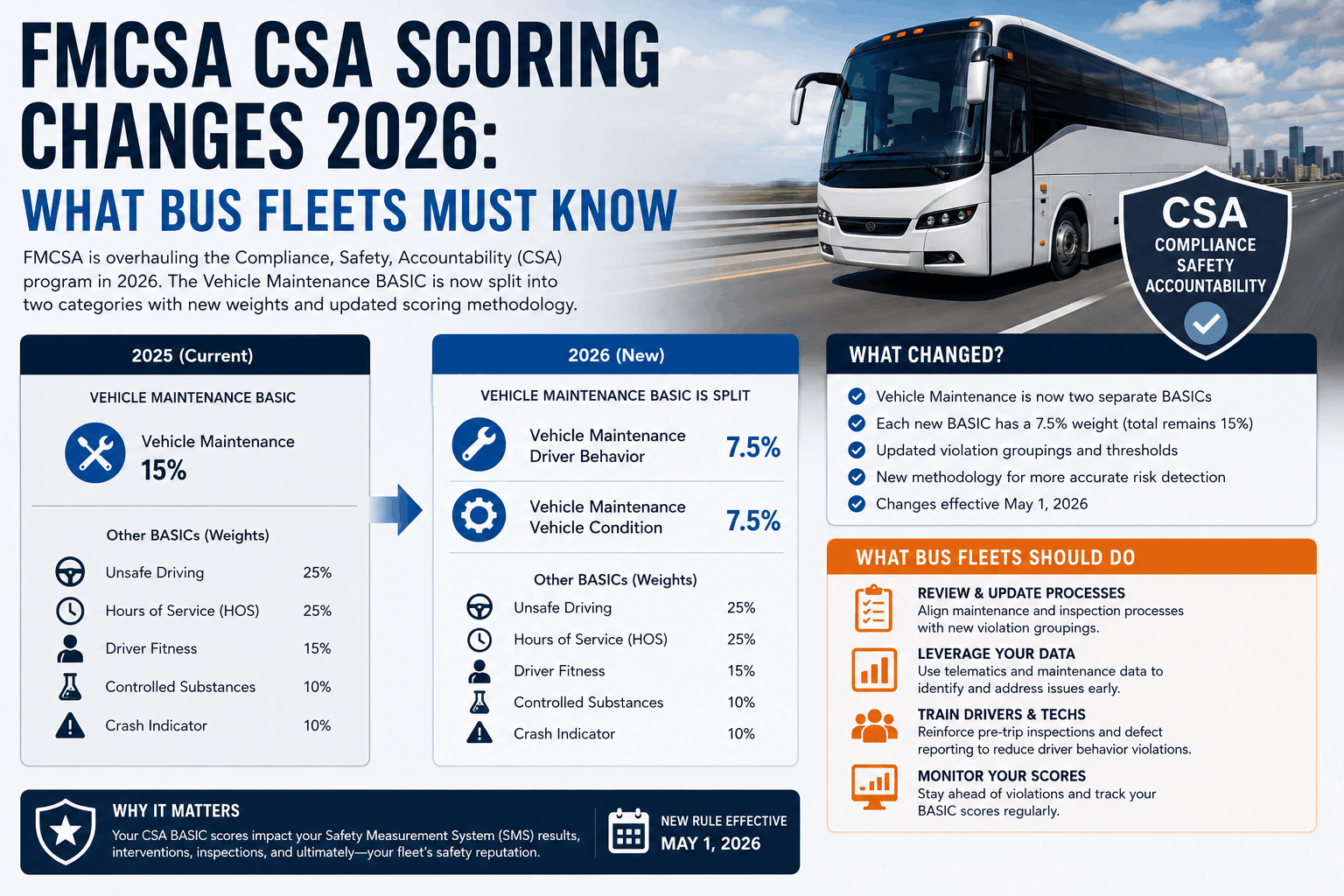
What exists today: Currently, FMCSA scores carriers on seven categories: Unsafe Driving, Crash Indicator, Hours of Service Compliance, Vehicle Maintenance, Driver Fitness, Controlled Substance and Alcohol, and Vehicle Inspection. The Vehicle Maintenance category combines all vehicle-related violations into one score, mixing mechanical defects with documentation failures and inspection compliance.
Problem with current approach: A carrier can have very different reasons for poor Vehicle Maintenance scores. One carrier might have mechanical problems from deferred maintenance. Another might maintain vehicles well but fail to document properly. Another might not conduct inspections regularly. The single Vehicle Maintenance score does not distinguish between these different problems, making it difficult to know which remediation approach is needed.
Impact on current CSA scores: Carriers experiencing Vehicle Maintenance violations may not know whether the problem is mechanical, documentation, or inspection-related. A carrier improving documentation might miss underlying mechanical problems. The single category prevents proper targeting of improvements.
New category structure: Effective January 1, 2026, FMCSA will score carriers on eight categories instead of seven. The Vehicle Maintenance category is split into: Vehicle Mechanical (focusing on physical vehicle condition) and Vehicle Documentation (focusing on record-keeping and compliance). All other categories remain essentially unchanged.
Vehicle Mechanical Category: This category measures mechanical fitness violations: inoperable brakes, worn tires, defective lights, steering problems, missing safety equipment, and other mechanical defects. The focus is on whether vehicles are actually being maintained to remain mechanically sound.
Vehicle Documentation Category: This category measures documentation and record-keeping: missing maintenance records, incomplete inspection reports, failure to document repairs, and documentation compliance. A carrier with well-maintained vehicles but poor documentation will now have separate scores reflecting both strengths and weaknesses.
Vehicle Inspection Category: The existing Vehicle Inspection category is clarified to focus on whether inspections are being performed regularly and whether defects discovered are being corrected. The distinction from documentation is that inspection focuses on performance while documentation focuses on record-keeping.
Key differences: The current system has seven scoring categories. The 2026 system has eight. Current Vehicle Maintenance scores become two separate scores: Vehicle Mechanical and Vehicle Documentation. This split provides greater visibility into specific problem areas. A fleet currently with acceptable overall Vehicle Maintenance scores might find that one new category exceeds acceptable thresholds when split, identifying the specific area needing attention.
Current scoring categories: Unsafe Driving, Crash Indicator, Hours of Service Compliance, Vehicle Maintenance, Driver Fitness, Controlled Substance and Alcohol, Vehicle Inspection.
2026 scoring categories: Unsafe Driving, Crash Indicator, Hours of Service Compliance, Vehicle Mechanical (new), Vehicle Documentation (new), Driver Fitness, Controlled Substance and Alcohol, Vehicle Inspection (clarified).
Practical implications: Fleets will have more detailed CSA scores showing specific strengths and weaknesses. This transparency helps identify exactly where improvement is needed. A fleet with good mechanics but poor documentation will now have one strong score and one weak score, making the documentation problem obvious.
Vehicle Mechanical violations include: Brake system defects (worn pads, air pressure loss, non-functioning components), tire violations (under-inflated, worn beyond limits), lighting defects (inoperable headlights, brake lights, turn signals), steering system defects, missing or non-functional emergency equipment, seat belt failures, suspension defects. Any physical vehicle condition failing safety standards scores in Vehicle Mechanical.
Vehicle Documentation violations include: Missing or incomplete DVIR forms, failure to document vehicle maintenance, missing inspection records, incomplete work order documentation, failure to record component service dates. A vehicle might be well-maintained but documentation is poor.
Vehicle Inspection violations include: Missing or incomplete pre-trip inspections, failure to correct defects found during inspections, inadequate post-trip inspections, non-compliance with required inspection frequency.
Other categories unchanged: Unsafe Driving, Crash Indicator, Hours of Service, Driver Fitness, and Controlled Substance/Alcohol violations are not affected by 2026 changes. These categories remain as they currently exist.
Assess current violations: Determine whether your current Vehicle Maintenance violations are primarily mechanical or documentation-related. Review your SafetyNet data and recent inspection reports. A fleet with primarily mechanical violations should focus on maintenance improvements. A fleet with documentation violations should improve record-keeping.
Improve both mechanics and documentation: Begin improvements now rather than waiting for 2026. Ensure vehicles are mechanically sound while simultaneously ensuring all maintenance is documented. This positions your fleet well when new scoring begins.
Implement systematic documentation: The new Vehicle Documentation category will reward carriers with complete documentation. If not already using a CMMS, implement one before 2026 to ensure all maintenance is documented systematically. If already using a CMMS, audit record-keeping to ensure completeness.
Establish documented inspection procedures: Create written procedures for pre-trip inspections, maintenance inspections, and post-trip inspections. Ensure all inspections are recorded and defects are corrected promptly. Documentation of inspection procedures demonstrates compliance.
Set new performance targets: When 2026 begins, set targets for performance in each new category. Previously you might have had a single Vehicle Maintenance target. In 2026, you'll have separate targets for Vehicle Mechanical, Vehicle Documentation, and Vehicle Inspection.
Dual scoring during transition: FMCSA plans to display both old (seven categories) and new (eight categories) scores for a transition period. This allows carriers to monitor performance under both systems simultaneously. Use the transition period to understand how your operations perform under new scoring framework.
SafetyNet updates: FMCSA will update SafetyNet to display new category scores separately. You will see detailed violations by each new category. This visibility helps identify specific areas needing improvement rather than aggregated scores.
Customer and insurer expectations: Your customers and insurance companies will eventually transition to evaluating new CSA scores. Be prepared to explain performance under both scoring systems if questioned. Strong performance in both old and new systems demonstrates safety commitment.
Industry communications: Monitor industry associations and FMCSA for updates and clarifications about new scoring. As 2026 approaches, detailed guidance will be available about scoring methodology and threshold levels.