Ask five people whether FMVSS 111 requires a rear camera on your buses and you will get five answers, most of them wrong. The honest version is not a one-line rule. FMVSS 111 buses compliance turns on gross vehicle weight rating, whether the vehicle is a school bus, and when it was built. This guide lays out exactly what the standard requires, which buses fall under the rear-camera requirement and which stay on mirror requirements, and how to keep the paperwork an inspector or your own board would ask for. Talk to BusCMMS about a 10-bus camera and compliance pilot.
Updated September 2026 · Reviewed against FMVSS No. 111 (49 CFR 571.111) and NHTSA guidance
FMVSS 111 and Bus Rear Visibility: What Actually Applies to Your Fleet
Rear-camera applicability, mirror requirements, GVWR thresholds, school bus types, and the records that prove compliance.
What FMVSS 111 Is and Why It Was Renamed
FMVSS No. 111 (49 CFR 571.111) is the federal motor vehicle safety standard for rear visibility. Its stated purpose is to reduce deaths and injuries that happen when a driver does not have a clear, reasonably unobstructed view to the rear. It applies to passenger cars, multipurpose passenger vehicles, trucks, buses, school buses, low-speed vehicles, and motorcycles, though the rear-image requirement reaches only certain weight classes, which is where buses get interesting.
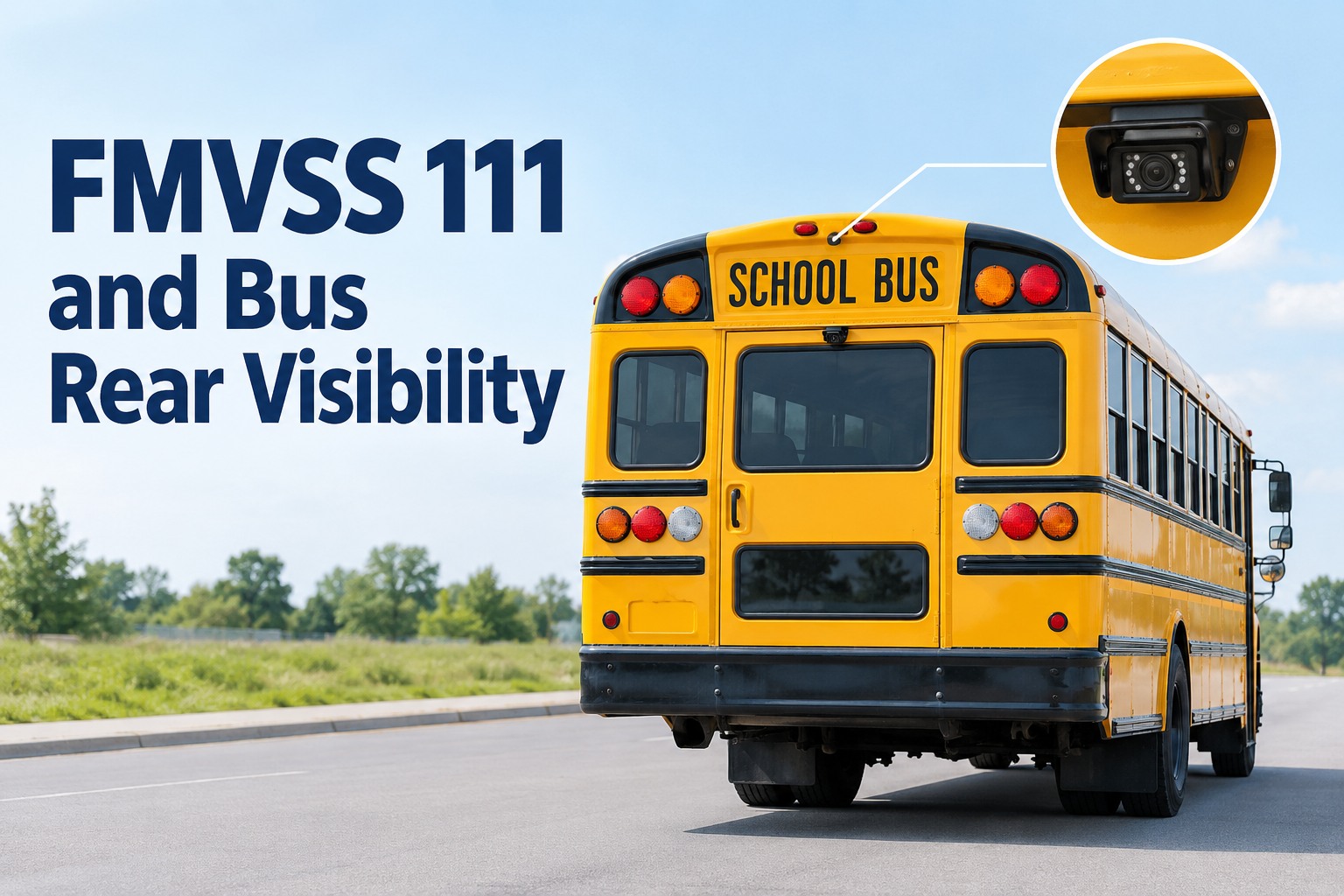
For decades the standard was titled "Rearview Mirrors" and was almost entirely about mirror geometry. A 2014 final rule, driven by the Cameron Gulbransen Kids Transportation Safety Act of 2007, renamed it "Rear Visibility" and added a performance requirement for a rearview image, phased in and fully effective for covered vehicles manufactured on or after May 1, 2018. That change expanded the required view to include a roughly 10-foot by 20-foot zone directly behind the vehicle. The only vehicles fully outside the rear-image requirement are motorcycles and trailers. Book a demo to see build dates and equipment tracked per bus.
Does the Rear-Camera Requirement Apply to Your Bus?
Here is the single most misquoted point in bus safety: the rear-camera requirement is keyed to a 10,000 lb (4,536 kg) GVWR line, and most full-size buses sit above it. Reduce FMVSS 111 to "buses need cameras now" and you will either over-buy against a mandate that does not apply or miss a requirement that does. Walk the applicability logic in order.
Is the bus GVWR 10,000 lb or less?
If yes, the FMVSS 111 rear visibility system requirement applies and a compliant camera (or equivalent system) is required. This catches some small Type A-1 buses and passenger vans.
Is it over 10,000 lb?
Then the federal rear-camera mandate does not apply. The bus follows FMVSS 111 mirror requirements instead. This is where most Type C, D, and full-size transit buses live.
Does your state add a requirement?
Several states require rear or side cameras on school buses regardless of GVWR. Check your state DOT and pupil transportation office; state law can be stricter than the federal floor.
No federal or state mandate?
Then a camera is a voluntary safety decision based on backing-incident history, insurer expectations, and your own safety goals, not a box a federal inspector checks.
Notice that "compliant" is doing real work in Q1. The rear-image requirement is a performance standard, not just "a camera is present." It covers field of view, image size, response time after the driver selects reverse, deactivation, durability, a default view, and how long the image lingers. A random backup camera is not automatically an FMVSS 111-compliant rear visibility system. Book a demo to record which buses are in scope and why. Or start free and log it yourself.
How the Standard Splits by Weight and Bus Type
FMVSS 111 does not treat all buses the same. It is organized into weight bands, and school buses get their own mirror rules on top. This table maps the bus-relevant requirements so you can place any vehicle in your fleet without guessing.
| Vehicle | GVWR | Rear image (camera) | Mirrors |
|---|---|---|---|
| Bus / school bus | 10,000 lb or less | Required (compliant rear visibility system) | Mirror options also apply |
| Bus, not a school bus | Over 4,536 kg | No federal camera mandate | Outside unit-magnification mirrors, both sides |
| School bus | Over 10,000 lb | No federal camera mandate | System A and System B mirror systems |
School bus classifications line up with that weight logic. Type A-1 is the lightest, and the portion of that class at or under 10,000 lb is what the camera requirement can reach. Type C (the traditional flat-front bus) and Type D typically run 23,500 to 29,500 lb, well over the line, so they answer to mirror requirements federally. For a bus other than a school bus over 4,536 kg, the standard calls for outside mirrors of unit magnification with a minimum reflective surface on both sides, adjustable and positioned for a rearward view. School buses over the line carry the System A and System B outside mirror systems plus the crossover mirrors that show the front danger zone. Book a demo to tag each bus by type, GVWR band, and applicable requirement.
New-Vehicle Certification vs. Buses Already in Service
FMVSS standards apply at manufacture. That is the detail that resolves most "do I have to retrofit?" questions. The rear-image requirement binds the manufacturer of a covered new bus at the time it is built; it does not reach back and order you to retrofit a bus that was compliant when it left the factory. A 2015 Type A bus built before the requirement took effect is judged against the standard in force on its build date.
This is a federal-certification point, not permission to ignore a broken camera. If a bus was built with an FMVSS 111 rear visibility system, that system has to keep working. And a state rule, an insurer, or your own safety policy can require cameras on buses the federal standard never touched. Federal minimums are a floor, not a ceiling.
The practical upshot for a mixed-age fleet: sort buses by build date and GVWR first, decide what the standard required of each when new, then layer your state and internal requirements on top. Voluntary camera adoption on older, heavier buses is common and often smart, but it should be logged as a safety decision with its own rationale, not filed as if it were a federal mandate. Book a demo to separate federal, state, and voluntary requirements per bus.
Two Buses, Two Different Answers
Here is an illustrative scenario with hypothetical numbers. A district runs a mixed fleet and needs a clean answer for two very different vehicles: a small Type A-1 activity bus rated at 9,800 lb, and a full-size Type C route bus rated at 27,000 lb. Same standard, opposite determinations.
- In scope. At or under 10,000 lb, so the rear visibility system requirement applies.
- Equipment. Verify the factory rear camera meets the performance spec, not just that a camera exists.
- Record. Log build date, system present, and the compliance determination.
- Out of federal camera scope. Over 10,000 lb, so mirror requirements govern federally.
- Check state law. A state camera rule may still apply regardless of weight.
- Any camera is voluntary. Log it as a safety decision with its own rationale.
Both determinations are defensible because both are documented: the weight, the type, the applicable requirement, the equipment, and the reasoning. That is what turns "we think we are compliant" into a record you can hand to a reviewer or an insurer. Book a demo to see both determinations captured on the vehicle record.
Inspection, Maintenance, and Compliance Records
A rear visibility system is only compliant while it works. A cracked lens, a dead display, a camera knocked out of aim, or a firmware change can quietly drop a required system below spec, and none of that shows up unless the inspection tests for it. This is where equipment compliance and daily fleet operations meet, and where a lot of otherwise-compliant fleets have a gap.
- Determination on file. Per bus: GVWR, type, build date, and whether the rear-image requirement applied when new.
- Equipment verified. For in-scope buses, evidence the installed system meets the performance requirement, not just that a camera is present.
- Camera in the inspection. Lens clarity, display function, aim, and response on reverse folded into the regular inspection routine.
- Defect to work order. A failed camera check becomes a documented defect and a work order, closed with sign-off.
- State and voluntary items flagged. Requirements beyond the federal floor tracked separately so nothing is mistaken for a mandate or missed.
BusCMMS is built to hold exactly this. It ties the vehicle asset, its camera or mirror equipment, inspections, defects, work orders, and maintenance history to one operational record, and it works around compatible camera or MDVR hardware you already run rather than forcing a specific ecosystem. Compliance evidence then falls out of daily operations instead of getting rebuilt the week before a review. Book a demo to see a camera defect become a tracked work order.
The Bottom Line on FMVSS 111 for Buses
FMVSS 111 for buses is not a single camera rule, and treating it like one is how fleets end up either overspending or exposed. The rear-image requirement applies to buses at or under 10,000 lb GVWR, which reaches some small Type A buses; most Type C, D, and full-size transit buses sit above that line and answer to mirror requirements instead. The standard binds new vehicles at manufacture, states can be stricter, and any camera beyond the mandate is a voluntary safety call. Get the determination right per bus, keep the equipment working, and document all of it, and FMVSS 111 becomes a checklist you can actually pass rather than a claim you hope holds up. Talk to BusCMMS about a 10-bus camera and compliance pilot.
What is FMVSS 111 for buses?
FMVSS No. 111, "Rear Visibility" (49 CFR 571.111), is the federal safety standard governing what a driver must be able to see behind and beside the vehicle. For buses it sets mirror requirements and, for vehicles at or under 10,000 lb GVWR, a rear visibility system (backup camera) requirement that fully took effect May 1, 2018. It was renamed from "Rearview Mirrors" to "Rear Visibility" in a 2014 final rule that added the rear-image requirement and expanded the required view to a roughly 10-by-20-foot zone behind the vehicle.
Does FMVSS 111 require a rear camera on buses?
Only on buses with a GVWR of 10,000 lb (4,536 kg) or less, where a compliant rear visibility system is required. That reaches some small Type A-1 buses. Most Type C, D, and full-size transit buses exceed 10,000 lb and are not covered by the federal camera mandate; they follow FMVSS 111 mirror requirements instead. So the accurate answer is "sometimes," and it depends on the specific bus's weight rating rather than the fact that it is a bus.
Does the 10,000 lb GVWR threshold apply to every bus?
No. The threshold is what determines whether the rear-camera requirement applies, but it does not change the fact that mirror requirements apply to larger buses. Buses at or under 10,000 lb need the rear visibility system; buses over it are governed by mirror requirements, which for non-school buses means outside unit-magnification mirrors on both sides, and for school buses means System A and System B mirror systems. Weight sets the camera question; it does not exempt a bus from visibility requirements altogether.
Are rear cameras mandatory for Type C and D school buses?
Not under FMVSS 111 federally, because Type C and D school buses typically exceed 10,000 lb GVWR and fall outside the federal rear-camera mandate. However, several states require rear or side cameras on school buses regardless of weight, so state law may make them mandatory in your jurisdiction. Even where nothing mandates them, many districts add cameras voluntarily based on backing-incident history and insurer expectations. Check your state DOT and pupil transportation office for the current rule.
How should agencies document FMVSS 111 compliance?
Record, per bus, the GVWR, vehicle type, build date, and the compliance determination for whether the rear-image requirement applied when new. For in-scope buses, keep evidence the installed system meets the performance requirement, not just that a camera is present. Fold camera checks (lens, display, aim, response on reverse) into the regular inspection, turn any failure into a documented defect and work order, and track state and voluntary requirements separately from the federal floor. A connected maintenance record makes that evidence reproducible instead of reconstructed at audit time.