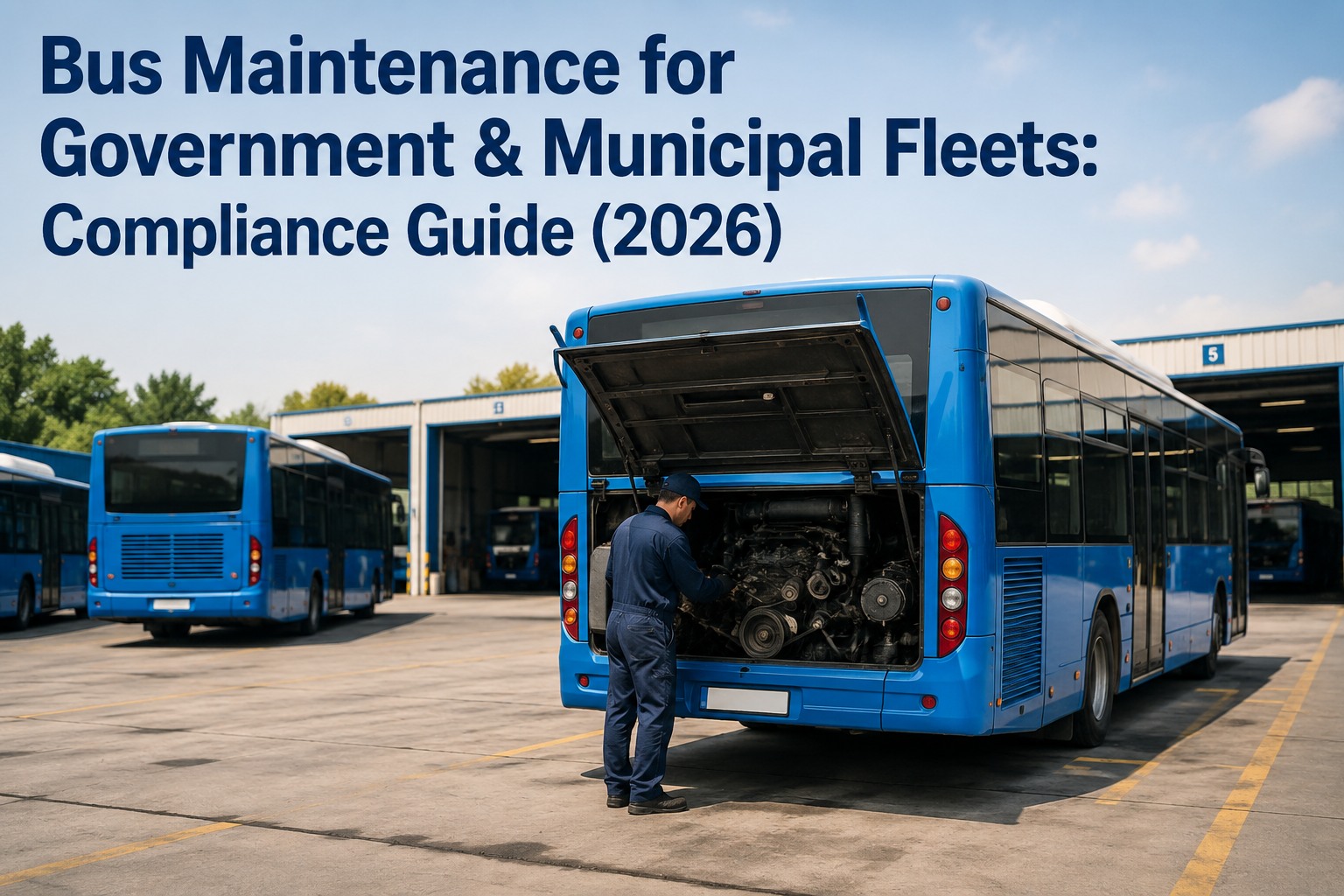
A municipal bus fleet doesn't just carry passengers -- it carries federal funding. FTA Section 5307 grants, state transportation dollars, and every future capital replacement budget flow through one recurring question: can you prove, with organized records, that you maintained the buses that grant money paid for? One transit agency's triennial review famously surfaced a $7.3 billion regional infrastructure backlog largely because its maintenance data was so scattered that auditors questioned whether the agency could manage federal funding responsibly. The buses themselves weren't the problem. The evidence was. For a government or municipal bus fleet, maintenance compliance isn't just about running safe service. It's the paper trail that keeps the funding cycle intact.
Bus Maintenance for Government & Municipal Fleets: Compliance Guide
How municipal transit agencies and government bus fleets tie maintenance operations to funding continuity, audit readiness, and board-defensible reporting -- without a compliance scramble.
Funding
Operation
Records
Triennial Review
Funding
Why Government Bus Maintenance Compliance Is Different
A private charter operator answers to a state DOT audit. A municipal transit agency answers to the FTA, the NTD, state oversight programs, its own board or council, and often the public at open meetings -- each expecting slightly different records in slightly different formats. Federal funding comes with a documentation load that private-sector fleet software wasn't designed for, and paper-based systems simply cannot satisfy at scale.
FTA Triennial Review
Up to 23 review areas, with maintenance and asset management as core focus points for grant recipients.
NTD Submission
Strict data validation rules on ridership, fleet condition, safety events, and financial reporting.
TAM Plan
Transit Asset Management plan updates tied to state of good repair asset condition data.
PTASP
Public Transportation Agency Safety Plan documentation, updated annually and board-approved.
Miss documentation on any of these, and consequences can include funding withholding of up to 25% of Section 5307 formula funds under 49 U.S.C. 5329. Book a demo to see how BusCMMS organizes records across all these frameworks in one place.
The Four Records That Actually Get Checked
Across the different compliance frameworks, the same core records show up in almost every review. Get these four organized well, and most audit findings resolve themselves before an auditor asks.
PM Plan & Completion Records
Defined intervals, completed on schedule per bus, with technician sign-off and mileage. FTA specifically checks whether vehicles are maintained in a state of good repair following manufacturer recommendations.
State of Good Repair (SGR)
Asset condition tracked over time, feeding directly into TAM plan updates. This is where poor data quality can trigger findings that put entire budgets at risk.
Roadcall & Failure Analysis
Mean distance between failures, by mode, is one of the most common data requests during a triennial review. Agencies that can't produce this from a system usually can't reconstruct it from paper.
DVIRs & ADA Equipment Records
Daily pre-trip inspections plus wheelchair lift and accessibility equipment logs, per 49 CFR 37.163. ADA violations carry civil penalties starting at $75,000.
If your maintenance records currently live in a mix of paper defect reports, spreadsheets, and institutional memory, that's the exact profile of the fleet whose funding was questioned in the case above. Sign up free to see your fleet's current record completeness before the next review notice arrives.
Reporting the Board Actually Needs to See
A municipal fleet manager doesn't just answer to auditors. Every month or quarter, someone -- a city council member, a transit board, a public commissioner -- asks a version of the same question: "Are the buses in good shape, and are we spending the money well?" A good answer takes minutes to prepare if the data is in one system, and a full day of chasing spreadsheets if it isn't.
Fleet Availability
Available hours divided by scheduled hours
PM Compliance Rate
Completed PMs vs scheduled PMs
Cost Per Mile
Broken out by fleet type
Roadcalls Per Month
By cause, tracked over time
State of Good Repair
Asset condition per unit
Upcoming Capital Needs
Replacement pipeline by unit
These are the numbers a transit board actually asks about, and the numbers an FTA reviewer expects to see documented. When they come from the same system, board-facing and audit-facing reporting reinforce each other rather than requiring two separate scrambles. Book a demo to see board-ready reports built directly from your maintenance data.
Where Procurement and Maintenance Meet
Government fleets face a procurement layer private fleets don't -- competitive bidding, documented justification, and public transparency. Maintenance data feeds procurement decisions in ways new municipal fleet managers often don't realize until their first bus replacement cycle.
| Maintenance Data | Procurement Decision It Supports |
|---|---|
| Cost per mile by bus age | When to replace vs. refurbish |
| Failure history by make/model | Which OEMs to prioritize in the next bid |
| Parts usage patterns | Contract negotiations with parts vendors |
| Fuel type PM cost comparison | Diesel vs. CNG vs. electric fleet mix decisions |
Without this data, capital replacement decisions default to age-based rules that may or may not match actual fleet condition. With it, procurement conversations move from "we always replace at 12 years" to "these three buses are still performing above cost-per-mile targets while these five aren't." Book a demo to see cost-per-mile trends per bus feed capital planning automatically.
From a Municipal Transit Director on Passing Reviews Clean
Our first triennial review after I took the role wasn't a disaster, but it wasn't clean either -- we had four findings, all documentation-related. The buses had been maintained. We just couldn't prove it fast enough. The next cycle, we'd moved everything into one system, and the same review went smoothly with zero findings on maintenance. Same shop, same techs, same buses. The difference was that when auditors asked for eighteen months of PM records by unit, I clicked twice and had them. Federal funding conversations changed after that too. Board members stopped asking whether we could justify the capital request and started asking how much more we needed.
Digital vs. Paper: Why Government Fleets Feel It First
Private fleets can often get away with paper systems longer -- the audit surface is narrower and the documentation demands more forgiving. Government fleets don't have that grace period.
- Records reconstructed from binders under audit pressure
- NTD submission is a multi-week annual scramble
- PM completion tracked in someone's memory or a wall calendar
- ADA lift logs scattered across defect books
- Full per-bus history retrievable in seconds during audits
- NTD-ready exports built from real work order data
- Automatic PM scheduling by mileage or calendar
- ADA lift logs timestamped and searchable
BusCMMS ships with FTA, NTD, and PTASP-aligned templates pre-loaded, so municipal fleets don't spend weeks building compliance frameworks from a generic CMMS. Book a demo to see the full municipal compliance workflow live.
Government Bus Maintenance: The Bottom Line
For a government or municipal bus fleet, maintenance compliance and funding continuity are the same conversation. The FTA triennial review, the annual NTD submission, the TAM plan, and every board meeting between them all draw from the same underlying question: can you demonstrate, with organized records, that the fleet is being managed well? Build a system where PM records, DVIRs, ADA lift logs, and roadcall data all live in one place, and every one of those audiences gets the answer they need without a separate scramble.
If your current setup would take a week to assemble records for the next review notice, that's the risk profile that gets funding questioned rather than expanded. Sign up free and put your fleet's compliance records on one dashboard.
What makes government bus fleet maintenance different from private fleets?
Government and municipal bus fleets receiving federal funding face additional compliance frameworks beyond standard DOT requirements -- FTA triennial reviews every three years, annual NTD data submissions, Transit Asset Management (TAM) plans, and Public Transportation Agency Safety Plans (PTASPs) under 49 CFR 673. Missing documentation on any of these can trigger funding withholding under 49 U.S.C. 5329.
What does an FTA triennial review examine for maintenance?
Reviewers examine whether transit agencies maintain vehicles and facilities in a state of good repair following manufacturer recommendations. Required documentation includes preventive maintenance plans with defined intervals, completed PM records per vehicle, roadcall and failure analysis, and state of good repair asset condition data feeding the TAM plan.
How does maintenance data connect to federal funding continuity?
Annual NTD submissions and triennial review outcomes both influence formula funding allocations. Agencies unable to produce clean maintenance and asset management records can face documentation-based findings even when the fleet is well-maintained, and repeated findings can lead to funding withholding of up to 25% of Section 5307 formula funds.
What maintenance KPIs should a municipal fleet report to its board?
The most useful board-facing metrics are fleet availability rate (target 95%+), PM compliance rate (target 95%+), cost per mile by fleet type, roadcalls per month by cause, and state of good repair status. These are the same metrics an FTA reviewer expects to see documented, so board reporting and audit reporting can reinforce each other rather than requiring two separate scrambles.
How does a bus-specific CMMS help government and municipal fleets?
A bus-specific CMMS like BusCMMS ships with FTA, NTD, and PTASP-aligned templates pre-loaded, tracks ADA lift compliance under 49 CFR 37.163, generates NTD-ready exports from actual work order data, and stores full per-bus maintenance history retrievable in seconds during an audit. Transit agencies using structured digital systems report 96-98% fleet availability compared to 82-86% for agencies still relying on manual maintenance tracking.