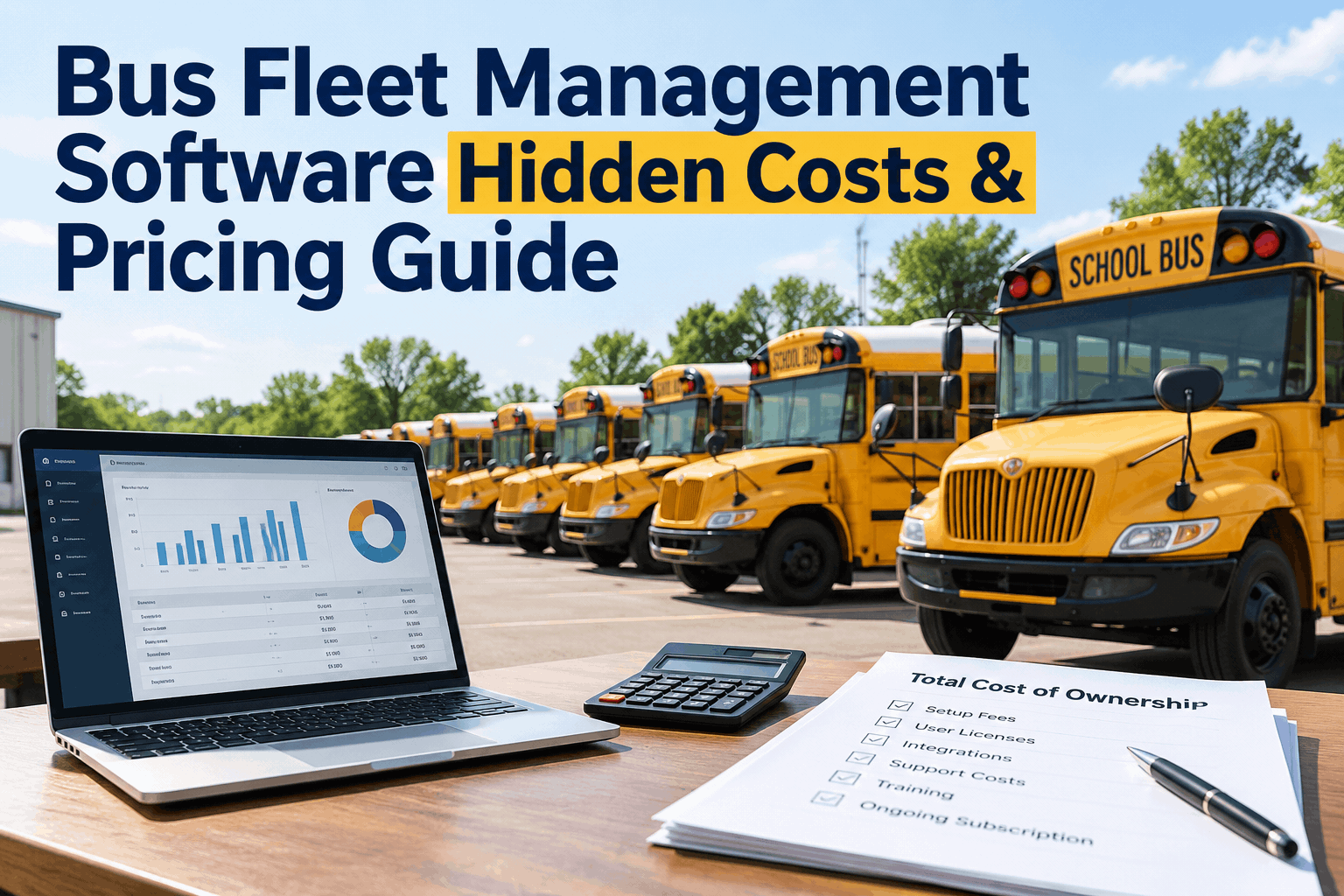
Every vendor quote you pull up is built differently — one bills per bus, one bundles setup, one buries training in a footnote. Bus fleet maintenance software pricing in 2026 isn't one sticker; it's a stack of line items that add up differently for a 20-bus district than a 200-bus agency. It helps to get a real quote in a demo and see every line.
Bus Fleet Maintenance Software Pricing Guide 2026
The real price isn't the subscription line alone. Here's every piece that lands on a 2026 invoice — and what moves each one up or down.
Illustrative shares, not a price quote — the mix shifts with fleet size and which model a vendor uses. The point: the subscription line is rarely the whole story.
The Four Pricing Models You'll See in a Bus Fleet Software Quote
Almost every bus fleet maintenance software pricing quote lands in one of four shapes. Knowing which one you're looking at tells you how the number will behave when your fleet grows or you add a route — and whether a low headline rate stays low. Here's how they compare side by side.
Swipe sideways to see all columns →
The model matters more than the headline rate — a cheap per-vehicle quote can beat a flat one at ten buses and lose at eighty. The quickest way to know which fits is to create a free account and price your own fleet against each shape.
What Actually Moves Bus Maintenance Software Pricing
Two districts can get very different quotes for the same software. These are the factors that push the number, ranked by how much weight they usually carry — so you know which questions to ask first when you're comparing bus fleet management software pricing.
Relative weighting, not exact dollars — fleet size and the pricing model decide most of the quote, which is why those are the first two things to pin down. You can book a demo and see which drivers apply to your fleet.
One-Time vs Recurring: Budget for Both Lines
The mistake that blows a bus fleet software budget isn't the monthly rate — it's forgetting the one-time costs that hit in the first weeks. Split your 2026 plan into two tracks so nothing lands as a surprise after the board has approved the number.
A purpose-built bus platform keeps the one-time track short — pre-loaded DVIRs and bus PM logic mean no weeks of custom form-building before go-live.
Your 2026 Pricing Worksheet: Six Questions Before You Sign
Run every bus fleet maintenance software quote through the same six questions. If a vendor can't answer one cleanly, that's the line item that comes back to bite the budget later. Use this as your checklist on the next sales call.
Where BusCMMS Fits on Price
BusCMMS is priced for a school-district or transit-agency budget, not an enterprise contract — and the bus-specific features that cost extra elsewhere are included, not bolted on. Here's what shapes a BusCMMS quote.
Priced per the fleet, not per seat
It scales with your bus count, so the number stays board-defensible as you add routes.
Bus features included
Pre-loaded DVIRs, fuel-type PM, and compliance reporting ship on day one — not as paid modules.
Short setup, lower one-time cost
A 2–4 week rollout keeps the one-time line small versus a months-long custom build.
A number you can defend
Clear line items for a board or agency finance office — no footnote fees.
BusCMMS reports districts saving an average of roughly $2,800 per bus per year and reaching 95%+ fleet availability — figures it publishes from its own customer data, useful as a yardstick when you weigh a subscription against what downtime already costs. For the full picture, read the complete guide to what a bus CMMS does.
"I stopped asking vendors 'what's your price' and started asking for the line items — subscription, per-bus, setup, integrations. The honest ones hand it over in a minute. The one that dodged setup fees was the one that would've wrecked my first-year budget."
Fleet Services Manager · mid-size public transit agency
The Takeaways on Bus Fleet Maintenance Software Pricing
Boil the whole 2026 pricing question down and it comes to a handful of things worth keeping on a sticky note before your next vendor call.
Get the full set of line items, compare the models honestly against your fleet size, and bus fleet maintenance software pricing stops being a guessing game — it becomes a number you can carry into a board meeting and defend.