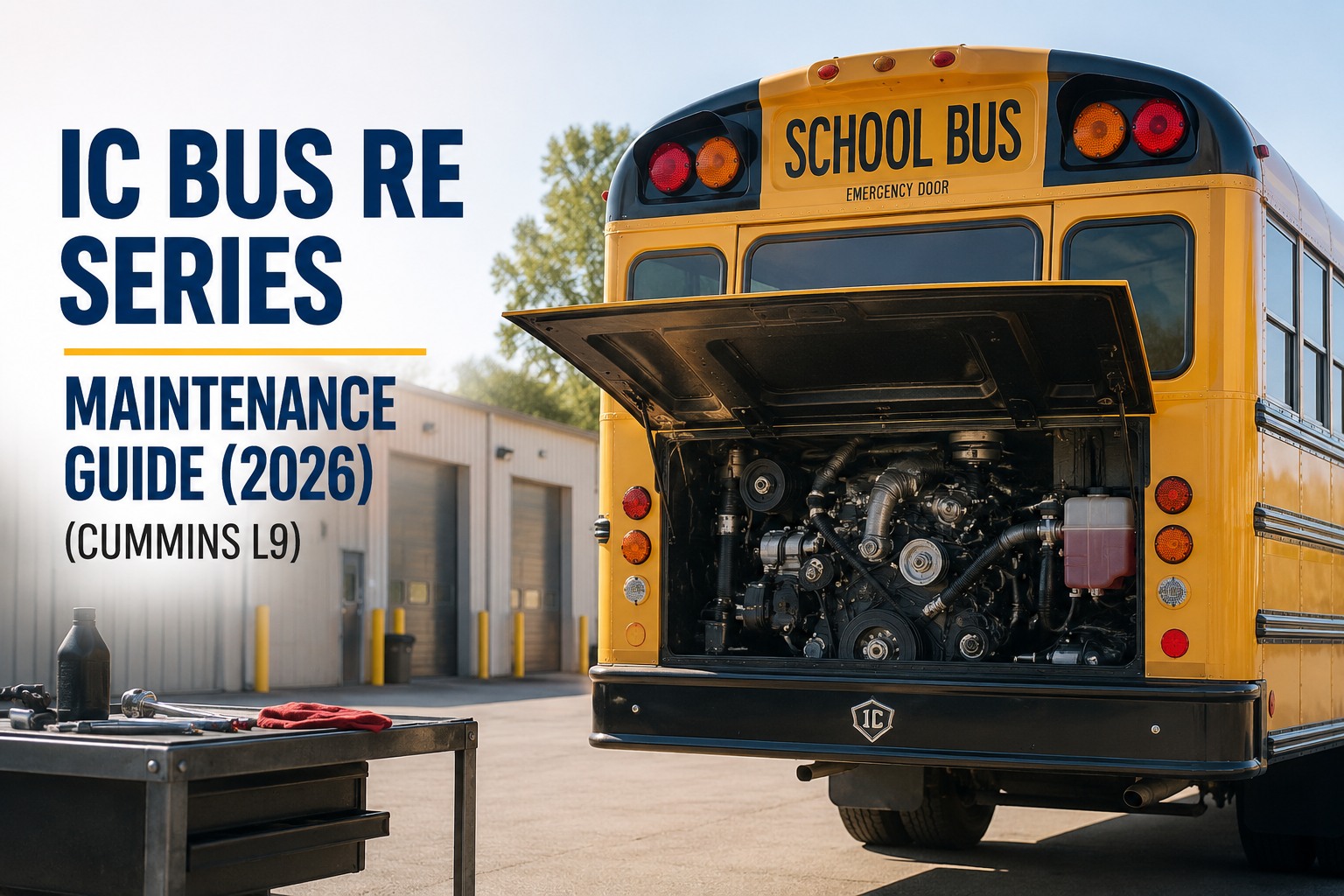
The IC Bus RE Series is the Type D workhorse that ran America's toughest routes for nearly three decades. Paired with the Cummins L9, it's built to be rebuilt -- if you actually run the maintenance program the way Cummins wrote it. This guide walks the L9 service intervals, the two-door rear-access advantage, and the faults that show up past 100K. Book a demo to see RE Series PM schedules pre-loaded in BusCMMS.
IC Bus RE Series Maintenance Guide Cummins L9
Service intervals, cooling checks, common faults past 100K miles, and the PM program that carries an L9 past 300,000 miles.
- 1Cummins L9 · wet-sleeve
- 2Rear service doors
- 3Single Module DPF+SCR
- 4Side-intake radiator
The RE Series wasn't a passenger van adapted for schools. It was engineered from the frame up for the Type D mission -- high seating capacity, long routes, and the kind of duty cycle where a bus racks up 300,000 miles over a 15-year life. IC Bus discontinued the RE for the 2025 model year, but tens of thousands are still running routes today. Knowing how to service them isn't nostalgia -- it's fleet economics.
Rear-Engine Layout
Weight over the drive axle, quieter cabin, simpler service access than a Type C conventional.
Twin Rear Doors
Walk-around access to all fluid checkpoints. A 10-minute PM stays 10 minutes.
Wet-Sleeve L9
Replaceable liners mean bottom-end rebuilds at 400K+ instead of full swaps.
16-Gauge Steel Body
All-steel rub rails. Holds up in salt-belt districts on 12–15 year cycles.
The two rear doors are the single biggest reason a fleet with 60 REs can run a leaner shop than the same fleet of Type C conventionals. Everything a tech touches during PM -- oil dipstick, coolant reservoir, fuel filter housing, DEF cap, air cleaner -- is at chest height with the doors open. Nothing is buried under a hood.
Cummins L9 Severe-Duty Service Intervals
School bus operation = severe duty per Cummins. These are the intervals.
Miss one of these intervals and you don't just risk a warranty claim -- you accelerate wear on the parts you were trying to protect. Here's the full L9 program in an odometer view. Read it left-to-right the same way the bus racks miles.
- 15KMILES / 6 MOCRITICAL
Engine Oil & Filter
CJ-4 / CK-4 15W-40 or synthetic 10W-30. Every drain, no exceptions. Synthetic oil alone does not justify extending this interval.
- 15KMILES / 6 MOCRITICAL
Primary & Secondary Fuel Filter
Both filters swap at every oil change. Drain water separator daily as part of pre-trip.
- 45KEVERY 3RD OILHIGH MISS
Crankcase Coalescing Filter
Every third or fourth oil service. Skip it and you WILL see crankcase pressure faults. The most-missed item on RE Series fleets past 100K.
- 60KMILESSTANDARD
Coolant Drain / Flush / Fill
Standard interval. Extended interval possible with fully-formulated ELC and annual refractometer + test-strip verification.
- 150KMILES / 48 MOSTANDARD
Overhead Valve Adjustment
Injector and valve lash reset. Skip this and injector life shortens dramatically. Fuel economy walks off the cliff around 175K without it.
- 200KMILESSTANDARD
DEF Dosing Filter
Replace at interval or earlier if code triggers. Common miss on fleets that assume DEF is maintenance-free.
- 200KMILESSTANDARD
DPF Ash Cleaning
Send to a Cummins Authorized Repair Location. Do not use unauthorized ash-cleaning machines -- Cummins is explicit on that.
The coalescing filter surprises new fleets. It looks minor on the interval sheet, but skipping it causes crankcase pressure faults that mimic much bigger problems. A tech chasing a blowby complaint on a 130K RE will almost always find a coalescing filter that hasn't been touched since the bus was new. Book a demo to see these intervals auto-triggered per bus from telematics odometer data.
Cooling System: The RE's Biggest Weak Point
Rear-mount radiator + side intake = airflow is everything.
The rear-engine layout that makes the RE easy to service also makes cooling the toughest system on the bus. The radiator sits at the back with a side-mounted air intake, and any restriction in that airflow path pushes coolant temps up fast in summer or on heavy grades. Ninety percent of cooling complaints trace back to five checkpoints along the airflow path.
- 01
Side Intake Screen & Fins
Grass, leaves, route debris pack into the screen. Blow clean weekly in fall, monthly otherwise. Bent fins can cost ~15% of cooling capacity.
- 02
Charge Air Cooler Face
Oil film + dust builds on the CAC. Pressure-wash from the fan side, not the intake side. A contaminated CAC drives EGT and DPF regen frequency up.
- 03
Direct Drive Fan Clutch
2018+ REs use a Direct Drive fan with engine-mounted clutch. Verify engagement with a scan tool -- a fan that won't clutch in mimics a bad thermostat.
- 04
Coolant Chemistry
Refractometer test twice a year. Cummins requires ASTM D6210 / CES14603 fully-formulated coolant. Wrong chemistry pits the L9 wet sleeves.
- 05
Thermostat & Housing
Stuck-open thermostat is common past 150K. Slow warmup, MPG drop, EGR carbon buildup. Replace the housing gasket as a set.
The wet-sleeve L9 amplifies the cost of getting cooling wrong. Weak coolant chemistry pits the cylinder liners from the outside; once that happens, no top-end service saves the engine. A $12 refractometer test twice a year prevents a $12,000 bottom-end rebuild. Book a demo to see cooling PM checks scheduled per bus in BusCMMS.
Faults You'll See Past 100K — Symptom to Fix
Six patterns that show up on almost every fleet's L9 work-order history.
The L9 in an RE Series is durable, but six complaints show up on almost every fleet's work-order history once buses cross 100,000 miles. Knowing them ahead of time turns a mystery road call into a 30-minute yard fix. Read across left to right: what the driver reports, what's actually wrong, what to do.
Blowby smell, oil at breather, active crankcase code
Coalescing filter left in past 3rd oil interval
Replace coalescing filter, verify crankcase vent flow
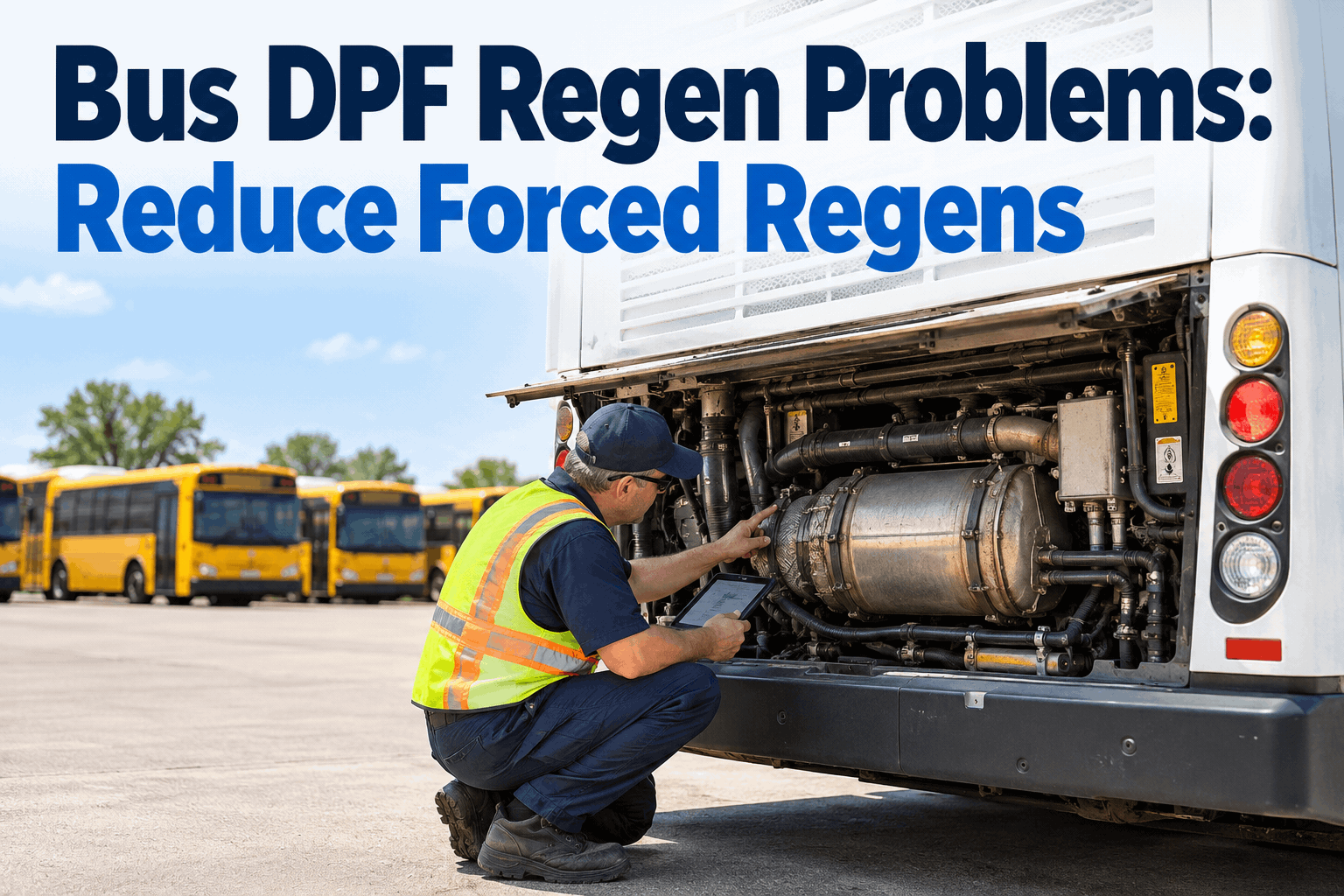
Repeated forced DPF regens on short routes
Duty cycle -- exhaust never sustains passive regen temp
Enable Cummins Stay Warm feature; rotate buses weekly
Slow warmup, MPG drop, driver cold-cab complaints
Stuck-open thermostat, common on higher-mileage L9
Replace tstat + housing gasket as a set; recheck level
Rough idle, injector complaints, MPG walking down
Missed 150K valve lash / overhead adjustment
Perform overhead adjustment; log against bus for next cycle
P207F, SCR efficiency codes, derate warnings
DEF dosing valve crystallization at nozzle tip
Clean or replace dosing valve; check DEF quality & storage
Rough running, P0401, elevated soot production
EGR cooler / valve carbon buildup
Clean EGR valve, flow-test cooler; replace if cracked
Every one of these is preventable with proper PM tracking. The problem isn't that fleets don't know about them -- it's that the intervals live in a service manual, not in a system that pings the shop when the bus is due. Sign up free and stop losing L9 buses to preventable, well-documented faults.
The Daily · Weekly · PM Checklist
Consistency at these checkpoints is what carries an L9 past 300K.
Long-term reliability on an RE Series comes from consistency at the daily and weekly checkpoints, not heroics at PM time. The two rear doors make the walk-around fast -- the whole daily check should run under seven minutes with a trained driver. Here's what keeps L9-powered REs running past 300K.
Pre-Trip & Post-Trip
~7 MINYard Inspection
~25 MINScheduled Service
~3 HRSThe oil and coolant sampling row is what separates fleets that make 300K miles from fleets that lose engines at 220K. Wear-metal trends catch a failing injector, a leaking head gasket, or coolant intrusion months before a code sets. A $25 sample beats a $12,000 rebuild every time. Book a demo to see oil-sample results tracked per bus in BusCMMS.
How BusCMMS Handles the RE Series Program
Cummins L9 severe-duty tasks pre-loaded. Type D DVIRs built in.
A CMMS built for buses knows the difference between a Type C ISB and a Type D L9. BusCMMS ships with Cummins L9 severe-duty PM tasks pre-loaded, mapped to mileage triggers from your telematics odometer. The intervals in section 02 are already in the system -- your shop just does the work when the ticket drops.
L9 PM Templates
15K oil, 60K coolant, 150K valve lash, 200K DEF/DPF -- pre-loaded and auto-triggered.
Type D DVIRs
Rear-engine pre-trip forms with stop arms, crossing gates, 8-light warning system checks.
J1939 Code Ingestion
Cummins fault codes flow into work orders automatically from Samsara or Geotab.
Warranty Windows
Cummins engine + IC Bus body coverage tracked per bus. Alerts before expiration.
Parts & Inventory
Auto-reorder on Fleetguard filters and Cummins consumables. Dead-stock reporting.
CPM & MPG Reports
Per-bus cost per mile, MPG, and regen frequency. Board-ready exports on demand.
BusCMMS reports districts running L9-powered REs on its platform typically extend intervals to Cummins-published maximums with fewer missed items and cleaner warranty records, based on customer-reported outcomes. The software doesn't change the manual -- it makes sure the manual actually gets followed on every bus, every mile.
We have 32 REs in the fleet, oldest is an '09, newest is a '23. The L9s in the last five model years have been the easiest engines we've ever run -- if you actually do the coalescing filter on time and keep the coolant chemistry right. We had one bus fight us for a year with crankcase pressure faults before we found out the previous shop had never touched the coalescing filter in 180,000 miles. Twenty-minute job. That's the RE Series in a sentence.
Frequently Asked Questions
What is the oil change interval for the Cummins L9 in an IC Bus RE Series?
Cummins publishes a 15,000-mile or 6-month oil and filter interval for the L9 under severe duty, which is how school bus operation is classified. Both primary and secondary fuel filters change at the same interval. The crankcase coalescing filter should change every third or fourth oil service. Synthetic oil alone does not justify extended drain intervals -- Cummins is clear on that. If your fleet extends intervals, do it based on documented oil analysis showing wear metals and viscosity within spec, not on assumption.
What are the most common problems on IC Bus RE Series buses past 100,000 miles?
Six patterns show up on almost every fleet's L9-powered RE Series past 100K miles: crankcase pressure faults from a skipped coalescing filter, repeat forced DPF regens on short routes, stuck-open thermostat around 150K, missed 150K valve lash / overhead adjustment, DEF dosing valve crystallization on buses stored outside in hot climates, and EGR cooler / valve carbon buildup past 200K. Every one is preventable with proper PM interval tracking. The problem is usually that the intervals live in the service manual rather than in a system that alerts the shop.
How do I keep the RE Series cooling system healthy?
Five checkpoints handle the vast majority of cooling issues: keep the side-intake radiator screen and CAC face clean (weekly in fall, monthly otherwise), verify the Direct Drive fan clutch actually engages with a scan tool, test coolant with a refractometer twice a year and use only Cummins-approved fully-formulated ASTM D6210 or CES14603 coolant, replace the thermostat with its housing gasket as a set past 150K, and do the full drain-flush-fill at 60,000 miles standard interval. The L9 uses wet cylinder sleeves, so wrong coolant chemistry causes liner pitting that no top-end service can fix.
Is the IC Bus RE Series still being made?
No. IC Bus discontinued the RE Series after the 2025 model year. That said, tens of thousands of RE Series buses are still in active school and transit service and will be for the next decade. The Cummins L9 is a wet-sleeve, rebuildable engine, and the 16-gauge steel body construction typically holds up in salt-belt districts through 12- to 15-year replacement cycles. Fleets that maintain their REs on the published PM schedule regularly get 300,000+ miles of service life without a major engine overhaul.
How does BusCMMS help maintain IC Bus RE Series buses?
BusCMMS ships with Cummins L9 severe-duty PM tasks pre-loaded and auto-triggered by mileage from your telematics odometer. Type D pre-trip DVIRs include RE Series-specific items like stop arms, crossing gates, 8-light warning systems, and rear-engine access checks. Cummins J1939 fault codes ingest automatically from Samsara or Geotab into work orders. Warranty period tracking flags Cummins engine and IC Bus body coverage windows before expiration. Parts and inventory management auto-reorders Fleetguard filters and Cummins consumables. Cost per mile, MPG, and regen-frequency reports export in one click.