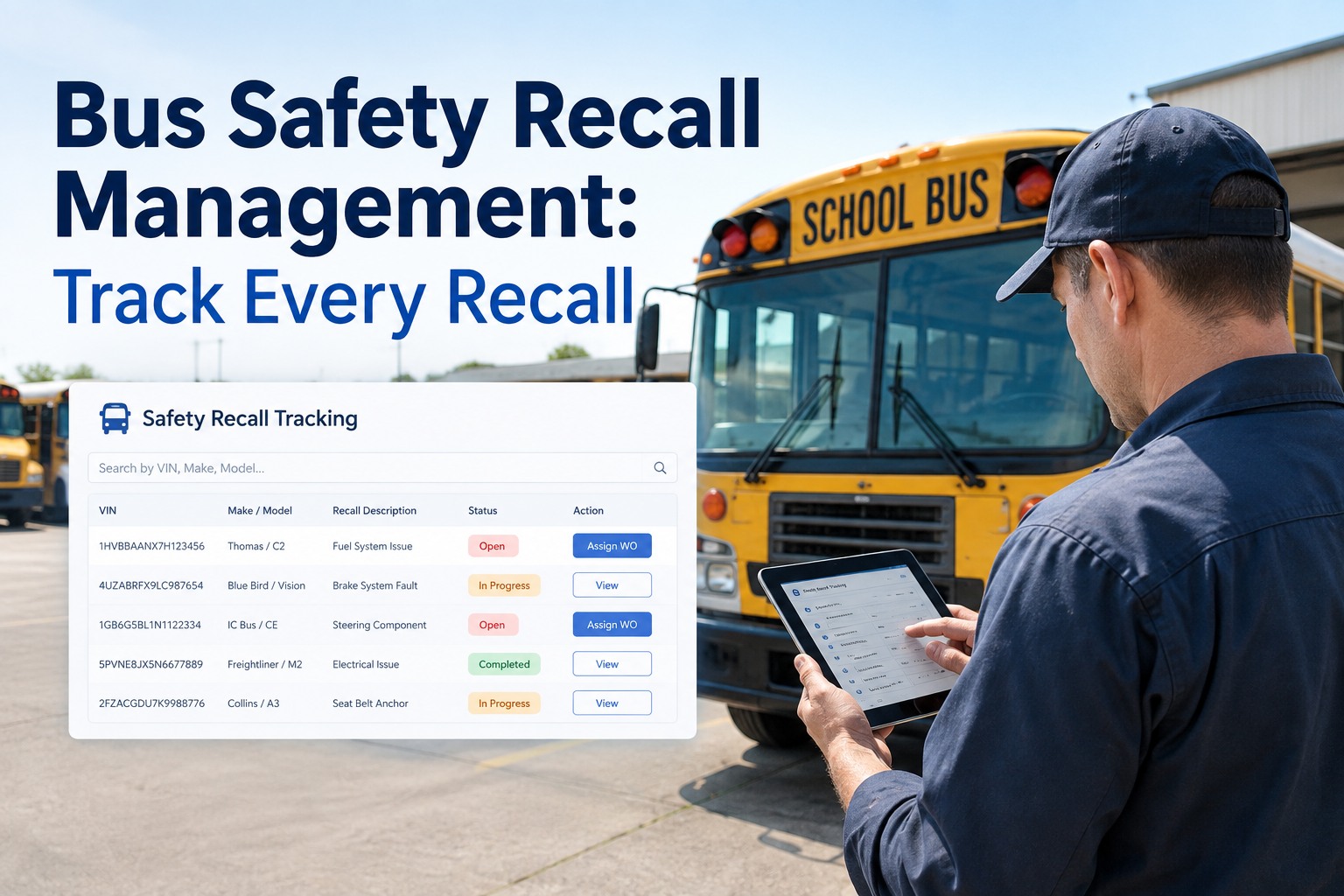
An NHTSA recall notice hits your inbox on a Tuesday. It covers a brake caliper defect on a specific range of 2019-2021 chassis. You have 47 buses in the fleet. You know some are affected. You cannot tell me right now — without opening three spreadsheets and calling the OEM — exactly which VINs, which routes they run, whether any of them are already scheduled for PM this week or whether last year's recall on the same platform was ever closed out. That is the recall problem. Not the recall itself — the tracking of it. This guide walks through bus safety recall management the way it actually works in a maintenance shop: how recalls flow from OEM notice to closed work order, what auditors want to see and why spreadsheet tracking fails the moment you have more than 20 buses.
Bus Safety Recall Management: Track Every Recall Across Your Fleet
VIN-level recall tracking, corrective work order workflows, and audit-ready documentation for school, transit, and charter fleets
- 33M+Vehicles recalled annually (NHTSA)
- 25%Recalls never completed
- 1Missed recall = audit finding
Why Bus Safety Recall Management Fails in Most Shops
Recalls do not fail because maintenance managers do not care. They fail because the tracking system is wrong for the job. In most shops the recall notice arrives by email, gets forwarded to the shop foreman, gets printed and pinned to a corkboard, and then sits there while the daily fire drill of pre-trip failures, road calls, and parts backorders takes priority. Three weeks later nobody remembers which buses got the fix and which are still exposed.
The problem compounds with fleet size. A 15-bus operation can maybe get away with a spreadsheet and a good foreman's memory. A 60-bus district cannot. A 200-bus transit agency has zero chance. NHTSA runs a recall lookup by VIN — one VIN at a time. Nobody is sitting at a desk pasting 200 VINs into a website every month, and even if they did, matching those results back to route assignments, PM schedules, and completed repair records is where the process breaks. This is why automated VIN-level recall tracking inside your CMMS is not a nice-to-have — it is the only way this scales.
The 6-Stage Recall Lifecycle Every Fleet Should Run
A recall is not a task. It is a process with six distinct stages, and each stage has a handoff that can break. Miss any handoff and the recall dies quietly in someone's inbox. Here is the workflow that keeps every recall on the rails from notice to closed record.
-
1
Recall Notice Received
NHTSA publishes the campaign; the OEM sends notices to registered owners within roughly 60 days. Notices arrive by email, mail, or dealer portal. First failure point: nobody logs it centrally.
-
2
VIN Match Against Fleet
Match the affected VIN range against every bus in your roster. Manual lookup is fine for 5 buses. It is a full afternoon for 200. Second failure point: partial matches — you catch 8 of the 11 affected buses.
-
3
Corrective Work Order Assigned
Each affected bus gets a work order tied to the recall campaign number. Assigned to a technician, scheduled around the bus's active route. Third failure point: WO opened but never assigned, or assigned to a tech who is out.
-
4
Parts Sourced & Repair Scheduled
Recall parts come from the OEM at no cost but often on backorder. Track the parts ETA, hold the WO open, schedule the repair when parts land. Fourth failure point: parts arrive but the WO never gets rescheduled.
-
5
Work Completed & Signed Off
Technician completes the fix, logs labor and parts, attaches photos or the OEM completion form. Supervisor signs off. Fifth failure point: work done in the bay but never digitally closed in the system.
-
6
Audit Record Archived
The closed WO, the OEM notice, the parts invoice, and the sign-off live together in that bus's permanent record. When FMCSA or the state DOT audits, you pull it in 30 seconds. Sixth failure point: paper records that cannot be found on demand.
Every stage in that list has been the point of failure in a real audit finding somewhere. The lifecycle is not complicated — running it consistently across 60 buses and 12 open recall campaigns without a system is what is hard. Sign up free to see the full recall lifecycle running on your fleet.
What Auditors Actually Look For in a Recall Record
When FMCSA, a state DOT inspector, or an FTA triennial reviewer asks about recall compliance, they are not asking whether you got the notice. They are asking whether you can prove — bus by bus — that every open recall was either closed with documentation or is actively in progress with a paper trail. Here is the checklist an auditor is running through in their head as they page through your records.
-
The NHTSA campaign number for every recall affecting your fleet — not just the OEM's internal reference, the federal campaign ID.
-
The list of affected VINs from your fleet, with a status for each: open, in progress, or closed.
-
A work order per affected bus with a date opened, technician assigned, parts used, labor logged, and date closed.
-
Supervisor sign-off on every completed recall repair — a name and a date, not just a technician's initials.
-
Documentation of why an open recall is still open — parts on backorder from the OEM is a valid answer; "we forgot" is not.
-
Pre-trip DVIRs for any bus with an open safety-critical recall showing the affected system was inspected before service each day.
-
A retention record going back at least 12 months — most state DOTs want the current active recall list plus the last year of closed recalls available on request.
A binder with printed emails does not satisfy this list. Neither does a shared spreadsheet where the "date closed" column is filled in from memory. Auditors want traceability from the federal campaign number down to the individual bus, the individual technician, and the individual part number — a chain of custody that a paper process cannot produce on demand. Book a demo to see audit-ready recall records generated automatically.
Spreadsheet Tracking vs. CMMS-Based Recall Tracking
Almost every shop starts with a spreadsheet. It works until it does not. The break point is usually somewhere between 20 and 40 buses, or the first serious multi-VIN recall campaign, whichever comes first. Here is what changes when recall tracking moves out of Excel and into a bus-specific CMMS.
The spreadsheet column above is not a straw man — it is what roughly 70% of small and mid-sized bus fleets are still doing in 2026. It works right up until the first missed recall shows up in an audit finding or, worse, a post-incident investigation. At that point every hour spent building a real tracking system in advance pays for itself many times over.
How BusCMMS Handles Recalls End to End
BusCMMS treats a recall the way it treats any other maintenance event that has to be traceable, assigned, completed, and archived — as a work order with structured metadata attached. The difference is that recall WOs carry the campaign number, the OEM reference, and a permanent link to the specific VINs affected, so the entire chain stays intact from notice to audit.
-
VIN-Level Recall Lookup
Every bus in the fleet carries its VIN in its asset record. New recall campaigns match automatically against the roster and flag affected buses on the dashboard.
-
Auto-Generated Work Orders
One WO per affected bus, tagged to the recall campaign, ready for a technician assignment. No re-typing VINs into a separate WO system.
-
Parts Ordering & Backorder Tracking
Recall parts linked to the WO. When OEM parts land, the WO gets flagged as ready to schedule. No parts sitting on a shelf while the WO stays open.
-
Sign-Off with Digital Trail
Technician closes the WO; supervisor authenticates and signs off. Photos, OEM completion forms, and part invoices attach to the WO permanently.
-
Open Recall Dashboard
Real-time view of every open recall by campaign, by bus, and by status. See which buses are still exposed at a glance without opening any spreadsheet.
-
Audit-Ready Export
One-click export per recall campaign or per VIN — complete chain of documentation for FMCSA, FTA, or state DOT review. No manual assembly.
Because BusCMMS is purpose-built for bus fleets rather than adapted from generic trucking or manufacturing software, the recall workflow ties in directly to the pieces that already live in the system — the VIN-level asset records, the DVIRs, the PM schedules, and the parts inventory. There is no separate recall module to buy, no integration to configure. It is part of how work orders work. Book a demo to see recall work orders auto-generated on a sample fleet.
The Practitioner View: Why This Matters at the Shop Level
That is the point most maintenance managers do not appreciate until they live it. Recall management is not really about the specific recalls — it is about not having to hold 12 open compliance items in your head every day while also running a shop. When the system holds the tracking, the manager holds the operation. That trade is the real ROI. Sign up free and get open recalls off your mental to-do list.
The Bottom Line on Bus Safety Recall Management
Recalls are not going away. NHTSA campaigns run year-round, OEMs push notifications in waves, and the buses in your fleet will remain subject to defect notices for as long as they are in service. The question is not whether your fleet will face open recalls — it will — but whether your system can prove, on demand, that every one of them was tracked, assigned, closed, and archived. That is bus safety recall management. Everything else is paperwork waiting to become an audit finding. Move the process into a system that was built for buses and the whole thing shifts from a source of quarterly anxiety to a routine part of how work gets done.
What is bus safety recall management?
Bus safety recall management is the process of tracking every NHTSA and OEM recall campaign that affects the buses in your fleet, matching affected VINs against your roster, opening corrective work orders for each affected bus, sourcing recall parts, completing the repair, and archiving the closed record for compliance audits. It covers the full lifecycle from recall notice to closed audit record and applies to school districts, transit agencies, and charter/motorcoach operators alike.
How do I know if my buses are affected by an open recall?
NHTSA offers a VIN lookup at nhtsa.gov that shows any open safety recalls for a specific VIN. For a fleet, this is impractical to do manually every month — a bus-specific CMMS like BusCMMS automatically matches new recall campaigns against every VIN in your asset roster and flags affected buses on the dashboard, so you do not have to check VIN by VIN.
What records do auditors want to see for recall compliance?
FMCSA, FTA, and state DOT auditors typically want the NHTSA campaign number, the list of affected VINs from your fleet with status, a work order per affected bus showing date opened, technician, parts used, labor logged, and date closed, supervisor sign-off, documentation of why any open recall is still open (for example, parts on backorder), and a retention record covering at least the last 12 months of recall activity.
Can I manage bus recalls with a spreadsheet?
A spreadsheet can work for a small fleet of roughly 15 buses or fewer, but it breaks down quickly beyond that. Spreadsheets do not link recall notices to work orders, do not track parts backorders, do not enforce supervisor sign-off, and cannot generate an audit-ready export on demand. Most missed recalls happen in fleets tracking on spreadsheets — the process depends on human memory rather than system enforcement, and human memory fails at scale.
How does BusCMMS help with recall management specifically?
BusCMMS ties every recall to the VIN-level asset records already in the system, auto-generates a work order per affected bus with the NHTSA campaign number attached, tracks parts backorder status, requires authenticated technician completion and supervisor sign-off, attaches photos and OEM completion forms to the closed WO, and exports a full audit-ready record for any recall campaign or any specific VIN in one click. Because it is purpose-built for bus fleets, no separate recall module or configuration is required.