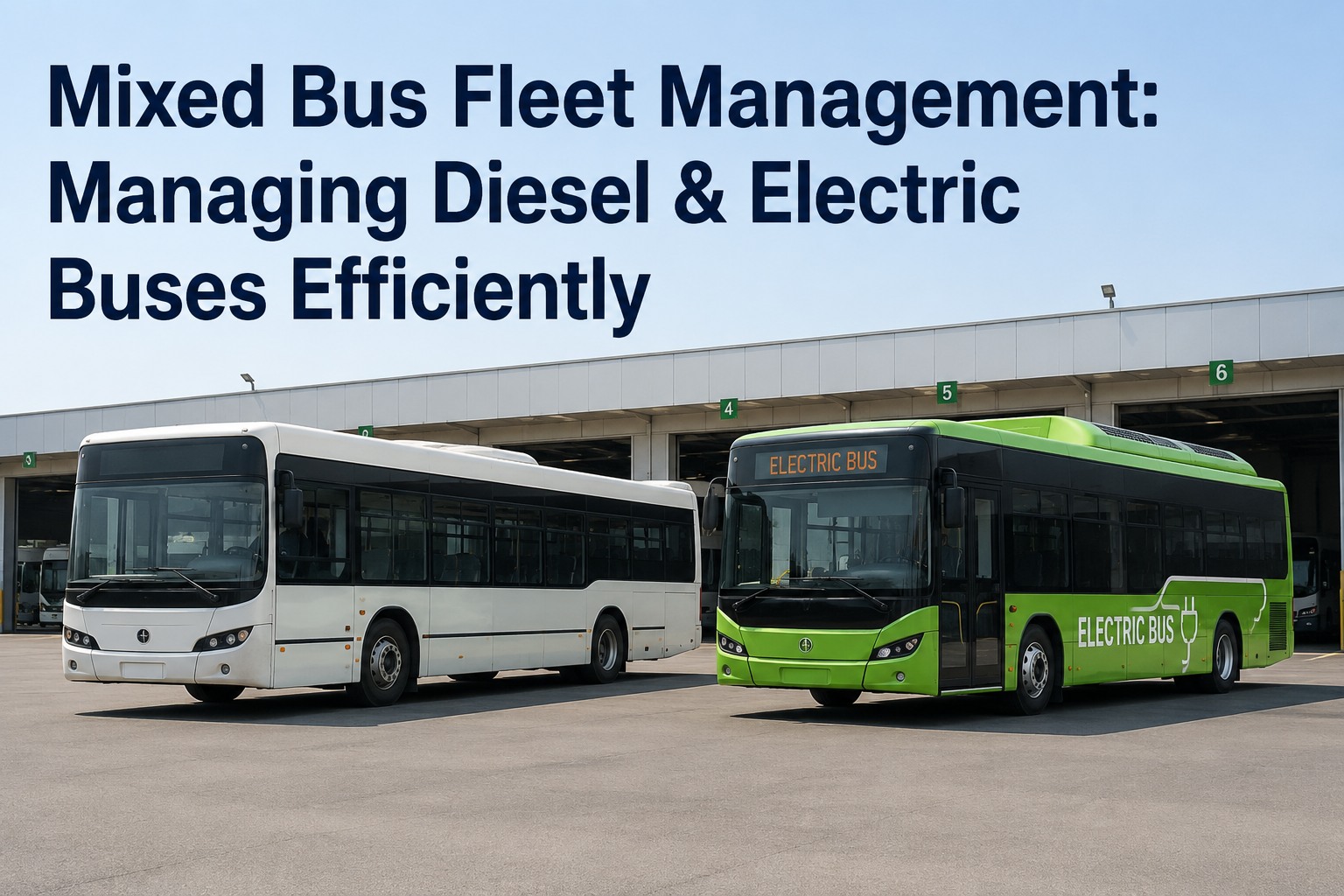
Your shop foreman is standing between two buses right now. On the left, a diesel unit due for a DEF top-off and a transmission service. On the right, an electric bus that needs a battery state-of-health check and a technician who's actually HV-certified to touch it. Same lot, same morning, two completely different maintenance worlds -- and if your system only speaks one of those languages, one of those buses is getting tracked on a spreadsheet nobody trusts. Most fleets aren't choosing between diesel and electric anymore. They're running both, side by side, for the next 10-15 years, whether that's a school district phasing in EPA Clean School Bus grant buses one route at a time or a transit agency working toward a 2040 electrification target. Mixed bus fleet management isn't a phase you pass through on the way to all-electric. For most operators, it's the actual job for the next decade.
Mixed Bus Fleet Management: Managing Diesel & Electric Buses Efficiently
How to run diesel and electric buses on one operation without doubling your maintenance workload, your parts inventory, or your technician headaches.
Why Mixed Fleet Management Is Harder Than Either Fuel Alone
A pure diesel fleet is simple in one sense: every bus follows roughly the same PM logic, every technician has roughly the same skill set, and every part fits roughly the same supply chain. A pure electric fleet, once you're fully there, settles into its own rhythm too. The hard part is the years in between, when you're running both at once and neither system was built to talk to the other.
The number of full-size zero-emission buses on U.S. roads grew 14% between 2023 and 2024 alone, crossing 7,000 units nationally, and that growth is landing inside fleets that were diesel-only a few years earlier -- not replacing them overnight. Electric bus maintenance runs roughly $0.19-$0.40 per mile against $0.52-$0.90 per mile for diesel, but capturing that gap requires a system that tracks cost per mile separately by powertrain, not one blended average that hides where the savings actually are. Book a demo to see diesel and electric cost-per-mile tracked side by side instead of averaged into one number that tells you nothing.
Which Routes Actually Fit an Electric Bus?
Mixed fleet management starts before a bus ever reaches the shop -- it starts with route assignment. Electrification isn't a uniform swap across a district; it's a route-by-route fit question, and the same fleet can reasonably run both powertrains side by side for years without that being a sign the transition is stalled.
-
Strong EV Fit
Short In-Town Loops
Predictable mileage, frequent stops, easy overnight charging back at the yard. The easiest routes to electrify first.
-
Workable With Planning
Mixed Suburban Routes
Can work well for EVs but are more sensitive to range variation -- needs careful energy and schedule planning.
-
Stay Diesel For Now
Rural Long-Haul Routes
Distance and limited charging access make these routes better suited to diesel or propane in most current fleets.
-
Evaluate Case-by-Case
Special-Ed Micro-Routes
Short in miles but energy-intensive from frequent stops and heavy HVAC use -- range math doesn't always favor EV here.
Assigning buses by route tier, not just by what's parked and available, is what keeps a mixed fleet efficient instead of just mixed. Sign up free to tag each bus by powertrain and match it to the right route profile in your asset register.
Where Diesel and Electric PM Schedules Actually Diverge
This is the part that trips up most fleets running a single generic PM template. Some maintenance items are identical across both powertrains. Others don't just change frequency -- they don't exist at all on one side.
| System | Diesel Bus | Electric Bus |
|---|---|---|
| Engine/Motor Service | Oil changes, DEF, DPF service | None -- no engine oil or exhaust system |
| Braking | Standard friction wear schedule | Regenerative braking -- pads last 3-5x longer |
| Power System Checks | Fuel injectors, fuel filters, fuel lines | HV cable insulation, battery SOH, inverter diagnostics |
| Technician Requirement | Standard certified mechanic | HV-certified technician with PPE for battery/motor work |
| Infrastructure PM | Fuel pump and tank maintenance | Charger (EVSE) inspection and firmware updates |
A generic fleet tool built for trucking or construction treats these as one undifferentiated PM list, which is exactly how HV inspections get skipped or charger maintenance falls through the cracks. Book a demo to see fuel-type-specific PM templates running on the same dashboard without any manual re-configuration per bus.
Staffing and Parts: The Two Places Mixed Fleets Quietly Overspend
Beyond the maintenance schedule itself, two operational areas cause the most friction in a mixed fleet, and both are solvable with better tracking rather than more headcount or more warehouse space.
-
1
HV Technician Coverage
High-voltage certification runs $2,000-$5,000 per technician plus specialized tools. Track who's certified, when it expires, and route HV work orders only to qualified staff -- don't let a diesel-only tech get handed a battery job by accident.
-
2
Dual Parts Inventory
Diesel filters and DEF fluid sit next to inverter components and charger connectors. Without powertrain tagging on every part, you risk duplicate ordering for parts one side of the fleet will never use.
-
3
Cross-Training Scheduling
Most shops can't afford two completely separate crews. Building a training rotation that gets diesel techs HV-certified over time keeps coverage flexible as your electric share grows.
-
4
Charger Infrastructure as a Maintenance Line Item
EVSE units need their own inspection cycle and firmware updates. Treat chargers as fleet assets in your PM schedule, not a facilities afterthought separate from the buses they serve.
From a Fleet Manager Running Both Fuel Types
"For about two years we were tracking our diesel buses in the CMMS and our electric buses on a shared spreadsheet because the software just didn't have EV fields. Every board meeting I'd have to manually build a slide showing cost per mile by fuel type, and half the time the numbers didn't match what my foreman had on his clipboard. Once everything moved into one system with powertrain tagged on every bus, that slide takes me five minutes instead of an afternoon, and I trust the number on it."
What a Bus-Specific CMMS Adds to Mixed Fleet Management
Generic fleet software built for trucking treats every vehicle the same way, which is exactly backward for a mixed bus fleet where the whole management challenge is handling two genuinely different maintenance worlds without doubling your workload.
Powertrain-Tagged Assets
Every bus carries a fuel-type tag that drives which PM template, parts list, and technician pool applies automatically.
One Dashboard, Filterable
Fleet availability, cost-per-mile, and PM compliance viewable together or split by diesel vs. electric instantly.
HV Certification Routing
Work orders on HV components route only to certified technicians, with expiration dates tracked automatically.
Board-Ready TCO Reports
One-click reports showing real savings by powertrain, formatted for a board meeting or an NTD submission.
BusCMMS reports that fleets managing mixed diesel and electric operations on one platform capture 15-25% additional savings beyond the inherent EV cost advantage, largely from better PM compliance and eliminating the duplicate-tracking overhead of running two separate systems. Book a demo to see your fleet's mixed-powertrain dashboard built live.
Managing a Mixed Fleet: The Bottom Line
Mixed bus fleet management works when you stop trying to force one PM template onto two different propulsion systems and start building the distinction in from the start -- route assignment by powertrain fit, PM schedules that diverge where they need to, technician certification tracked and routed correctly, and parts inventory that doesn't duplicate across fuel types. With zero-emission buses now a permanent part of most fleets rather than a future replacement, the operators who build this structure now are the ones who'll scale smoothly as their electric share grows, instead of drowning in two disconnected systems at 30% electrified.
If your diesel and electric buses are still living in two different tracking systems, that gap only gets more expensive as your fleet mix shifts. Sign up free and bring your whole mixed fleet onto one dashboard.
What makes mixed bus fleet management different from a single-fuel fleet?
A mixed fleet requires separate PM schedules, parts inventories, and technician certifications for diesel and electric buses running side by side. Diesel maintenance centers on oil changes, DEF, and exhaust systems, while electric buses need HV cable checks, battery state-of-health monitoring, and charger infrastructure PM -- items a single generic schedule usually misses.
How do you decide which routes get electric buses in a mixed fleet?
Route fit depends more on mileage predictability, charging access, and stop frequency than on distance alone. Short in-town loops with overnight charging access are typically the strongest fit, mixed suburban routes work with careful energy planning, and rural long-haul or high-HVAC special routes often remain better suited to diesel for now.
Do technicians need special certification to work on electric buses?
Yes, for high-voltage components. Anything involving the battery pack, drive motor, inverter, or orange HV cables requires a technician with high-voltage certification and proper PPE, typically costing $2,000-$5,000 per technician. Routine items like tires, brakes, and body work can still be handled by any trained mechanic.
How much does managing a mixed fleet with one system save versus separate tools?
BusCMMS reports that fleets consolidating diesel and electric tracking onto one platform capture an additional 15-25% in savings beyond the inherent electric cost advantage, largely from eliminating duplicate parts ordering, catching missed PM compliance, and reducing the staff hours spent reconciling two separate tracking systems.
Is charger infrastructure part of fleet maintenance management?
It should be. EVSE charging units need periodic inspection, firmware updates, and occasional repair just like any other fleet asset. Treating charger PM as part of the same maintenance schedule as the buses -- rather than a separate facilities task -- prevents downtime that looks like a bus problem but is actually a charging problem.