Every U.S. bus fleet manager faces this decision dozens of times per year: OEM at full price or aftermarket at 30-50% less. Get it right and you protect the budget without compromising reliability. Get it wrong and a single misapplied aftermarket component can void a $15,000 warranty, cause a premature failure, or put a bus out of service on a school morning. This data-backed guide covers when aftermarket is the right call, when OEM is non-negotiable, and how BusCMMS helps fleet managers build their own parts quality database to drive every future purchasing decision with evidence.
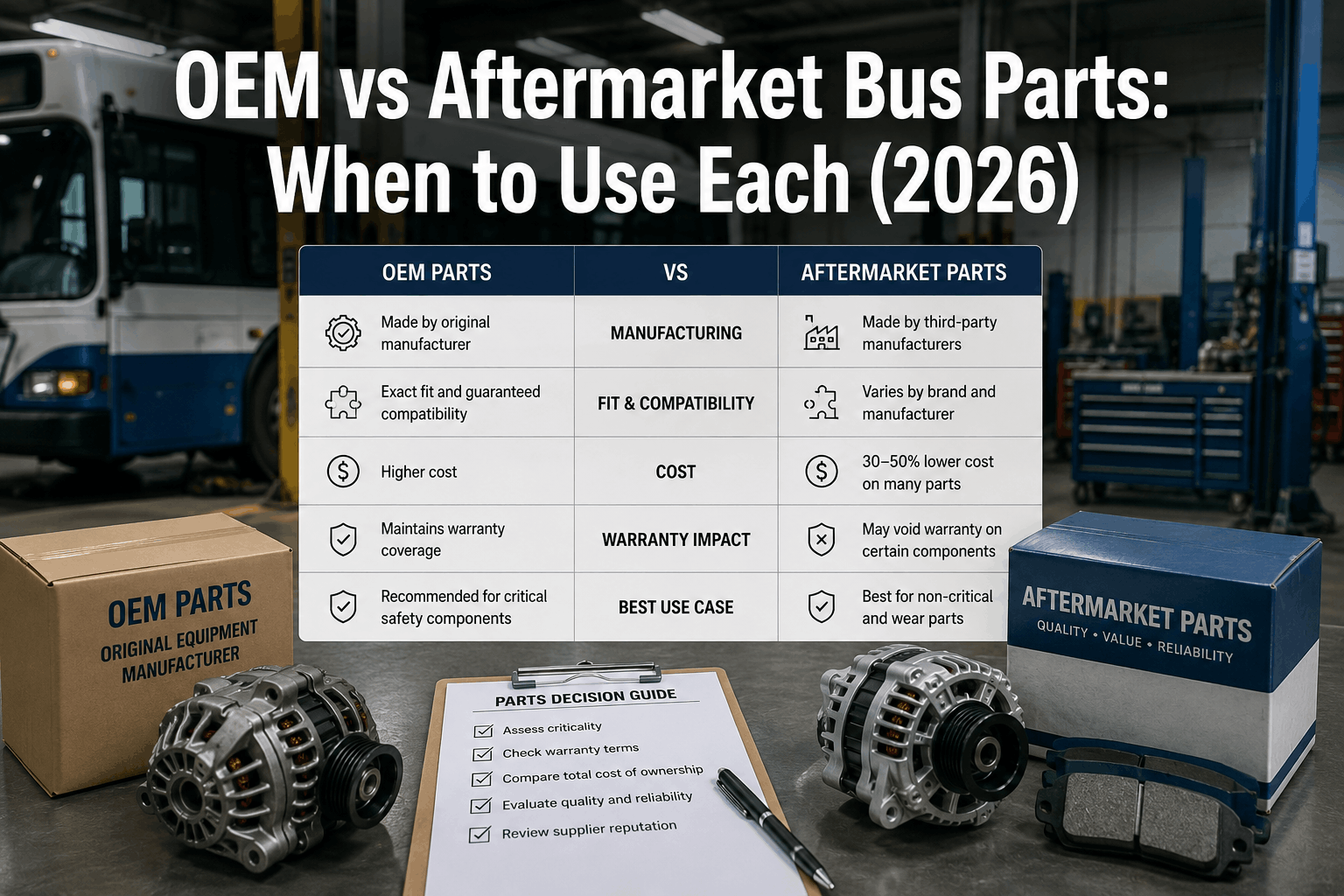
OEM vs Aftermarket Bus Parts: When to Use Each (2026)
30-50% aftermarket savings on the right components. $15K+ warranty voids on the wrong ones. The complete decision framework for school bus, transit, and charter fleet parts purchasing -- backed by fleet performance data.
30-50%
Aftermarket savings on eligible components
$15K+
Potential warranty void from wrong aftermarket
4,600
Monthly searches for this decision
68%
Of bus fleet parts are aftermarket-eligible
Track Parts Quality Outcomes by Vendor and Component in BusCMMS
BusCMMS logs every part used on every work order -- brand, cost, install date, and failure date. Build your fleet's own OEM vs aftermarket performance database and make every future parts decision with real data. Free 14-day trial.
Understanding the OEM vs Aftermarket Decision in Bus Fleet Maintenance
OEM stands for Original Equipment Manufacturer -- the company that made the part installed on the bus when it left the factory. In school bus and transit operations, OEM suppliers include Blue Bird, IC Bus, Thomas Built, Cummins, Allison, Bendix, Meritor, and Wabash National, among others. An aftermarket part is any replacement component not sourced from the original equipment manufacturer -- produced by a third party to fit and function in the same application.
The aftermarket bus parts industry ranges from Tier 1 suppliers manufacturing to OEM specification to commodity importers with minimal quality control. The decision is not binary -- it is a tiered evaluation based on component category, failure consequence, vehicle warranty status, and supplier quality tier. Parts Inventory tracking in BusCMMS gives fleet managers the data infrastructure to make this evaluation consistently rather than relying on technician preference or purchasing habit.
The Three-Tier Aftermarket Supplier Landscape
Before the OEM vs aftermarket component analysis, fleet managers need to understand that not all aftermarket suppliers are equivalent. U.S. bus fleet maintenance decisions should be made with this three-tier framework in mind.
Tier 1 -- OEM-Equivalent
Top Aftermarket Suppliers
Examples: Bendix, Meritor, Wix, Fleetguard, Gates, Dayco, Dorman HD. These suppliers manufacture to OEM specification, often supply OEM brands under white-label agreements, and publish independent quality certifications. Tier 1 aftermarket is functionally equivalent to OEM at 25-45% lower cost for most non-safety-critical components.
Tier 2 -- Acceptable with Vetting
Mid-Range Aftermarket
Regional distributors offering house-brand parts to general commercial specification. Acceptable for low-risk components when backed by a supplier warranty and fleet history. Require quality documentation before approval. Avoid on safety-critical or warranty-sensitive components.
Tier 3 -- Avoid for Fleet Use
Low-Cost Import Aftermarket
No-name parts from online marketplaces with no published quality certification. May appear correct but frequently fail FMVSS testing and carry no warranty. The apparent 60-70% savings on a $40 part are eliminated by a single premature failure. Flag all Tier 3 parts as non-approved in the BusCMMS parts catalog.
When Aftermarket Bus Parts Are the Right Choice
For approximately 68% of bus fleet parts categories by volume, Tier 1 aftermarket is the correct and fiscally responsible choice. These categories share: manageable failure consequences, a mature and documented aftermarket supply chain, and savings material enough to significantly impact the annual parts budget.
Aftermarket Recommended
Filters (Oil, Air, Fuel, Hydraulic)
Tier 1 aftermarket filters from Wix, Fleetguard, Baldwin, and Donaldson meet or exceed OEM specifications for virtually all school bus engine applications. Savings of 35-50% are standard. Track filter intervals in Preventive Maintenance Planning to maintain documentation.
Aftermarket Recommended
Belts and Hoses (Non-Turbo Applications)
Gates, Dayco, and Continental produce belts and hoses to OEM specification for most Cummins, International, and Ford Powerstroke school bus applications. Savings of 30-45% are typical. Turbo inlet and outlet hoses are the exception -- use OEM or Tier 1 rated for boost pressure.
Aftermarket Recommended
Lighting and Electrical Accessories
Interior and exterior lighting, mirror assemblies, and non-safety electrical accessories are well-served by Tier 1 aftermarket at 40-55% savings. Aftermarket alternatives are typically DOT-certified. Stop arm lights and 8-light flasher systems require additional DOT certification verification before substituting.
Aftermarket Recommended
Wiper Systems and Body Seals
Wiper blades, wiper motors, door seals, window seals, and body weatherstripping are high-volume, low-risk aftermarket candidates. Tier 1 alternatives are readily available and most U.S. school bus fleets source these exclusively from aftermarket without measurable reliability impact.
Aftermarket Recommended
Cooling System Components (Non-EGR)
Radiators, coolant tanks, thermostats, and water pump housings from Spectra Premium, CSF, and Dorman HD perform comparably to OEM for most bus diesel applications. EGR coolers and integrated cooling modules on modern emissions engines are the exception -- use OEM or Tier 1 validated for the specific engine family.
Aftermarket Recommended
Chassis Hardware and Fasteners
Grade 5 and Grade 8 aftermarket chassis hardware is appropriate for non-structural applications. U-bolts, spring hardware, and suspension fasteners require published tensile strength certifications. Log all chassis hardware by bin and supplier in BusCMMS Parts Inventory for traceability.
When OEM Bus Parts Are Non-Negotiable
For approximately 32% of parts categories by volume -- but a far higher share by cost and liability -- OEM is the correct choice regardless of price differential. These components are safety-critical, covered by active OEM warranty, or require exact OEM precision tolerances to function correctly.
Brake System Components
S-cam assemblies, brake chambers, ABS modulators and sensors, and stability control components are OEM-required on all active-warranty vehicles. FMVSS 121 and 105 performance minimums can only be reliably met by OEM or verified Tier 1 components. A brake failure on a school bus carries catastrophic liability. Budget zero savings here.
Transmission and Drivetrain
Allison internal components, torque converters, and shift selectors require OEM Allison parts or Allison-approved ReCon remanufactured components to preserve the warranty -- covering up to $18,000 in repair costs. Using non-approved aftermarket voids this warranty immediately and permanently.
Engine Control Modules (ECM/ECU)
ECMs, aftertreatment control modules, and body control modules require OEM components and calibration files. Aftermarket ECMs for Cummins ISB, ISL, and L9 engines have caused widespread DEF faults, DPF regeneration failures, and engine derates that strand buses mid-route. This is not a cost-savings category.
Steering Components
Power steering pumps, gearboxes, tie rods, and drag links require OEM or verified Tier 1 components with FMVSS documentation. Steering failure at highway speed is catastrophic. The cost differential between OEM and an uncertified aftermarket steering component is irrelevant against the liability of a steering accident involving students.
Wheelchair Lift and Accessibility Equipment
Wheelchair lifts and securement systems must use OEM parts from the lift manufacturer (Braun, Ricon, Maxon) to maintain ADA compliance certification. Non-OEM lift components invalidate ADA certification and create direct liability under the Americans with Disabilities Act.
Emissions Control System (DPF/SCR/DEF)
DPFs, SCR systems, DEF injectors, and NOx sensors on EPA 2010+ engines require OEM or OEM-validated components. Aftermarket DPFs fail at 3-4x the OEM rate on high-cycle bus applications. A failed aftermarket DPF triggering an engine derate costs $8,000-$22,000 -- far exceeding any initial savings.
The Warranty Void Risk: What Fleet Managers Get Wrong
The most costly OEM vs aftermarket mistake is not choosing the wrong part -- it is using the right aftermarket part on the wrong vehicle. Using aftermarket on an active OEM warranty-covered system creates void risk that does not surface until a major claim is submitted months or years later.
Under Magnuson-Moss, OEMs cannot void an entire warranty for aftermarket use -- but they can deny a specific system claim if they show the aftermarket part contributed to the failure. An Allison transmission failure with non-approved clutch packs or fluid results in a denied claim. A Cummins failure with non-approved injector seals faces exclusion review. Denied claims average $8,000-$18,000 per incident. BusCMMS Work Order Management logs every part with brand, part number, and work order linkage -- documenting warranty-active installations before substitutions occur.
Cost Analysis: OEM vs Aftermarket by Component Category
| Component | OEM Avg Cost | Tier 1 Aftermarket | Savings | Recommendation |
|---|---|---|---|---|
| Oil filter (Cummins ISB) | $18 | $9-11 | 39-50% | Aftermarket (Wix, Fleetguard) |
| Air filter (bus engine) | $65 | $32-42 | 35-51% | Aftermarket (Donaldson, Wix) |
| Serpentine belt | $48 | $26-34 | 29-46% | Aftermarket (Gates, Dayco) |
| Brake shoe set (S-cam) | $110 | $65-85 | 23-41% | OEM or verified Tier 1 only |
| Brake chamber | $180 | $90-120 | 33-50% | OEM or Bendix/Haldex Tier 1 |
| ABS sensor | $95 | $40-65 | 32-58% | OEM only (warranty/safety) |
| Allison filter kit | $140 | N/A -- Allison only | 0% | OEM required (warranty) |
| Coolant hose set | $220 | $110-155 | 30-50% | Aftermarket (Gates, Dayco) |
| Radiator (transit bus) | $1,400 | $750-1,050 | 25-46% | Aftermarket (Spectra, CSF) |
| DPF filter (Cummins) | $2,800 | $1,200-1,800 | 36-57% | OEM strongly recommended |
| ECM (Cummins ISL) | $3,200 | Avoid -- failure rate high | -- | OEM only |
| Wheelchair lift component | Varies by OEM | Not available / non-compliant | -- | OEM only (ADA compliance) |
Annual Parts Budget Impact: Fleet-Level OEM vs Aftermarket Strategy
The financial impact of a disciplined OEM vs aftermarket parts strategy is significant at the fleet level. The following analysis applies to a 40-bus school or transit fleet running approximately 180 service days per year, with an annual parts spend of $95,000-$140,000 (typical for this fleet size in the U.S.).
All-OEM Strategy (No Aftermarket)
$140,000
Maximum warranty protection, zero substitution risk, highest cost. Appropriate only during the first 2-3 years when comprehensive OEM warranties are active. This approach is unnecessarily expensive for out-of-warranty fleets -- filter, belt, and hose categories are fully aftermarket-eligible.
Disciplined Mixed Strategy (68% Aftermarket-Eligible)
$98,000
Apply Tier 1 aftermarket to eligible categories (filters, belts, hoses, cooling, lighting, hardware) while maintaining OEM on safety-critical and warranty-active components. Annual savings of $38,000-$42,000 versus all-OEM on a 40-bus fleet -- the optimal balance for fleets 3+ years out of initial OEM warranty.
Undisciplined Low-Cost Aftermarket (Tier 3 Heavy)
$88,000 apparent / $130,000+ actual
Apparent savings of $52,000 are erased by 2.3x higher Tier 3 failure rate, warranty denials averaging $12,000 per incident, and unplanned downtime costs of $800-$1,400 per day. This is the most expensive strategy despite appearing cheapest at the purchase order.
Performance Metrics: OEM vs Aftermarket Bus Parts Data
Premature Failure Rate by Parts Tier
Annual Parts Budget Savings (40-bus fleet, disciplined strategy)
Warranty Claim Denial Rate When Aftermarket Used on Active Warranty
Parts Tracking Accuracy with BusCMMS vs Paper
Visual KPI: Parts Decision Impact at a Glance
Aftermarket Eligibility by Parts Category (%)
OEM vs Tier 1 Aftermarket: Failure Rate Comparison
Annual Cost: Three Parts Strategies (40-bus fleet)
Warranty Claim Outcome: OEM Parts vs Aftermarket on Active Warranty
How BusCMMS Supports Your OEM vs Aftermarket Strategy
The best decision framework fails without consistent implementation at the work order level. A policy saying "use OEM on brakes" is irrelevant if the technician does not know which components on that specific bus are warranty-active. BusCMMS closes this gap by making parts strategy a structural feature of the work order and inventory system -- not a separate document.
Parts Catalog with OEM/AM Classification
Every part in the BusCMMS catalog is tagged OEM-required, Tier 1 approved, or Tier 3 restricted. When a technician requests a part on a work order, the approved sourcing designation appears automatically. See full Parts Inventory capabilities.
Warranty Status per Vehicle
Each bus carries a warranty record with coverage dates and mileage limits. When a work order opens on a warranty-active bus, the system flags components requiring OEM sourcing -- preventing warranty voids before they happen.
Parts Performance Tracking by Brand
Every part is logged with brand, part number, install date, and vehicle. When the same component needs replacement, BusCMMS surfaces the prior install history -- showing whether the previous OEM or aftermarket choice lasted to expected life or failed early. This is how fleets build their own quality database.
Vendor Performance Reporting
Maintenance Analytics generates vendor reports showing failure rates, return rates, and warranty claim frequency by supplier. Over 12 months this data identifies which aftermarket vendors perform to OEM standard and which do not -- evidence over guesswork.
Work Order Parts Cost Tracking
Parts link automatically to work orders, capturing OEM vs aftermarket cost by vehicle and repair type. Maintenance Reporting surfaces annual spend by category for budget justification and strategy review at any point in the fiscal year.
Best Practices: Building a Fleet Parts Procurement Policy
A parts procurement policy ensures the OEM vs aftermarket framework is applied consistently regardless of individual preference or vendor relationship. These practices reflect how high-performing U.S. bus fleets structure their sourcing decisions.
Create an Approved Parts List by Category
Document OEM-required categories, approved Tier 1 suppliers by component type, and restricted suppliers. Load into BusCMMS as catalog designations enforced at the point of parts request -- not remembered from a policy document. Review quarterly as vendor performance data accumulates.
Tie Warranty Status to Procurement Rules
Document warranty status per vehicle in BusCMMS -- powertrain, body, and component coverage with expiration dates. Create a procurement rule that defaults to OEM for any work order on a warranty-active vehicle. This prevents the most common warranty void scenario in U.S. fleet operations.
Require Supplier Quality Documentation
Before approving any aftermarket supplier, require ISO 9001 certification, FMVSS documentation for safety components, and a written defects warranty. Suppliers who cannot provide documentation should not be on the approved list regardless of pricing. Record vendor documentation in BusCMMS vendor records.
Track and Review Parts Failure Data Quarterly
Run a quarterly parts failure report in BusCMMS Maintenance Analytics showing components replaced before expected service life. Recurring failures on a specific part from a specific supplier signal a switch to OEM or alternative Tier 1. This removes vendor loyalty and price bias from the decision.
Industry Applications: OEM vs Aftermarket by Fleet Type
K-12 School Bus Districts
School districts face the strictest liability for parts quality under state pupil transportation contracts. State DOT auditors review parts quality documentation during annual fleet inspections. Maintain OEM on safety-critical components and document Tier 1 approvals in BusCMMS for audit-readiness and EPA Clean School Bus grant compliance.
Municipal Transit Agencies
FTA-funded agencies face Buy America provisions for major capital components -- OEM or U.S.-manufactured parts for structural, propulsion, and safety-critical systems. Maintenance consumables (filters, belts, hoses) are generally Buy America-exempt and represent the primary aftermarket savings opportunity for transit fleets.
Charter Bus Operators
Charter operators must meet FMCSA Part 396 requirements -- parts "equal to" OEM for safety-critical systems. Tier 1 aftermarket with FMVSS documentation satisfies this. FMCSA SMS scores are directly affected by OOS violations from failed parts, making parts quality a compliance risk beyond just reliability.
Paratransit and Demand-Response
Paratransit vehicles carry the highest regulatory burden for parts quality on accessibility equipment and safety systems -- OEM exclusively. Drivetrain and engine components on high-mileage, out-of-warranty paratransit vehicles are strong Tier 1 aftermarket candidates to manage the above-average maintenance cost per mile of these operations.
We had no parts policy -- everything was up to whoever was ordering that day. We found out the hard way when Allison denied a $14,000 transmission warranty claim because we had been using a non-approved aftermarket filter kit. After that we loaded every bus warranty into BusCMMS, tagged every part in the catalog as OEM-required or aftermarket-approved, and ran the whole strategy through the system. In the first year we saved $36,000 on parts by switching eligible categories to Tier 1 aftermarket. We have not had a warranty claim denied since. The platform paid for itself on the first Allison warranty claim it helped us keep valid.
Frequently Asked Questions
Does using aftermarket parts void the bus warranty automatically?
What is the safest aftermarket brand for Cummins engine filters on school buses?
Can I use aftermarket parts on Allison transmission service?
How does BusCMMS help track OEM vs aftermarket parts decisions?
Are aftermarket DPF filters safe to use on school buses?
What aftermarket parts categories deliver the best savings for school bus fleets?
How do I know if an aftermarket supplier meets OEM quality standards?
Does BusCMMS support vendor performance tracking for parts suppliers?
Make Every Parts Decision With Data, Not Guesswork.
BusCMMS logs every part, every brand, every install date, and every failure -- building your fleet's own OEM vs aftermarket performance database. Track warranty status per vehicle. Flag OEM-required components. Generate vendor performance reports. Built for U.S. school bus and transit operations.
Conclusion: The Right Part at the Right Time Is a Strategy, Not a Guess
The OEM vs aftermarket bus parts decision is one of the highest-leverage financial decisions a U.S. fleet manager makes. Applied correctly, a disciplined mixed strategy saves $38,000-$42,000 annually on a 40-bus fleet without compromising reliability. Applied incorrectly through Tier 3 sourcing or warranty-active substitution, apparent savings are erased by premature failures and denied warranty claims averaging $12,000 per incident.
BusCMMS provides the infrastructure: parts catalogs with sourcing designations, warranty status per vehicle, performance tracking by brand, and analytics that build your fleet's own quality database. Start Free today and begin building the parts data your fleet needs -- or Book Demo for a guided parts catalog and vendor tracking walkthrough.
```