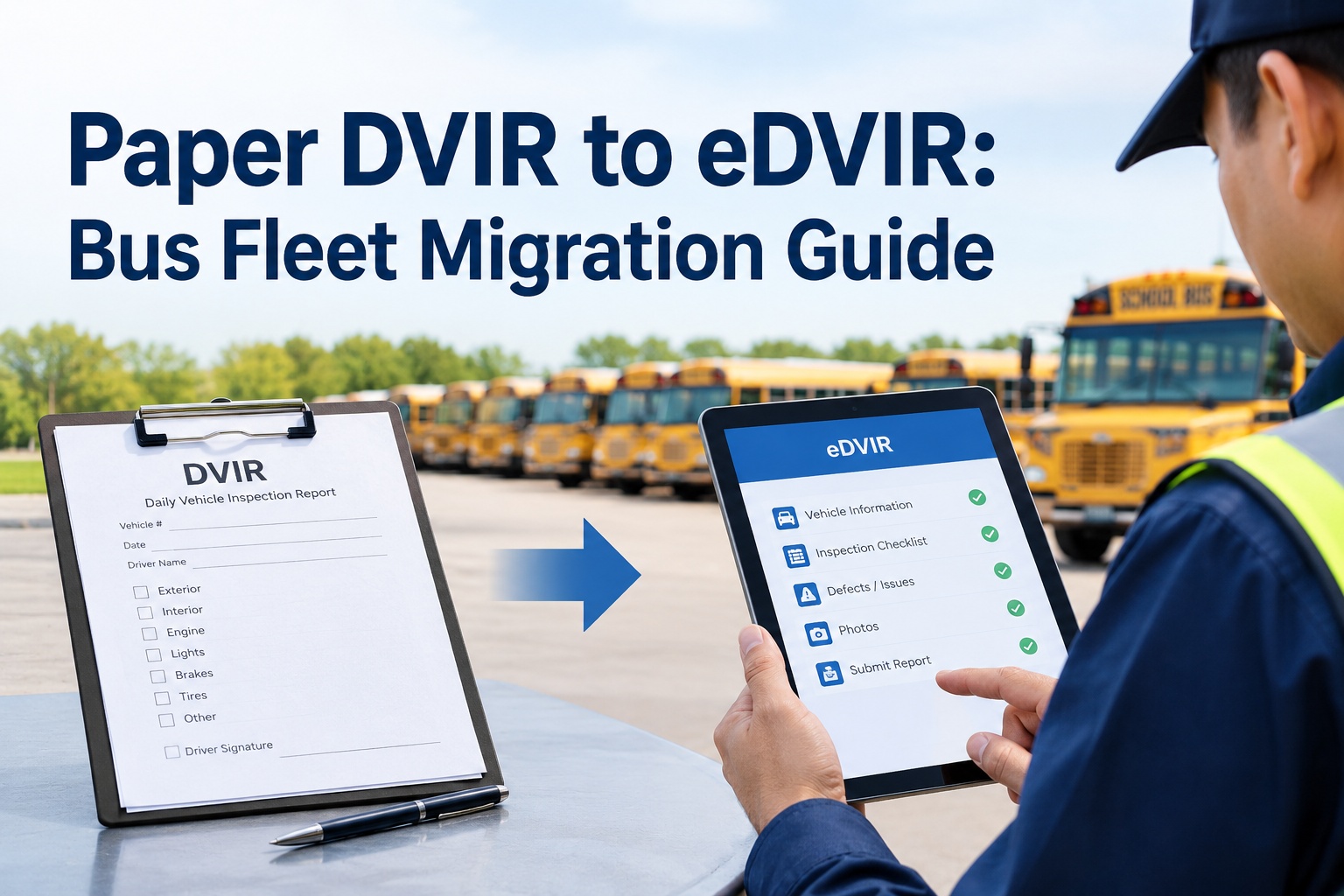
Moving from paper DVIRs to eDVIRs means replacing the clipboard-and-glovebox inspection process with mobile digital inspections that capture defects, signatures, and photos and route them straight into maintenance — and a successful migration is a phased project, not a switch you flip. Fleets make the move because paper breaks the three-signature compliance chain daily and disappears before an audit; the migration works when you pilot it, run paper and digital in parallel, train drivers well, and connect the data to your maintenance workflow rather than building another island.
Paper DVIR to eDVIR: Bus Fleet Migration Guide
The clipboard is not a compliance system — it is a hope. Here is how to move a bus fleet to eDVIRs in phases, without breaking a route or an audit.
Updated September 2026 · A practical migration guide, not legal advice; verify current FMCSA requirements for your operation.Paper DVIRs have a structural problem: the inspection, the repair certification, and the next driver's acknowledgment are supposed to form one connected chain, but on paper those three signatures live on a sheet that gets rushed, lost, or filed where nobody links it to the actual repair. eDVIRs fix the chain by making it digital and connected — but only if the migration is done deliberately.
What the rules require, and what is just software
Before planning a migration, separate three things that get conflated: the federal requirement, the software feature, and your district's own policy. Getting this straight keeps the project honest.
396.11 requires the driver's inspection report documenting the vehicle's condition and defects; 396.13 requires the next driver to be satisfied the vehicle is safe and review the most recent DVIR before operating. Together they form a three-signature chain — driver, mechanic, next driver — with records retained at least 90 days.
FMCSA's final rule (Docket FMCSA-2025-0115, effective March 23, 2026) added explicit language that DVIRs may be created, signed, and maintained electronically — already permissible since 2018 under 390.32. It authorizes and encourages electronic DVIRs; it does not mandate them, and paper remains legal.
So the migration is a choice, not a compliance deadline: the federal requirement is the inspection, the chain, and the records — electronic or paper. Mobile forms, photos, offline mode, and audit exports are software features that make meeting the requirement easier, and how you configure approvals is district policy. This page is a practical guide, not legal advice — verify the current FMCSA requirements and how they apply to your operation before you plan.
Keeping those three straight matters during vendor demos too: a vendor may sell a feature as if it were a mandate. Hold to what the regulation actually requires, and evaluate the software on how well it helps you meet it. Discuss a pilot that keeps the compliance chain intact
The migration, step by step
A clean migration follows a sequence. Skip a step — especially the mapping or the parallel run — and the problems surface after go-live, when they are hardest to fix.
Map the paper process
Document exactly how inspections, defects, and sign-offs flow today — including the informal steps — before you digitize anything.
Configure the digital forms
Build bus-specific inspection forms that improve on paper, not just copy it — this is the chance to fix the workflow, not freeze it.
Define defect workflows
Decide how a reported defect becomes a work order, who owns it, and how it is prioritized and closed.
Train the drivers
Hands-on training on real devices, not a memo — driver adoption makes or breaks the whole migration.
Deploy mobile & offline
Confirm inspections work on the devices drivers actually use, and keep working in the yard and out of cellular coverage.
Run in parallel
For a set period, run paper and digital together, validate the records match, and build confidence before cutting over.
Set approval workflows
Establish the electronic three-signature chain and the sign-off routing per your policy.
Measure adoption
Track completion rates, defect throughput, and record quality — and fix the gaps before rolling wider.
Notice steps six and eight: the parallel run proves the system works before you depend on it, and measuring adoption catches the drivers or routes that are slipping. Both are the difference between a migration that sticks and one that quietly reverts to paper. Start free and configure your first digital inspection
A phased plan: small fleet and large district
The stages are the same; the pace and scope differ. A 20-bus operation can move quickly; a 300-bus district needs more runway and tighter validation at each gate.
The large-fleet version is not slower for its own sake — each gate is a chance to catch a problem on ten buses instead of three hundred. Rushing a district-wide cutover is how migrations produce a month of chaos and a quiet return to clipboards. Discuss a phased pilot sized to your fleet
The mistakes that sink a migration
Nearly every failed eDVIR rollout traces to one of these. Knowing them upfront is most of the protection.
Copying paper into software
Digitizing an inefficient paper form just makes a faster bad process. Redesign the workflow during the move.
Thin driver training
A memo is not training. Drivers who are not comfortable revert to paper or rush the digital form.
Poor mobile usability
If the app is slow or clumsy on the device drivers actually hold, adoption dies regardless of features.
Weak offline capability
Yards and routes lose signal. If inspections need a connection, they will not get done.
Missing audit trail or unclear defect ownership
No timestamped history, or no clear owner for a defect, and the whole compliance chain has a hole in it.
Signing before testing the full workflow
A long-term contract before a real end-to-end pilot is how you get locked into software that does not fit.
Every one is avoidable with mapping, real training, an offline-capable mobile app, a clear defect owner, and a pilot before the contract — which is exactly the plan this guide lays out. Start free and test the full workflow before you commit
Paper DVIR vs eDVIR, side by side
The case for migrating is clearest laid out directly. This is what changes across the parts of the process that matter for compliance and maintenance.
The last row is the one that turns an eDVIR from a digital form into an operations upgrade: when the inspection connects to the maintenance record, a defect found at 5am is a tracked repair by mid-morning instead of a note in a folder. Discuss a pilot that connects inspections to repairs
A day in the workflow: defect to closed
Here is the migrated process doing its job on a normal morning — the thing paper never managed cleanly.
That end-to-end trail — inspection to defect to repair to retained history, all on one record — is what a migration is really for. It is the difference between passing an audit and hoping to. Start free and see the full chain on one record
Evaluating an eDVIR vendor
Not every eDVIR platform survives contact with a real fleet. Score every vendor on these before you sign anything longer than a pilot.
Weight these by what your operation needs — a district with dead zones will rank offline capability far above a vendor's report library — and demand a pilot on your buses before committing. BusCMMS is an AI-native bus fleet operations platform that connects inspections, defects, maintenance, and operational records on one vehicle record and helps teams prioritize the highest-risk defects, so the eDVIR is part of the fleet workflow rather than another isolated system. Run it through the same evaluation as everyone else. Discuss an eDVIR migration pilot with BusCMMS
Discuss an eDVIR migration pilot with BusCMMS
Move from paper to eDVIRs in phases — map, pilot, run in parallel, roll out — with inspections, defects, work orders, and vehicle history on one record and AI surfacing the highest-risk defects first. Test the full workflow on a small group of buses before you commit to anything.
One vehicle record · AI prioritizes high-risk defects · Pilot before you commit
Frequently asked questions
Are electronic DVIRs legal, or is paper still required?
Electronic DVIRs are fully legal, and paper is also still legal — neither is mandated. Electronic DVIRs have been permissible since 2018 under 49 CFR 390.32, and FMCSA's final rule (Docket FMCSA-2025-0115, effective March 23, 2026) added explicit language to 49 CFR 396.11 and 396.13 confirming that DVIRs may be created, signed, and maintained electronically, which removed the remaining interpretive ambiguity. The rule authorizes and encourages electronic methods but does not require them, so moving from paper to eDVIR is an operational choice rather than a compliance deadline. The underlying federal requirement — the inspection, the three-signature chain, and record retention — is unchanged whether you use paper or digital. Always verify how the current requirements apply to your specific operation.
What does a successful paper-to-eDVIR migration involve?
It is a phased project, not a single switch. The core steps are: map your existing paper inspection and defect process including the informal parts; configure digital inspection forms that improve on paper rather than copying it; define how a defect becomes a work order and who owns it; train drivers hands-on with real devices; deploy mobile inspections and confirm they work offline; run paper and digital in parallel for a period and validate the records match; establish the electronic approval and three-signature workflow; and measure adoption to catch gaps before rolling wider. A small fleet can move through these quickly, while a large district should gate each depot on the prior one succeeding. The parallel run and adoption measurement are the two steps that most determine whether the migration sticks.
What are the most common eDVIR migration mistakes?
The recurring ones are: copying an inefficient paper workflow straight into software instead of redesigning it; thin driver training that leaves drivers reverting to paper; poor mobile usability on the devices drivers actually use; weak offline capability, which fails in yards and routes without signal; missing audit trails or unclear defect ownership, which puts a hole in the compliance chain; and signing a long-term contract before testing the complete end-to-end workflow in a pilot. Each is avoidable by mapping the current process first, investing in real hands-on training, requiring an offline-capable mobile app, assigning a clear owner to every defect, and running a genuine pilot before committing. Building those into the plan is what separates a migration that sticks from one that quietly returns to clipboards.
Should eDVIR connect to maintenance, or is it just an inspection tool?
It should connect. An eDVIR that only digitizes the inspection form and stores it in a separate system captures better records but does not change operations. The larger value comes when a reported defect automatically becomes a tracked work order with a clear owner, is prioritized, repaired, and signed off, and the inspection, the corrective action, and the signatures all remain on the same vehicle record. That connection turns a defect found on a route into a documented, closed repair rather than a note that may never reach the shop, and it produces an audit-ready chain from inspection through repair. When evaluating platforms, treat maintenance integration as a core requirement, not a nice-to-have, because it is what makes the migration an operations improvement rather than a filing upgrade.
How does BusCMMS support an eDVIR migration?
BusCMMS is an AI-native bus fleet operations platform designed so the eDVIR is part of the fleet workflow rather than an isolated system. It connects inspections, defects, work orders, preventive maintenance, and vehicle history on one record, so a defect submitted on a route becomes a tracked work order and the inspection, repair, and signatures stay together and audit-ready. AI helps teams prioritize the highest-risk defects so the most important issues surface first. For the migration itself, the recommended approach is to start with a pilot on a small group of buses with baseline metrics and a parallel run against paper, validate the records and adoption, and only then roll out more widely — testing the complete workflow before any long-term commitment, exactly as this guide recommends.