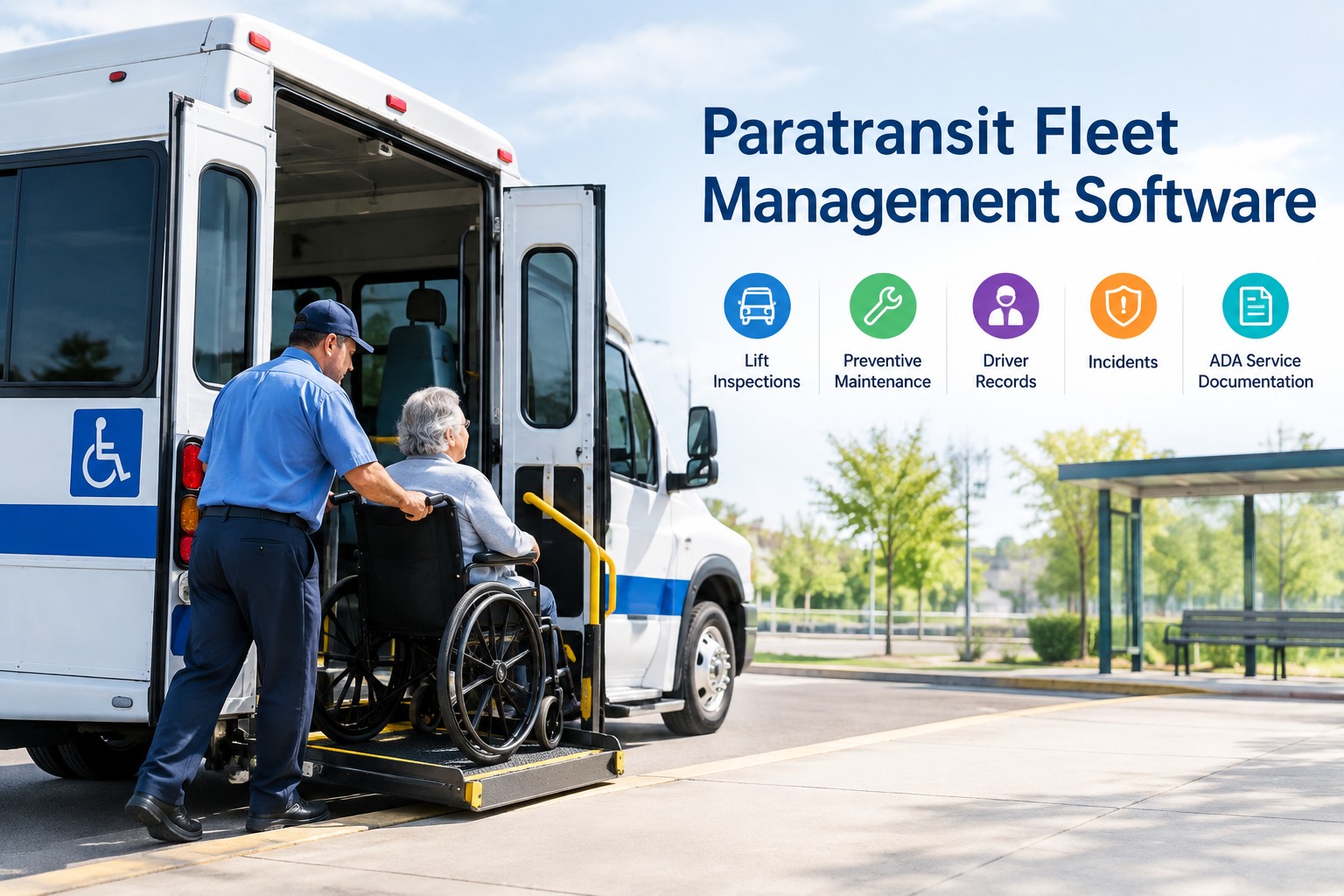
For most bus fleets, a vehicle out of service is a scheduling problem. For a paratransit fleet, it can be something else entirely: a rider with a disability and no other way to reach dialysis, work, or home. When the lift fails, the trip does not just run late — the service is denied, and under the ADA that denial has legal weight, not just an operational cost. This page is about running a paratransit operation where the accessibility equipment simply works: lifts and ramps maintained ahead of failure, securement ready, and every check and repair documented the way an FTA reviewer will ask to see it. See how BusCMMS keeps accessible service running and documented
Updated September 2026 · ADA and related requirements (49 CFR Parts 37 and 38) apply by entity and service type and are summarized here for context, not as legal advice. Verify current requirements against the regulation and your counsel.
Paratransit Fleet Management Software
In paratransit, the accessibility equipment is the service. Every ride depends on a chain that has to hold from the curb to the seat — and one broken link is a denied trip.
A paratransit vehicle is really a stack of accessibility systems bolted to a bus, and the rider depends on every one of them in sequence. A perfectly running engine is worthless if the lift will not deploy. So the maintenance priority inverts from a normal fleet: the accessibility equipment comes first, because it is the part that turns a vehicle into service a rider can actually use. Here is each link, why it fails, and what keeps it operative.
Why it fails: Hydraulic drift, a laboring motor, an outer barrier that will not raise, a stuck roll-stop. Failures often show under load, not at rest — which is why a static glance misses them.
What keeps it operative: Regular, frequent lift checks sufficient to confirm it actually works, plus a deploy-and-cycle test, not just a visual. Any failure pulls the vehicle for an accessible replacement.
Why it fails: A worn slip-resistant surface, a cracked platform, a barrier that sits below spec height or wobbles under pressure — small degradations that become a fall risk at the exact wrong moment.
What keeps it operative: A tactile check of surface and edges, and confirming the barrier rises to full height and latches every cycle. Reject on wear, cracks, or exposed hardware.
Why it fails: Frayed straps, a worn ratchet, a floor anchor with play, a belt that no longer latches. Securement is what turns a lift into a safe ride, and it wears from constant use.
What keeps it operative: Inspecting every securement position and its belts on a regular basis, and replacing any component that shows wear before it fails with a rider aboard.
Notice that every link fails in a way a walk-past inspection misses — drift under load, a barrier that is almost full height, a strap that is mostly fine. Accessibility equipment has to be operated and tested, not glanced at, and that testing has to be logged. Book a demo to turn lift and securement checks into a logged routine
What a lift failure actually costs
A fleet manager sees an inoperable lift as a vehicle to swap and a repair to schedule. In paratransit the cost is measured on a different scale, because the failure lands on a rider who has no alternative and on an agency that answers to a federal standard. Here is what a single lift failure really sets in motion.
A denied trip. That can mean a missed dialysis session, a missed shift, or being stranded away from home — for someone whose whole day was built around that ride.
Under 49 CFR Part 37, lifts and securement must be kept operative. A failure means the vehicle comes out of service for an accessible replacement, and if none exists, a tightly limited exception period with documented justification and immediate repair.
Accessibility failures can generate ADA complaints and draw DOT or DOJ attention, with civil-penalty exposure. And in an FTA review, missing documentation is itself a finding — even when the maintenance was actually done.
That last line is the one that catches good operators off guard: doing the maintenance is not enough if you cannot prove it. The repair bill is the smallest part of a lift failure; the rest lands on the rider's day and the agency's standing. Start free and catch accessibility failures before a rider does
The paper trail is part of the service
Paratransit is the rare fleet where the documentation is not back-office overhead — it is a compliance deliverable. FTA reviewers do not just ask whether your lifts work; they ask you to prove it, across a specific set of records. And because missing documentation counts as a finding on its own, the record you keep is as important as the wrench you turn. These are the records that have to exist.
Showing the lift was checked before service, with the driver identified.
Each failure, the repair timeline, and any alternate transport provided to the rider.
Scheduled maintenance and repair histories showing parts and labor.
Where a spare was unavailable, the justification and the limited days used.
Documentation that operators are trained on lift and securement use.
Accessibility complaints logged, with how and when each was resolved.
Assembled from paper logs and scattered systems, producing this for a review is a scramble that can take days. Generated automatically as daily operations happen, it is an export. That is the practical case for one connected record in paratransit: the compliance paper trail builds itself. Book a demo to make the FTA paper trail build itself
The paratransit readiness checklist
A paratransit pre-trip is a normal bus check with the accessibility systems moved to the front, because those are the parts that decide whether a rider can actually board. This is the operation-level version — the safety and mechanical basics, plus the lift, ramp, and securement items that turn a vehicle into accessible service.
- Lift deploys and cycles fully, holds under load, no drift
- Outer barrier and roll-stop raise and latch every cycle
- Platform surface intact, slip-resistant, no cracks
- All securement positions and belts present and functional
- Kneeling suspension and controls working; backup operable
- Brakes, tires, lights, signals, and fluids all good
- Interior clean; aisle and door path clear for boarding
- Seatbelts, grab rails, and stanchions solid
- A/C, heat, and PA or communication working
- Fire extinguisher, first-aid kit, and safety equipment present
Any accessibility item that fails should pull the vehicle for an accessible replacement and open a work order — not get waved through because a run is due. Captured on a phone, each check is timestamped, each flag becomes a tracked repair, and the log is ready the day a reviewer asks. Start free and put this checklist in every driver's hand
One record behind every accessible ride
Paratransit runs on records as much as on vehicles — and when the lift checks live in one place, the repair histories in another, the complaints in an inbox, and the training files in HR, proving compliance becomes a project every time a reviewer or a rider raises a question. BusCMMS is an AI-native bus fleet platform that puts preventive maintenance, inspections, DVIRs, work orders, driver records, incidents, and video evidence on one record per vehicle. That means a lift check is timestamped and tied to the driver, a failure becomes a tracked work order that flags the vehicle out of service, an accessibility complaint links to the vehicle and the response, and the FTA paper trail is a lookup rather than a scramble. It reduces the admin burden and protects the service riders depend on — without pretending software alone makes a fleet ADA-compliant, which remains the operator's responsibility.
Keep every lift ready and every record audit-ready
BusCMMS makes lift, ramp, and securement checks a logged daily routine, triggers preventive maintenance on the accessibility equipment, turns any failure into a tracked repair that flags the vehicle out of service, and keeps the timestamped documentation an FTA review requires. Start a free trial or book a demo and see it on your own fleet. Grab the paratransit maintenance checklist while you are at it.
No credit card · Timestamped lift inspection logs · Audit-ready documentation from day one
Frequently asked questions
What is paratransit fleet software?
Paratransit fleet software is a platform for managing the operation of accessible, ADA-oriented transportation: keeping wheelchair lifts, ramps, and securement systems maintained and operative, scheduling preventive maintenance and inspections, tracking driver records and training, logging incidents and complaints, and producing the timestamped documentation that reviewers require. Because the accessibility equipment is what makes the service usable and is governed by federal requirements under 49 CFR Parts 37 and 38, the software's central job is to keep that equipment reliable and to make every check, failure, and repair provable. A platform like BusCMMS connects inspections, work orders, driver records, incidents, and video evidence on one record per vehicle.
Why is a wheelchair lift failure more than a maintenance issue?
Because the rider affected often has no alternative, and because the service is federally protected. Under the ADA and 49 CFR Part 37, lifts and securement must be kept in operative condition during service, so a failure is treated as a denial of accessible service rather than a simple breakdown. A vehicle with an inoperative lift is removed from service and replaced with an accessible one; if no spare is available, a narrow exception permits limited operation with documented justification and immediate repair. Beyond the operational impact, accessibility failures can generate ADA complaints and draw DOT or DOJ attention with civil-penalty exposure, which is why lift reliability is treated as a compliance priority, not just upkeep.
What documentation do FTA reviewers expect for lifts?
Reviewers typically expect timestamped daily pre-service inspection logs showing the lift was checked with the driver identified, records of any lift failures along with the repair timeline and any alternate transport provided, preventive and periodic servicing records with parts and labor, exception-period tracking with justification where a spare was unavailable, driver ADA training documentation, and a log of accessibility complaints with their resolution. A critical point many operators miss is that missing documentation can constitute a finding even if the maintenance was actually performed. That is why capturing checks and repairs digitally, as daily operations happen, matters so much: it turns audit preparation from a multi-day reconstruction into an export.
What should a paratransit pre-trip inspection cover?
It should lead with the accessibility systems: the lift deploying and cycling fully and holding under load without drift, the outer barrier and roll-stop raising and latching each cycle, the platform surface intact and slip-resistant, every securement position and its belts present and functional, and the kneeling suspension, controls, and emergency backup working. On top of that come the standard safety and mechanical items — brakes, tires, lights, fluids, seatbelts, and required safety equipment — plus a clean, clear boarding path. Any accessibility item that fails should pull the vehicle for an accessible replacement and open a work order. Capturing the inspection digitally so it is timestamped and any flag becomes a tracked repair is what keeps the record audit-ready.
How does software help a paratransit operation?
The main benefits are equipment reliability and provable compliance. Instead of lift checks in one place, repair histories in another, and complaints in an inbox, a platform like BusCMMS keeps inspections, work orders, driver records, incidents, and video evidence on one record per vehicle. That means a lift check is timestamped and tied to the driver, a failure becomes a tracked work order that flags the vehicle out of service until repaired, an accessibility complaint links to the vehicle and its response, and the documentation an FTA review requires is ready as a lookup. It reduces administrative work and protects the accessible service riders depend on, without claiming software alone makes an operation ADA-compliant, which remains the operator's responsibility.