Ask five bus drivers what the difference is between a pre-trip and a post-trip inspection, and you'll usually get some version of "one's in the morning, one's at night." That's true, but it misses the part that actually matters during a DOT audit: they're governed by two different regulations, they require two different things on paper, and mixing them up is one of the most common findings auditors cite. Pre-trip vs post-trip bus inspection isn't just a timing question -- it's the difference between a physical safety check the law requires with no paperwork, and a written report the law requires regardless of what you find. Get that distinction wrong in your fleet's process, and you can be doing both inspections faithfully and still fail an audit on the documentation alone.
Pre-Trip vs Post-Trip Bus Inspection: Key Differences, Checklist & DOT Rules
What separates a pre-trip inspection from a post-trip DVIR under FMCSA rules, what each one legally requires, and the checklist that keeps both from falling through the cracks.
Pre-Trip vs Post-Trip Bus Inspection: Side-by-Side Comparison
Both inspections cover the same 11 component categories under FMCSA's 2014 harmonization rule -- brakes, lights, tires, steering, and more -- but that's where the similarity ends. Here's what actually separates them.
| Element | Pre-Trip | Post-Trip |
|---|---|---|
| Governing rule | 49 CFR 392.7 | 49 CFR 396.11 |
| What it is | Physical inspection act | Written DVIR document |
| Paperwork required | None, by federal law | Yes, every day for buses |
| Timing | Before driving | End of the driving day |
| Purpose | Confirm the bus is safe now | Document defects found today |
| Prior-day link | Must review/sign prior DVIR | Feeds tomorrow's pre-trip review |
Note the row that trips up the most fleets: for passenger-carrying vehicles like buses, a DVIR is required at the end of every single day -- defects or not. That's different from property-carrying trucking fleets, where a no-defect day doesn't require a report. Book a demo to see pre-trip and post-trip tracked as the two distinct steps they legally are, not one blended inspection log.
Why the Post-Trip DVIR Is Where the Real Value Lives
Pre-trip gets almost all the training attention, but experienced fleet managers know the post-trip inspection is where defects actually get caught with time to fix them. A problem noticed at 3:15 PM becomes a work order by 3:16 PM, gets repaired that evening, and the next morning's driver reviews and signs off on the repair before their own pre-trip even begins. On paper, that same defect gets scribbled on a form that sits in a binder until someone finds it -- sometimes not until the DOT audit does.
FMCSA estimates that thorough DVIRs prevent approximately 14,000 accidents annually, yet audits find DVIR issues in the vast majority of compliance reviews -- only about 7% of motor carriers pass without a single violation. Most of those findings trace back to a broken link somewhere in the chain: a defect logged but never certified as repaired, or a next-day driver who never actually reviewed the prior report. Sign up free and see your fleet's pre-trip and post-trip completion rate side by side, not buried in separate paper stacks.
What Belongs in Each Inspection
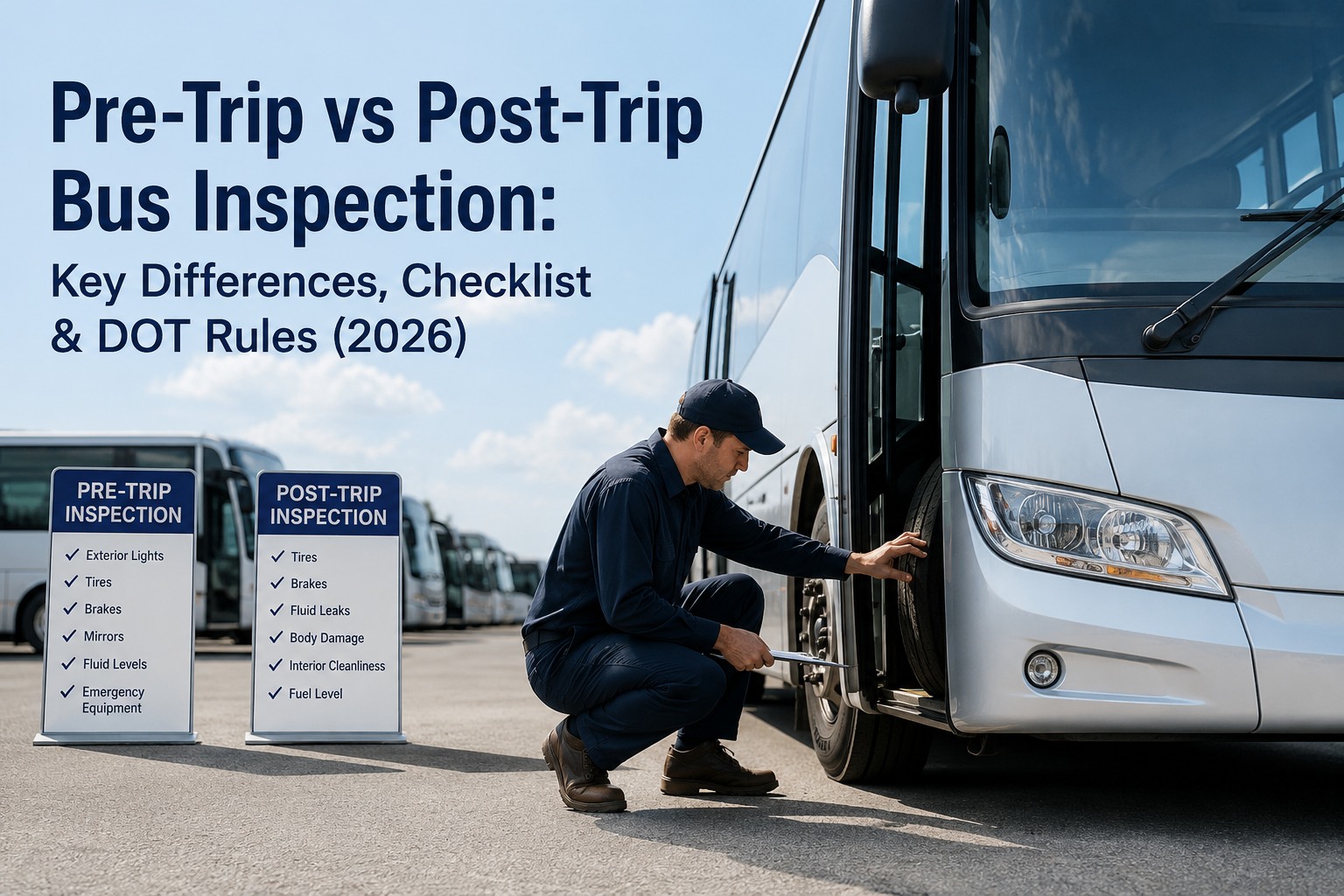
Same 11 categories, different focus. A pre-trip is verifying the bus is safe to leave the lot right now. A post-trip is documenting what happened to it over the course of the day, especially anything that changed since the morning.
Pre-Trip Focus
- Brakes, tires, and steering confirmed safe before departure
- Stop arm, crossing gate, and emergency exits cycle correctly
- Prior day's DVIR reviewed and repair acknowledgment signed
- Fluid levels, mirrors, and lights checked fresh for the day
Post-Trip Focus
- Any defect noticed during or after the day's routes
- Unusual noises, warning lights, or handling changes
- Written DVIR submitted regardless of whether anything was found
- Defects routed to maintenance for overnight repair
Skipping the "no defect" post-trip report is a common mistake -- most compliance experts strongly recommend filing one daily for every bus as standard practice, since it creates a positive compliance record auditors can actually verify. Book a demo to see no-defect DVIRs logged automatically without adding extra steps for your drivers.
The Chain That Connects Them: The 3-Signature Rule
Pre-trip and post-trip aren't two isolated events -- they're linked by a chain of custody that auditors specifically look for. Break any link, and the whole record loses credibility even if both inspections actually happened.
-
1
Driver Signs the Post-Trip DVIR
End of the day, defects documented or "no defect" noted, signed and dated.
-
2
Mechanic Certifies the Repair
If a defect was logged, a certified technician signs off that it was fixed or was not safety-affecting.
-
3
Next Driver Reviews and Signs
Before starting their pre-trip, the next driver must review the prior DVIR and acknowledge the repair status.
On paper, this chain breaks constantly -- a defect written up, the bus fixed, but nobody can prove the next driver ever saw the repair note. That single missing signature is one of the most frequently cited DVIR findings in DOT audits. Book a demo to see the 3-signature chain enforced digitally, where a driver literally can't start a pre-trip until the prior DVIR is acknowledged.
From a Transportation Director on Getting the Chain Right
"For years we treated pre-trip and post-trip like the same form filled out twice a day. It wasn't until an auditor specifically asked to see the next-driver acknowledgment signature on three random defects that I understood they're actually two different legal requirements linked by a signature chain. Two of those three had no acknowledgment on file. The buses were fine -- the drivers had all checked them -- but the paperwork couldn't prove it, and that's what the audit actually measures."
The 2026 eDVIR Rule: What Changed for Digital Records
On February 19, 2026, FMCSA published a final rule, effective March 23, 2026, explicitly adding electronic DVIR authorization to 49 CFR 396.11 and 396.13. Electronic records were technically permitted since 2018 under 49 CFR 390.32, but this rule removed any remaining ambiguity -- digital signatures, mobile submission, and cloud storage are now unambiguously compliant for all three signatures in the chain. The rule didn't change the 11-item inspection minimum or the required retention period, and it didn't reinstate skipping DVIRs on no-defect days for passenger carriers.
What it did do is remove the last excuse fleets had for staying on paper. Book a demo to see a fully 2026 eDVIR-compliant pre-trip and post-trip workflow built specifically for bus fleets, not adapted from a trucking template.
Pre-Trip vs Post-Trip: The Bottom Line
Pre-trip and post-trip bus inspections aren't the same task performed twice a day -- they're two distinct regulatory obligations connected by a signature chain that most audits check directly. Treat the pre-trip as the physical safety check it legally is, treat the post-trip DVIR as the mandatory written record it legally is, and make sure every defect that gets logged actually gets certified as repaired and acknowledged by the next driver. Get that chain right, and the paperwork stops being the thing that trips up an otherwise well-run fleet.
If your fleet's pre-trip and post-trip records currently live in two different binders -- or worse, aren't clearly linked at all -- that's the gap most DOT audits find first. Sign up free and connect your pre-trip and post-trip inspections into one auditable chain.
What is the difference between a pre-trip and post-trip bus inspection?
A pre-trip inspection under 49 CFR 392.7 is the physical act of checking the bus before driving, with no federally required paperwork. A post-trip inspection under 49 CFR 396.11 is the written DVIR a driver must prepare at the end of the day documenting any defects found. They cover the same 11 component categories but serve different regulatory purposes at different times.
Is a post-trip DVIR required if no defects are found?
Yes, for passenger-carrying vehicles like buses. Unlike property-carrying trucking fleets, which have not been required to file a no-defect DVIR since a 2014 rulemaking, bus and other passenger-carrying CMVs must file a DVIR every day regardless of whether any defects were found.
What is the 3-signature chain in bus DVIR compliance?
The chain consists of the driver signing the post-trip DVIR documenting any defects, a mechanic certifying that the defect was repaired or deemed unnecessary, and the next driver reviewing and signing acknowledgment of that repair status before their pre-trip inspection. A missing signature anywhere in this chain is one of the most commonly cited findings during DOT audits.
Are electronic DVIRs legally compliant for pre-trip and post-trip inspections?
Yes. Electronic DVIRs have been permitted under 49 CFR 390.32 since 2018, and FMCSA's final rule published February 19, 2026, effective March 23, 2026, added explicit electronic authorization directly to 49 CFR 396.11 and 396.13. Digital signatures, mobile submission, and cloud storage are all fully compliant for every signature in the chain.
How does a CMMS help manage pre-trip and post-trip inspections together?
A bus-specific CMMS links pre-trip and post-trip inspections into one digital chain, automatically presenting the prior day's DVIR for driver review before a new pre-trip can begin, routing defects to maintenance instantly, and requiring mechanic certification before a bus returns to service. This closes the signature-chain gaps that are among the most common findings in DOT compliance audits.