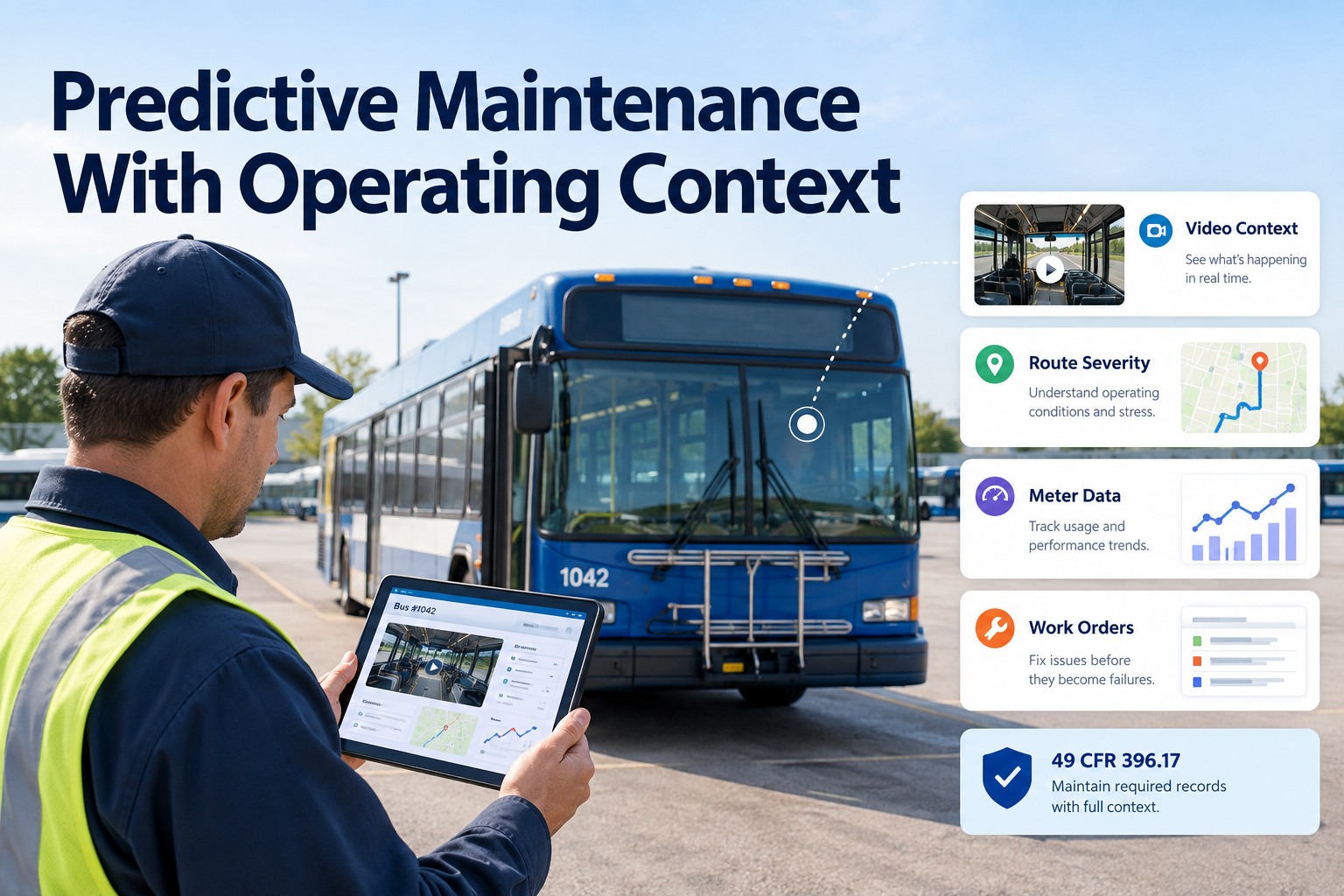
A fault code fires at 6:41 AM. On its own, it tells you almost nothing — is this the sensor drifting, or the transmission actually failing? Was the bus climbing a steep hill in stop-and-go traffic, or cruising an empty highway? Most predictive maintenance tools stop at the alert. The ones that actually change outcomes go one step further: they attach the video, the route severity, and the meter data to that alert, so a technician can look at one screen and know exactly what happened, why, and what to do about it — with a repair record that holds up under a 49 CFR 396.17 or 396.3 review.
Why a Fault Code Alone Doesn't Tell the Whole Story
Telematics can already flag a coolant fault, a brake-wear threshold, or an abnormal vibration pattern. The gap isn't detection — it's interpretation. A maintenance manager staring at a raw diagnostic trouble code has to guess whether it's urgent, whether it's driver behavior, or whether the road itself is the real culprit. That guesswork is what turns a 20-day early warning into a breakdown anyway, because nobody trusted the alert enough to act on it in time.
The Context Pipeline: From Fault to Fixed
This is what happens between a sensor noticing something and a technician closing the work order — when the system connects the dots instead of leaving your team to do it manually.
Want to see this run against your own fleet's fault history instead of a demo dataset? Book a demo and walk through a real fault-to-repair trace with our team.
Expert Review: Context-Blind Alerts vs. Context-Rich Maintenance
We compared how a typical fault alert plays out with and without operating context attached — the difference shows up in how fast a technician can trust the alert and act on it.
Staying Audit-Ready Under 49 CFR 396.17 and 396.3
Section 396.3 requires a systematic inspection, repair, and maintenance record for every vehicle you control — one that identifies the unit, the dates, and the work performed. Section 396.17 requires proof of an annual periodic inspection kept with the vehicle. Neither section cares how thorough your shop actually is if you can't produce the record on request.
When the video, the route data, and the repair sit in one linked record instead of three separate systems, an auditor's question stops being a fire drill. Sign up to start building 396.3-ready repair records automatically.
No New Hardware, Just Smarter Use of What's Already There
This isn't a rip-and-replace project. Most buses built after 2015 already carry factory telematics broadcasting the diagnostic data this depends on, and if you're already running dash or interior cameras, that footage becomes part of the same record instead of sitting on a separate server nobody checks. Connect your existing telematics and camera feeds to see it in action. The work is in linking systems that were never designed to talk to each other — not in buying more sensors.
Fleets that get this right stop treating maintenance alerts as noise to filter and start treating them as evidence to act on. The buses that break down are usually the ones where a fault sat unverified for days — not the ones where nobody had a sensor watching in the first place. Talk to our team about mapping this workflow to your current fleet and see what a linked fault-to-repair record actually looks like for your buses.
Frequently Asked Questions
What does "operating context" mean in bus predictive maintenance?
Operating context is the surrounding data that explains a fault code — the video from the moment it triggered, the severity of the route the bus was running (grade, stops, load), and the meter trend leading up to it. Without this, a maintenance team sees an isolated alert and has to reconstruct the story manually. With it, the story is already attached to the work order.
Do we need new hardware to connect video and telematics to a CMMS?
Usually not. Most buses built after 2015 already have factory telematics broadcasting usable diagnostic data, and if dash or interior cameras are already installed, that footage can be linked into the same maintenance record. The integration work is in connecting existing systems, not installing new sensors.
How does this help with 49 CFR 396.17 and 396.3 compliance?
Section 396.3 requires a systematic record of inspection, repair, and maintenance for every vehicle, including dates and a description of the work performed. Section 396.17 requires proof of an annual periodic inspection. When video and route data are linked directly to the repair record at the time of the event, that documentation builds itself instead of being reconstructed under audit pressure.
How fast do fleets see results from context-linked predictive maintenance?
Most bus fleets see a measurable difference within the first few months, since the first prevented breakdown or avoided missed route often covers the cost of getting the system running. The bigger shift is qualitative — technicians stop treating alerts as noise and start trusting them enough to act early.
Can this work alongside our existing telematics or camera provider?
Yes. Rather than replacing your telematics or camera system, BusCMMS is built to sit on top of them — pulling fault data, video, and route information into one linked work order and repair record, so your existing hardware investment does more work instead of sitting in separate dashboards.