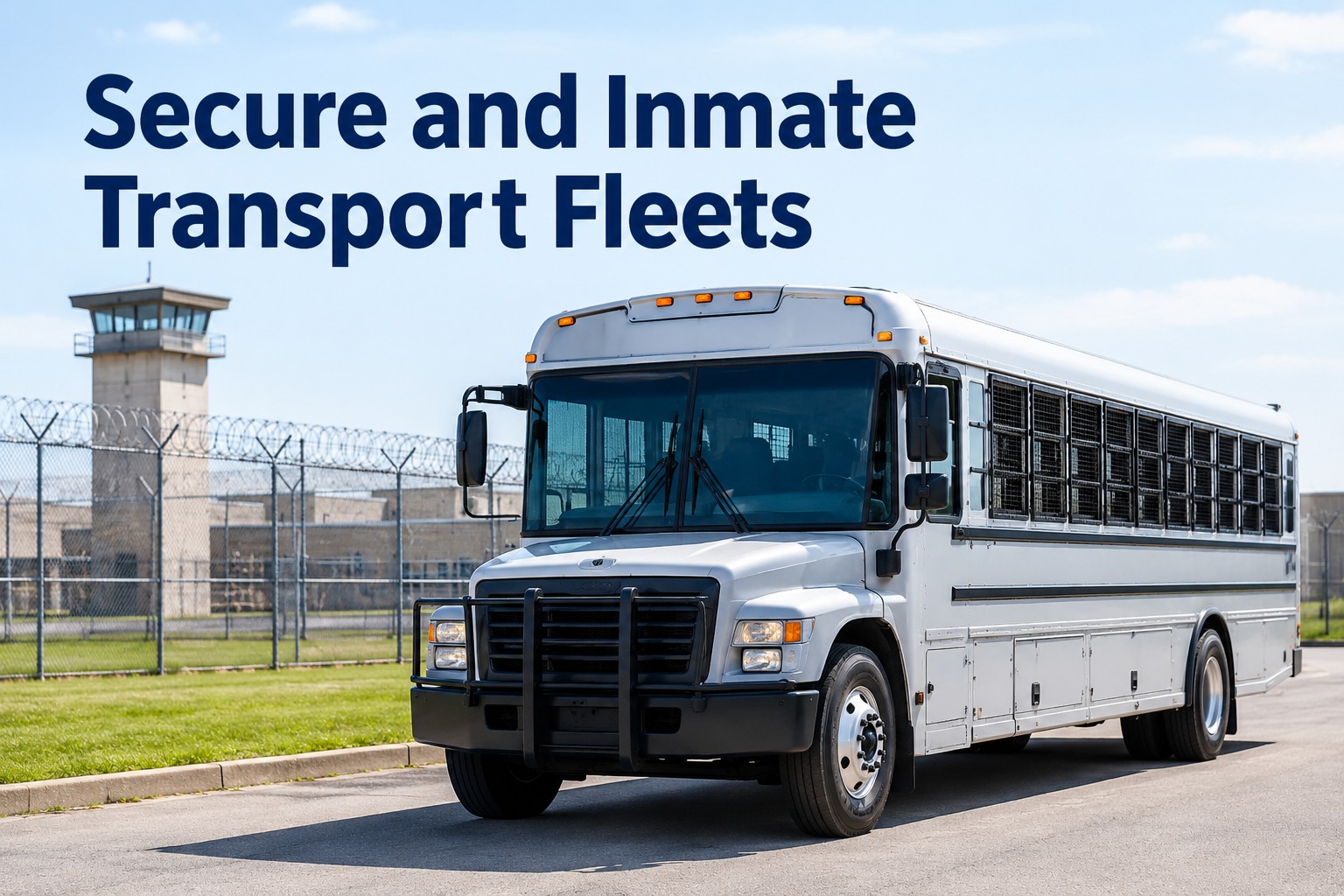
An inmate transport vehicle isn't just a bus with a different paint scheme — it's a rolling secure environment where a failed door latch, a dead camera, or a missed partition inspection isn't a maintenance ticket, it's a security incident. Managing a secure transport fleet means keeping the vehicle mechanically sound and its security-critical equipment verified, documented, and audit-ready every single day. This page covers how that gets done in one system instead of a drawer of spreadsheets.
Secure and Inmate Transport Fleets
Inspections, maintenance records, camera evidence, and contract compliance for correctional transport — managed in one platform
- SecureEquipment verified
- ChainOf custody on evidence
- ContractCompliance, documented
- Secure fittingsDoors, latches, partitions
- Mechanical PMBrakes, tires, drivetrain
- Cameras & commsRecording, GPS, radio
- Records clearNo open defect, docs current
What an Inmate Transport Vehicle Fleet Actually Requires
An inmate transport vehicle is a purpose-configured secure vehicle — commonly a transport bus, a converted van, or a specialized secure coach — built to move people in custody safely between facilities, courts, and medical appointments. Managing a fleet of them means two jobs at once: keeping each vehicle mechanically reliable like any bus, and keeping its security-critical equipment verified like a piece of correctional infrastructure. Both have to be true before the vehicle rolls.
That dual requirement is what sets secure transport apart. A standard bus that's mechanically sound is ready to go. A secure transport vehicle that's mechanically sound but has a partition mount working loose or a rear camera that isn't recording is not ready — it's a liability on the road. The management challenge is holding both the mechanical and the security picture in one place, so nobody signs off a vehicle as fit for service when half the story is missing. You can book a walkthrough to see secure inspections, maintenance, and vehicle evidence in one system.
The Security-Critical Equipment That Has to Be Verified
Beyond the usual brakes-and-tires checklist, a secure transport vehicle carries equipment whose failure has consequences a normal bus never faces. Each of these needs a documented inspection status, not a mechanic's memory.
Secure doors & latches
Locking mechanisms, hinges, and latch integrity — the primary containment barrier. A sticky or worn latch is a security defect, not a nuisance.
Partitions & compartments
Cage walls, secure compartments, and mounts. Inspected for structural integrity, secure fastening, and no tampering or damage.
Restraint points
Where applicable, anchor points and securing hardware are checked for wear and secure attachment per the operation's protocols.
Cameras
Interior and exterior cameras verified as recording and storing correctly — the evidence record depends on them actually working.
GPS & tracking
Location and route tracking confirmed operational, so a transport is monitored end to end and its path is on the record.
Communications
Radios and comms equipment tested, so a crew is never out of contact during a run — a safety requirement, not a convenience.
The common thread: every one of these has a pass/fail status that belongs on the vehicle's record, tied to a date, an inspector, and — where useful — a photo. When a partition mount or a camera fails, that's a documented defect that pulls the vehicle from service until it's repaired, not a note that lives in someone's head until the next audit. Getting that discipline into one system is exactly what starting free with a mobile inspection workflow is for.
Inspecting Secure Equipment Without Disrupting Operations
Here's the operational tension unique to secure transport: the vehicles are often in demand, on tight court and facility schedules, and you can't just pull one out of rotation for a leisurely inspection. Yet the security equipment absolutely must be checked. The answer is a fast, mobile, documented inspection that a technician can complete at the vehicle — not a paper form that gets filled in later from memory.
- 1
Inspect at the vehicle, on mobile
A technician runs a structured secure-vehicle checklist on a phone or tablet — mechanical items plus every security-critical fitting — right at the vehicle, offline if needed.
- 2
Document the defect with a photo
A failed latch or a cracked partition mount is logged as a defect with a photo attached, timestamped and tied to the vehicle — objective, not a vague note.
- 3
Escalate and pull from service
A security-critical defect flags the vehicle as not fit for service and escalates to the right person immediately — before it can be dispatched by mistake.
- 4
Repair, verify, return
A work order tracks the fix; the vehicle only returns to service once the repair is verified and the defect closed — with the whole history on its record.
That loop — inspect, document, escalate, repair, verify — is what keeps a security defect from ever reaching a live transport. The key is speed and structure: the inspection is quick enough not to strand a vehicle needed for a court run, but rigorous enough that nothing security-critical gets waved through. When a defect is genuinely serious, the vehicle stays out of service until it's cleared, full stop. That non-negotiable gate is easier to enforce when it's built into the system rather than left to judgment under schedule pressure. You can book a demo to see the defect-to-repair gate in action.
Camera Evidence: Access, Retention, and Chain of Custody
In secure transport, camera footage isn't just operational — it can be evidence. That raises the bar on how it's handled. Who can view a clip, how long it's kept, and whether its handling can be accounted for all matter in a way they don't for an ordinary bus. Sloppy footage handling can undermine an otherwise solid case, so this deserves deliberate policy, not defaults.
Access controls
Not everyone should be able to pull footage. Role-based access limits who can view or export a clip, with a record of who did — the foundation of accountable handling.
Retention policy
Footage is kept for a defined window and preserved when flagged for an incident, so an evidence clip isn't lost to a routine overwrite before it's needed.
Chain of custody
A clear record of a clip's handling — when it was captured, preserved, accessed, and by whom — supports its integrity if it's ever relied upon.
Recording & privacy rules
Recording and privacy requirements vary by state and locality — including rules on audio — so confirm your own jurisdiction's rules rather than assuming one policy fits everywhere.
The practical goal is that when a clip is tied to a specific vehicle, run, and time — and its access and retention are recorded — the footage stays trustworthy and defensible. There is no single federal rule that governs every secure-transport recording setup, and requirements differ by jurisdiction, so the safe approach is to set access, retention, and handling as deliberate written policy and let the system enforce it. A platform that keeps footage tied to the vehicle record with access logging makes that far simpler than a shared drive of loose clips.
Contract Compliance Without the Spreadsheet Sprawl
Many secure transport operations run under a contract — with a county, a state agency, or as a private contractor — and that contract usually specifies inspection schedules, maintenance standards, vehicle availability, and driver requirements. The failure mode is predictable: those obligations end up scattered across separate spreadsheets, and proving compliance at renewal or audit becomes a frantic archaeology project.
Inspection schedules
Contract-required inspections tracked with due dates and completion status, so nothing lapses unnoticed.
Vehicle availability
A live view of which vehicles are fit for service against the availability the contract requires.
Driver checks
Driver qualification and check records kept alongside the vehicles, so the people side of compliance is covered too.
Maintenance records
A complete, timestamped maintenance history per vehicle — the evidence that proves the standard was met.
When all of this lives in one system, compliance stops being a scramble and becomes a report you can pull on demand. Instead of assembling proof from four spreadsheets and a shared inbox the week before a review, you show a continuous, timestamped record that the contract terms were met all along. That's not just less painful — it's the difference between renewing a contract confidently and hoping the gaps don't get noticed. You can book a demo to see contract compliance managed from one record.
Why Generic Fleet Software Falls Short Here
The instinct is to reach for whatever general fleet or trucking software is around. It fails secure transport for a specific reason: it has no concept of the workflows and equipment that define the operation.
No security-equipment inspections. Generic tools track oil and tires, not latch integrity, partition mounts, or camera-recording verification.
No fit-for-service gate. Nothing links a security-critical defect to an automatic hold that keeps the vehicle off a live run until it's cleared.
No evidence handling. No access controls, retention, or handling record for footage that may become evidence — just loose clips.
No contract-compliance view. No way to prove inspection schedules, availability, and maintenance standards were continuously met.
The fix isn't a generic tool with a custom field or two — it's a platform whose inspections, defect handling, evidence, and records are built for the way a secure fleet actually operates. That combination of bus-grade maintenance and secure-transport discipline is what closes the gaps generic software leaves wide open. You can start free with a platform built for real fleet operations, not a trucking tool stretched to fit.
A Practical Scenario: A Failed Latch Before a Court Run
Here's how the whole system earns its place on a morning when a security defect turns up right before a scheduled transport.
A technician runs the pre-service check on Vehicle #7, due for an 8:00 court transport. On mobile, the secure-door latch fails inspection — it's not seating fully.
The defect is logged with a photo, timestamped to Vehicle #7. The system flags it security-critical, marks the vehicle not fit for service, and escalates to the transport supervisor.
The supervisor reassigns the 8:00 run to Vehicle #12, which is verified fit for service, and a work order for #7's latch goes to the shop as priority.
#7's latch is repaired, the fix verified, and the defect closed on its record. The whole sequence — defect, photo, hold, repair, clearance — is documented for the contract file.
That's the point of the system: a security defect surfaced at 6:40 became a safe reassignment and a documented repair, and no vehicle with a compromised latch ever went on a transport. At an operation running paper checklists and separate spreadsheets, that same latch might get noted, forgotten under schedule pressure, and discovered only when it matters most. The difference is a fit-for-service gate that can't be skipped. You can book a walkthrough to see this workflow on your own fleet.
Key Secure-Transport Workflows at a Glance
A quick side-by-side of how these workflows run on disconnected tools versus one platform.
| Security equipment | Checked ad hoc, noted on paper → structured inspection with pass/fail per item |
|---|---|
| A security defect | Might be missed under time pressure → auto-holds the vehicle from service |
| Evidence footage | Loose clips on a shared drive → access-controlled, retained, handling recorded |
| Contract proof | Assembled in a pre-audit scramble → continuous, timestamped, pull on demand |
| Vehicle readiness | Assumed if it runs → verified across mechanical and security items |
| Records | Scattered across spreadsheets → one timestamped history per vehicle |
Where BusCMMS Fits — and Getting Started
Standing up secure-transport management well comes down to a few implementation considerations: build inspection checklists that cover both mechanical and security-critical items, set the fit-for-service gate so a serious defect always holds the vehicle, define evidence access and retention as written policy, and keep contract requirements in the same system as the records that prove them.
That's the role BusCMMS plays. BusCMMS is the AI-native, mobile-first fleet operations platform for inspections, maintenance records, photos, video clips, work orders, and vehicle readiness — applied to the specific demands of secure transport. Security-critical items get inspected and documented, a serious defect holds the vehicle until it's cleared, camera evidence stays tied to the vehicle with access and retention controls, and contract compliance is a continuous record rather than a scramble. No single federal mandate universally governs how a secure transport fleet is managed; this is about running the operation safely, accountably, and audit-ready. If you'd like to see it on your own operation, book a BusCMMS walkthrough to see secure transport inspections, maintenance, and vehicle evidence managed in one system.
What is an inmate transport vehicle?
An inmate transport vehicle is a purpose-configured secure vehicle — commonly a transport bus, a converted van, or a specialized secure coach — used to move people in custody safely between facilities, courts, and appointments. Beyond a standard vehicle's mechanical systems, it carries security-critical equipment such as secure doors and latches, partitions or compartments, restraint points where applicable, cameras, GPS, and communications equipment. Managing a fleet of them means keeping both the mechanical systems and the security equipment verified and documented before a vehicle returns to service.
How do you inspect secure equipment without pulling vehicles out of service?
The practical approach is a fast, mobile, documented inspection completed right at the vehicle rather than on a paper form filled in later. A technician runs a structured checklist on a phone or tablet covering mechanical items plus every security-critical fitting, logs any defect with a photo, and the system escalates a serious defect and flags the vehicle not fit for service. The inspection is quick enough not to strand a vehicle needed for a scheduled run, but rigorous enough that nothing security-critical gets waved through, and a serious defect keeps the vehicle out of service until it is repaired and verified.
How should camera footage be handled in secure transport?
Because footage can become evidence, it needs deliberate handling: role-based access controls so only authorized people can view or export a clip with a record of who did, a defined retention policy that preserves flagged footage before a routine overwrite, and a clear record of a clip's handling to support its integrity if it is relied upon. Recording and privacy requirements, including rules on audio, vary by state and locality, so confirm your own jurisdiction's rules rather than assuming one policy fits everywhere. There is no single federal rule governing every secure-transport recording setup, so set access, retention, and handling as written policy and let the system enforce it.
Can generic fleet software manage a secure transport fleet?
Usually not well. Generic fleet or trucking software typically tracks oil and tires but has no concept of security-equipment inspections like latch integrity, partition mounts, or camera-recording verification, no fit-for-service gate that automatically holds a vehicle with a security-critical defect, no evidence-handling controls for footage, and no way to prove contract compliance continuously. Secure transport needs a platform whose inspections, defect handling, evidence, and records are built for how the operation actually runs, rather than a general tool stretched to fit with a couple of custom fields.
How does one system help with contract compliance?
Secure transport operations often run under a contract that specifies inspection schedules, maintenance standards, vehicle availability, and driver requirements. When those obligations live in separate spreadsheets, proving compliance at renewal or audit becomes a scramble. Keeping inspection schedules, vehicle availability, driver checks, and maintenance records in one system turns compliance into a report you can pull on demand: instead of assembling proof from scattered sources before a review, you show a continuous, timestamped record that the contract terms were met all along.