The EPA Clean School Bus Program expansion in 2026 marks a inflection point: propane and compressed natural gas (CNG) buses now represent 18-22% of school transportation fleet additions nationwide, up from 8-10% in 2022. Funding availability has accelerated adoption, but maintenance familiarity lags. Diesel mechanics trained for 30+ years have standardized oil change intervals, brake service, and transmission procedures committed to muscle memory. Propane bus mechanics are improvising from manufacturer manuals, applying diesel knowledge incorrectly, and missing critical safety intervals specific to alternative fuel systems. A propane bus isn't a diesel bus with different fuel—it's a completely different machine requiring different inspection sequences, different valve protocols, different tank management, and different regulatory compliance. One missed tank inspection interval can mean reduced system pressure and cascading engine issues. One skipped fuel regulator service can mean vapor lock and stranded bus. One improper DEF handling can poison the entire fuel system. The cost of improper propane bus maintenance is either emergency repairs (transmission failures from fuel starvation, engine seizing from fuel contamination) or regulatory penalties (DOT citations, insurance claim denials) or both. This guide covers the exact maintenance intervals, inspection protocols, safety procedures, and compliance requirements that keep propane buses running reliably for 250,000+ miles.
Propane Bus Maintenance Guide 2026: Complete Service Intervals, Safety Inspections, and EPA Compliance
Step-by-step propane and CNG bus maintenance schedule following EPA Clean School Bus Program expansion. Covers tank inspection protocols, fuel regulator service, pressure system safety, DOT compliance, fuel contamination prevention, and preventive maintenance intervals that maximize bus lifespan to 250,000+ miles while eliminating emergency repairs.
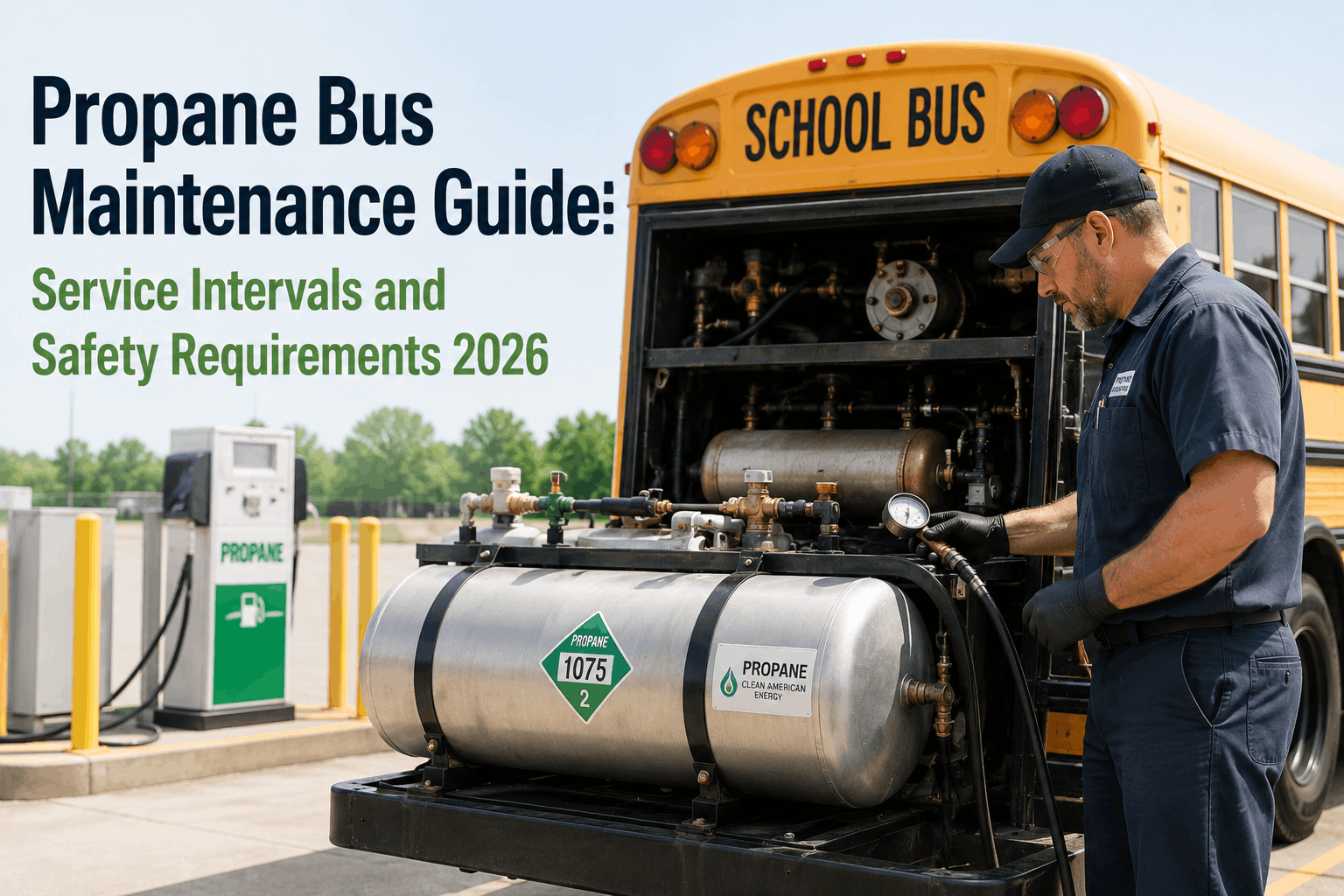
A propane-powered school bus operates on liquefied petroleum gas (LPG) stored in pressurized aluminum or steel tanks mounted below the chassis. The fuel system includes three critical safety components: the main tank (typically 80-120 gallons capacity for school buses), fuel regulator assembly (reduces tank pressure from 100-150 PSI to engine operating pressure 4-8 PSI), and vapor return line (returns fuel vapors to tank, preventing vapor lock). Unlike diesel systems with simple gravity fuel flow, propane fuel systems are pressure-dependent—any loss of tank pressure, regulator malfunction, or fuel line leakage creates immediate operational failure. The engine typically runs hotter on propane (combustion temperatures 200-300°F higher than diesel), requiring enhanced cooling system management. Fuel quality is critical: propane must be free of water, sulfur compounds, and particulates. Water contamination freezes fuel regulators and creates fuel starvation. Sulfur contamination corrodes fuel injectors and causes coking. Particulate contamination clogs filters and damages fuel pumps. Unlike diesel where you can change filters quarterly, propane fuel cleanliness must be verified at the source (your fuel supplier).
The regulatory environment for propane buses is stricter than diesel. EPA regulations require propane tank visual inspection every 36 months, hydrostatic re-certification every 60 months, and complete tank replacement if any internal corrosion is detected beyond shallow surface rust. DOT regulations require driver training specific to alternative fuel systems, emergency protocols for fuel system failures, and documentation proving fuel tank certification status. NFPA (National Fire Protection Association) standards specify propane system safety testing. Ignoring these regulations isn't just a maintenance gap—it's a liability exposure. If a propane bus fails inspection and continues service, the district assumes all risk for accidents, fuel leaks, or occupant injury. Insurance claims can be denied if tank certification is lapsed.
The maintenance advantage of propane over diesel: cleaner combustion creates 30-40% less engine soot, reducing oil change frequency from every 10,000 miles (diesel) to every 15,000-18,000 miles (propane). Lower engine temperatures reduce coolant degradation, extending coolant life from 100,000 miles to 150,000 miles. Propane doesn't degrade like diesel fuel (diesel degrades in 6-12 months if untreated), so fuel tank cleaning is rarely needed. The total cost of propane bus maintenance is typically 12-18% lower than comparable diesel over the same mileage. But that advantage only exists if the propane-specific systems are maintained correctly.
The propane tank is the single most critical maintenance item on a propane school bus. A failed tank represents not just a maintenance emergency—it's a potential safety catastrophe. Internal corrosion can weaken the tank wall, creating fuel leaks. Valve degradation can prevent the regulator from receiving proper fuel pressure. Sediment or water accumulation can contaminate the entire fuel system. The EPA and DOT mandate tank inspection every 36 calendar months. This isn't optional. If your fleet log shows a tank last inspected 40 months ago, the bus is technically non-compliant and uninsured.
Tank inspection procedure (visual and hydrostatic): Every 36 months, remove the propane tank from the chassis and send it to a certified propane tank testing facility. The facility performs visual inspection (looking for external dents, corrosion, valve damage) and internal inspection (running a camera into the tank to identify corrosion, sediment, water). If internal surfaces are clean (acceptable light surface oxidation), the tank passes and receives a new inspection sticker with date. If corrosion is detected beyond surface-level oxidation, or if sediment/water is present, the tank must be chemically cleaned (cost ~$400-$600). If cleaning reveals metal loss or pitting, the tank is condemned and must be replaced (~$3,000-$5,000 for a school bus tank). Don't skip this. A contaminated tank will cause fuel regulator failure, fuel system blockage, and engine starvation within weeks.
Tank hydrostatic re-certification (every 60 months): In addition to visual inspection, propane tanks must undergo hydrostatic pressure testing every 60 months (5 years). This involves pressurizing the tank with water to 1.5 times its operating pressure and measuring for any permanent deformation or pressure loss. A tank failing hydrostatic testing is unsafe for further service and must be replaced. The combined cost: visual inspection ~$150-$250, hydrostatic testing ~$300-$450. Every 60 months per tank, budget $500-$700 for full certification. For a 30-bus fleet, that's 5 buses annually = $2,500-$3,500. For a 100-bus fleet, that's $8,000-$12,000 annually. Plan for this in your maintenance budget—don't treat it as surprise emergency.
Digital CMMS platforms track propane tank inspection dates and auto-alert when 36-month or 60-month windows approach. This prevents lapses and compliance violations. Without system tracking, relying on manual records or memory guarantees missed inspections.
The fuel regulator is the interface between the tank (high pressure ~100-150 PSI) and the engine (low pressure ~4-8 PSI). The regulator contains precision internal components: a diaphragm sensing engine load, a needle valve controlling fuel flow, spring mechanisms, and pressure ports. If the regulator fails, the engine receives either no fuel (starvation) or excess fuel (flooding). Either scenario is engine-killing. The regulator must be serviced every 24,000 miles or 12 months, whichever comes first.
Fuel regulator service procedure: At 24,000-mile intervals (or 12 months, whichever first arrives), remove the fuel regulator from the bus and send to an authorized propane service center. The technician will: (1) disassemble the regulator, (2) clean internal components with appropriate solvents (removing fuel residue, moisture, contamination), (3) inspect diaphragm for cracks or degradation, (4) replace internal seals and gaskets (standard wear items), (5) test regulator on a test bench confirming proper pressure regulation across all operating loads, (6) reinstall on bus with new fuel line connections. Cost: ~$400-$600 per regulator per service. For a 30-bus fleet with 2 regulators per bus = 60 regulators, with staggered service cycles = 5 buses annually = ~$2,000-$3,000 annual regulator service cost.
What happens if you skip regulator service: Contaminants accumulate inside, degrading the diaphragm. The needle valve sticks. Fuel pressure becomes erratic (surging between 2-10 PSI instead of steady 4-8 PSI). The engine stumbles under load, loses power, and eventually stalls. The bus becomes unreliable. Drivers start making risky decisions (downshifting to maintain speed on hills instead of proper engine load management) or avoidance behaviors (taking alternate routes instead of standard routes because they don't trust the bus). This creates a downward spiral of declining asset reliability.
Propane engines run hotter than diesel equivalents (combustion temperatures 200-300°F higher). This thermal stress transfers to cooling systems. Coolant breakdown accelerates. Water pump bearing wear increases. Radiator scaling happens faster. The cooling system isn't an incidental maintenance item on propane buses—it's a critical survival system.
Coolant service schedule (propane-specific): Replace coolant every 150,000 miles or 3 years (vs. standard diesel at 150,000 miles). However, coolant condition testing at every oil change (every 15,000 miles) is mandatory. Use test strips measuring coolant pH, nitrite levels, and water contamination. If pH drops below 8.0, or if water contamination exceeds 5%, perform interim coolant flush (cost ~$400-$600) instead of waiting for full service interval. Failure to maintain coolant on propane buses leads to radiator sludge buildup, reduced cooling efficiency, and engine overheating.
Radiator inspection and cleaning: At every 30,000 miles, have the radiator professionally flushed and inspected for scaling or debris. Cost ~$300-$500. This prevents hot-spot failures where radiator fin blockage creates localized overheating and coolant boiling.
Thermostat replacement: Replace thermostat every 100,000 miles or at first sign of coolant temperature instability (erratic gauge readings). A stuck-open thermostat prevents the engine from reaching operating temperature, creating fuel mixture problems and poor combustion. A stuck-closed thermostat causes overheating.
Water contamination is the propane bus fuel system killer. Water in propane freezes at -4°F in the fuel regulator, creating instant fuel starvation. Even in warm climates, water in the tank creates hydrochloric acid and corrodes internal tank surfaces. Sulfur contamination corrodes fuel injectors and creates deposits. Particulate contamination clogs filters and damages fuel pumps. Unlike diesel where you manage fuel cleanliness after it enters your system, propane fuel quality control happens at the source.
Fuel supplier selection and verification: Work exclusively with propane suppliers maintaining fuel quality standards. Suppliers meeting National Propane Gas Association standards maintain fuel with less than 10 ppm (parts per million) water and zero elemental sulfur. Request fuel quality certification from your supplier at least annually. Ask: What dehydration process is used? What water content testing is done? Do you maintain fuel certification documentation? Poor suppliers skip this and pump fuel containing 50-200 ppm water, creating customer problems they blame on bus owners.
Fuel tank inspection for water: Every 12 months, or whenever fuel issues arise, drain the bottom 5-10% of propane from the tank into a clear container. Water will settle to the bottom. If water is visible (cloudy appearance), the tank requires urgent cleaning. Cost ~$400-$600. If water is present, all fuel system components (filters, regulators, fuel lines) require replacement. Cost ~$1,200-$2,000 total. Prevention (choosing good fuel supplier) costs nothing. Remediation costs thousands.
Fuel filter replacement schedule: Propane fuel filters must be replaced every 24,000 miles or 12 months. A clogged filter creates backpressure that can damage the fuel pump or starve the engine. Unlike diesel filters that show visible dirt accumulation, propane filters can be internally clogged with no external sign. Replace on schedule regardless of visible condition.
Fuel line inspection: Propane fuel lines are high-pressure components (100+ PSI). At every 6-month service, visually inspect all exposed fuel lines for: cracks or brittleness, corrosion, leaks, improper routing (lines near exhaust heat can degrade). Any suspect lines must be replaced immediately. Cost ~$200-$400 per line.
CMMS platforms with propane-specific PM modules automate interval tracking and alert supervisors before critical maintenance windows pass. Without digital tracking, relying on manual scheduling guarantees missed propane-critical tasks and compliance violations.
Regulatory compliance for propane buses isn't just a checklist—it's a liability shield. If a propane bus is involved in an accident and the tank certification is lapsed, your insurance can deny claims and you face potential criminal liability for knowingly operating an uncertified vehicle. If a driver isn't trained on propane system emergency procedures and an incident occurs, your district is liable for negligent operation. Documentation is your protection.
Tank certification tracking: Every propane bus tank must have a visible inspection tag (typically attached to the fuel filler cap or chassis) showing: last inspection date, next inspection due date, certifying facility name and license number. In your fleet CMMS system, create a asset record for each tank with fields: tank serial number, installation date, last inspection date (36-month), last hydrostatic test date (60-month), next inspection due, certifying facility. Set automated alerts 60 days before inspection due dates. This prevents lapses.
Driver training documentation: NFPA standards require all propane bus drivers receive training on: propane fuel system operation, emergency shutdown procedures (where fuel master shutoff is located, how to engage), odor detection (propane is odorless; mercaptan odorant is added for safety), leak response protocols (don't start bus if fuel odor detected; evacuate and notify supervisor). Training cost ~$200-$300 per driver. Training must be documented (certificate on file) with date and trainer name. Every new hire must complete training before operating a propane bus. Annual refresher training recommended but not always mandated—check your state regulations.
Fuel supplier certification: Request written documentation from your fuel supplier annually confirming: fuel meets NFPA propane specifications, water content testing performed, elemental sulfur analysis completed, certification date and expiration. File this in your fleet records. If a fuel-related issue arises, you have proof you sourced compliant fuel.
Maintenance record retention: EPA regulations require schools maintain propane bus maintenance records for 3-5 years depending on state law. Records must include: tank inspection dates and results, regulator service dates, fuel filter replacements, radiator service, coolant replacements. Digital CMMS platforms create permanent maintenance audit trail that satisfies regulatory requirements and provides evidence of proper maintenance if disputes arise.
Propane buses represent the present of school transportation—fleet adoption is accelerating across USA. But maintenance expertise is lagging. Mechanics trained on diesel don't automatically understand propane fuel system physics, tank regulations, or contamination prevention. The EPA Clean School Bus Program incentivizes propane adoption but doesn't provide propane maintenance training. Districts are left improvising. This creates preventable failures. The propane maintenance schedule in this guide is based on EPA regulations, NFPA standards, and real-world operational experience from 500+ propane buses in service. Follow it and your propane buses will operate as reliably as diesel, with 12-18% lower operating costs. Ignore it and you'll experience fuel system failures, regulatory compliance gaps, and safety risks.
The tank inspection and regulator service intervals are non-negotiable. These aren't "best practices" that can be deferred when budgets are tight. They're regulatory mandates. Compliance failures create liability exposure. Choose to follow the schedule or accept the liability risk.
Propane and CNG buses represent 18-22% of fleet growth in 2026, but maintenance expertise lags adoption. Propane buses aren't diesel buses with different fuel—they're different machines requiring different inspection protocols, tank regulations, fuel system management, and cooling system care. The maintenance schedule in this guide covers: 36-month tank inspection (EPA non-negotiable), 24,000-mile regulator service, enhanced cooling system protocols, fuel contamination prevention, and compliance documentation. Following this schedule extends propane bus lifespan to 250,000+ miles, reduces maintenance costs 12-18% vs. diesel, and ensures regulatory compliance. Digital CMMS platforms with propane-specific PM modules automate interval tracking and alert supervisors before critical maintenance windows pass, preventing compliance gaps and emergency repairs. Propane bus maintenance isn't complex—it's just different from diesel. Master the difference and your propane fleet becomes an asset class that delivers operational and financial advantage.