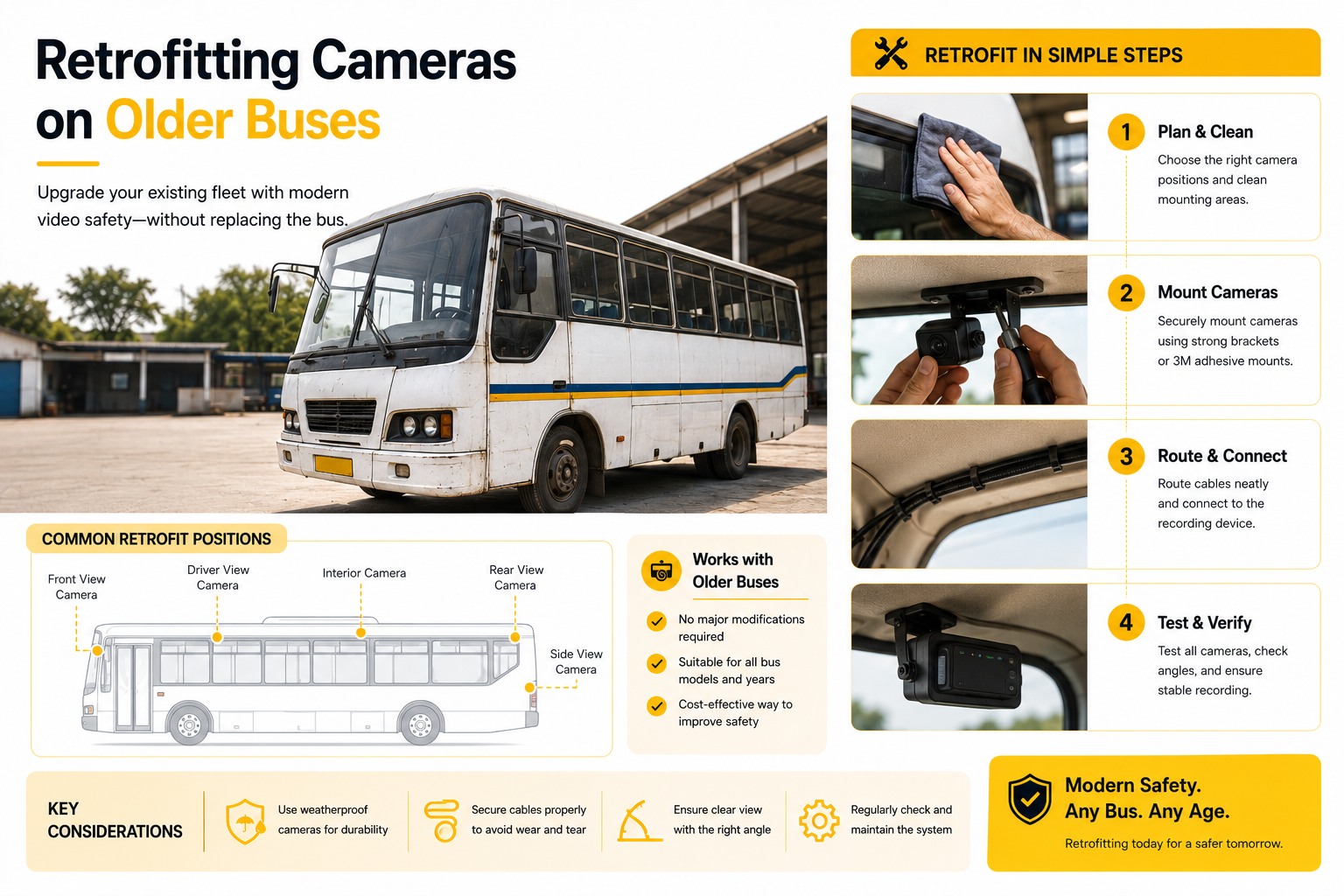
Not every bus in a mixed-age fleet is worth retrofitting with a camera system — a unit with two years of remaining service life competing for the same install slot as a unit with eight years left is a straightforward budget question once you frame it that way. Retrofitting cameras on older buses comes down to three decisions: which buses qualify given remaining life, how the wiring differs on a pre-multiplex chassis, and when in the year the work actually gets done without pulling buses off active routes. Start a free BusCMMS trial and connect your first bus.
Retrofitting Cameras on Older Buses
How to assess a mixed-age fleet, what changes on a pre-multiplex chassis, and staging the work around the one window in the year when buses aren't running routes.
About 480,000 yellow school buses carry roughly 26 million students every school day and cover some 4.4 billion miles a year — the largest passenger fleet in the United States (School Transportation News safety resources, retrieved Aug 2026). A meaningful share of that fleet is older, pre-multiplex hardware where a retrofit decision isn't automatic.
Assessing a Mixed-Age Fleet Before Committing Budget
Not every bus qualifies for the same retrofit priority.
49 CFR 396.17, the periodic/annual inspection requirement, and 49 CFR 396.3, covering systematic inspection, repair, and maintenance records, both require documented upkeep regardless of a bus's age — which means every bus in the fleet already generates a maintenance record that can inform a retrofit decision. The most useful input from that record isn't the bus's calendar age, it's its remaining service life relative to your fleet's typical replacement cycle. A bus with two years of expected service left competing for the same camera install budget as a bus with eight years left is a straightforward comparison once framed around remaining value rather than sentiment about "the older buses need it most."
Wiring on a Pre-Multiplex Chassis
Older buses often lack the shared data bus that makes a modern install straightforward.
Newer buses typically run a multiplexed electrical architecture, where a shared data bus carries signals for multiple systems over a common set of wires, simplifying how a new camera system taps into power and trigger signals like reverse gear. Older, pre-multiplex buses generally rely on point-to-point wiring, where each system has its own dedicated circuit run from source to destination with no shared bus to tap into. Retrofitting a camera system on this kind of chassis means running dedicated new harness lines rather than connecting into an existing shared architecture, which takes longer per bus and requires a technician familiar with the specific point-to-point layout of that platform rather than a generic multiplex-era install guide.
Staging Retrofits Around the Summer Maintenance Window
The one stretch of the year when a bus isn't needed on an active route.
Retrofitting a fleet during the school year means pulling buses off active routes one at a time, which strains route coverage and substitute planning. The summer maintenance window — when route demand drops significantly — is the natural staging period for retrofit work, but it's also when every other deferred maintenance item competes for the same shop capacity and technician hours. A retrofit plan that doesn't get scheduled and budgeted well before summer starts often loses out to more urgent mechanical work once the window actually opens, meaning the camera rollout slips another full year. Prioritizing which buses get retrofitted first — based on the remaining-life assessment above — matters specifically because summer capacity is limited and not every bus will get done in one pass.
The Failure That Shows Up After the Retrofit Is Complete
A retrofit that isn't health-monitored can quietly fail on exactly the older bus most likely to have wiring issues.
Here's the objection worth naming directly: cameras get retrofitted onto older buses and, without ongoing health monitoring, nobody knows whether a point-to-point harness connection has come loose from the same vibration and age-related wear affecting the rest of that bus's electrical system. On a fleet relying on manual spot-checks rather than continuous monitoring, it's common to find a meaningful share of retrofitted units with a degraded or non-functional camera at any given time — and older buses, with more wear across their entire electrical system, are statistically more likely to develop this kind of intermittent connection issue than newer units. The gap typically surfaces during an incident review, which is the worst possible time to discover a retrofit that stopped working months earlier.
A Scenario From a Real Bus Operation
A retrofit plan that avoided wasting budget on buses about to be replaced.
A district running 60 buses, including 22 units over ten years old, initially planned to retrofit cameras across the entire older segment during a single summer window. Running remaining-life assessment against each bus's individual maintenance record and planned replacement schedule showed that 7 of those 22 buses were already slated for replacement within the following two years — camera budget spent on those units would largely be wasted. The district retrofitted the remaining 15 older buses with longer remaining service life, reallocating the budget originally planned for the 7 soon-to-be-replaced units toward extending coverage further into the fleet's mid-age segment instead, getting more total years of camera coverage from the same overall spend.
We almost retrofitted seven buses that were already on the replacement list for the following two budget cycles. Once we actually cross-referenced retrofit candidates against the replacement schedule, it was obvious we were about to waste real money on units that wouldn't be around long enough to pay that investment back. Now remaining life is the very first filter before a bus even gets considered for retrofit.
Not sure which of your older buses are actually worth retrofitting? That's a remaining-life calculation worth running before summer scheduling starts. Talk to the team about a retrofit assessment →
Quick Spec Reference
Scannable on a phone during a planning meeting.
| Factor | What to check |
|---|---|
| Remaining service life | Prioritize buses with 3+ years remaining before planned replacement |
| Chassis architecture | Confirm multiplex vs point-to-point wiring before quoting labor time |
| Maintenance records | Cross-reference 396.17/396.3 inspection history for existing electrical issues |
| Scheduling window | Book summer capacity early — it fills with deferred mechanical work fast |
| Health monitoring | Automated alerts post-retrofit, especially critical on older wiring |
| Budget allocation | Skip units already slated for near-term replacement |
Frequently Asked Questions
How do I decide which older buses are worth retrofitting with cameras?
The most useful factor is remaining service life relative to your fleet's replacement cycle, not calendar age alone. A bus with only a year or two of expected service left competing for retrofit budget against a bus with several years remaining is a straightforward comparison once framed around remaining value. Cross-referencing retrofit candidates against your replacement schedule before committing budget avoids spending on units that won't be in service long enough to justify the investment.
What's different about camera wiring on a pre-multiplex bus?
Newer buses typically use a multiplexed electrical architecture with a shared data bus, simplifying how a camera system connects to power and trigger signals. Pre-multiplex buses rely on point-to-point wiring, where each system has its own dedicated circuit. Retrofitting on this kind of chassis requires running new dedicated harness lines rather than tapping into a shared bus, which takes longer and requires familiarity with that specific platform's wiring layout.
Why is summer the recommended window for camera retrofits?
Retrofitting during the school year means pulling buses off active routes, which strains route coverage and substitute planning. Summer's reduced route demand is the natural staging period, but shop capacity during that window fills quickly with other deferred maintenance work. Scheduling and budgeting retrofit work well before summer starts helps ensure it isn't crowded out by more urgent mechanical priorities.
What inspection records are relevant to a retrofit decision?
49 CFR 396.17, the periodic/annual inspection requirement, and 49 CFR 396.3, covering systematic inspection, repair, and maintenance records, both require documented upkeep on every bus regardless of age. These existing records can reveal prior electrical issues on a specific bus that would complicate a camera retrofit, making them a useful input when assessing which buses to prioritize.
Why do retrofitted cameras on older buses fail more often without health monitoring?
Older buses generally have more overall wear across their electrical systems, making a retrofitted camera's wiring connections statistically more susceptible to the same age-related vibration and wear issues affecting the rest of the vehicle. Without automated health monitoring, a degraded connection can go unnoticed for months, typically surfacing during an incident review rather than through routine detection.