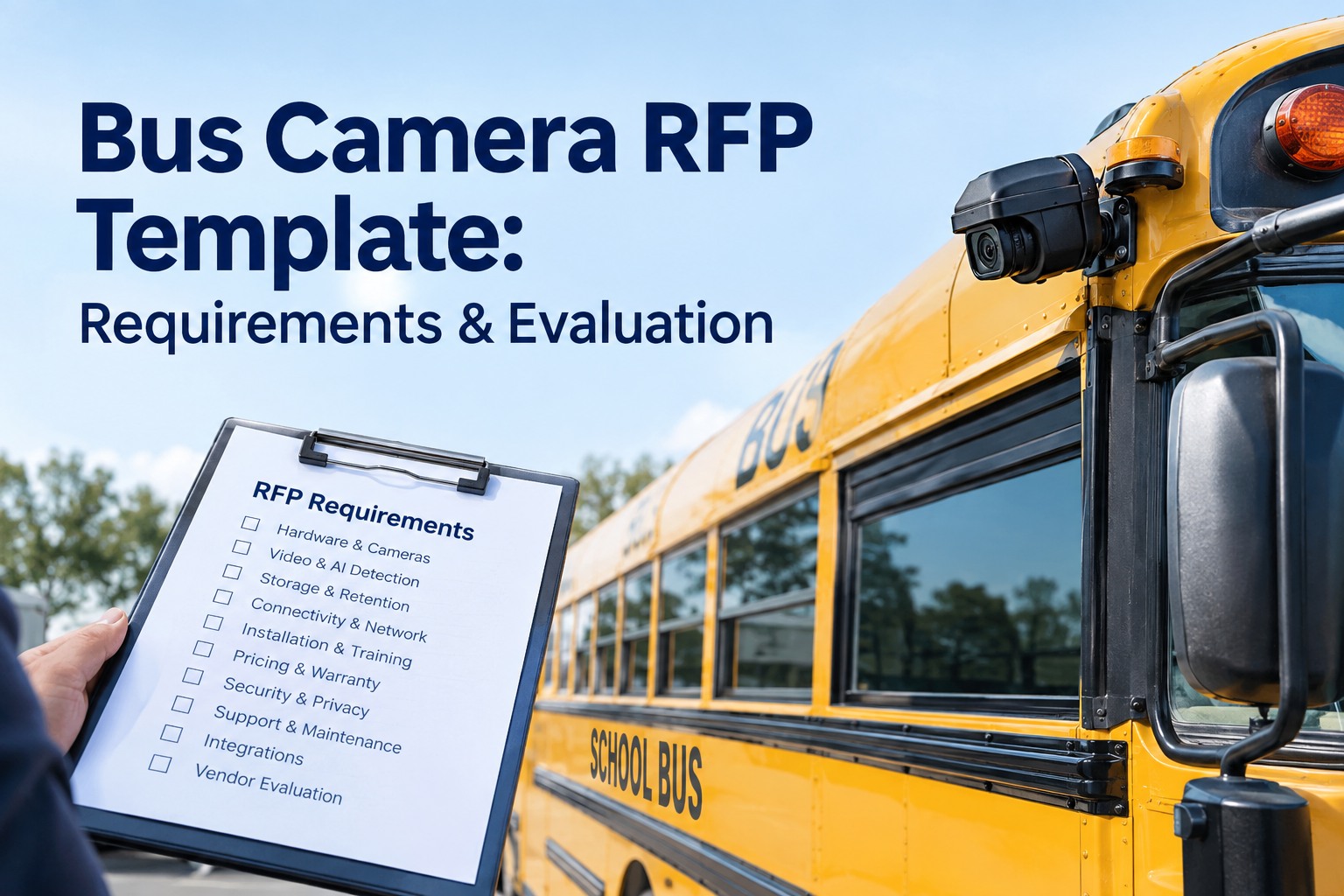
A bus camera RFP should spell out exactly what you need — camera hardware and placement, image and low-light quality, recording and event-triggered video, AI detection, connectivity and GPS, cloud storage, retention and retrieval, security and data ownership, installation, warranty, support, and how video events connect to your maintenance workflow — plus how you will score every response on the same terms. A vague RFP gets you vague proposals; a precise one gets you comparable bids and a defensible decision.
Bus Camera RFP Template: Requirements and Evaluation
The quality of your camera program is decided before a single bid arrives — in how well your RFP is written. Ask for the right things and the right vendors rise to the top.
Updated September 2026 · A practical procurement guide, not legal advice; state, local, and district requirements vary.Most disappointing camera purchases can be traced to an RFP that asked for cameras and forgot everything around them — the storage costs, the retrieval workflow, the data ownership, the way evidence does or does not reach maintenance. A strong RFP is really a specification of the whole program, written so that two vendors answering it produce bids you can actually compare side by side.
The sections every bus camera RFP needs
Organize the requirements into clear sections so nothing is left to the vendor's interpretation. These are the areas a complete bus camera RFP should cover.
Camera types and placement, image quality, low-light performance, and rugged build for the bus environment.
Continuous plus event-triggered video, AI detection, stop-arm events, and driver-facing or interior views where applicable.
GPS, cellular data, live view, and how footage uploads — and what it costs on a recurring basis.
Cloud storage, retention periods, and how fast and easily video can be retrieved when you need it.
User permissions, cybersecurity, encryption, and — critically — who owns the data.
Installation, warranty, replacement hardware, system uptime, technical support, and training.
Rollout timeline, data migration, and the plan for getting the whole fleet live.
Whether video events connect to inspections, defects, work orders, and maintenance records.
That last section is the one most RFPs miss, and it is often the most important. If the RFP does not ask how video connects to maintenance, you will get quotes for cameras that record beautifully into a portal nobody links to the shop. Get the RFP checklist with every section spelled out
The requirement that separates real value: isolated or connected?
Here is the single requirement that decides whether a camera program pays off or just records. Ask every vendor to show, not claim, whether their video events stay isolated in a portal or become part of the fleet workflow.
Write this into the RFP as a hard requirement, not a nice-to-have: video events must be able to connect to inspections, defects, and maintenance work orders on the vehicle record. It is the difference between a camera system and a fleet operations program. Discuss a pilot where events become work orders
How to score the responses
A good RFP tells vendors upfront how you will score them, which both sharpens their bids and keeps your evaluation honest. Publish the categories and weight them by what matters to your fleet.
Score each category on the same scale for every vendor, weight it, and total it. A published, weighted rubric turns a stack of glossy proposals into a numeric ranking you can defend to a board — and it stops the flashiest bid from winning on presentation alone. Get the checklist with the scoring rubric included
Four scenarios to put in the RFP
Do not let vendors answer in the abstract. Put concrete scenarios in the RFP and require them to describe — and in a pilot, demonstrate — exactly how their system handles each. These four reveal the truth fast.
Retrieve video after a complaint
A parent reports an incident on a specific bus and run. How fast can the vendor find, review, and export the relevant footage, and under what access controls?
Review a stop-arm event
A stop-arm event is triggered. Show the captured video, the vehicle it belongs to, and the workflow to act on it.
Identify a high-risk vehicle
Across the fleet, which buses show the most risk events, and did the system surface them proactively or only when asked?
Turn a defect into a work order
A confirmed defect from an event or inspection — does it become a maintenance work order on the bus, or stop at the video?
Scenario responses expose the gap between a slick portal and a real operations workflow. The vendors who can walk all four end to end are a short list worth piloting; the ones who cannot are answering a different RFP than the one you need. Discuss a pilot and run these scenarios live
The RFP requirements table
For each core requirement, this is the shape of a strong RFP line — why it matters, the question to put to the vendor, and how you will judge the answer. Copy this pattern across every requirement in your document.
The evaluation column is what keeps scoring objective — you decided how you would judge each answer before the bids arrived, so you are grading against your own standard, not the vendor's pitch. Get the full requirements table as a template
What pricing the RFP should force vendors to disclose
Ambiguous pricing is how a cheap-looking bid becomes the expensive choice. Require every vendor to itemize these, so you are comparing true total cost, not headline numbers.
Per-camera and per-bus hardware cost, by camera type.
Installation per bus, and whether it is turnkey or district-run.
Cellular data plans, billed monthly and by bus.
Cloud storage by retention tier, and cost to keep footage longer.
Software licenses and recurring platform fees per bus.
Replacement costs, minimum commitments, and contract length.
A vendor who answers all six plainly is one you can budget around. One who leaves gaps — especially on recurring fees and contract minimums — is showing you a red flag before you have even signed. Discuss a pilot with full pricing on the table
Red flags, references, and the pilot
Before you sign, three checks catch most weak proposals. Build them into the RFP so they are not an afterthought.
Vague pricing, "on the roadmap" answers, no data-ownership clarity, no reference customers, or footage that only lives in a portal.
Ask references how implementation actually went, what surprised them on cost, and how support responds when something breaks.
Require a pilot on a small group of buses with baseline metrics and written acceptance criteria before any fleet-wide commitment.
The pilot is your safety net: define what success looks like in numbers before it starts, capture the baseline, and only scale if the acceptance criteria are met. A vendor confident in their product will welcome it. Get the checklist with red flags and pilot criteria
How BusCMMS answers the RFP
Put BusCMMS through the same RFP and the pattern is consistent: it is built so the requirement most systems fail — connecting video to the fleet workflow — is the thing it does natively.
Events on the vehicle record
Video events, inspections, defects, and maintenance on the same bus record — not isolated in a portal.
AI-native prioritization
AI surfaces the high-risk buses and events first, so staff review what matters instead of every clip.
Hardware-agnostic
Works with the cameras you already run or specify, so the RFP is not locked to one hardware vendor.
Pilot-ready
Start on a small group of buses with a baseline and acceptance criteria, exactly as the RFP should require.
None of that has to be taken on faith — which is the point of a good RFP. Run BusCMMS through your requirements table, your scoring rubric, and the four scenarios, and judge it the same way you judge every other bid. Discuss a BusCMMS pilot on your terms
Access a district-ready RFP checklist, or discuss a pilot
Use the checklist to build a bus camera RFP with every requirement, the scoring rubric, and the four evaluation scenarios — then run BusCMMS through it. Video events, inspections, defects, and maintenance on one vehicle record, with AI surfacing high-risk buses first. Works with the cameras you already run or specify.
One vehicle record · AI prioritizes high-risk buses · Pilot before you commit
Frequently asked questions
What should a bus camera RFP include?
A complete bus camera RFP should specify camera hardware and placement, image quality and low-light performance, continuous and event-triggered recording, AI detection and stop-arm events, driver-facing or interior cameras where applicable, GPS and cellular connectivity, cloud storage with retention and retrieval requirements, user permissions, cybersecurity and data ownership, installation, warranty and replacement hardware, system uptime, technical support and training, implementation and data migration, and integrations. The section most RFPs omit but should include is whether video events connect to inspections, defects, work orders, and maintenance records, because that determines whether camera evidence stays isolated or becomes part of the fleet workflow. Alongside the requirements, publish how you will score responses so bids are comparable.
How do you evaluate bus camera vendor proposals?
Use a published, weighted scoring rubric applied identically to every proposal. Suggested categories are functionality, video quality, AI capabilities, reliability, usability, integrations, security, implementation, support, and total cost of ownership. Score each category on the same scale for every vendor, weight the categories by what matters most to your fleet, and total them for a ranking you can defend. Reinforce the scores with concrete evaluation scenarios — retrieving video after a complaint, reviewing a stop-arm event, identifying a high-risk vehicle, and turning a confirmed defect into a work order — ideally demonstrated in a pilot on your data. This keeps the decision on measurable performance rather than the polish of the sales presentation.
What pricing should the RFP require vendors to disclose?
Require an itemized breakdown so you compare true total cost rather than headline numbers: hardware cost per camera and per bus by type, installation per bus, cellular connectivity and data plans, cloud storage by retention tier, software licenses and recurring platform fees, replacement hardware costs, minimum commitments, and full contract terms and length. Vague or incomplete pricing — especially around recurring fees and contract minimums — is a warning sign in itself. A vendor who itemizes every line plainly is one you can budget around and hold accountable, and the itemized totals are what make the total-cost-of-ownership category in your scoring rubric meaningful.
Why does connecting video to maintenance matter in a camera RFP?
Because it separates a camera system from a fleet operations program. If video events stay isolated in the camera vendor's portal, someone has to watch and export footage manually, and there is no link to inspections, defects, or work orders — so the evidence and the repairs never meet, and the program mostly records rather than improves anything. When a video event can connect to the affected bus and a confirmed defect can become a maintenance work order, the camera investment starts driving actual fleet outcomes. Writing this connection into the RFP as a hard requirement, and testing it with the defect-to-work-order scenario, is one of the most consequential things a buyer can do.
How does BusCMMS fit into a bus camera RFP?
BusCMMS is an AI-native bus fleet operations platform designed to be evaluated on the same RFP as any vendor. Its differentiator is the requirement most systems struggle with: video events, inspections, defects, and maintenance operate on the same vehicle record, so an event can connect to the affected bus and a confirmed defect can become a work order rather than staying isolated in a portal. AI surfaces the high-risk buses and events first, so staff review what matters, and it is hardware-agnostic, working with the cameras you already run or choose to specify, which keeps the RFP from being locked to a single hardware vendor. The recommended approach is to run it through your requirements table, scoring rubric, and evaluation scenarios in a pilot with a baseline, and compare it directly to every other bid.