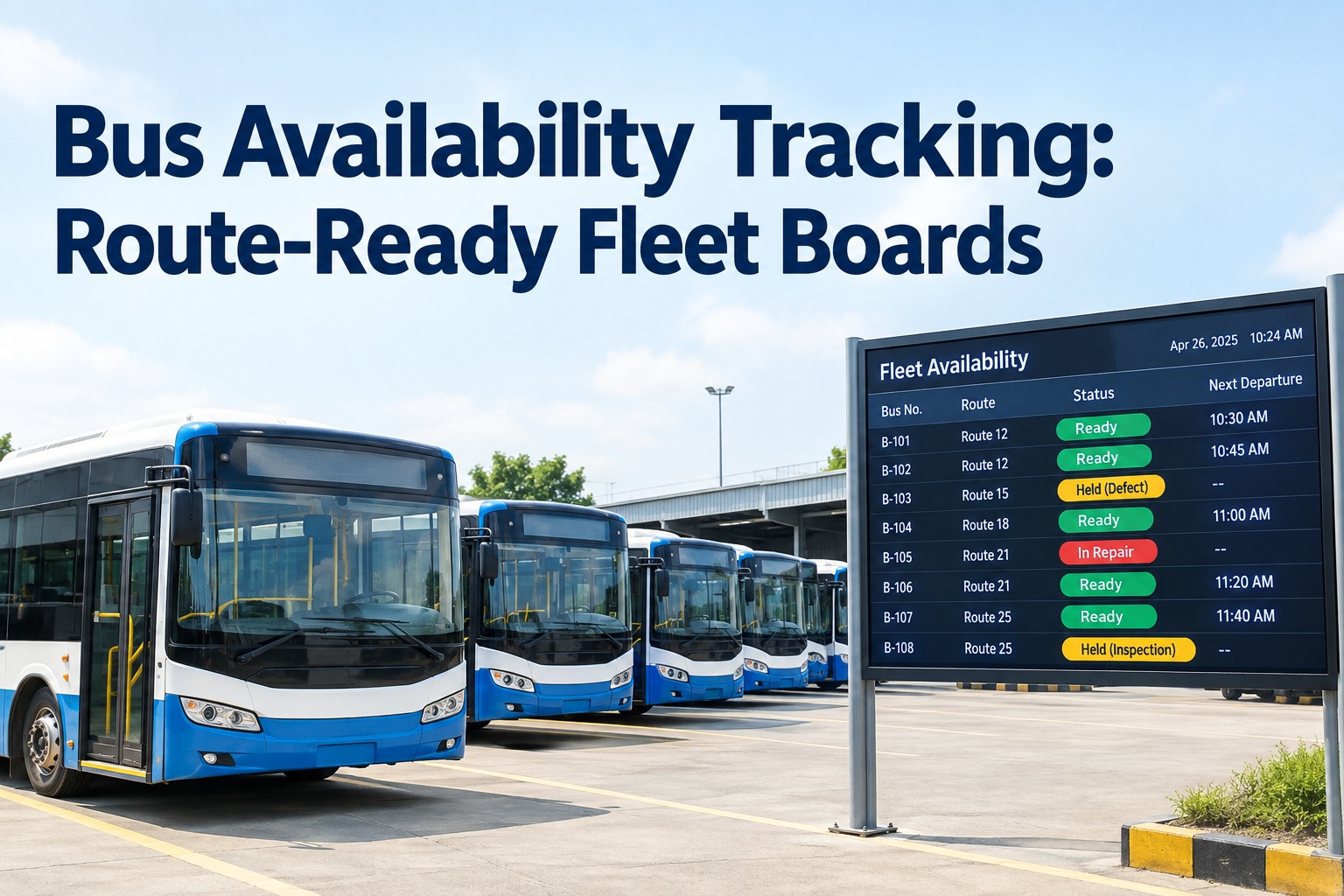
Bus availability tracking is a live view of which buses are actually route-ready right now versus held for a defect, in maintenance, or down — not a monthly average. Done well, it lets a dispatcher make fast, defensible calls at 5:30am from one board everyone trusts, instead of reconciling a management report against the shop's records mid-crisis.
Bus Availability Tracking: Route-Ready Fleet Boards
The question every morning starts with is not "how many buses do we own" — it is "how many can roll a route right now." A live board answers it in one glance.
The whole discipline of availability tracking comes down to knowing, for every bus, which of four states it is in and what it would take to move it back to ready. A monthly percentage hides this; a live board makes it obvious. Here are the four states and the line between them.
The four states every bus is in
Route-ready
Inspected, no open safety defect, cleared to carry passengers today. This is the only number that matters at dispatch.
Held for defect
A defect was reported and the bus is flagged out of service until it is resolved — even if it is mechanically drivable. Held is not ready.
In maintenance
Actively in the shop for scheduled PM or an open repair. Known, planned, and on its way back — but not available right now.
Unavailable
Stuck — waiting on a back-ordered part, an insurance hold after an incident, or an unresolved issue with no timeline. The hardest state to plan around.
The critical line runs between the first state and the other three: a bus is either route-ready or it is not, and everything that is not ready needs a reason and a path back. A board that only shows a green count without the held, shop, and down detail is hiding the very information a dispatcher needs. Book a demo to see every bus in its real state, live
The morning dispatch sequence, on a live board
Availability tracking earns its keep in the twenty minutes before the first route rolls. Here is a dispatcher working the board at 5:30am — each decision faster and more defensible because the status is already there, not phoned in from the shop.
Open the board
One glance: 34 ready, 3 held, 2 in shop, 1 down. The dispatcher knows the day's capacity before a single call is made.
Check the held buses
Two of the three held are for minor defects the shop can clear by 6:15; one is a real problem. The board shows the reason, not just the flag.
Cover the gap
Routes need 35 buses; 34 are ready now. The dispatcher assigns a spare and holds the two soon-to-clear buses for the second wave.
Make the call, on record
Every assignment ties to a bus in a known state. If anyone asks later why bus 12 sat, the answer is on the board with a timestamp.
Without the board, that same sequence is a series of phone calls to the shop, a whiteboard that is already out of date, and decisions nobody can reconstruct afterward. With it, the morning is a scan and a few assignments — and every call is defensible. Start free and run your morning off one shared board
Route-ready is not total fleet: a worked snapshot
The number that trips up leadership is the gap between how many buses exist and how many can actually run. A 40-bus fleet is not 40 buses of capacity on any given morning. Here is that same snapshot, counted honestly.
Owned: 40. Route-ready: 34. If routes need 35, you are one short — and no monthly "95% available" figure would have warned you, because averages smooth over the exact morning that matters. Route-ready is a count you take today, not a percentage you report next month. Book a demo to see route-ready capacity, every morning
The two-numbers problem: when reports and the shop disagree
Here is the failure that quietly erodes trust in availability data. Leadership's report says the fleet is 95% available. The shop knows three of those "available" buses have open defects nobody closed in the system. Now there are two truths, and every meeting starts with reconciling them instead of acting on them.
A rolled-up figure from a spreadsheet updated weekly, disconnected from what happened in the shop this morning.
Open defects flagged in maintenance that never made it into the management number — so the report overstates what can actually run.
Neither side is lying; they are reading two systems that were never connected. The fix is not a better spreadsheet — it is one source of truth where the shop's flag and the leadership view are the same underlying record. When availability is computed from live statuses instead of a periodic hand-off, the two numbers become one. Start free and end the reconciliation meeting
What actually pulls buses off the board
Availability is the visible result of a handful of underlying causes. Track these and you can see a shortage coming; ignore them and route-ready just drops one morning with no warning.
Preventive maintenance
Planned and predictable — the easy one to schedule around if the board shows what is due.
Unscheduled repairs
Breakdowns and failures that pull a bus without warning; the reason a buffer exists.
Inspections & defects
A failed check or reported defect flags a bus held until it is cleared and documented.
Parts delays
A bus waiting on a back-ordered part is unavailable indefinitely — the hardest to forecast.
Recurring defects
The same issue coming back means a bus that is never reliably ready — a pattern only a connected record reveals.
Camera incidents
An event caught on MDVR or AI cameras can flag a bus for review or repair — if it reaches the maintenance record.
That last cause is where most fleets leak availability, so it is worth its own section. Book a demo to see every downtime cause on one board
Turning camera events into a board status
Cameras and MDVR systems catch things that should change a bus's availability — a defect visible in footage, a harsh event worth a look. But if that video lives in a separate system, the bus stays green on the board while a real issue goes untracked. Connecting the event to the maintenance record is what keeps the board honest.
BusCMMS is an AI-native, hardware-agnostic bus fleet operations platform that reads events from the MDVR or AI camera systems you already run — no rip-and-replace — and connects them to asset records and maintenance work orders. So a camera-detected defect actually changes the board, opens a tracked repair, and closes the loop, instead of leaving a bus falsely marked ready. Start free and connect your existing cameras to the board
What the regulations do and do not require
Before setting an availability target, know what is actually mandated: on this, less than people assume. There is no federal regulation that sets a universal bus availability percentage or route-ready threshold every fleet must hit. What exists governs the condition of the buses, not how many you keep ready.
This governs inspection, repair, and maintenance — keeping vehicles in safe operating condition and keeping the records to prove it. It is directly relevant to why a bus is held or ready (a bus with an unresolved safety defect should not be route-ready) and to the records behind each status. But it does not set an availability target or a route-ready ratio. Any availability goal you adopt is an operational decision, not a Part 396 requirement.
So the honest framing: your availability target is yours to set from your service needs and history, the FTA has guidelines that apply only to certain transit recipients, and Part 396 determines whether a bus is genuinely fit to be counted as ready. The board makes all of that visible and provable. Book a demo to keep every route-ready status inspection-backed
Download the bus camera programme checklist
Get the checklist for connecting your MDVR or AI cameras to real availability tracking — so a caught defect flags the bus, opens a work order, and shows on the board instead of hiding behind a green count. BusCMMS is hardware-agnostic and gives directors, maintenance, and leadership the same live view. Grab the checklist, then book a demo to see it on your own fleet.
Hardware-agnostic · Works with your existing MDVR or AI cameras · Role-based views from one record
Frequently asked questions
What is bus availability tracking?
Bus availability tracking is a live, per-vehicle view of which buses are route-ready right now versus held for a defect, in maintenance, or unavailable, rather than a single monthly average. It lets dispatchers and transportation managers see the fleet's true capacity at the moment they are assigning routes, and it ties every non-ready bus to a reason and a path back to service. The goal is a shared, real-time board that the shop and the office both trust, so decisions during the morning dispatch sequence are fast and defensible instead of pieced together from phone calls and out-of-date whiteboards.
How is route-ready different from total fleet size?
Total fleet size is how many buses you own; route-ready is how many can actually carry passengers on a given morning after subtracting those held for defects, in maintenance, or down on parts. A 40-bus fleet might be only 34 route-ready today. The distinction matters because routes are covered by route-ready buses, not by the number on the asset list, and a monthly availability percentage can look healthy while a specific morning falls short. Route-ready is a live count you take today; it is the number that determines whether every route rolls.
Why do management reports and shop records show different availability?
Because they are usually two disconnected systems. A management report is often a rolled-up figure updated periodically, while the shop tracks open defects and repairs in a separate maintenance record. When a bus is flagged held in the shop but that flag never reaches the management number, the report overstates what can run. Neither side is wrong; they are reading different data. The fix is a single source of truth where availability is computed from live statuses, so the shop's flag and the leadership view are the same underlying record and there is nothing to reconcile.
Is there a required bus availability or route-ready percentage?
No federal regulation sets a universal bus availability percentage or route-ready threshold that every fleet must meet. The FTA maintains spare-ratio guidelines that apply only to certain transit recipients, and 49 CFR Part 396 governs vehicle inspection, repair, and maintenance and the associated records — it determines whether a bus is genuinely fit to be counted as route-ready, but it does not mandate an availability target. Any availability goal you set is an operational decision based on your service requirements and history, not a specific regulatory mandate.
Do we have to replace our cameras to connect them to availability tracking?
No. BusCMMS is hardware-agnostic and is designed to read events from the MDVR or AI camera systems you already operate, rather than requiring a rip-and-replace deployment. It connects those events to the correct asset record and a maintenance work order, so a camera-detected defect can flag a bus as held on the board and open a tracked repair. The aim is to close the gap between what the cameras catch and what the availability board shows, using your existing hardware, and to give directors, maintenance teams, and leadership role-based views of the same underlying fleet data.