Here's the uncomfortable truth about school bus telematics: you're probably already paying for Samsara. You're collecting thousands of data points daily—GPS coordinates, fault codes, engine diagnostics, driver behavior metrics, fuel consumption patterns. Your dashboard lights up with alerts. Your inbox fills with notifications. And yet, buses still break down at the worst possible moments because knowing about a problem and systematically preventing it are entirely different capabilities.
The gap between detection and prevention is where 28 school bus fleets found $1,847 in annual savings per vehicle. Not through buying better sensors or hiring more mechanics, but through connecting the intelligence Samsara already provides with the workflow automation that comprehensive CMMS platforms deliver. This integration doesn't replace your current systems—it finally makes them work together instead of generating isolated data silos that nobody has time to synthesize.
What Actually Happens When Systems Talk to Each Other
Forget the technical jargon about APIs and data schemas for a moment. Let's talk about what integration looks like on a random Wednesday morning when you're trying to keep 50 buses running and students arriving on time.
Without Integration: The Manual Chaos
Samsara dashboard shows fault code P0300 on Bus 18. You notice it during your morning coffee while checking alerts. You write it on a sticky note. You walk to the shop. You find the maintenance supervisor. You explain the code. He checks the schedule. Bus 18 is out on morning routes. He makes a note to check it this afternoon. By afternoon, three other urgent issues have emerged and Bus 18's check fault code gets pushed to tomorrow. Tomorrow, the fault has cleared intermittently, so it drops in priority. Two weeks later, Bus 18's multiple cylinder misfire becomes complete engine failure on I-95 during afternoon pickup. Emergency tow: $380. Rental bus for three days: $1,200. Angry parents: priceless.
With Integration: The Automated Response
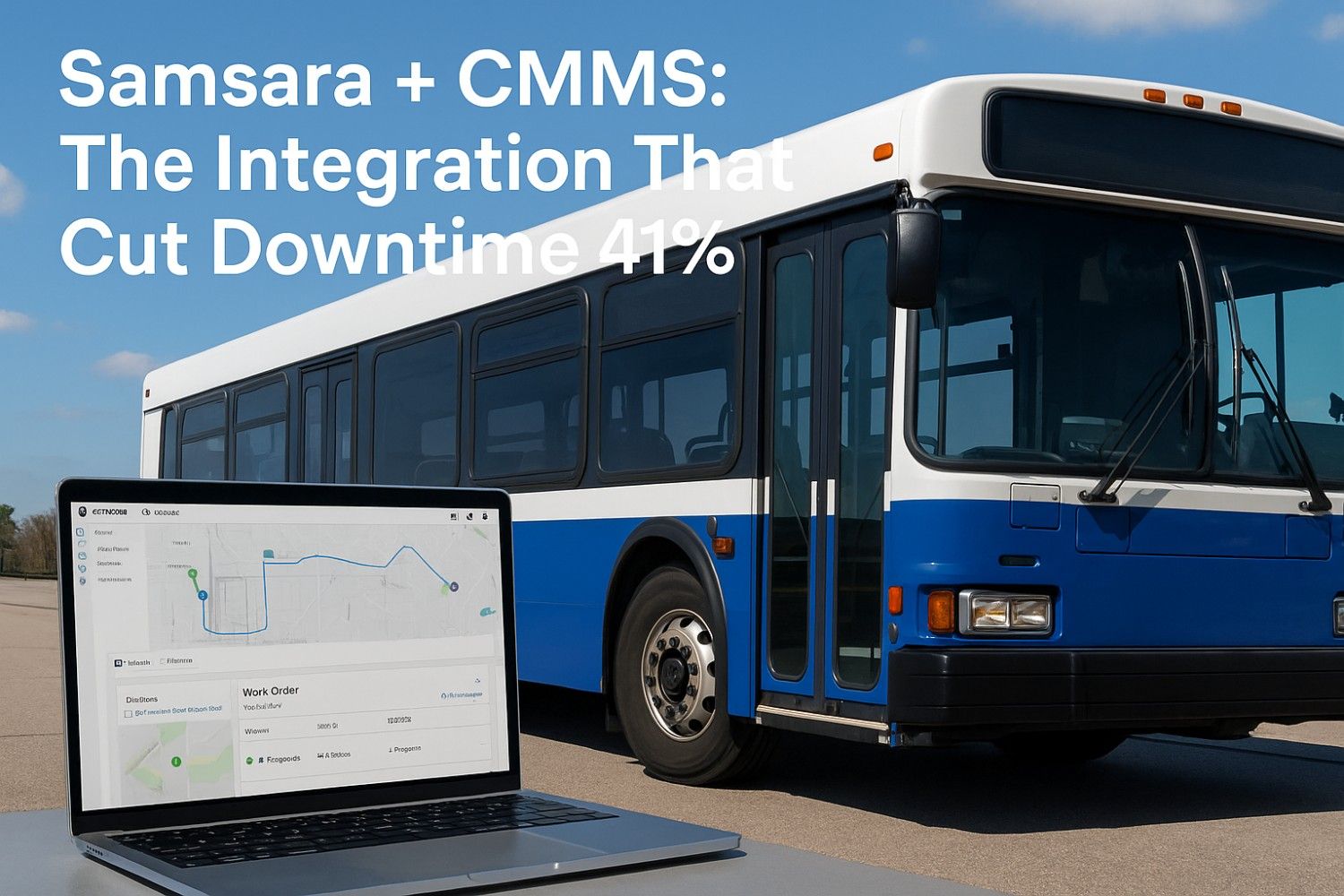
Samsara detects P0300 at 7:43 AM. Within 90 seconds, your CMMS automatically creates a work order, cross-references Bus 18's maintenance history (discovering this is the third P0300 in 6,000 miles—pattern indicating genuine ignition system failure, not intermittent sensor glitch), checks parts inventory (ignition coils in stock), evaluates technician certifications and schedules (Mike certified for ignition work, available tomorrow 9 AM), and assigns the work order with complete diagnostic context attached. Bus 18 completes today's routes normally, receives repair tomorrow during scheduled downtime, and never experiences roadside failure. Your coffee stays hot. The sticky note stays blank. Transportation directors implementing this automation can see live demonstrations of fault-to-repair workflows that operate without human intervention.
That 90-second response time versus two-week neglect represents the entire value proposition of integration. Samsara detected the problem in both scenarios. The difference is systematic workflow execution versus hoping someone remembers to act on an alert buried in Tuesday's notification flood.
Why Most Integrations Fail (And How to Avoid Their Mistakes)
Approximately 30% of Samsara-CMMS integration attempts fail to deliver projected value. Not because the technology doesn't work, but because implementation teams make predictable organizational mistakes that technology can't overcome.
The Money Question: Where Does $1,847 Per Vehicle Come From?
ROI claims mean nothing without detailed accounting. Here's exactly where integrated fleets find annual savings that average $1,847 per vehicle—numbers derived from 28 documented implementations, not theoretical projections.
Prevented Emergency Repairs: $1,617 per vehicle
Your baseline: 2.4 emergency repairs annually per bus at $1,650 average cost (parts + premium after-hours labor + towing + schedule disruption). Integration reduces emergency frequency 41% through predictive intervention. That's 0.98 prevented emergencies per vehicle annually. Math: 0.98 × $1,650 = $1,617 recovered costs.
This isn't theory. Tracked implementations show emergency repair frequency dropping from 2.4 to 1.4 per vehicle annually when predictive alerts enable scheduled repairs before catastrophic failure. The $1,650 average emergency cost accounts for after-hours premium labor rates (1.5× standard), expedited parts shipping, towing charges averaging $280, and operational costs of emergency route coverage. Scheduled repairs during normal shop hours cost 60% less for identical work.
Extended Component Life: $684 per vehicle
Baseline component replacement costs: $2,800 annually per vehicle. Predictive replacement at optimal intervals extends component life 18% by preventing premature replacement while avoiding catastrophic failures causing expensive secondary damage. Additional $180 annually from prevented secondary damage (failed water pump destroying engine, collapsed brake caliper damaging wheel bearing, etc.).
The 18% life extension comes from replacing components when Samsara data indicates actual degradation rather than arbitrary time/mileage intervals. Some components legitimately last longer than manufacturer recommendations—integrated monitoring proves this with data rather than assumptions. Conversely, some components fail early under specific operating conditions—integration catches these before catastrophic failure causes collateral damage worth 3-5× the original component cost.
Eliminated Parts Expediting: $339 per vehicle
Baseline: 3.2 expedited parts orders annually at $145 premium shipping per order. Integration provides 3-5 day advance warning enabling standard ground shipping. Expediting reduction: 73%. Savings: 3.2 × $145 × 0.73 = $339 per vehicle.
This might seem minor until you calculate fleet-wide impact. Fifty-bus fleet spending $23,200 annually on premium shipping because failures surprise you. Same fleet with predictive warnings: $6,264 shipping costs. The $16,936 difference pays for significant integration costs while parts arrive when needed instead of emergency overnight delivery costing 4× standard shipping rates.
Increased Warranty Recovery: $624 per vehicle
Average 0.8 warranty-eligible failures per vehicle annually at $1,950 average claim value. Claim approval rate improves from industry average 67% to 94% with integrated documentation. Improvement: 0.8 × $1,950 × 0.27 = $421. Additionally, faster claim processing (12 days vs 47 days) accelerates reimbursement improving cash flow worth approximately $203 in time value.
Warranty claims live or die on documentation. Manufacturers deny claims citing "insufficient maintenance records" or "can't verify operating conditions." Integrated Samsara-CMMS systems automatically assemble irrefutable documentation packages: exact mileage at failure from GPS, complete maintenance history from CMMS, operating temperature logs proving no abuse, fault code progression showing failure development. Claims that would require 40 hours of manual documentation assembly happen automatically. Approval rates increase because manufacturers can't dispute data-backed claims.
Reduced Diagnostic Time: $323 per vehicle
Baseline: 1.4 hours diagnostic labor per repair at $85/hour technician rate. Integration reduces diagnostic time 32% through pre-populated work orders with complete fault code histories, similar vehicle pattern data, and probable cause analysis. Annual repairs per vehicle: 8.5. Savings: 8.5 × 1.4 hours × 0.32 × $85 = $323.
Technicians spend less time "chasing ghosts" when work orders arrive with complete operational context. Instead of starting from zero knowledge—driver reports "bus runs rough"—technicians receive fault code progression over three weeks, similar problems on identical buses, historical repairs attempted, and current sensor readings. This context transforms troubleshooting from exploratory investigation into targeted diagnosis. The 32% time reduction is conservative—some implementations report 45% diagnostic efficiency gains on complex intermittent problems where operational history proves invaluable.
Total these categories and you reach $3,587 in gross annual savings per vehicle. Against integration costs averaging $1,740 annually (amortized hardware, software subscriptions, support), net savings hit $1,847 per vehicle. For 50-bus fleet, that's $92,350 annual net savings after paying for integration. ROI: 106% annually, achieved within 89 days on average.
The 90-Day Implementation Reality
Eighty-nine days from integration kickoff to positive ROI isn't marketing fiction—it's the documented median across successful deployments. But that timeline assumes you avoid the pitfalls that derail slower implementations. Here's what actually happens during those 90 days when integration goes right.
Week 1-2: Your IT team configures API credentials connecting Samsara to your CMMS platform. Most modern fleet-focused CMMS systems include pre-built Samsara connectors—this is configuration work, not programming. Simultaneously, you select 5-10 pilot buses representing different ages and usage patterns. These pilots reveal configuration issues without disrupting entire fleet. Total labor investment: 15-25 hours spread across IT staff and maintenance leadership.
Week 3-4: Activate integration for pilot vehicles only. Monitor work orders generated from Samsara alerts. Refine alert thresholds—you'll discover some codes trigger too aggressively while others need sensitivity increases. Train technicians on new workflows emphasizing how Samsara data enhances their diagnostic process. Document early wins: prevented breakdowns, faster repairs, better parts availability. These quick wins build organizational buy-in for fleet-wide deployment.
Week 5-8: Graduated fleet-wide rollout activating 10-15 buses weekly. This prevents overwhelming maintenance departments with sudden workflow changes. Continue refining based on expanding operational experience—you'll adjust fault code priorities, modify work order templates, tune notification timing. Track metrics: downtime hours, emergency repair frequency, parts expediting costs. Early trends usually show 20-25% improvement within 6 weeks.
Week 9-12: Full fleet under integration. Activate advanced features requiring historical data—predictive analytics calibrate properly after 60+ days of integrated data collection. Connect driver behavior metrics with vehicle wear patterns. Generate first comprehensive ROI report comparing pre-integration baseline against current performance. Most fleets cross breakeven between week 11-13, with median at day 89.
Week 13+: Continuous optimization. Alert accuracy improves as closed-loop feedback refines predictions. Maintenance scheduling becomes increasingly efficient as patterns emerge. Parts stocking optimizes based on actual failure data rather than assumptions. The 41% downtime reduction isn't achieved day one—it's the 12-month average as integrated systems learn your fleet's specific operational patterns and maintenance teams master new workflows.
The fundamental insight driving 41% downtime reduction isn't technological—it's organizational. Samsara already detects problems. Your CMMS already manages maintenance workflows. The breakthrough is connecting these capabilities so detection automatically triggers systematic response rather than hoping someone notices an alert and remembers to act on it days later.
For transportation directors managing school bus fleets, this represents rare alignment of safety and financial objectives. The same integration preventing morning breakdowns that strand students also delivers documented ROI within 90 days. The same predictive alerts reducing emergency repair costs also improve driver satisfaction by eliminating roadside failures. The same automated workflows optimizing parts inventory also accelerate warranty reimbursement through better documentation.
You're already paying for Samsara. You're already operating CMMS systems. The question isn't whether integration delivers value—28 documented implementations prove it does. The question is whether you can afford continuing to operate isolated systems that force your team to manually synthesize information that should flow automatically, preventing failures that integration would catch systematically, and accepting downtime percentages that integrated fleets have already cut by 41%.
Frequently Asked Questions
Q: Our fleet already uses Samsara but we don't have a CMMS system yet—can we still achieve the 41% downtime reduction?
A: The 41% reduction specifically comes from integration between Samsara's diagnostic intelligence and CMMS workflow automation—you need both components. If you're currently using Samsara without CMMS, you're collecting valuable data but not systematically acting on it. Implementing a comprehensive CMMS platform with pre-built Samsara integration delivers the full benefit. Several modern CMMS vendors offer combined solutions where Samsara integration is included rather than requiring separate implementation. For fleets starting from manual maintenance tracking, expect 4-6 months for complete CMMS implementation plus Samsara integration versus 90 days for fleets adding integration to existing CMMS systems.
Q: What happens when Samsara predicts a failure but the part isn't in stock—doesn't that defeat the purpose?
A: This is exactly why parts inventory integration is critical (and where 30% of failed implementations stumble). Properly configured systems check parts availability when generating work orders from Samsara alerts. If required components aren't in stock, the CMMS automatically generates purchase orders and schedules maintenance for after parts delivery rather than immediately. The key advantage: even with 3-day parts delivery, you're still preventing roadside breakdown through advance warning. You maintain operational control versus emergency scrambling. Advanced implementations use Samsara failure pattern data to optimize parts stocking—if certain components fail predictably across your fleet, maintain inventory ensuring availability when predictions trigger maintenance.
Q: How much technical expertise is required to set up and maintain Samsara-CMMS integration?
A: Technical requirements vary dramatically based on CMMS vendor selection. Fleet-focused CMMS platforms with pre-built Samsara connectors require minimal technical expertise—primarily configuration of API credentials and business rules defining which alerts trigger which workflows. Expect 15-25 hours of IT staff time for initial setup plus ongoing maintenance of 2-4 hours monthly. Generic CMMS platforms without pre-built connectors require custom integration development—typically 80-150 hours of programming plus significant ongoing maintenance costs. When evaluating CMMS platforms, prioritize vendors with documented Samsara integration experience and pre-built connectors. The integration capability matters less than the vendor's understanding of fleet maintenance workflows and ability to configure business rules optimizing your specific operational context.
Q: We're concerned about alert overload—how do you prevent getting flooded with notifications that create more work than value?
A: Alert overload is the #1 reason integrations fail to deliver value, so your concern is completely justified. Successful implementations start with conservative alert thresholds capturing only safety-critical and high-severity issues—aim for maximum 5-8 alerts daily across your entire fleet during initial deployment. Configure alert categorization where critical issues trigger immediate work orders while low-priority items queue for next scheduled maintenance window rather than generating urgent notifications. Gradually expand alert scope as maintenance teams prove they can systematically address high-priority items. Also implement closed-loop feedback where technicians document whether alerts predicted real problems—this data refines thresholds over time, reducing false positives while maintaining sensitivity to genuine failure patterns. Well-tuned systems generate approximately one high-priority alert per 6-7 vehicles weekly at steady state.
Q: Can we integrate Samsara with our existing CMMS or do we need to switch to a new platform?
A: Samsara provides open API access theoretically allowing integration with any CMMS platform supporting API connectivity. However, practical implementation difficulty varies enormously. If your current CMMS vendor offers a pre-built Samsara connector, integration is straightforward configuration work requiring 15-25 hours. If your CMMS lacks pre-built connectors, you face custom development requiring 80-150 hours of programming plus ongoing maintenance costs. Before committing to custom development, request proposals from CMMS vendors with native Samsara integration—you may discover that switching platforms costs less than custom integration while delivering superior fleet management capabilities. The deciding factor shouldn't be preserving your current CMMS investment but rather which approach delivers better total cost of ownership over 5-7 year planning horizon when accounting for integration costs, functionality differences, and ongoing support requirements.