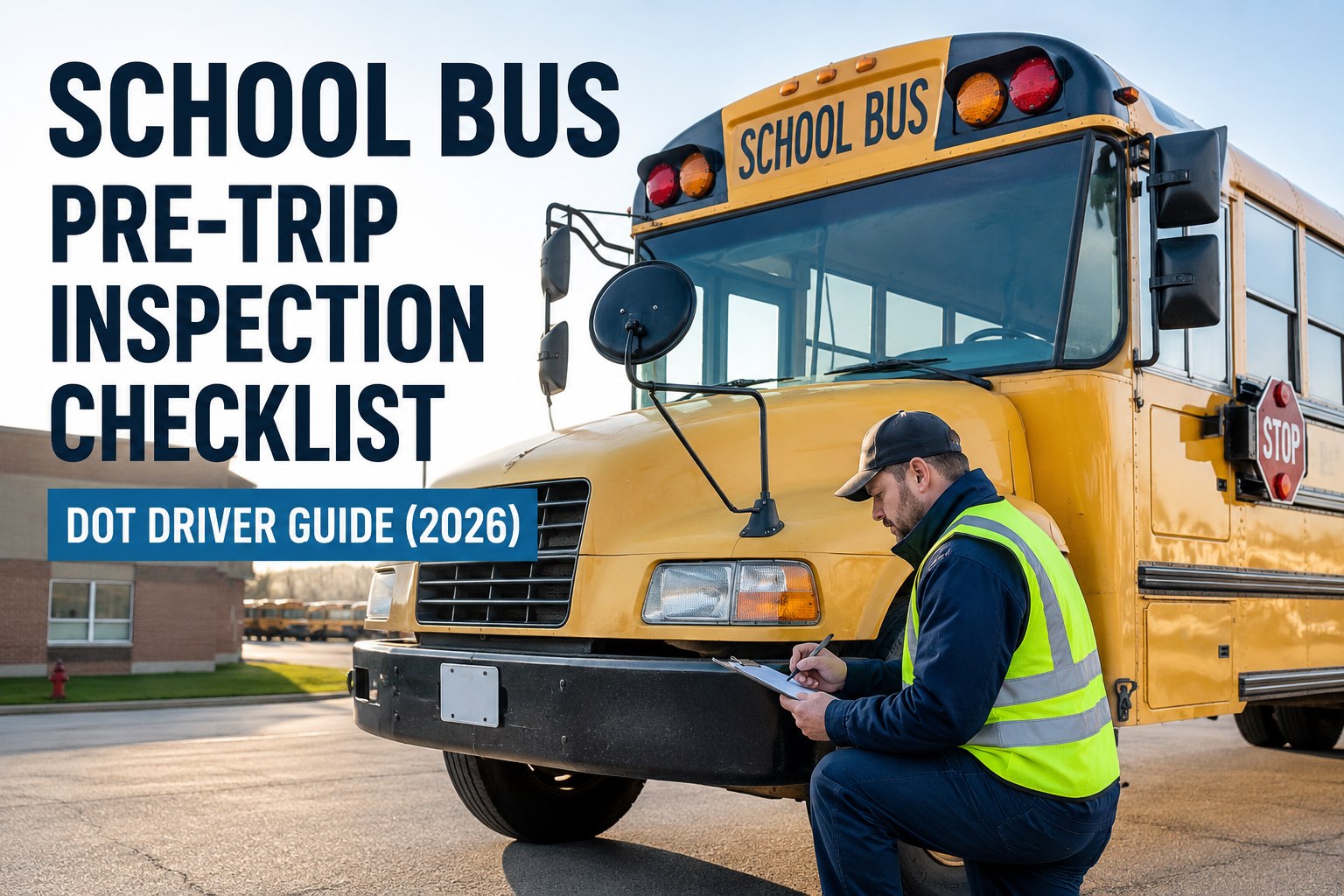
Your driver's pre-trip walkaround used to matter for one reason: keeping students safe. As of the February 2026 CSA overhaul, it now matters for a second reason too -- FMCSA created a dedicated "Vehicle Maintenance: Driver Observed" scoring category that tracks exactly the kind of defects a thorough walkaround should catch: bald tires, a broken light, an obvious fluid leak. Miss one of those on a rushed pre-trip, and it doesn't just risk a roadside citation anymore. It shows up as a separate, visible mark on your carrier's public safety score. This school bus pre-trip inspection checklist covers every point FMCSA requires, organized the way a driver actually walks the bus, with the 2026 rules built in from the start.
School Bus Pre-Trip Inspection Checklist (2026): DOT Driver Guide
Every point FMCSA requires in a school bus pre-trip inspection, organized in the 7-point walkaround sequence, with the 2026 CSA scoring changes built in.
Why the School Bus Pre-Trip Inspection Checklist Matters More in 2026
Under 49 CFR 392.7, a driver may not operate a school bus unless satisfied its parts and accessories are in good working order. Under 49 CFR 396.13, the driver must also review and sign the prior DVIR before departing. These have been federal requirements for years. What changed is how a missed defect gets scored: FMCSA's February 2026 CSA overhaul split the old "Vehicle Maintenance" category into two -- general maintenance findings, and a new "Vehicle Maintenance: Driver Observed" category that specifically tracks violations a driver should have caught during the walkaround.
That distinction matters because CSA scores are public and directly influence insurance rates, contractor eligibility, and how often your fleet gets pulled for a DOT audit. Fewer than 7% of carriers pass a compliance review without a single violation, and a single out-of-service finding averages roughly $4,200 in penalties. Book a demo to see how BusCMMS documents driver walkaround quality in a format that protects your CSA score, not just your audit file.
The 7-Point Walkaround: Complete School Bus Pre-Trip Checklist
FMCSA recommends walking the bus in a consistent clockwise pattern so nothing gets skipped under time pressure. Here's every point, in the order a driver actually moves.
-
1
Approach
Look for obvious body damage, leaning or leaks under the bus, and general condition before touching anything.
-
2
Engine Compartment
Fluid levels, belt condition, visible leaks, and battery connections checked with the hood up.
-
3
Driver's Side
Steering linkage, front tire and brake condition, mirrors, and fuel tank on this side of the bus.
-
4
Rear
Rear tires, brake components, exhaust system, rear emergency exit, and rear lighting.
-
5
Passenger Side
Mirrors, tires, brakes, stop arm and crossing gate cycling correctly, service door operation.
-
6
Interior
Seats, handrails, aisle clearance, emergency exits and alarms, first aid kit, fire extinguisher.
-
7
In-Cab
Gauges, air brake test, horn, wipers, defroster, prior DVIR review and sign-off before moving.
This same sequence, done consistently, is what turns a rushed 90-second checkbox exercise into the 15-20 minute inspection that actually protects students and your CSA score. Sign up free to load this 7-point sequence into your drivers' daily workflow.
Emergency Equipment: The Section Drivers Rush Most
Emergency equipment checks take thirty seconds and get treated that way, but a missing item here is one of the most preventable out-of-service findings on the books.
- Fire extinguisher charged and mounted
- First aid kit stocked and accessible
- Reflective warning triangles present
- Emergency exits open from inside and outside
- Exit alarm sounds when door opens
- Body fluid cleanup kit available
Keep this section as its own checklist item rather than folding it into a general "safety" catch-all -- treating it as a distinct step is what keeps it from becoming the thing that gets skipped when a driver is running late. Book a demo to see emergency equipment tracked as its own required section, not an afterthought.
What Auditors and CSA Scoring Actually Look For
| Finding | Typical Cost / Impact |
|---|---|
| Missing DVIR | Up to $1,270/day |
| Dispatching with unrepaired defect | Up to $15,420 |
| Out-of-service violation (average) | ~$4,200 per case |
| Driver-observed defect (new 2026 category) | Separate CSA score impact |
Brake defects and missing annual inspection documentation remain the highest-volume violation category overall, and driver qualification file gaps account for roughly 12% of all FMCSA violations. Both are preventable with a consistent daily process rather than a rushed one. Book a demo to see how BusCMMS flags exactly these categories before an auditor does.
From a Transportation Director on the 2026 Changes
"When I heard 'driver observed' was becoming its own scoring category, my first thought was that we were already doing fine because our pre-trips were thorough. Then I actually looked at our numbers and realized three of our drivers were consistently missing the same tire wear pattern because they were checking pressure but not tread depth. That's exactly the kind of thing this new category is built to catch. We retrained on measurement instead of visual checks, and it made a real difference within a month."
Why Digital Pre-Trip Checklists Fit the 2026 Rules Better
A paper form makes a rushed inspection look identical to a thorough one -- every box checked "OK" either way. That gap is exactly what the new Driver Observed category is designed to expose, and a digital system closes it by design rather than by asking drivers to try harder.
Photo-Verified Checks
Critical items require a photo, making a real inspection visibly different from a skipped one.
Instant Defect Routing
A flagged item notifies maintenance immediately and blocks dispatch until it's resolved.
DVIR Review Chain
A driver can't start a new pre-trip until the prior day's DVIR is reviewed and certified.
Instant Record Retrieval
Every inspection stored and searchable by bus and date -- produce months of history in seconds.
On February 19, 2026, FMCSA published a final rule, effective March 23, 2026, explicitly authorizing electronic DVIRs under 49 CFR 396.11 and 396.13. Digital signatures, mobile submission, and cloud storage are all fully compliant. Book a demo to see a fully 2026-compliant digital pre-trip workflow built for school buses specifically.
School Bus Pre-Trip Inspection: The Bottom Line
A school bus pre-trip inspection checklist has always been about student safety first. In 2026, it's also a direct input into your carrier's public CSA score through the new Driver Observed category, which makes measurement-based checks -- an actual tire gauge reading, an actual steering play measurement -- more important than ever. Walk the bus in the same 7-point sequence every time, treat emergency equipment as its own required step, and keep records in a system that shows a real inspection happened, not just a signature.
If your fleet's pre-trip process is still paper-based, the 2026 CSA changes make the gap between a thorough inspection and a rushed one more visible than ever. Sign up free and put your school bus pre-trip checklist on one digital system.
What must be included in a school bus pre-trip inspection checklist?
A complete checklist covers brakes, tires, steering, lights, mirrors, stop arm and crossing gate function, emergency exits, fire extinguisher, first aid kit, and a review of the prior day's DVIR. FMCSA recommends the 7-point walkaround method -- approach, engine compartment, driver side, rear, passenger side, interior, and in-cab -- to ensure nothing gets missed under time pressure.
What is the new "Driver Observed" CSA category in 2026?
FMCSA's February 2026 CSA overhaul split the Vehicle Maintenance scoring category into two parts: general maintenance findings, and a new "Vehicle Maintenance: Driver Observed" category that specifically tracks violations a driver should have caught during pre-trip -- bald tires, broken lights, obvious fluid leaks. This makes inspection thoroughness a direct, visible factor in a carrier's public safety score.
Is a written report required for a defect-free school bus pre-trip?
Yes, for passenger-carrying vehicles like school buses, a DVIR is required at the end of every day regardless of whether defects were found. This differs from property-carrying trucking fleets, which have not been required to file a no-defect DVIR since a 2014 rulemaking.
Are electronic DVIRs compliant for school bus pre-trip inspections?
Yes. FMCSA's final rule, published February 19, 2026 and effective March 23, 2026, explicitly authorizes electronic DVIRs under 49 CFR 396.11 and 396.13. Digital signatures, mobile submission, and cloud storage are all fully compliant, and FMCSA actively encourages the transition from paper.
How does a digital checklist help with the 2026 CSA changes?
A digital pre-trip checklist requires interaction with each item, often with photo verification, making a thorough inspection visibly different from a rushed one. It routes flagged defects to maintenance instantly, enforces review of the prior day's DVIR before a new inspection begins, and stores records in a format that can be retrieved in seconds -- all of which support a stronger showing under the new Driver Observed scoring category.