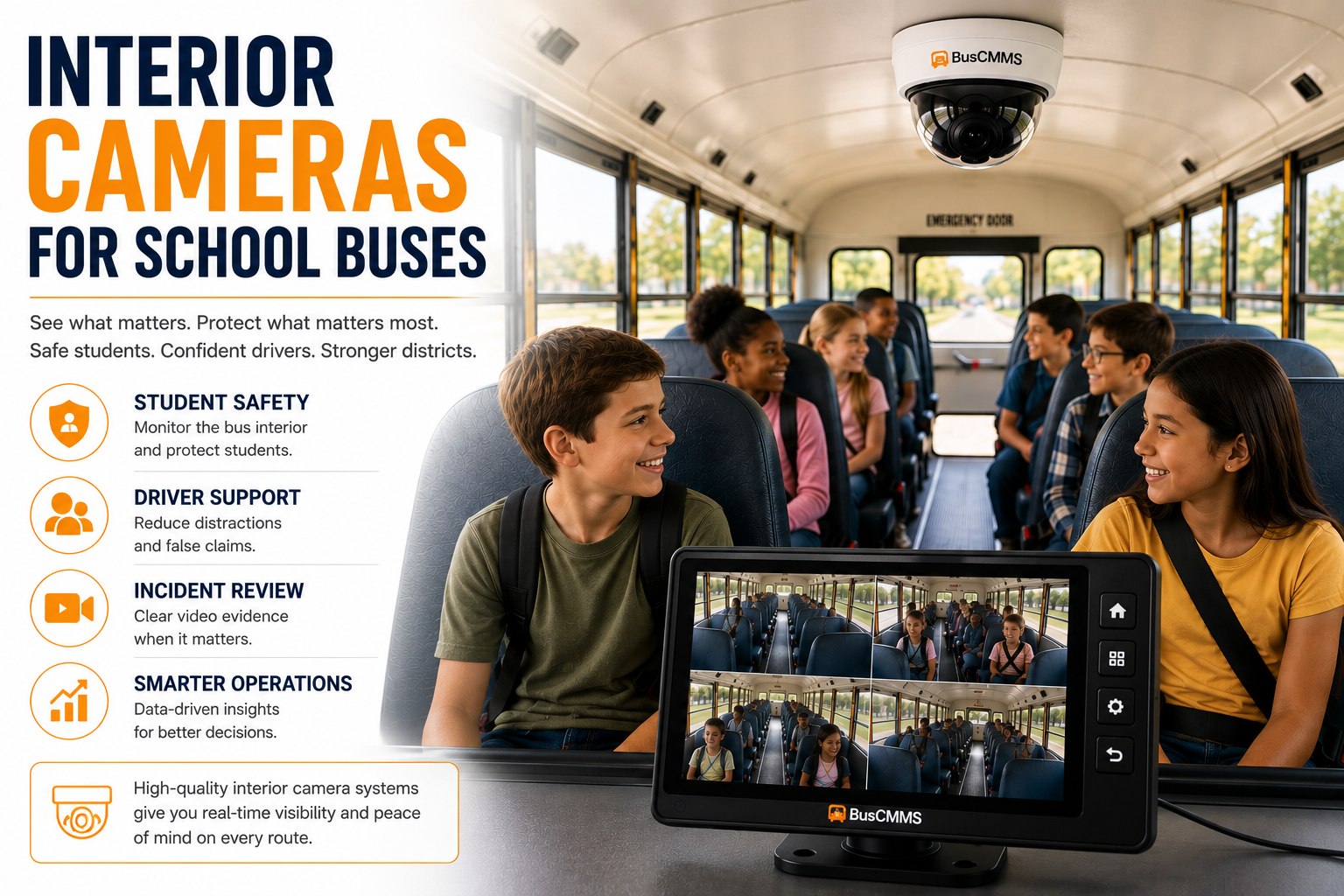
A school bus interior camera exists to answer one question when something happens three rows back and the driver didn't see it: what actually occurred, and who was involved. That's a narrower job than most districts assume when they buy on camera count alone — this covers exactly how many cameras a bus actually needs by length, the audio decision that has real legal weight, and the FERPA rules that govern who ever sees the footage. See interior camera events on one bus timeline in BusCMMS → book a demo.
Interior Cameras for School Buses
Aisle and stairwell coverage that scales with bus length, the audio decision most districts get wrong, and what resolution actually needs to identify a seat row.
Aisle and Stairwell Coverage: What Each Zone Is For
Two distinct jobs, not one generic "interior camera" spec.
Aisle coverage and stairwell coverage solve different problems and shouldn't be treated as the same line item. Aisle cameras watch seat-to-seat interactions along the length of the bus — the zone where most behavior incidents and injury claims actually originate. Stairwell and entry-door cameras watch a narrower, higher-risk zone: boarding and exiting, where trips, door-closing incidents, and disputes over whether a student was properly clear of the door before it moved all concentrate. A bus spec'd with aisle coverage but no dedicated stairwell angle has a real gap at exactly the highest-incident zone on the vehicle.
The Audio Decision: What FERPA and State Law Actually Say
This is the single biggest legal exposure point in an interior camera program, and it's often decided by default settings.
FERPA (20 U.S.C. 1232g), as applied to bus video, treats interior footage that identifies individual students as potentially part of their education record — which affects who can access it, how it's shared, and how long it's retained. Layered on top of that, state public-records law and your district's own retention schedule set the specific rules for how long footage sits before it's purged, and audio capture specifically can trigger separate state wiretap or consent requirements beyond what FERPA addresses. A vendor's default audio-on setting is not automatically compliant with your state's law — it's a configuration decision that has to be made deliberately, not inherited from a factory default.
Audio capture may be appropriate when:
- Your state law doesn't impose all-party consent requirements for onboard recording
- District policy clearly documents the retention and access rules for audio specifically
- Behavior investigations regularly need context that video alone can't provide
Video-only is the safer default when:
- State consent law is unclear or restrictive on onboard audio
- No one has reviewed audio retention against FERPA and state records law together
- The primary use case is behavior identification, which video alone usually covers
This is a decision worth getting a clear answer on before purchase, not something to leave at a vendor's default. Talk through your state's specific requirements on a demo call →
Resolution: What's Actually Needed to Identify a Seat Row
Higher resolution than you'd think, for a reason that has nothing to do with picture quality.
The functional requirement for interior footage isn't cinematic clarity — it's being able to identify which seat row an incident occurred in and which students were involved, often from a wide-angle camera mounted at the front of the bus looking down a 35+ foot aisle. At that distance and angle, a low-resolution camera can render faces and seat numbers as an indistinguishable blur by the time you're six or seven rows back, even though the overall picture looks "fine" on a monitor. This is where a specification written around resolution as a single headline number, without checking it against actual aisle-length test footage, produces cameras that technically work but functionally can't answer the question they were bought to answer.
The Spec Mistake: Resolution Alone, Ignoring the Other Three
The same failure pattern as exterior cameras, just less obvious until an investigation needs the footage.
Here's the objection worth naming directly: fleets frequently write interior camera specs around resolution because it's the easiest number to compare between vendors, and skip three specs that determine whether the footage is actually usable when an investigation needs it. Low-light performance matters because bus interiors are dim even during the day, especially toward the rear away from windows. Vibration rating matters because interior mounts on a bus chassis absorb the same constant jolting as exterior units. Retention window matters because behavior and injury investigations often don't start until days or weeks after an incident — footage that's already been overwritten by then is worthless regardless of how sharp it was when recorded.
Resolution
TEST AGAINST ACTUAL AISLE LENGTHConfirm seat-row identification at the farthest point from the camera, not just picture sharpness up close.
Low-Light Rating
OFTEN OVERLOOKED INDOORS TOOInterior lighting is dim even in daylight, especially rear rows away from windows — test in real conditions.
Vibration Rating
SAME CHASSIS, SAME JOLTINGInterior mounts face the same constant vibration as exterior units — cheap mounts loosen and shift over time.
Retention Window
MATCH TO INVESTIGATION TIMELINESBehavior and injury reports often surface days or weeks later — confirm the window covers that gap.
A Scenario From a Real Bus Operation
One bus record, one timeline, no assembly required across systems.
A district running 52 buses had interior cameras installed, but footage lived in a separate vendor portal from maintenance records, fuel logs, and inspection history. When a parent reported an injury claim three weeks after the fact, the safety coordinator had to cross-reference the incident date against a separate camera system's retention log, confirm the footage hadn't been overwritten, and manually compile it alongside the bus's maintenance and inspection history to build a complete response. After moving camera events into the same platform as maintenance, fuel, and inspection records — one chronological timeline per bus — the same type of request took a fraction of the time, because everything relevant to that bus on that date already lived in one place rather than three separate systems.
We bought interior cameras thinking resolution was the whole decision. First real injury investigation, we found out the hard way that our retention window was two weeks and the complaint came in on day nineteen. Footage was gone. Now retention window is the first question in any camera conversation, not an afterthought buried in a contract nobody read closely.
Not confident your current retention window covers a delayed complaint? Worth checking before it becomes a problem. Sign up free and review your camera retention settings →
Quick Spec Reference
Scannable on a phone during a vendor call.
| Spec | What to actually check |
|---|---|
| Camera count | 2 for Type A, 3-4 for Type C, 4-5 for Type D — with overlap, not just count |
| Stairwell coverage | Dedicated angle separate from general aisle view, highest-incident zone |
| Audio capture | Confirm state consent law before enabling — don't rely on vendor default |
| Resolution | Test seat-row identification at full aisle length, not just close-up clarity |
| Retention window | Match to realistic investigation timelines — weeks, not days |
| FERPA compliance | Access and sharing rules documented in writing, tied to district policy |
Frequently Asked Questions
How many interior cameras does a school bus actually need?
Camera count scales with bus length and zone coverage rather than a fixed number. A Type A bus around 25 feet typically needs 2 cameras for front and rear aisle coverage. A Type C bus around 36 feet generally needs 3-4, adding a dedicated stairwell or entry unit. A Type D bus around 40 feet often needs 4-5, including a rear-cross-aisle unit for full-length wheelchair bays. Overlap between adjacent aisle cameras matters more than raw count.
Does FERPA restrict who can view school bus interior camera footage?
FERPA (20 U.S.C. 1232g), as applied to bus video, can treat interior footage identifying individual students as part of their education record, which affects who can access it and how it can be shared. This is layered with state public-records law and district retention schedules, meaning access and retention rules need to be documented against all three together, not assumed from a vendor's default configuration.
Should audio recording be enabled on interior school bus cameras?
It depends on state law. Audio capture can trigger separate state wiretap or consent requirements beyond what FERPA addresses, and a vendor's default audio-on setting is not automatically compliant with every state's rules. Districts should confirm their state's specific consent requirements and document a clear retention and access policy for audio before enabling it, rather than inheriting a factory default.
What resolution is needed to identify a seat row on interior footage?
Higher than many districts assume. A wide-angle camera mounted at the front of a 35+ foot aisle needs enough resolution to keep faces and seat rows distinguishable at that full distance, not just close to the lens. Testing against actual aisle-length footage before purchase is the only reliable way to confirm a camera meets this bar, since resolution numbers alone don't guarantee usable footage at the rear of a long bus.
How long should interior camera footage be retained?
Retention windows should be set against realistic investigation timelines rather than the shortest option a vendor defaults to. Behavior and injury complaints often surface days or weeks after an incident, and footage that's already been overwritten by the time a complaint is filed is unusable regardless of its original quality. Retention policy should be reviewed alongside FERPA and state public-records law together.