Navigating passenger vehicle regulations often feels like trying to serve two masters simultaneously. Bus and passenger transit operations are governed by a complex, layered framework where state Department of Transportation (DOT) mandates closely overlap—and sometimes directly collide with—federal Federal Motor Carrier Safety Administration (FMCSA) regulations. Too many fleet managers mistakenly believe that strictly following federal guidelines shields them from regional penalties, only to get grounded by a state highway patrol inspector over localized safety configuration rules. Conversely, purely intrastate operations frequently trigger hidden federal oversight rules without realizing it. Managing a modern fleet requires a clear, operational understanding of where federal jurisdiction ends and state authority begins. This comprehensive guide clarifies the legal boundaries of compliance authority, tracks the primary mechanical and documentation friction points, and demonstrates how to handle dual-layer compliance frameworks smoothly without multiplying administrative work.
Compliance
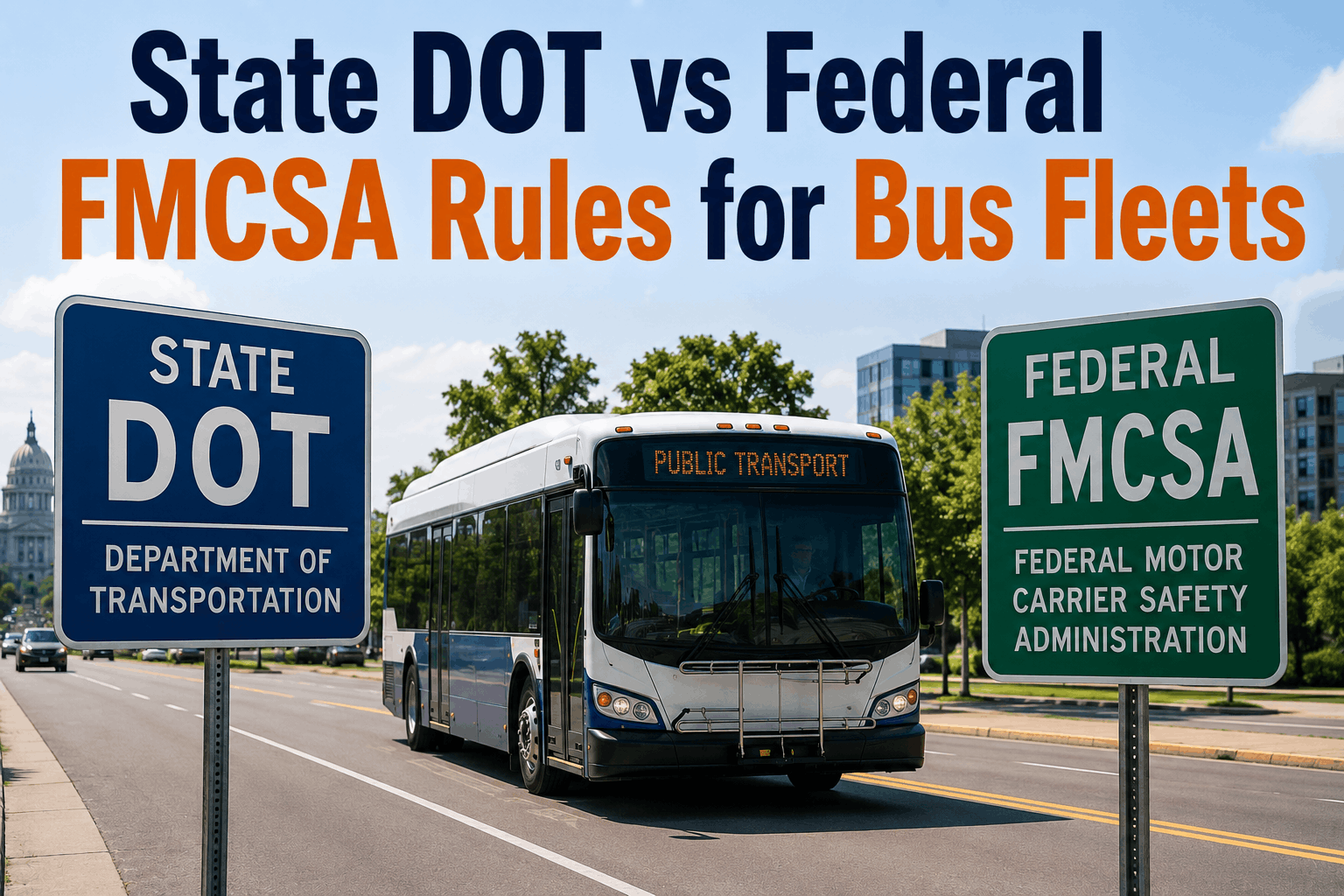
State DOT vs Federal FMCSA Rules for Bus Fleets
Two distinct layers of rules govern your passenger assets. Learn how state-level DOT requirements interact with federal FMCSA regulations and how to bridge compliance gaps.
Why Fleets Fail Dual-Jurisdiction Audits
Compliance failures rarely stem from flat-out ignoring the rules; instead, they happen because of minor details found in the structural differences between state and federal oversight loops. When a shop floor applies a single, generalized standard across all vehicle maintenance routines, they leave themselves wide open to localized compliance violations.
Reason 1: The Intrastate Operational Trap
Many operators assume that because their buses never cross state lines, federal FMCSA rules do not apply. However, most states have integrated federal safety regulations directly into state law for vehicles meeting specific weight or passenger-capacity limits.
Reason 2: Conflicting Inspection Rhythms
While the FMCSA mandates a baseline annual mechanical inspection under 49 CFR 396.17, many states require strict semi-annual or even quarterly physical vehicle reviews at state-certified inspection facilities to retain valid plates.
Reason 3: Divergent Equipment Requirements
Federal guidelines outline broad vehicle system standards, but states frequently enforce micro-level equipment additions—such as specialized first-aid kits, distinct reflective tape dimensions, or specific warning buzzer tones.
Reason 4: Fragmented Record-Retention Lifecycles
State enforcement teams often demand historical vehicle maintenance and driver service record logs extending far beyond the standard windows outlined by federal compliance books, leading to unexpected record-keeping gaps during audits.
The Jurisdictional Boundary: Assessing Real-World Risk
To properly secure your operational safety scores, you cannot treat compliance as a one-size-fits-all target. The true metric of compliance depends on understanding exactly how federal rules establish base baselines, while state laws layer unpredictable variations directly on top of them.
State DOT Mandates vs. Federal FMCSA Benchmarks
Topic: Preventive Maintenance Scheduling
FMCSA defaults to a standard 12-month inspection interval. State DOT agencies (such as those in California, New York, or Pennsylvania) frequently superimpose mandatory 90-day, 6-month, or school-bus specific garage check-ins.
Topic: Passenger Capacity Triggers
Federal rules generally focus on commercial motor vehicles built to transport 9 to 15 passengers for hire. State regulations often lower that threshold, tracking non-profit, medical shuttle, or local shuttle fleets of any size.
Topic: Driver Medical & Waiver Handling
FMCSA manages interstate medical qualification processes via centralized federal portals. Intrastate operators must instead navigate individual state-level DMV waiver loops, which may have different vision or physical requirements.
Topic: Emergency Tooling Specifications
Federal inspectors check for fundamental safety equipment like fire extinguishers and triangles. State highway patrols frequently audit for highly explicit local items, including specific passenger-compartment axes or wheel chock profiles.
The Fix: Automating Multi-Layer Compliance in a CMMS
Stop trying to balance dual compliance mandates on paper calendars. Build a unified, automated asset architecture within your fleet management system:
1
Tag Assets by Specific Jurisdictional Footprint
Group your vehicle assets within the CMMS by operational profile—Interstate, Intrastate, or State-Specific (e.g., School/Transit). This structure applies the correct regulatory filter to each bus automatically.
2
Layer Concurrent Preventive Maintenance Intervals
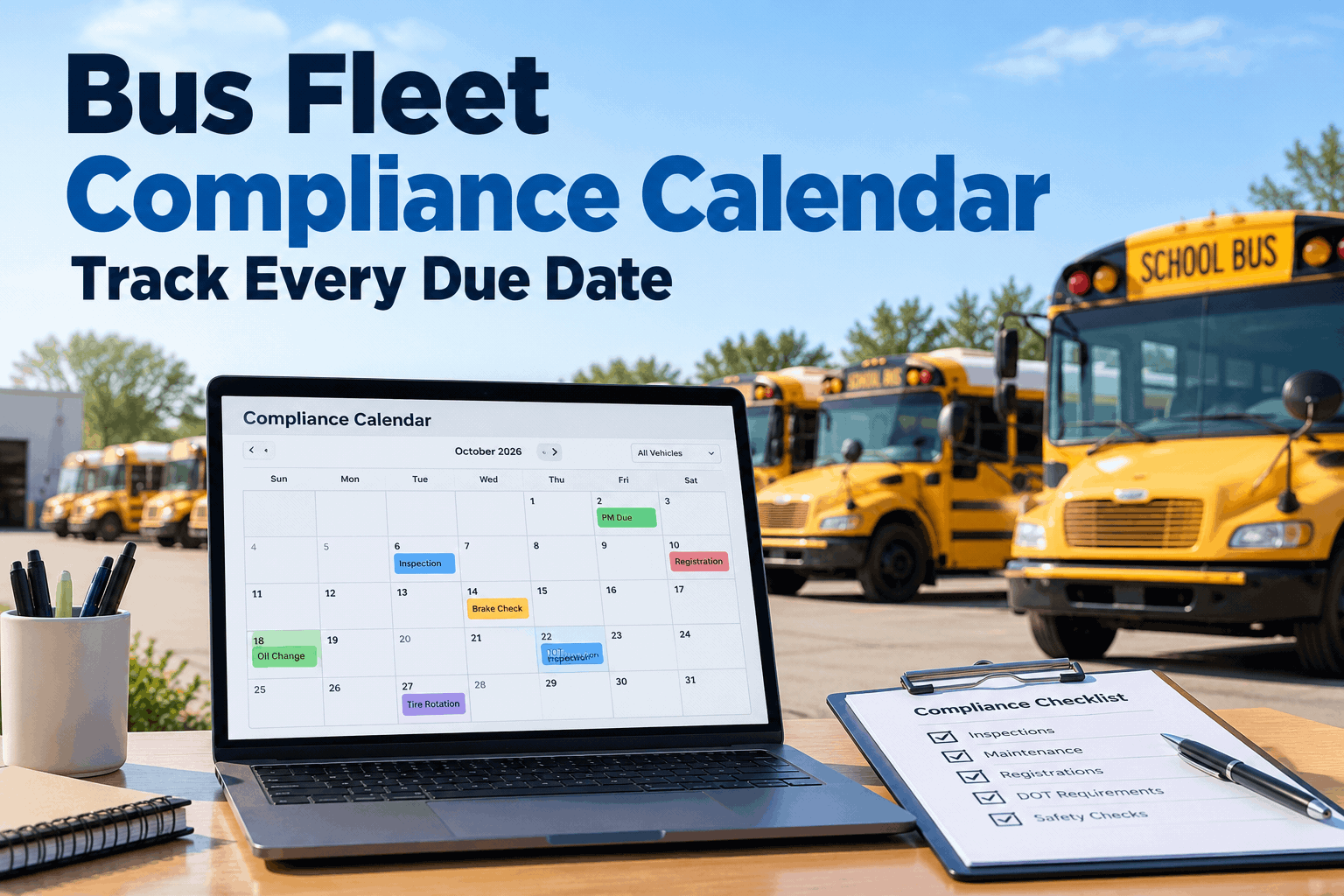
Program overlapping schedule triggers into the system. The software will track your standard 12-month federal inspections alongside your mandatory 90-day state checks on a single, clean timeline.
3
Deploy Dynamic Multi-Tier Inspection Checklists
Create electronic inspection workflows that adapt to the vehicle's assigned location. Technicians are prompted to check both FMCSA safety items and state-specific emergency hardware on the exact same service ticket.
4
Compile Centralized Split-Audit Report Libraries
Organize maintenance records so they can be instantly filtered. When a state Trooper or a federal auditor arrives at your facility, you can pull up a clean, tailored digital history log in seconds.
"We run a regional passenger charter network spanning three states. We always maintained a high federal FMCSA safety score, so we felt completely secure. That changed when a state DOT officer pulled one of our multi-passenger shuttles over for a roadside inspection and issued a severe fine because we lacked a specific state-level inspection decal and local safety tooling items. We realized our federal-only approach left dangerous gaps. Transitioning our compliance tracking to an automated CMMS allowed us to embed state-specific rules directly into our routine PM cycles. Our next regional compliance review was flawless. We finally have total visibility over both rule sets."
— Safety & Compliance Director, Tri-State Charter Services, Pennsylvania
Take the Chaos Out of Dual Compliance Management
Protect your operational authority across every state line. Automate overlapping state DOT and federal FMCSA maintenance schedules inside one centralized system.