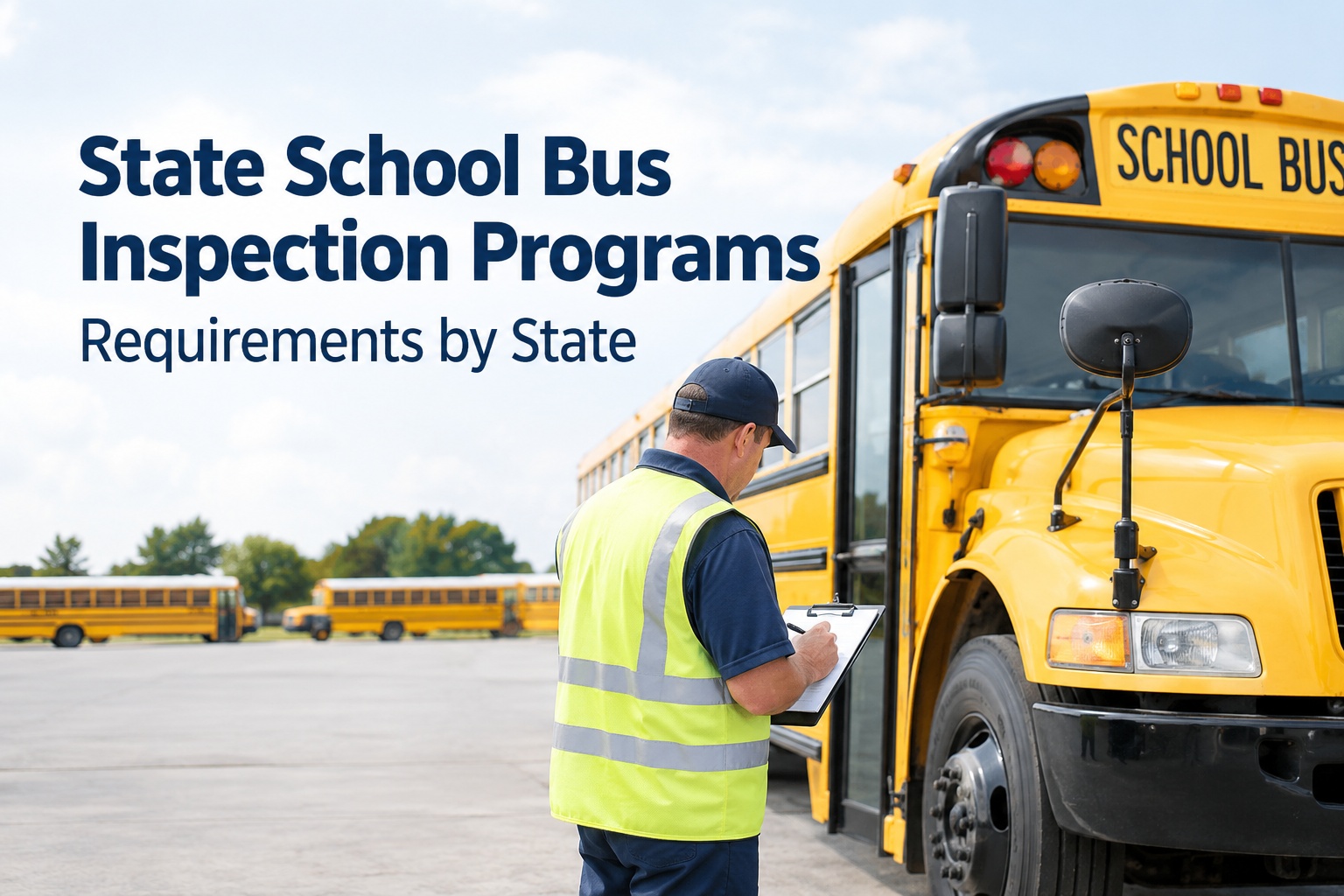
It is the third week of July. Your buses have to pass state inspection before the first bell in September, and the rules you are prepping against are not the federal ones every article quotes. State school bus inspection programs sit on top of the federal floor, and they vary more than most directors expect, in how often buses are checked, who does the checking, and what happens when one fails. This guide maps how those programs differ across the country, what trips fleets up, and how to walk into inspection day already knowing you will pass. Get the School Bus State Inspection Readiness Checklist in a quick BusCMMS demo.
Updated September 2026 · State requirements change; verify against your state's current official source before relying on any figure below
State School Bus Inspection Programs: How Requirements Differ by State
Inspection frequency, inspecting authority, out-of-service defects, reinspection, and the records that prove compliance.
The Federal Floor, and Why Your State Sits Above It
Start with the baseline, because state programs are written against it. Federal rules require an annual periodic inspection for commercial vehicles including school buses, emergency-exit checks every 90 days, and a driver vehicle inspection report each day a bus runs. That is the floor. It is the least a fleet can do, not the standard most fleets are actually held to.
States run their own school bus inspection programs on top of that floor, and they are frequently stricter. Some inspect twice a year. Some tie frequency to bus age. California layers a short-interval preventive inspection under its certification cycle. The inspecting authority differs too: in many states the state police or highway patrol perform the official inspection, not the district's own shop. The practical result is that "did we pass the federal inspection" is the wrong question. The right one is "did we pass the program that governs buses in our state." Book a demo to auto-schedule inspections against your state's actual cadence.
How Selected State Programs Compare
Here is a snapshot of how a few state programs differ. Treat it as a starting point, not gospel: programs change, and your own state may sit anywhere on this spectrum. Always confirm against the current official source named in each row before you plan around it.
- AuthorityCalifornia Highway Patrol certifies each bus at least once every 13 months
- PlusCarrier preventive inspection every 3,000 miles or 45 days, whichever first (13 CCR 1232)
- SourceCHP School Bus Program; CA Code of Regs Title 13
- AuthorityIndiana State Police perform the official inspection
- FrequencyAnnual on all buses; semi-annual on buses at least 12 years old
- SourceISP School Bus Inspection program and manual
- AuthorityMinnesota State Patrol inspects every school bus annually
- RuleCertificate valid 12 months; no bus operates without one displayed
- SourceMinnesota Statutes 169.451
- FrequencyWidely operated on a roughly every-six-months inspection cycle
- NoteAmong the states exceeding the federal annual minimum
- SourceConfirm current cadence with NYSDOT / State Police program
Two patterns jump out. First, frequency is not uniform: annual is the floor, but semi-annual and age-based schedules are common, and California's 45-day preventive interval is a different animal entirely. Second, the inspector is often not you. When a state trooper certifies the bus, the failure is public and the bus is grounded until it passes again, which raises the cost of walking in unprepared. Book a demo to store your state's schedule and certificate dates per bus. Or start free and set it up yourself.
What Actually Puts a Bus Out of Service
A failed inspection is rarely a surprise part. It is almost always one of the same handful of items that quietly drift out of spec between inspections. Some of these are automatic out-of-service findings: the bus does not leave the lot until it is fixed and re-inspected. Knowing the usual suspects lets you pre-inspect for exactly the things that fail buses.
Notice how ordinary these are. None requires a rebuild; all are catchable weeks ahead with a proper pre-inspection. The fleets that pass on the first attempt are not luckier, they simply check for these items before the trooper does. Book a demo to pre-inspect against your state's known failure points.
Out-of-Service, Reinspection, and the Records That Prove It
When a bus fails, the pattern is consistent across programs even if the details differ. The vehicle is placed out of service, the defects have to be repaired and documented, and the bus must pass a reinspection before it carries students again. Operating a bus that has been ordered out of service is where the real exposure lives, in fines and in liability if something goes wrong.
Out of service
The bus is grounded. It cannot transport students until the failed items are corrected.
Repair + document
Each failed item becomes a corrective work order, closed with parts, labor, and sign-off.
Reinspection
The bus is presented again and must pass before it returns to a route.
Record retained
The inspection result, repairs, and reinspection stay on the vehicle's history for audits.
The recordkeeping half is where quiet compliance gaps form. A defect logged but never repaired, a reinspection that happened but was never documented, a 90-day exit check nobody can produce: each is a preventable audit finding. Records must generally be retained for a defined period and made available on request, and a reviewer will often check the defect-to-resolution timeline first. Book a demo to keep every inspection, defect, and reinspection on one record.
Prepping 50 Buses for a Scheduled State Inspection
Here is an illustrative scenario with hypothetical numbers. A district has 50 buses and a state inspection date six weeks out. The director's job in those six weeks is to find every problem before the inspector does. Done on a spreadsheet, this is where things slip. Done as a structured sweep, it is a checklist that closes.
Find the overdue and the open
Pull every bus with an overdue inspection, an open defect, or a missing 90-day exit record. On a 50-bus fleet, expect a handful.
Pre-inspect for known failures
Run each bus against the usual out-of-service items: exhaust, brakes, reflective sheeting, buzzers, warning lights, safety kits.
Close the work orders
Every flagged item becomes a work order with parts ordered early, not at premium rush pricing the week of.
Confirm records are complete
Verify each bus has its inspection history, closed defects, and retained records ready to show. No gaps walk in.
The buses that fail on inspection day in this scenario are the ones nobody pre-inspected, and the records that trip an audit are the ones nobody could produce. Both are avoidable with six weeks and a system that surfaces the gaps for you instead of hiding them in a spreadsheet. Book a demo to see this exact readiness sweep across a 50-bus fleet.
How Fleets Keep Every Bus Inspection-Ready
Inspection readiness is not a July scramble; it is a state you stay in year-round. The fleets that pass cleanly share the same habits, and every one of them is easier with a system that gives the director, the shop, and the administration the same underlying data instead of three disconnected views.
- State schedule per bus. Each bus carries its own inspection cadence and certificate date, matched to the program that governs it.
- Pre-inspect two weeks early. Enough runway to order parts, make repairs, and reinspect before the official date, not after a failure.
- Every defect becomes a work order. A flagged item that does not generate a tracked, closable work order is a gap waiting to fail.
- 90-day and daily checks documented. Emergency-exit and daily inspection records kept and producible, since reviewers look for them specifically.
- Role-based visibility. Directors see readiness, the shop sees the work, administrators see compliance, all from the same fleet data.
BusCMMS is built around exactly this. It auto-schedules inspections to your state's cadence, turns every defect into a corrective work order, keeps inspection and reinspection history on the vehicle record, and gives each role its own view of the same data. Compliance evidence then falls out of daily operations instead of being rebuilt the week before a state inspection. Book a demo to see role-based inspection readiness on your own fleet.
The Bottom Line on State School Bus Inspection
State school bus inspection is not one rule, it is fifty programs sitting on a federal floor, and the one that matters is the one where your buses run. Frequency ranges from annual to semi-annual to age-based to California's 45-day preventive interval; the inspector is often a state trooper, not your shop; and a failure grounds the bus until it is repaired, documented, and reinspected. None of that is hard to pass. It is hard to pass by accident. Know your state's program, pre-inspect for the handful of items that actually fail buses, close every defect on a work order, and keep the records producible, and inspection day becomes a formality instead of a gamble. Get the School Bus State Inspection Readiness Checklist in a BusCMMS demo.
How often are school buses inspected?
The federal minimum is an annual periodic inspection, with emergency-exit checks every 90 days and daily driver inspection reports. Many states are stricter. Indiana requires annual inspections on all buses and semi-annual on buses at least 12 years old; Minnesota inspects every bus annually with a 12-month certificate; New York is widely operated on a roughly semi-annual cycle; and California certifies each bus at least every 13 months while also requiring a preventive inspection every 3,000 miles or 45 days, whichever comes first. Always confirm your own state's current cadence.
Who inspects school buses?
It depends on the state. In many states the official inspection is performed by the state police or highway patrol, such as the Indiana State Police, the Minnesota State Patrol, or the California Highway Patrol. Some states use state-certified inspectors or approved facilities. Districts still perform their own daily and preventive inspections through qualified in-house or ASE-certified technicians, but the certifying inspection that lets a bus carry students is frequently a state authority, which is why a failure is public and grounds the bus.
What causes a school bus to fail inspection?
The common failure points are consistent: exhaust leaks (often an automatic out-of-service finding due to carbon monoxide risk), brake linings worn below the minimum thickness, faded reflective sheeting on the stop arm or side chevrons, a non-functional emergency-exit buzzer, a failed lamp or out-of-spec flash rate in the eight-light warning system, and missing or expired safety equipment like the fire extinguisher, first-aid kit, or reflective triangles. Nearly all are catchable with a pre-inspection two weeks ahead of the official date.
What happens after a bus fails?
The bus is placed out of service and cannot transport students until the failed items are repaired and documented and the bus passes a reinspection. Operating a bus that has been ordered out of service exposes the district to fines and liability. The practical path is to turn each failed item into a corrective work order, complete and sign off the repair, present the bus for reinspection, and retain the full record of the failure, the repairs, and the passing reinspection on the vehicle's history.
How can a fleet prepare for a state inspection?
Start two weeks or more before the official date, not the day before. Pull every bus with an overdue inspection, an open defect, or a missing record; pre-inspect each against the known out-of-service items; turn every flag into a work order with parts ordered early rather than at rush pricing; and confirm each bus has complete, producible inspection and reinspection records. A system that auto-schedules to your state's cadence and surfaces the overdue and open items for you turns a July scramble into a routine sweep.