A 45-bus school district spends $18,000 per year in parts inventory. They don't know why. Mechanics order parts without consulting anyone. A mechanic orders a transmission cooler because they suspect it might be the cause of overheating. The part costs $340. It arrives. It doesn't fix the problem. The transmission cooler sits in inventory, gathering dust. The mechanic never follows up. Six months later, someone discovers $4,200 in unused parts sitting on shelves. The district has zero visibility into parts spending. They have no approva l workflow. There's no consequence for ordering expensive parts on a hunch. Industry data shows unauthorized parts spending averages $22,000 annually for a 45-bus fleet. That's $488 per bus per year in waste. For many fleets, it's the single largest controllable expense they're not actually controlling. Here's how to implement approval workflows that require manager sign-off on expensive parts, prevent wasteful orders, and improve repair accuracy without slowing down necessary repairs.
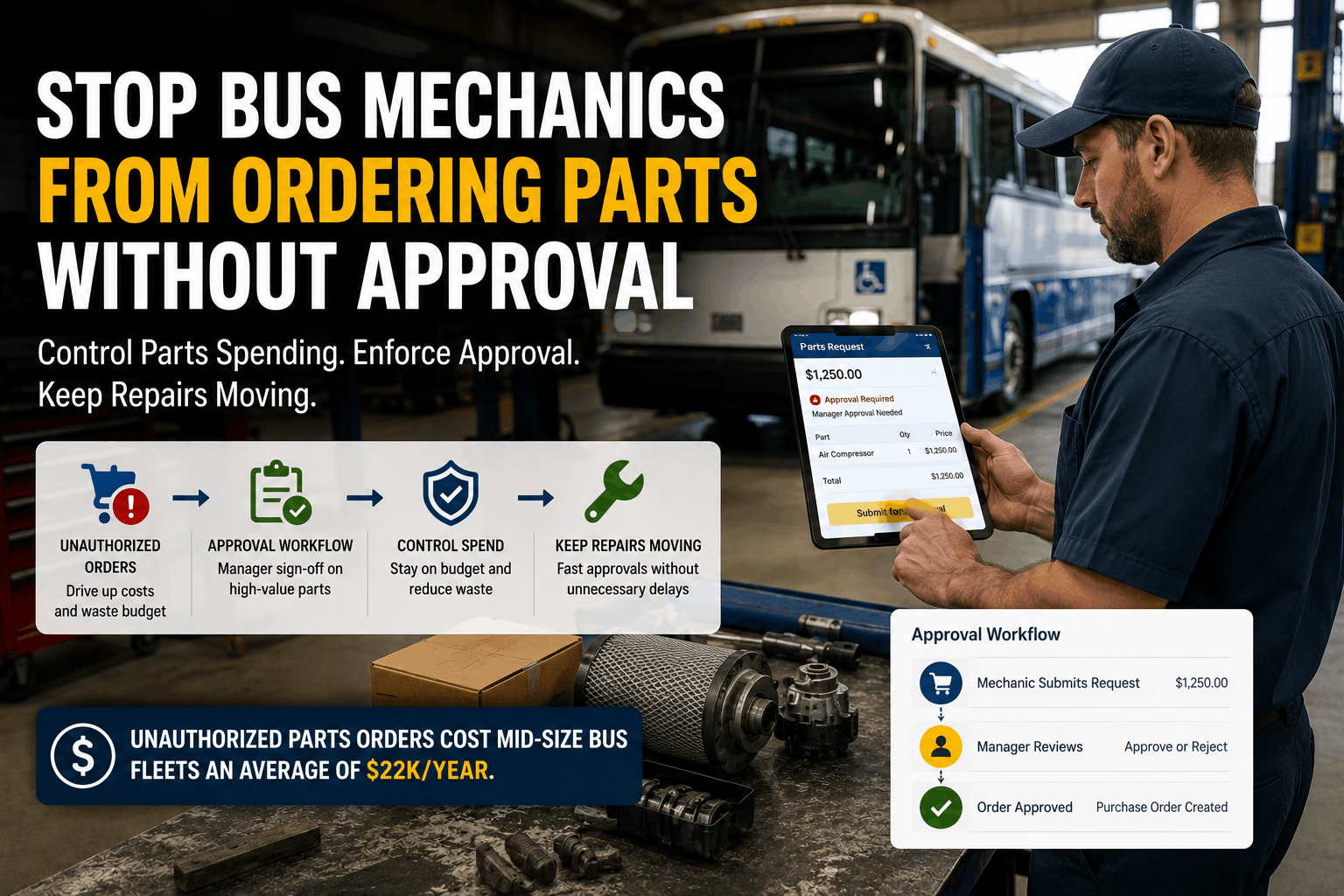
Stop Bus Mechanics From Ordering Parts Without Approval
Unauthorized parts orders cost mid-size bus fleets an average of $22K/year. How to configure CMMS approval workflows that require manager sign-off on parts over threshold — without creating bottlenecks that slow repairs. Complete parts approval system that prevents waste while ensuring emergency repairs aren't delayed.
The Unauthorized Parts Problem: Why Mechanics Order Without Asking
Mechanics aren't being reckless. They're being pragmatic. A mechanic diagnoses a problem and needs a $520 fuel injector. They call the parts vendor. They order the part. It arrives in 2 hours. They install it and fix the bus. From the mechanic's perspective, they're doing their job efficiently. But from a fleet management perspective, that $520 part might not have been necessary. Maybe the fuel injector was fine and the real problem was a clogged fuel filter ($45). Or maybe the part should have been ordered in bulk the previous month when the bus was scheduled for maintenance, not in an emergency panic moment when the mechanic is stressed and not thinking clearly about diagnostics.
The root causes of unauthorized ordering: (1) Mechanics feel empowered to make decisions because no one has told them they need approval. (2) No consequences exist for ordering the wrong part or wasting money — the mechanic doesn't pay for it, so they don't feel the cost. (3) Urgency pressure: "The bus needs to be fixed today or we lose a route," so the mechanic bypasses normal procurement to get parts faster. (4) Lack of visibility: Management doesn't know parts have been ordered until the invoice arrives weeks later.
The financial impact: Industry average: $22,000 annually for a 45-bus fleet. Breakdown: $12,000 in truly unnecessary parts (mechanic ordered wrong part, ordered expensive part when cheaper alternative existed). $6,000 in parts ordered but never installed (sitting in inventory). $4,000 in parts ordered for problems that resolved themselves or were diagnosed incorrectly.
The Approval System: Tiered Thresholds That Balance Speed and Control
A smart parts approval system doesn't require approval for every part. That would create paralysis: a mechanic needs a $8 air filter but can't order it without manager approval? That doesn't make sense. Instead, a tiered system requires approval only for parts above certain cost thresholds, and uses different thresholds based on part type and repair urgency.
Typical tiered structure
Tier 1 (<$50): No approval required. Mechanic can order immediately. Examples: filters, belts, hoses, fluids.
Tier 2 ($50-$300): Manager approval required. Mechanic submits order with brief diagnosis and reasoning. Manager can approve in under 5 minutes by seeing: part description, cost, mechanic's diagnosis, repair urgency (is this an emergency repair or preventative maintenance?). If approved, order is placed immediately.
Tier 3 (>$300): Manager + Maintenance Director approval required. Higher cost parts (transmissions, engines, complex components) require two levels of sign-off. This prevents the scenario where a mechanic and a sympathetic manager both make poor judgment calls.
Emergency override protocol
For true emergencies (bus broken down on the road, route cannot be covered without this repair), the mechanic can flag an order as "Emergency — Requires Immediate Approval." This bypasses the normal process and goes directly to the Maintenance Director with SMS notification and 2-minute approval window. If approved, parts are ordered immediately. If not approved, the alternative (cheaper part, different repair approach, delay route) is communicated.
Implementation: How to Roll Out Approval Workflows Without Friction
Phase 1: Communication and Training (Week 1)
Before implementing approval workflows, explain the why. Mechanics need to understand that the goal is not to prevent repairs — it's to prevent wasteful spending that ultimately comes out of their maintenance budget (which could otherwise go to better tools, raises, or improved working conditions). Show them the data: $22,000 a year in wasted parts is real money. Describe the tiered system: small parts are free to order; expensive parts just need a manager nod. Emphasize that emergency repairs are protected by the emergency override.
Phase 2: Configuration (Week 2)
Set your cost thresholds based on your fleet and budget. For a school district: <$50 (no approval), $50-$200 (manager), >$200 (director). For a charter company: <$75, $75-$400, >$400 (higher thresholds because parts are more expensive). Configure the system so mechanics see the thresholds when they go to order: "This $120 part requires manager approval. Estimated approval time: 5 minutes. To expedite, mark as emergency repair." This transparency prevents surprise rejections.
Phase 3: Soft Launch (Week 3-4)
Run the approval system in "monitor mode" for 2 weeks. Mechanics order parts normally, and the system tracks approvals, but doesn't actually block orders. The goal is to understand the baseline: How many Tier 2 orders do you have daily? Which mechanics order the most? What parts get rejected? This data informs whether your thresholds are realistic.
Phase 4: Enforcement (Week 5+)
Activate real blocking. Mechanic tries to order a $250 part; system requires approval. Manager gets notification. Approval is granted or requested with clarifications ("Can you try the $95 alternative first?"). The system becomes a normal part of the workflow.
Preventing Bottlenecks: Fast Approval Processes That Don't Slow Repairs
The fear with approval systems is that they'll slow repairs. A mechanic needs a part; the manager is in a meeting; the bus sits idle for 2 hours waiting for approval. To prevent this, build the system with speed in mind:
Speed Factor 1: Approval Notification
When a mechanic requests approval, the manager must be notified immediately via multiple channels: mobile app push notification, SMS text, and email. If using the app, the manager can approve in 20 seconds (read request, tap "Approve"). If not on app, SMS has "Reply APPROVE" or "Reply DENY" buttons.
Speed Factor 2: Approval Window
Set a clear SLA: Tier 2 approvals must be approved or rejected within 5 minutes. Tier 3 approvals within 15 minutes. If the deadline is missed, the order is automatically escalated to the next level (if Tier 2 manager doesn't respond in 5 minutes, automatically notify the Director). This prevents the system from becoming a bottleneck.
Speed Factor 3: Pre-Approved Parts
Certain parts can be pre-approved for specific repair scenarios. Example: "If bus has error code P0401 (EGR fault), approve EGR valve replacement up to $180 without manager review." This is based on mechanical diagnosis, not guessing. If the mechanic documents a specific diagnosis, certain parts are automatically approved.
Speed Factor 4: Alternative Suggestions
When a mechanic requests approval for a $340 part, the system can suggest: "3-year-old buses using this part typically fail due to [X] — have you checked [cheaper solution]?" This isn't blocking the order; it's providing information that might improve diagnosis. Some mechanics will say "You're right, let me check that first." Others will say "I've already checked it; this part is necessary," and approval is granted.
Data Insights: What Your Parts Approval System Reveals
A parts approval system isn't just about blocking orders. It creates a data stream that reveals patterns about your fleet and your mechanics' diagnostic accuracy. Over 3-6 months, analyze:
Insight 1: Mechanic Diagnostic Accuracy
Mechanic A orders a lot of expensive parts and they usually fix the problem (90% success rate). Mechanic B orders a lot of expensive parts and only 60% of them actually fix the problem. This suggests Mechanic B might benefit from diagnostic training. You're not punishing them; it's identifying where investment in training would help.
Insight 2: Bus Reliability Patterns
If three buses in your fleet account for 40% of expensive parts orders, those buses might be reaching end-of-life. You can make better capital budgeting decisions: replace these buses vs. continuing to repair them.
Insight 3: Vendor Pricing Variations
A $150 part from Vendor A consistently fails within 6 months. The same part from Vendor B at $180 lasts 3 years. The approval system can surface this data so purchasing can negotiate better prices or switch vendors.
Insight 4: Seasonal Patterns
Certain parts fail more in winter (brake fluid issues, cold-weather battery problems). Your approval system can highlight this so you can shift to preventative replacement in fall rather than reactive ordering in winter.
We implemented parts approval thresholds and immediately started seeing the waste. Mechanic A was ordering expensive parts constantly, most of which didn't fix the problem. We gave him additional diagnostic training. His part orders dropped 30% and his repair success rate actually improved. Mechanic B was fine — he ordered parts thoughtfully and usually diagnosed correctly. The biggest surprise was discovering that our most expensive recurring repair (transmission issues on three buses) wasn't mechanical — it was driver behavior. We added driver training and transmission failures dropped 65%. The approval system didn't slow us down; it actually helped us fix problems faster because we were being more thoughtful about root causes instead of just throwing parts at symptoms.
Parts Approval Questions
How much can we save with parts approval workflows?
Industry average: $22,000 annually for 45-bus fleet ($488 per bus). Most fleets reduce this by 40-60% through approval systems, saving $8,800-$13,200 annually. A 100-bus fleet saves $25-30K per year. The system investment pays for itself in 3-6 months.
What happens if a mechanic orders a part in an emergency without waiting for approval?
The system has an "Emergency Override" that allows immediate ordering with post-action approval. The order goes through, but it's flagged for review and the manager is notified immediately. If the manager disagrees with the decision, they can discuss with the mechanic about future similar situations, but the repair isn't reversed.
Do approval systems damage mechanic morale?
Only if communicated poorly. If presented as "we're checking your work to catch mistakes," yes. If presented as "we're checking to make sure expensive parts are really necessary," mechanics are usually fine with it. Most mechanics hate guessing anyway — they prefer diagnostic confidence. The approval process often improves morale because it validates their decisions.
What cost thresholds should we set?
It depends on your fleet size and budget. Small districts: <$50, $50-$150, >$150. Mid-size: <$75, $75-$300, >$300. Large agencies: <$100, $100-$500, >$500. Start conservative; you can adjust after 3 months of data showing which thresholds create the most value without friction.
How long does manager approval actually take?
With a mobile app: 20-40 seconds (read the request, approve). With SMS: 30-60 seconds (read text, reply). With email: 2-5 minutes (check email, respond). Average: under 2 minutes for straightforward approvals. More complex requests (where manager asks clarifying questions) might take 5-10 minutes, but that's rare.
What if the mechanic and manager disagree about what part is needed?
The system allows the manager to make an alternative suggestion: "Try the $95 fuel filter before ordering the $240 injector." If the mechanic tries the filter and it works, great. If it doesn't, the injector order is now approved based on documented attempt. This prevents both guessing and wasting expensive parts.
How do we handle parts that have variable pricing from different vendors?
The system can be configured to require approval for parts that exceed a price threshold OR that are X% more expensive than the mechanic's preferred vendor. If a mechanic requests a $250 part that normally costs $180 elsewhere, approval is required with the price variance highlighted. This encourages good vendor discipline.
Stop Wasting $22K per Year on Unauthorized Parts
Tiered approval workflows. Fast manager sign-off. Emergency overrides. Comprehensive parts analytics. The complete system that prevents wasteful orders without slowing necessary repairs. See how mid-size fleets save $10-15K annually while improving diagnostic accuracy and mechanic accountability.