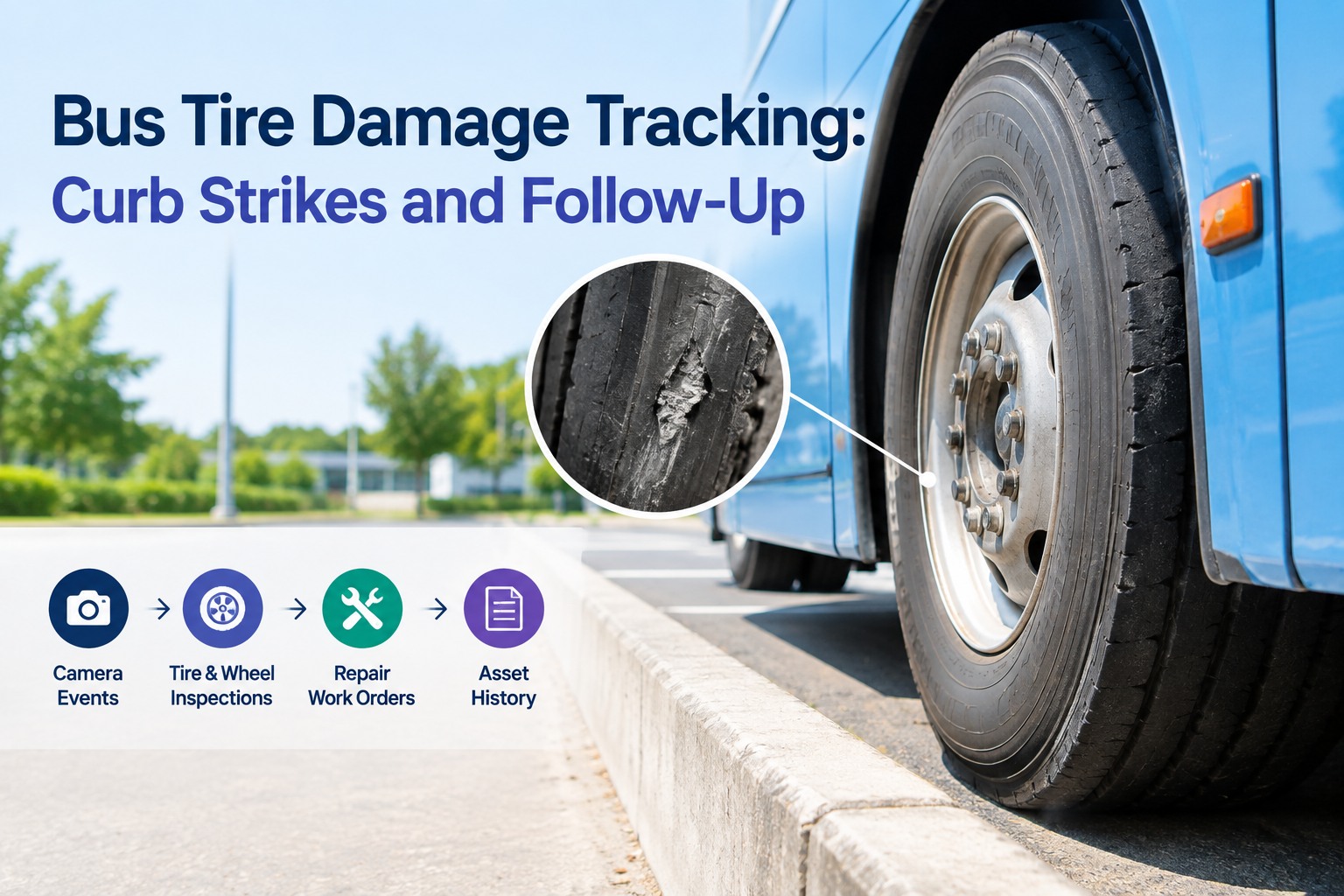
Bus tire damage tracking is the practice of catching curb strikes and other tire and wheel impacts, inspecting the tire promptly, and recording the result — so a hit that looks harmless today does not become a blowout next week. The danger with curb strikes is exactly that they are easy to shrug off: the bus keeps rolling, but the sidewall, rim, or bead may be quietly compromised until it fails on a route.
Bus Tire Damage Tracking: Curb Strikes and Follow-Up
A curb strike rarely shows its damage right away. Track the hit, inspect the tire, and follow up — before a small impact becomes a roadside failure.
Updated September 2026 · A practical guide, not legal advice; inspection practices vary by vehicle, state, and fleet.Curb strikes are among the most common impacts a bus takes — tight turns, crowded loading zones, snowbanks hiding the curb line. Most are minor. The problem is that the few that are not do not announce themselves, and a fleet that treats every strike as a non-event eventually pays for it with a failure that could have been caught. Tracking turns a fleeting bump into a documented inspection.
Why a curb strike is dangerous later, not now
The reason curb strikes deserve their own workflow is timing: the damage and the failure are often weeks apart. A hit pinches the sidewall or knocks the rim out of true, the bus finishes its route fine, and the weakened tire fails later under load — far from the curb that caused it. Here is what a strike can leave behind that a quick glance misses.
A pinch or bulge in the sidewall weakens the tire structurally, and it can let go suddenly later even though the tread looks fine.
A bent rim or damaged wheel can cause a slow leak, vibration, or an uneven seat that only shows up over the following days.
The impact can break the bead seal, so the tire loses pressure gradually — a leak that is easy to miss until it is low.
Internal cords or plies can be damaged with no visible mark outside, which is exactly why a strike calls for a real inspection, not a look.
None of these are reliably visible from the driver's seat, and several are not obvious even walking past. That is the case for tracking every strike and inspecting deliberately — the cost of one blown tire on a loaded route dwarfs the minute it takes to check. Book a demo to flag every curb strike for inspection
The post-strike tire and wheel inspection
After a strike, the check should go beyond a kick of the tire. This is the focused inspection that catches the hidden damage — quick enough to do before the next run, thorough enough to trust the result.
- Sidewall for cuts, bulges, or pinch marks
- Tread and shoulder for gouges or exposed cord
- Pressure checked against spec, not eyeballed
- Valve stem intact and not sheared or leaking
- Rim for bends, cracks, or curb gouging
- Bead area seated evenly with no leak
- Lug nuts and hardware tight and undamaged
- Any vibration or wobble noted on a slow roll
If anything fails, the tire comes out of service until it is resolved — and the finding, with a photo, goes on the record rather than into someone's memory. A documented "inspected, no damage found" is as valuable as a repair, because it proves the strike was handled. Start free and put this inspection in every driver's hand
From strike to resolved: the follow-up loop
Tracking is only useful if the strike leads somewhere. A connected loop takes a curb strike from the moment it is detected through inspection to a documented outcome — repaired, replaced, or cleared — so nothing is flagged and then forgotten.
Detect
A curb strike is flagged by a camera event or reported by the driver, tied to the bus and time.
Inspect
The tire and wheel are checked against the post-strike list before the next run.
Assess
Findings and a photo are recorded — damage confirmed, or a clean result logged.
Work order
If damage is found, a work order opens against the bus with the evidence attached.
Repair or retire
The tire or wheel is repaired or replaced and signed off, with parts and cost logged.
Record
The whole chain stays on the bus's asset history — strike, inspection, outcome.
At the end, a curb strike is not a rumor and a tire is not a question mark — the record shows it was caught, checked, and resolved. And because the strike also lands on the bus's asset history, repeated strikes on the same bus or route become visible over time. Book a demo to see the strike-to-repair loop on one record
Why strikes slip through: detection and repair are disconnected
The recurring failure is a gap between systems. A camera or telematics event may register the curb strike, but that lives in the vendor portal, while tire inspections and repairs are tracked separately. So the strike is recorded somewhere no mechanic sees, no inspection is triggered, and the tire keeps running until it fails — with no clear record of whether the hit was ever checked.
BusCMMS is an AI-native, hardware-agnostic bus fleet operations platform that closes that gap. It connects curb-strike and impact events from the MDVR or AI camera and telematics systems you already run — no rip-and-replace — to bus asset records, incidents, and maintenance work orders. A detected strike links to the bus and tire position, opens an inspection, turns confirmed damage into a tracked work order, and keeps the whole follow-up on one record — so no strike is flagged and forgotten. Start free and connect strike detection to inspections
What the regulations require
A quick, honest note on the rules: they set the expectation to keep tires safe and inspected, but they do not hand you a curb-strike workflow. That part is operational judgment.
Requires systematic inspection, repair, and maintenance of commercial motor vehicles, and the records to show it — which covers keeping tires and wheels in safe operating condition. A documented post-strike inspection supports that duty.
Covers periodic inspection requirements, part of which involves the vehicle's tires and wheels being examined on a regular basis. Curb-strike follow-up complements those periodic checks between them.
Neither rule prescribes a specific curb-strike detection or follow-up process, and beyond the federal baseline, tire inspection, documentation, and retention practices may depend on your vehicle, state, district, and fleet requirements. This page is a practical guide, not legal advice — confirm what applies to your operation. Book a demo to keep tire inspections documented and current
See how a curb-strike event becomes a closed work order in BusCMMS
Watch a curb-strike event link to the right bus and tire position, open an inspection before the next run, and turn confirmed damage into a tracked, closed work order — all on one bus record, using your existing MDVR, AI camera, or telematics events. Hardware-agnostic, no rip-and-replace.
Hardware-agnostic · Works with your existing cameras and telematics · One record per bus
Frequently asked questions
What is bus tire damage tracking?
Bus tire damage tracking is the practice of catching tire and wheel impacts — most commonly curb strikes — inspecting the affected tire promptly, and recording the outcome against the specific bus. Because a curb strike can weaken a tire without leaving an obvious mark, the aim is to make sure every strike triggers a real inspection before the bus runs again, and that the result is documented whether damage is found or not. Handled as one connected workflow rather than a forgotten bump, it prevents hidden damage from becoming a roadside failure and builds a tire and wheel history on each vehicle.
Why are curb strikes dangerous if the bus seems fine?
Because the damage from a curb strike is often hidden and delayed. A strike can pinch or bulge the sidewall, bend the rim, break the bead seal, or damage internal cords — none of which are reliably visible from the driver's seat or even a walk-past. The bus finishes its route without issue, but the weakened tire can fail later under load, far from the curb that caused it. That gap between the impact and the failure is exactly why a strike calls for a deliberate inspection rather than a glance, and why tracking the event matters even when the tire looks fine.
What should a post-curb-strike inspection cover?
It should examine both the tire and the wheel. On the tire: the sidewall for cuts, bulges, or pinch marks; the tread and shoulder for gouges or exposed cord; the pressure checked against spec rather than eyeballed; and the valve stem for damage or leaks. On the wheel: the rim for bends, cracks, or curb gouging; the bead area for an even, leak-free seat; the lug nuts and hardware; and any vibration or wobble on a slow roll. If anything fails, the tire should come out of service until it is resolved, and the finding — including a clean result — should be recorded with a photo so the strike is provably handled.
Do the regulations require curb-strike tracking?
Not specifically. 49 CFR 396.3 requires systematic inspection, repair, and maintenance of commercial motor vehicles and the records to show it, and 49 CFR 396.17 covers periodic inspection requirements — both of which relate to keeping tires and wheels in safe operating condition and documented. A post-strike inspection supports those duties, but neither rule prescribes a specific curb-strike detection or follow-up process. Beyond the federal baseline, tire inspection, documentation, and retention practices may also depend on your vehicle, state, district, and fleet requirements, so confirm what applies to your operation. This page is a practical guide and does not provide legal advice.
Do we need new cameras to detect curb strikes?
No. BusCMMS is hardware-agnostic and is designed to connect curb-strike and impact events from the MDVR, AI camera, or telematics systems you already operate to bus asset records, incidents, and maintenance work orders, without a rip-and-replace deployment. A detected strike links to the correct bus and tire position, opens an inspection before the next run, turns confirmed damage into a tracked work order, and keeps the follow-up on one record. The goal is to connect the detection you already have to the inspection and repair workflow, using your current hardware, so no strike is flagged and forgotten.