The most damaging compliance failures in U.S. bus fleet operations are not dramatic equipment failures — they are documentation failures. A bus completes its annual DOT inspection on schedule. The technician performs a proper brake test, verifies all safety systems, and documents the results on a paper form stored in a plastic binder. Six months later during an FTA (Federal Transit Administration) audit or FMCSA (Federal Motor Carrier Safety Administration) roadside inspection, that documentation cannot be located. The inspector issues a violation citing missing annual inspection record. Your fleet faces a $500–$5,000 per-vehicle penalty, potential insurance premium increases, and operational scrutiny from state oversight agencies. The inspection was performed correctly; the system for tracking that completion failed. This comprehensive guide covers the 7 most common bus fleet compliance mistakes that lead to DOT violations, FTA audit failures, and insurance claim denials, and demonstrates how digital CMMS platforms with automated compliance tracking prevent each mistake systematically across your entire fleet.
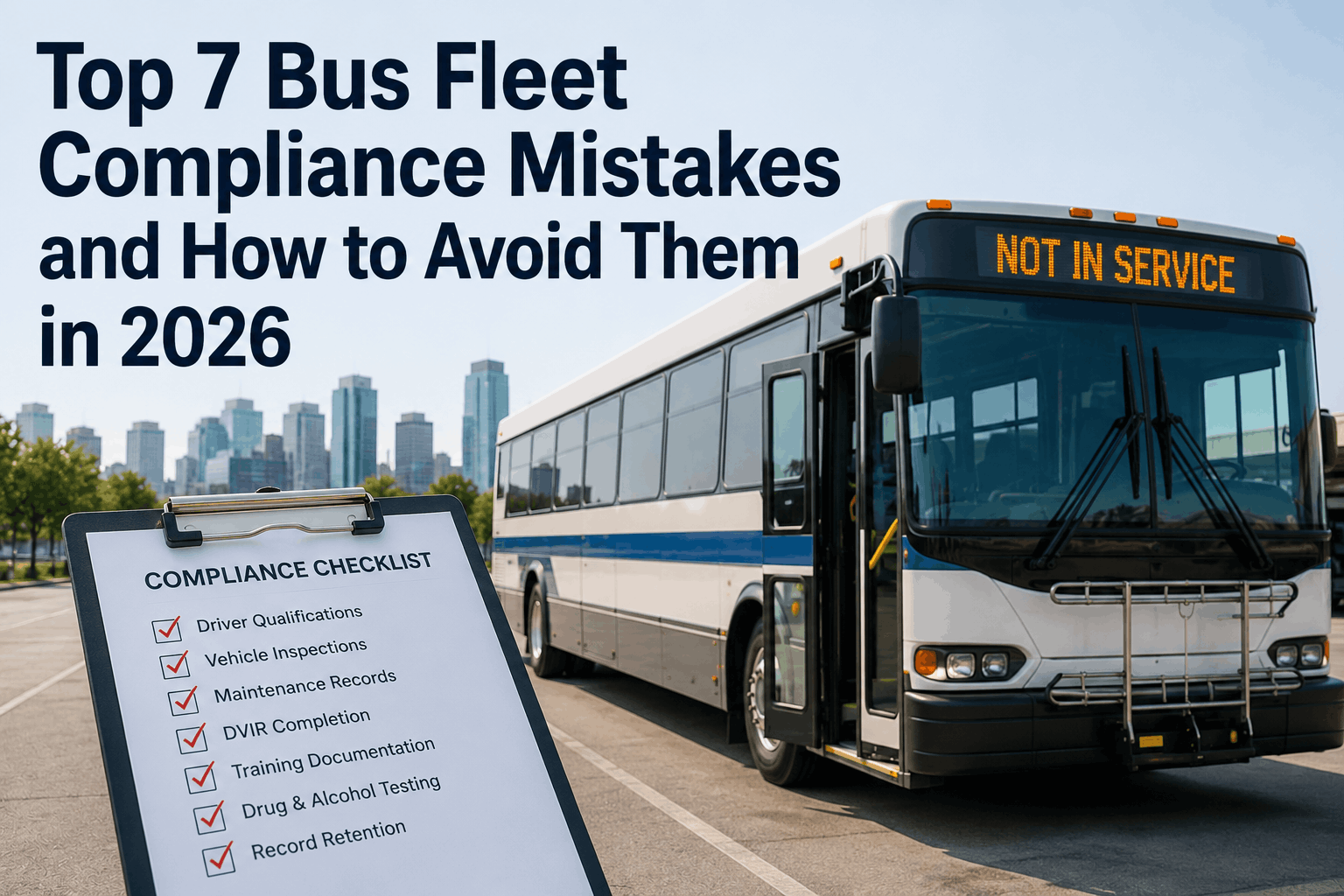
Top 7 Bus Fleet Compliance Mistakes and How to Avoid Them in 2026
Complete guide to avoiding DOT violations, FMCSA compliance errors, FTA audit failures, and insurance claim denials through automated digital compliance tracking and documentation in BusCMMS.
Compliance Failure Impact Metrics
Average DOT violation fine per bus
$2,400
Compliance mistakes caught in audits
78%
Insurance premium increase after audit failure
18-35%
Fleets with documentation systems preventing violations
92%
Audit failure risk without automated tracking
84%
Mistake #1: Missing or Incomplete Driver DVIR Records
Federal regulation 49 CFR 396.11 requires drivers to complete a Driver Vehicle Inspection Report (DVIR) after every shift, documenting the condition of the vehicle — brakes, lights, steering, tires, emergency equipment, passenger safety features. The DVIR must identify any defects discovered, and any defect must be corrected before the vehicle operates again (or the vehicle must be taken out of service if the defect is safety-critical). This is not optional. It is federal law. Yet most fleets operating on paper DVIR forms experience 15–35% non-compliance — drivers forget to complete the form, complete it incorrectly, or complete it but it gets lost before being filed. During a FMCSA roadside inspection or FTA audit, inspectors request DVIR records for the last 30 days. If your fleet cannot produce complete DVIR records for every vehicle, you receive a violation citation.
The risk is compounded by liability exposure. If a bus is involved in an accident and investigation reveals that a safety defect was noted on a DVIR three weeks prior but was never repaired, your fleet faces negligence liability for operating an unsafe vehicle. Insurance companies deny claims when fleet records show documented defects that were not addressed. Your legal liability extends beyond FMCSA fines into personal injury litigation. A single unrepaired brake defect documented on a DVIR that leads to an accident costing $2M in damages creates insurance exposure far exceeding the compliance fine itself. BusCMMS eliminates this risk by making DVIR completion digital, mandatory, and automatic escalation of reported defects to corrective maintenance work orders.
Mistake #2: Missed or Undocumented Annual DOT Inspections
49 CFR 396.17 requires annual vehicle inspections for all buses carrying passengers. This is a calendar-driven compliance requirement — if a bus passes its annual inspection on March 15, 2024, it must be re-inspected by March 15, 2025. Missing this deadline by even one day creates a compliance violation. For a 50-bus school district, that is 50 separate annual deadlines to track. For a 200-bus transit system, 200 deadlines. Using spreadsheets or manual compliance calendars, missing even 5–10% of those deadlines is typical — creating 10–20 vehicles operating without current annual inspection documentation. When auditors pull records, these gaps are immediately visible and result in violations.
The second part of this mistake is incomplete documentation. A vehicle passes its annual inspection, but the detailed inspection report is not stored in the vehicle's compliance file. During an audit, the inspector asks to see the annual inspection documentation and you cannot produce it. The inspection was performed; the documentation just was not retained or filed properly. BusCMMS solves both aspects: automated 90-day advance alerts before any vehicle's annual inspection deadline (giving you time to schedule the service), automatic documentation storage in the vehicle's permanent compliance file, and audit-ready reports that can be generated in a single click showing every vehicle's inspection status and completion date.
Mistake #3: Poor Driver Qualifications File Management and Medical Certification Lapses
Every commercial bus driver must maintain current medical certification, valid commercial driver's license (CDL), and documented training records including vehicle safety orientation and passenger safety procedures. Each of these expires at different intervals — medical certification every 1–2 years depending on condition, CDL renewal every 4–8 years, training certifications varying by state and employer requirements. For a fleet of 100 drivers, tracking 300+ separate compliance deadlines across distributed driver files is a logistics nightmare. When one deadline is missed — a driver's medical certification lapses and they continue operating a bus — you have a federal compliance violation plus potential liability for operating an unqualified driver.
The documentation mistake compounds this. Even when drivers maintain current certifications, many fleets do not maintain organized, audit-ready driver qualification files. A driver's medical card is stored in the dispatch office; their training certificate is in the HR department; their CDL photocopy is in the operations manager's drawer. During an audit, the inspector asks to see the complete driver qualification file and it cannot be assembled quickly. BusCMMS maintains digital driver profiles with all qualifications, certification dates, renewal deadlines, and automated alerts when any certification is approaching expiration. When audit time arrives, a complete driver qualification file can be generated for every driver in your fleet with a single click.
The 7 Compliance Mistakes: Risk Level & Audit Impact
Missing DVIR Records
Critical
$500–$2,400/vehicle
Missed Annual Inspections
Critical
$1,000–$5,000/vehicle
Driver Qualification Lapses
Critical
$500–$3,000/driver
Incomplete Brake Documentation
High
$400–$1,500/vehicle
Poor Vehicle Maintenance Records
High
$300–$1,200/vehicle
ELD Non-Compliance (for transit)
High
$200–$800/vehicle
Inaccurate Records/Documentation Gaps
Moderate
$150–$600/vehicle
Mistake #4: Incomplete Brake Inspection and Safety System Documentation
Federal regulations require detailed documentation of brake inspections, including brake lining thickness measurements, drum diameter verification, air pressure testing (for air-brake systems), and certification of proper operation. Many fleets perform brake inspections but document them as a single checkbox: "Brakes inspected — OK." This is insufficient. FMCSA regulations require specific measurements and pass/fail data for each brake component. When an auditor reviews brake documentation and finds only checkbox entries with no actual measurements recorded, this constitutes non-compliant documentation — even if the brakes were physically inspected correctly. Your fleet receives a citation for improper record-keeping, not for brake deficiency, but the citation still counts against your compliance rating.
The second layer of this mistake is missing documentation for emergency systems. Emergency door locks, emergency lighting systems, and passenger alert systems must be inspected and documented. These safety-critical systems are often overlooked in brake inspection documentation but are required compliance components. BusCMMS brake inspection templates include per-component measurement fields, photo capture for documentation evidence, and automatic archiving of completed inspections in audit-ready format. When you print brake documentation for an audit, inspectors see detailed measurements, dates, and technician signatures — meeting all regulatory documentation standards.
Mistake #5: Vehicle Maintenance Records That Are Incomplete, Disorganized, or Lost
Auditors expect to see complete vehicle maintenance history for every bus — what services were performed, when they were performed, who performed them, what parts were replaced, and what the cost was. Using paper work orders, technician notes scattered across multiple locations, and service data stored in different systems creates an audit nightmare. When asked for a vehicle's complete maintenance history, you spend days assembling records from multiple sources, some of which may be illegible or missing entirely. Missing pages from work order books, damaged or water-stained service records, and incomplete technician notes all create documentation gaps. Auditors interpret gaps as evidence that maintenance was not performed, not as evidence of documentation failure. A bus with a perfect maintenance history that is poorly documented appears (in an audit) to have had maintenance gaps.
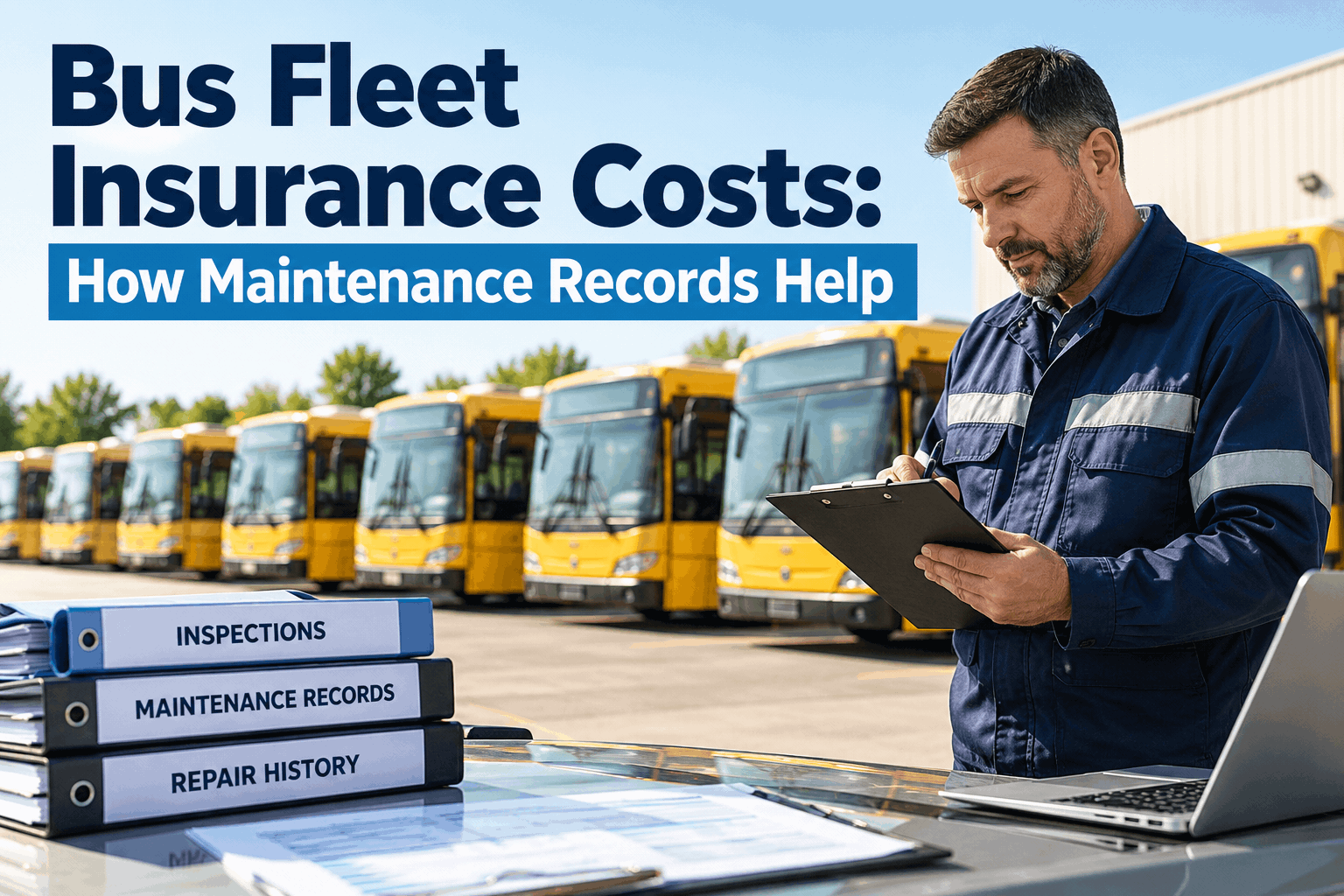
The compliance risk is compounded by liability. If a bus experiences a brake failure and you cannot produce complete brake service documentation showing when brakes were last inspected and serviced, your fleet appears negligent. Insurance companies use maintenance record quality as evidence of fleet safety management. Poor maintenance records become a liability in accident litigation. BusCMMS centralizes all vehicle maintenance records in a single searchable database, with automatic generation of complete maintenance history reports at a moment's notice. When an auditor requests maintenance documentation for any vehicle, you generate a complete report showing every service performed over the vehicle's entire service life, with dates, technician names, parts replaced, and measurements recorded.
Digital Compliance Tracking Prevents 92% of Documentation Violations
Automated compliance systems eliminate missed deadlines, generate audit-ready documentation, and provide instant proof of compliance. BusCMMS manages DOT inspections, DVIR records, driver qualifications, brake documentation, and vehicle maintenance history in a single platform, accessible during audits with one click.
Mistake #6: Electronic Logging Device (ELD) Non-Compliance and Hours-of-Service Violations
Transit agencies operating commercial bus services are subject to Hours of Service (HOS) regulations, particularly for driver rest periods and maximum driving hours in any 24-hour cycle. Electronic Logging Devices (ELDs) are federally mandated for tracking driver hours. Many fleets maintain ELDs for compliance but do not integrate that data with maintenance and compliance management systems. ELD data showing that a driver exceeded maximum driving hours without proper rest is a compliance violation that can also create safety liability. When maintenance systems are not coordinated with ELD data, a driver on extended hours during a charter run may miss a scheduled PM service, creating a maintenance gap that compounds the HOS violation.
The documentation mistake specific to ELDs is incomplete or inaccessible records. Drivers input HOS data into ELDs, but the data is stored in proprietary driver apps or on the ELD device itself. When an auditor requests 90 days of HOS records for verification, you cannot quickly produce a unified report covering all drivers and all vehicles. Records are scattered across multiple devices, stored in formats that are difficult to parse, or poorly organized. BusCMMS integrates with major ELD providers (Samsara, Verizon Connect, Geotab) to pull HOS data into a unified compliance dashboard. You can generate complete HOS compliance reports for your entire fleet with a single click, showing every driver's hours, rest periods, and compliance status for any date range.
Mistake #7: Inaccurate or Missing Records That Create Audit Failures Even When Practices Are Correct
This final mistake encompasses all documentation and record-keeping failures that lead to audit citations even when your fleet's actual maintenance and safety practices are adequate. You perform brake inspections correctly, but the documentation is incomplete. You perform annual inspections on schedule, but the records are not retrievable during an audit. You maintain driver qualifications, but the files are disorganized. None of these are safety practice failures — they are documentation and organization failures. Yet auditors cite them as compliance violations because documentation is what auditors can verify. Your actual safety practices are invisible to auditors; your records are what they see.
The cost of record-keeping failures extends beyond FMCSA fines. FTA audits of transit agencies specifically evaluate compliance documentation. A poor audit rating affects funding eligibility, state oversight, and insurance rates. Insurance companies request compliance documentation as part of renewal underwriting. Poor records lead to higher premiums. For school districts, state oversight agencies review maintenance records as part of safety certifications. Documentation gaps create apparent safety deficiencies that can restrict your operating approval. BusCMMS creates a single source of truth for all fleet compliance data — DVIR records, inspection documentation, maintenance history, driver qualifications, and ELD data — all organized, searchable, and audit-ready. When auditors request information, you produce professional, complete documentation that demonstrates systematic compliance management.
Frequently Asked Questions: Bus Fleet Compliance and DOT Violations
What is the average fine for a DOT compliance violation?
Average DOT fines range $500–$5,000 per vehicle per violation, with multiple violations per audit creating fleet-wide penalties of $25,000–$250,000. School districts and transit agencies can also face operational restrictions.
How often do bus fleets get audited by FMCSA or FTA?
FMCSA conducts roadside inspections randomly; FTA conducts comprehensive audits typically every 3–5 years for transit agencies. School districts may face unannounced state inspections if compliance issues are reported.
Can poor maintenance records affect insurance coverage?
Yes — insurance companies deny claims or charge premium increases (18–35%) when accident investigations reveal poor maintenance documentation. Well-organized digital records demonstrate fleet safety management to insurers.
What happens if a DVIR defect is not repaired before the vehicle operates again?
Operating a vehicle with a documented defect unrepaired creates federal violation liability. If an accident occurs, your fleet faces negligence liability claims for knowingly operating an unsafe vehicle.
How can BusCMMS prevent missed annual inspection deadlines?
BusCMMS generates 90-day advance alerts before any vehicle's annual inspection is due, allowing time to schedule service. Completion is automatically documented in audit-ready format.
Are driver medical certifications tracked in BusCMMS?
Yes — BusCMMS maintains digital driver qualification files with all certifications, training records, CDL status, and medical certification dates, with automatic renewal alerts.
What documentation do auditors request during FTA or FMCSA compliance audits?
Auditors request DVIR records, annual inspection documentation, brake inspection reports with measurements, driver qualification files, maintenance history, and ELD records. BusCMMS generates all of these in audit-ready format.
Can compliance violations affect school district funding or operating authority?
Yes — school districts with poor compliance ratings may face state oversight, reduced transportation funding, or requirements to contract out bus operations. Digital compliance tracking demonstrates safety management to regulatory agencies.
We were cited for missing DVIR documentation during an FTA audit and faced $28,000 in fines across our 50-bus fleet. The inspections were being performed, but paper DVIRs were getting lost. After implementing BusCMMS digital DVIR tracking, we have 100% completion rate. When our next audit came around, we had audit-ready DVIR records for every bus for every shift for the entire audit period. Zero violations this time. The investment in digital compliance paid for itself by avoiding just one audit failure.
Compliance Violation Cost Impact: Fleet of 50 Buses
Scenario 1: No Compliance System (Manual Tracking)
Violations per 3-year audit cycle
8–12 violations
Average fine per violation
$2,400
Insurance premium increase
18–25%
Total cost: $19,200–$28,800 fines + $18,000–$35,000 insurance increase
Scenario 2: Digital Compliance System (BusCMMS)
Violations per 3-year audit cycle
0–1 violations
Insurance premium impact
No increase / possible decrease
CMMS investment (3 years)
$21,000–$36,000
Total cost: $21,000–$36,000 system investment
Net Savings: $16,200–$42,800 over 3 years (PLUS avoided operational disruptions)
Avoid the Top 7 Compliance Mistakes. Prevent DOT Violations and Audit Failures.
Digital compliance tracking eliminates missed deadlines, generates audit-ready documentation automatically, and provides instant proof of regulatory compliance across all 50 states. BusCMMS manages DVIR records, annual DOT inspections, driver qualifications, brake documentation, vehicle maintenance history, and ELD data in a single platform. When auditors arrive, you produce complete, organized, professional compliance documentation demonstrating systematic safety and regulatory management. Prevent fines. Protect insurance rates. Maintain operational authority.