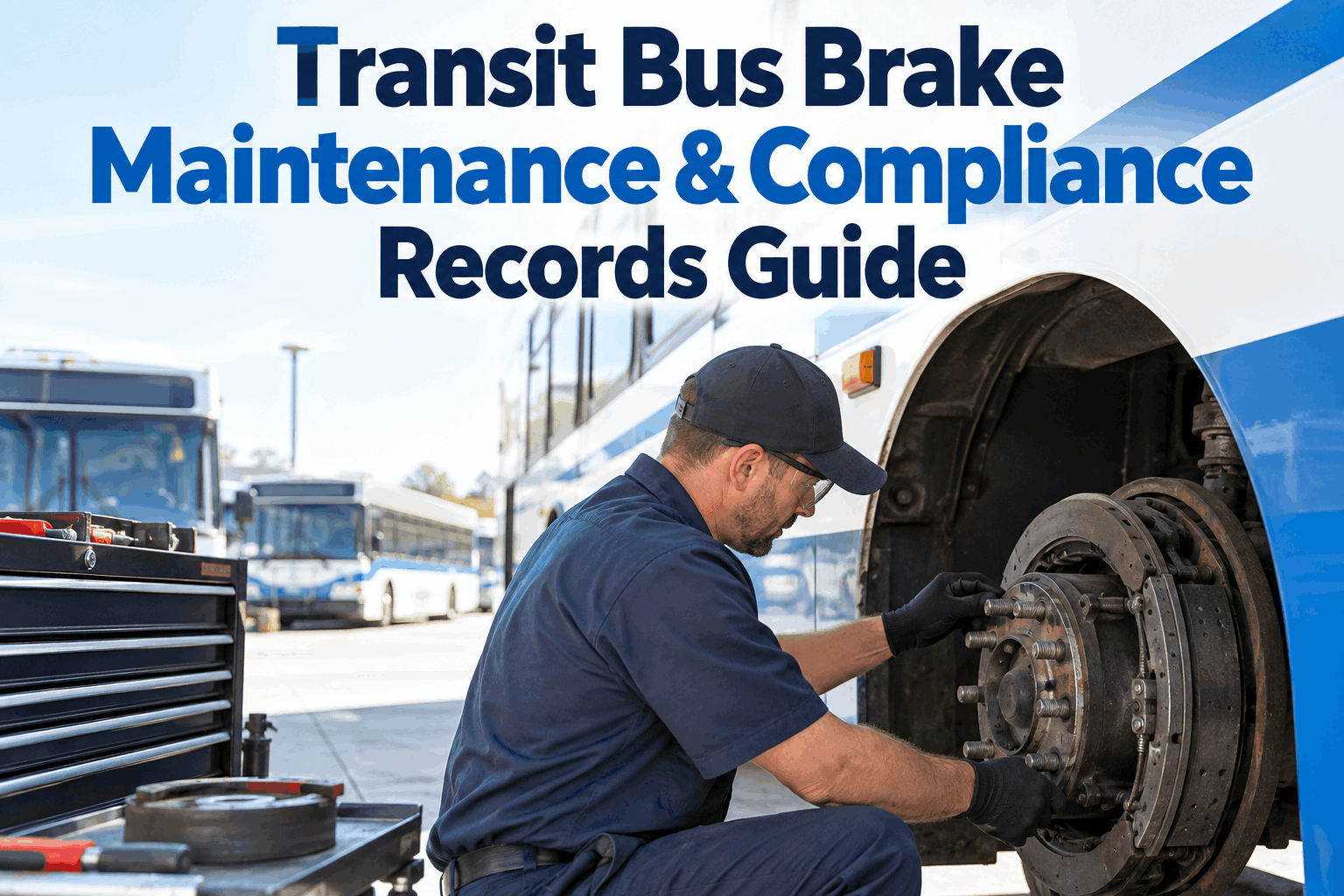
An FTA reviewer or a state inspector does not just ask whether your brakes work — they ask to see the records. Who relined that axle, when, and was the person who signed off a qualified brake inspector. If the paperwork is in a binder in the shop and the inspector's credentials are in someone's memory, a good brake job can still become an audit finding. Solid transit bus brake maintenance is as much about the record as the repair.
Transit Bus Brake Maintenance: Keeping Records Audit-Ready
Brake work is only as defensible as its documentation. Reline history, work orders, and proof that a qualified inspector did the job — all of it has to be findable, not filed away. Here is what an audit expects and how to keep it ready.
Three questions, and every one is a records question — which is exactly where audits are won or lost.
What 49 CFR 396.25 requires of your brake inspectors
Federal rules do not just govern how brakes are maintained — they govern who is allowed to do it. Under 49 CFR 396.25, the person responsible for brake inspection, service, or repair must be a qualified brake inspector, and you must be able to prove it.
Understands the task
The inspector understands the brake service or inspection to be performed and can actually perform it — competence on the specific work, not a general title.
Knows the methods and tools
They are knowledgeable of and have mastered the methods, procedures, tools, and equipment used in brake inspection and repair.
Training or experience
They have completed an approved apprenticeship or training program, or hold a certificate — or have at least one year of brake-related training or experience, or a combination.
The rule also sets a recordkeeping duty: you must keep evidence of each brake inspector's qualifications at your principal place of business or where the inspector works, for as long as they serve in that role and for one year after. (An exception applies to air-brake work done by someone who passed the CDL air-brake test.) The practical takeaway: the credential and the record are part of the job, not an afterthought — and you can book a walkthrough of inspector-qualification tracking to see it handled — and the same discipline applies when you decide to measure fleet condition that holds up to a review.
The brake records every transit fleet should keep
Audit-ready does not mean more paperwork — it means the right records, linked to the bus, findable in seconds. Five records carry brake compliance — and you can start free and organize them per bus.
Reline and service history
Every brake reline, adjustment, and component replacement, dated and tied to the specific bus and axle — the core history a reviewer traces.
Work orders behind each repair
The work order that authorized and recorded the job, linking the defect that triggered it to the repair that closed it.
Inspector qualification evidence
Proof each brake inspector meets 49 CFR 396.25 — training, certificate, or experience — kept while they hold the role and one year after.
Inspection and DVIR trail
The pre-trip and periodic inspection records that flagged brake defects, showing the system caught issues and routed them to repair.
PM schedule compliance
Proof brake PM happened on schedule, not just after a failure — the pattern that shows a program, not a scramble.
Kept this way, an audit request becomes a lookup instead of a fire drill. You can see brake records pulled on a live fleet to picture how fast that answer comes.
Turn a brake audit into a lookup
BusCMMS keeps brake reline history, work orders, inspection records, and inspector qualifications linked to each bus — so when a reviewer asks, the answer is a search, not a shelf of binders.
How BusCMMS keeps transit bus brake maintenance compliant
Brake compliance comes down to documentation that is complete, linked, and findable — and that is what a bus-specific maintenance system is built to produce.
Complete brake work history
Every reline, adjustment, and repair logged to the bus and axle with its work order — the full history a reviewer traces, in one place.
Inspector qualification tracking
Store and track each brake inspector's training, certificates, and experience, so the 49 CFR 396.25 evidence is on file and current, not in someone's memory.
Audit-ready reporting
Pull a bus's complete brake record — service, work orders, inspections, qualifications — as one export when an FTA review or state inspection asks.
Because BusCMMS is built for buses, brake records sit alongside DVIRs, PM, and every other compliance item your transit agency reports on. You can start a free account and organize your brake records the audit-ready way.
The brake work was never my worry at a review — my guys do good work. It was the records. An inspector would ask for the reline history on a bus and the proof that the tech who did it was qualified, and I would be digging through binders while the clock ran. Now it is all linked to the bus, inspector credentials included. Last review, every brake question was a thirty-second lookup. That is the difference between looking organized and looking exposed.
Key takeaways on transit bus brake maintenance compliance
At a review, brake questions are records questions — reline history, the work order behind each repair, and proof the inspector was qualified.
49 CFR 396.25 requires a qualified brake inspector and that you keep evidence of their qualifications while they serve and for one year after.
Keep five records linked to the bus: reline history, work orders, inspector qualifications, the DVIR trail, and PM schedule compliance.
Audit-ready is a system, not a binder: when records are linked and findable, a review request becomes a lookup instead of a fire drill.
Good brake work and good brake records are the same job done completely. Treat transit bus brake maintenance as documentation that follows the bus — and the next audit stops being the week you dread and becomes the day you prove your program works. To see it on your own fleet, a quick demo is the fastest way in.
Keep every brake job audit-ready
Set up BusCMMS to link brake history, work orders, and inspector qualifications to each bus — so your next FTA review or state inspection is a lookup, not a scramble. Rollout typically takes two to four weeks.
Transit bus brake maintenance compliance: frequently asked questions
What does 49 CFR 396.25 require?
It requires that anyone responsible for brake inspection, service, or repair on a commercial motor vehicle be a qualified brake inspector. That person must understand and be able to perform the task, have mastered the methods and tools, and have completed an approved training program or certificate, or have at least one year of brake-related training or experience. The carrier must keep evidence of these qualifications on file while the inspector holds the role and for one year after.
What brake maintenance records should a transit fleet keep?
At minimum: the reline and service history for each bus and axle, the work order behind every brake repair, evidence of each brake inspector's qualifications, the DVIR and inspection trail that flagged brake defects, and proof that brake PM happened on schedule. Linking all of it to the specific bus is what makes the records audit-ready rather than a pile to search.
Who can be a qualified brake inspector?
Under 49 CFR 396.25, a qualified brake inspector is an employee who understands and can perform the brake work, has mastered the methods and tools, and meets the training-or-experience bar — an approved apprenticeship or training program or a certificate, or at least a year of brake-related training or experience. There is an exception for air-brake inspections done by someone who passed the CDL air-brake test.
How long must brake inspector qualification records be kept?
Evidence of a brake inspector's qualifications must be retained for the period the person is employed in that capacity and for one year afterward, kept at the principal place of business or where the inspector works. Tracking this in a maintenance system rather than a personnel file keeps it current and tied to the brake work it backs up.
How does BusCMMS help with brake compliance?
BusCMMS keeps a complete brake work history — relines, adjustments, and repairs with their work orders — linked to each bus, tracks brake inspector qualifications so the 49 CFR 396.25 evidence is current, and pulls a bus's full brake record as one audit-ready export. Because it is built for buses, brake records sit with DVIRs, PM, and the other compliance items a transit agency reports on.