A school bus pre-trip checklist and a transit bus pre-trip checklist look similar on paper -- brakes, lights, tires, mirrors -- right up until you get to the front door. A transit bus has a farebox that needs to read cards, a kneeling system that has to lower the step for a rider who can't manage a curb, and a wheelchair lift that isn't just maintenance equipment -- under federal law, it's a civil rights obligation. Skip that section of the pre-trip and the consequences aren't just an OOS order. Civil penalties for ADA accessibility violations start at $75,000, and one 259-bus transit agency was found to have 63% of its fleet running with inoperable wheelchair lifts before enforcement action forced a fix. This is the complete transit bus pre-trip inspection checklist built for what actually rolls out of a transit yard every morning.
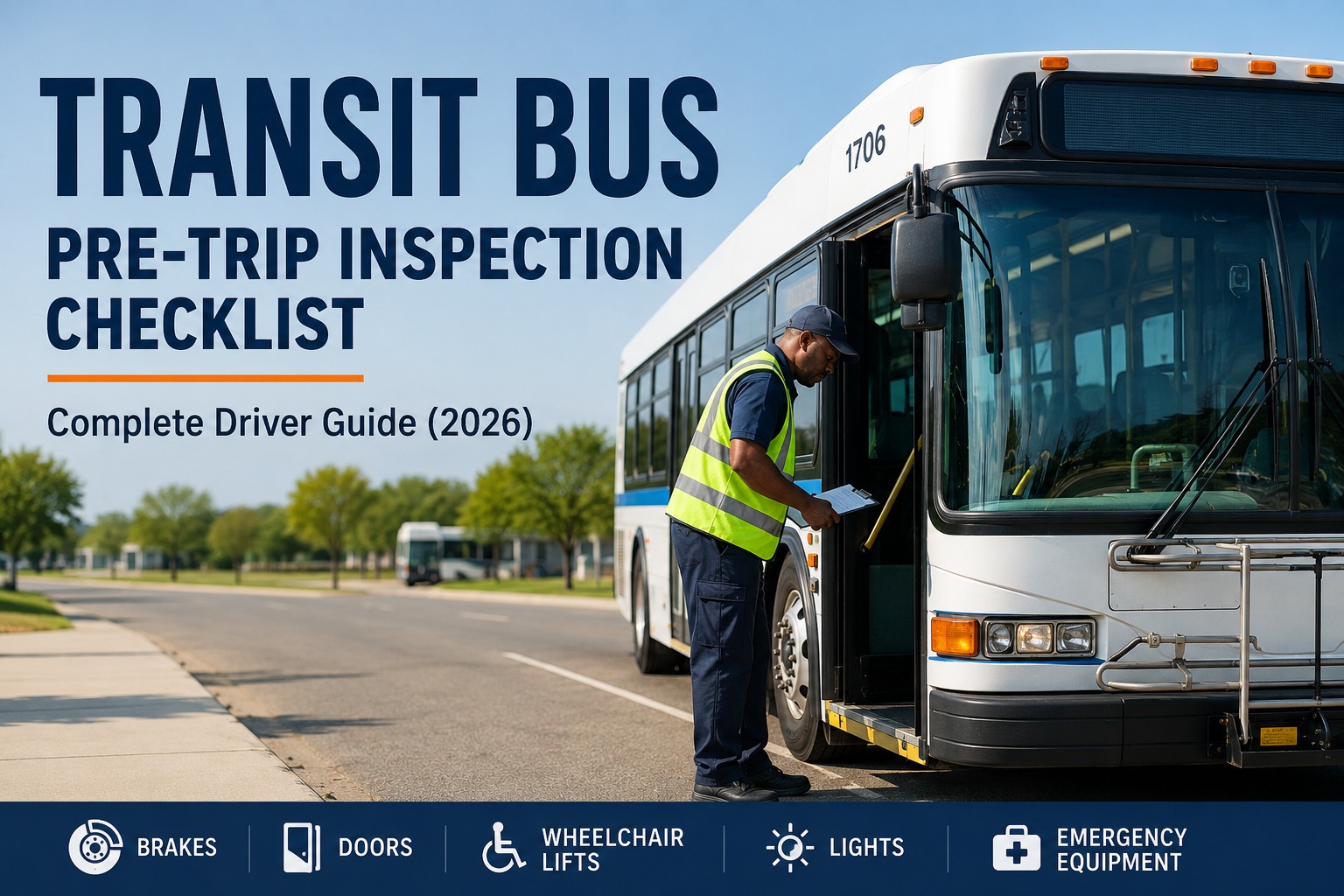
Transit Bus Pre-Trip Inspection Checklist: Complete Driver Guide
Every zone a transit driver needs to check before pulling out -- brakes and tires, plus the farebox, kneeling system, and wheelchair lift a school bus checklist doesn't cover.
Why Transit Bus Pre-Trip Inspections Carry Extra Weight
Every commercial bus driver must be satisfied the vehicle is safe under 49 CFR 392.7, and the prior day's DVIR must be reviewed and certified under 396.13. Transit buses carry an additional layer most other bus types don't: under 49 CFR 37.163, transit agencies must establish regular and frequent maintenance checks of wheelchair lifts, and FTA best practice specifically recommends daily pre-trip lift cycling -- physically deploying and stowing it, not just a visual glance.
During the 2025 CVSA International Roadcheck, 18.1% of vehicles inspected were placed out of service, with brake defects making up 41% of those violations and tire issues another 21.4%. Nearly every one of those is an item a proper transit pre-trip walkaround is designed to catch before the bus ever leaves the yard. Book a demo to see a transit-specific digital pre-trip checklist built around what actually rolls out of your yard, not a generic trucking form with a few bus fields added.
The Complete Transit Bus Pre-Trip Checklist, by Zone
Walk the bus in the same sequence every time. Here's every zone, organized the way a driver actually moves around the vehicle.
- Tire tread depth and pressure on all wheel positions, checked with a gauge
- Headlights, tail lights, turn signals, and clearance lights functioning
- Mirrors adjusted and clean -- exterior cross-view and interior rearview
- Body panels, windows, and windshield free of damage that impairs visibility
- No fluid leaks visible under the bus -- oil, coolant, or hydraulic fluid
- Exhaust system free of leaks, damage, or excessive noise
- Front and rear doors open, close, and seal fully with no obstruction
- Kneeling system lowers and returns to normal ride height correctly
- Wheelchair lift or ramp cycles fully -- deploy and stow, not just visual check
- Door and kneeling interlocks prevent lift deployment in unsafe positions
- Farebox reads cards and accepts payment without error
- Emergency exits open freely from both inside and outside
- Service brakes and parking brake hold before the bus moves
- Air system builds pressure correctly and holds within spec on leak-down
- Steering play at rest within spec -- measured, not eyeballed
- Gauges, warning lights, and horn functioning on startup
- Destination sign and route number display showing correctly
- Two-way radio or communication device powers on and connects
- Passenger seats secure with no damage, loose bolts, or sharp edges
- Handrails and grab bars mounted securely throughout the aisle
- Stop-request cords or buttons functioning at every position
- Wheelchair securement straps and anchor points present and undamaged
- Fire extinguisher charged and mounted, first aid kit stocked
- Interior lighting including step-well and emergency lighting functional
Wheelchair lift and ADA-specific inspection detail runs deep enough to deserve its own guide -- if you need the full lift maintenance and 49 CFR 37.163 breakdown, that's covered separately on our site. Here, the goal is the complete daily walkaround. Sign up free to load this exact checklist into your account, organized by zone just like this.
What Makes Transit Pre-Trip Different From a School Bus Checklist
The mechanical core is the same across bus types, but a transit bus carries passenger-facing systems a school bus checklist never touches -- and misses them, and a school bus checklist never asks about.
| Item | School Bus | Transit Bus |
|---|---|---|
| Brakes, tires, steering | Required | Required |
| Stop arm & crossing gate | Required | Not applicable |
| Wheelchair lift cycling | If equipped | Daily, ADA-mandated |
| Kneeling system | Rare | Common, daily check |
| Farebox function | Not applicable | Required |
| Destination sign display | Not applicable | Required |
A generic fleet tool that treats every bus the same misses this distinction entirely, which is exactly how a wheelchair lift inspection gets skipped in a system built for trucks. Book a demo to see transit-specific inspection items pre-loaded automatically, without manually building a custom checklist from scratch.
From a Transit Fleet Manager on Getting This Right
"We had a good pre-trip process for brakes and tires -- drivers were solid on the mechanical side. What we were missing was full-load lift testing. Our guys were cycling the lift empty every morning, which looked fine, but a lift can pass an empty cycle and still fail under an actual passenger's weight. We didn't find out until a rider got stranded and we had a stranding report to file with the FTA. Now every lift gets a full weighted test on a rotating schedule, logged with a timestamp, and that gap hasn't come up again."
Digital DVIRs for Transit: Why Paper Falls Short
A paper pre-trip form treats a rushed lift cycle and a full weighted test as identical -- both just get a checkmark. That's exactly the gap that leads to the kind of finding described above, and it's preventable with a system that makes a real inspection look different from a skipped one.
Lift Cycle Logging
Timestamped daily lift deployment records, with a separate field for full-load test cycles.
Instant Defect Routing
A flagged farebox, kneeling, or lift fault routes to maintenance immediately, not at the end of the shift.
FTA-Ready Reports
Pull lift maintenance and ADA compliance records in seconds for an FTA triennial review.
DVIR Review Chain
A driver can't start a new pre-trip until the prior day's DVIR is reviewed and certified.
On February 19, 2026, FMCSA published a final rule, effective March 23, 2026, explicitly authorizing electronic DVIRs under 49 CFR 396.11 and 396.13, removing any remaining ambiguity for fleets still on paper. Book a demo to see a fully 2026-compliant digital pre-trip workflow built specifically for transit operations.
Transit Bus Pre-Trip Inspections: The Bottom Line
A transit bus pre-trip inspection checklist has to cover everything a standard commercial vehicle check requires -- brakes, tires, steering, lights -- plus the passenger-facing systems that make transit different: the farebox, the kneeling system, and a wheelchair lift that carries federal civil rights weight, not just a maintenance line item. Walk the bus the same way every day, cycle the lift under real load on a regular schedule, and keep the daily record somewhere it can be pulled in seconds, not searched for in a binder.
If your current pre-trip process treats the lift cycle as a quick empty test and a checkmark, that's the gap most enforcement actions start from. Sign up free and put your full transit pre-trip checklist on one digital system your drivers actually use every morning.
What should a transit bus pre-trip inspection include?
A transit bus pre-trip inspection covers standard commercial vehicle items -- brakes, tires, steering, lights, mirrors -- plus transit-specific systems including the wheelchair lift, kneeling mechanism, farebox, and destination sign display. The full walkaround typically takes 15-20 minutes when done thoroughly by zone.
Is wheelchair lift testing required every day?
Yes. Under 49 CFR 37.163, transit agencies must establish regular and frequent maintenance checks of wheelchair lifts, and FTA best practice recommends daily pre-trip lift cycling -- physically deploying and stowing the lift, not just a visual check. Periodic full-load weight testing is also recommended since a lift can cycle fine empty but fail under actual passenger weight.
What happens if a wheelchair lift fails during service?
The driver must notify dispatch immediately, and under 49 CFR 37.163(f) the agency must provide alternative accessible transportation within 30 minutes for any stranded passenger. The bus must be removed from service before its next scheduled service day, with limited exceptions if no spare vehicle is available.
How is a transit bus pre-trip different from a school bus pre-trip?
The mechanical core -- brakes, tires, steering, lights -- is the same across both. Transit buses add passenger-facing systems like fareboxes, kneeling systems, and daily-mandated wheelchair lift cycling, while school buses require stop arm, crossing gate, and student-specific safety checks that transit buses don't have.
How does a digital DVIR improve transit pre-trip compliance?
A digital DVIR built for transit requires interaction with each checklist item, logs wheelchair lift cycles with timestamps, routes flagged defects to maintenance instantly, and stores records in a format that can be pulled in seconds for an FTA triennial review. FMCSA's 2026 eDVIR rule, effective March 23, 2026, confirms electronic DVIRs are fully compliant under 49 CFR 396.11 and 396.13.