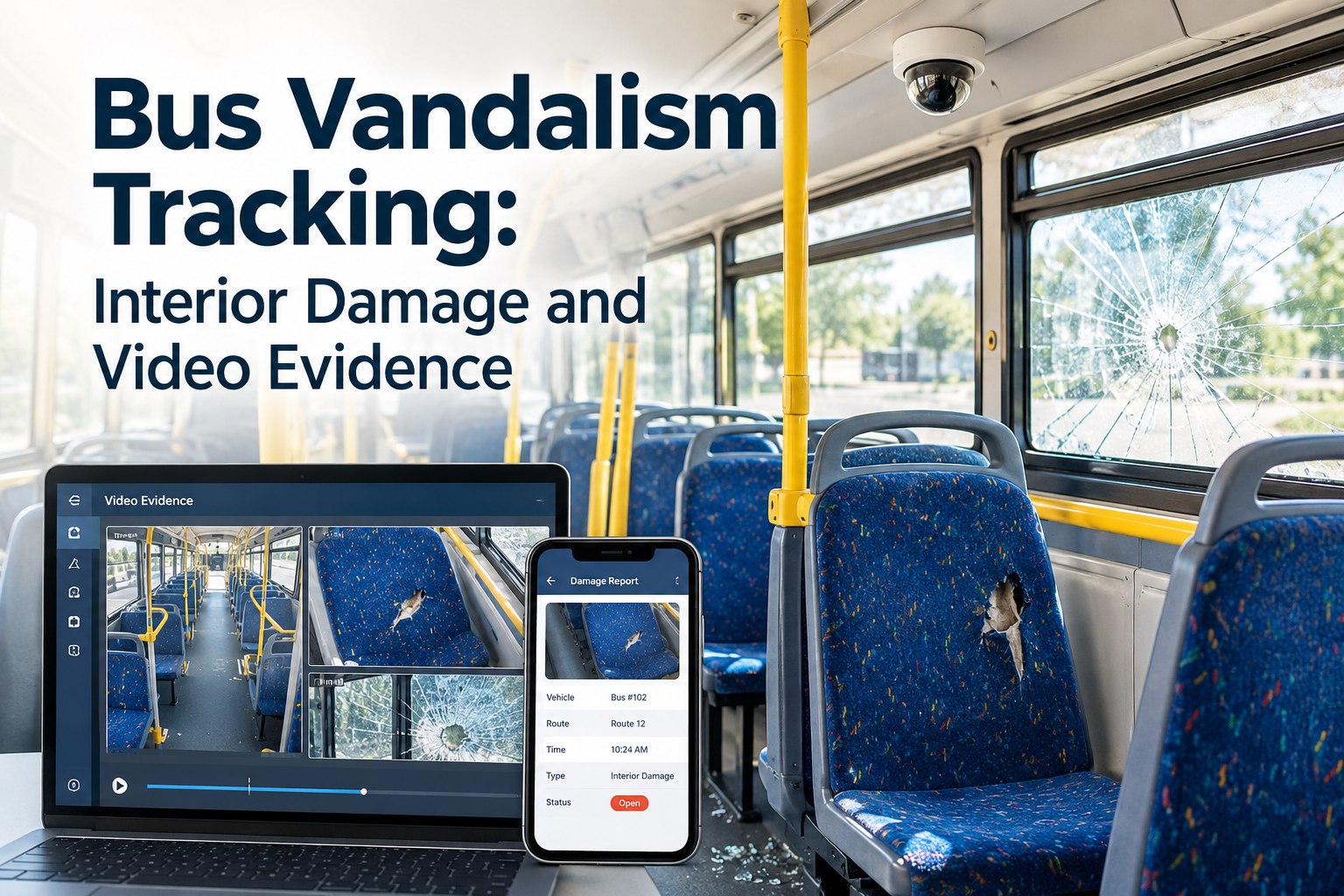
Bus vandalism tracking means recording interior damage against the specific vehicle, route, and time it occurred, linking any video evidence to the incident and the repair, so patterns become visible and every damage event can be shown to have been assessed and fixed. Done well, it turns scattered damage reports into a clear picture of which buses and routes keep getting hit and what it is costing.
Bus Vandalism Tracking: Interior Damage and Video Evidence
Slashed seats and scratched panels are not random — they cluster by route and time. Track them properly and the pattern, and the fix, become obvious.
Updated September 2026 · Not legal advice; does not establish district retention requirements.Most fleets treat vandalism as a series of one-off repairs: a seat gets slashed, someone fixes it, the report goes in a drawer. That approach hides the two things worth knowing — where the damage keeps happening, and whether every incident was actually documented and repaired. Tracking it as connected data instead of loose reports changes both.
Interior damage is a pattern, not an accident
The value of tracking vandalism is that it makes clusters visible. When every damage event is tagged to a bus, a route, and a time, the recurring hot spots surface on their own — and you can act on the pattern rather than just patching the latest seat. Here is what the data reveals when it is connected.
One or two routes usually account for most interior damage. Knowing which lets you focus monitoring, seating, or staffing where it matters.
If the same bus keeps coming back damaged, the question shifts from "fix it again" to "why this bus" — assignment, layout, or capacity.
Afternoon runs, certain days, or specific windows often concentrate the damage, pointing to when to add attention.
None of this requires identifying an individual student to be useful. The route, the vehicle, and the time period are enough to change how you run the service and where you invest — the pattern is the actionable thing. Get the evaluation template to map your damage patterns
A worked example: reading the pattern, not the student
Here is how pattern analysis works without exposing anyone. A district notices interior damage costs climbing and pulls 90 days of incidents by route, vehicle, and time — aggregate data, no names.
Every decision here was made from route, vehicle, and time data. Footage was reviewed only for specific incidents and handled under the district's policy — never trawled to identify students generally. That is the line: analyse the pattern in aggregate, and treat any student-related video as the sensitive record it may be. Start free and analyse damage by route, vehicle, and time
From incident to repaired: the workflow
Tracking is only half the value; the other half is proving each incident was handled. A connected workflow takes a damage event from the moment it is noticed all the way to a closed, documented repair — so you can always show what happened and that it was fixed.
Detect
Damage is spotted on a check or flagged by a camera event, tied to the bus and trip.
Review evidence
The relevant clip is reviewed for that trip, under policy, to confirm what occurred.
Assess & document
The damage is photographed and described — what, where, and how bad.
Work order
A repair work order opens against the bus, with the evidence attached.
Repair
The fix is completed and signed off, with parts and cost logged.
Retain
The record and any evidence are kept per the district's retention policy.
At the end of that chain, an incident is not a rumor and a repair is not a maybe — both are on the bus record, retrievable, and defensible. And because each step is connected, nobody has to reconcile a camera portal against a maintenance log by hand. Get the template to map this workflow to your district
Privacy and retention: handle video carefully
Bus video that may involve students is sensitive, and the rules are not one-size-fits-all. This is the part to get right with your own counsel, not from a blog. Here is the honest, non-legal summary of what to consider.
FERPA (20 U.S.C. 1232g) may apply to bus video when the footage is directly related to a student and maintained by or for the school — but not all bus video is automatically an education record. Whether a given clip qualifies depends on the facts.
State privacy laws and public-records laws may impose their own requirements on when footage must be disclosed, protected, or withheld — and these vary widely by state.
Camera-vendor contracts and your district's own policies may set additional obligations on access, sharing, and how long footage is kept.
How long to keep footage and damage records is a district decision driven by policy and applicable law — this page does not set a retention period for you.
The practical takeaway: use video for lawful evidence handling and maintenance accountability, review it for specific incidents under policy rather than trawling it, and confirm your obligations with counsel. This article is a practical guide, not legal advice, and it does not establish district-specific retention requirements. Start free and keep evidence handling policy-aligned
Why damage cases fall apart: two disconnected systems
The recurring failure is structural. Camera footage sits in one vendor portal; damage reports and maintenance records sit in a separate system. So when someone asks what happened on a given trip and whether the damage was repaired, staff have to manually reconcile the two — matching a clip to a report to a work order — and often cannot prove the full story cleanly.
BusCMMS is an AI-native, hardware-agnostic bus fleet operations platform that closes that gap. It connects events from the MDVR or AI camera systems you already run — no rip-and-replace — to bus asset records, incidents, and maintenance work orders. A damage event links to the correct bus and trip, evidence attaches to the incident, a work order tracks the repair, and everything is retained under your policy on one record — so vandalism is analysed by pattern and every case is documented end to end. Get the evaluation template for your team
The cost side: what tracking actually saves
Beyond proof, connected damage tracking has a budget payoff. When incidents, repairs, parts, and cost are on one record, the fleet can report the real financial impact of vandalism — and target the spending that reduces it.
Roll up repair cost by route and vehicle, so the true cost of vandalism is a number, not a guess buried in general maintenance.
Spend on the hot spots the data reveals — a monitor on the worst run — instead of paying for the same repair repeatedly.
Show leadership the pattern and the trend, so budget for prevention or monitoring is a defensible, data-backed request.
That is the quiet return on tracking: repeated interior damage stops being an untraceable line in the maintenance budget and becomes a measured problem you can actually shrink. Start free and put a number on your vandalism cost
Get the district-ready evaluation template
Use the template to evaluate vandalism and damage tracking for your fleet — connecting your existing camera events to incidents and work orders, analysing damage by route, vehicle, and time, and handling video under your privacy and retention policy. Hardware-agnostic, no rip-and-replace.
Hardware-agnostic · Works with your existing cameras · Policy-aligned evidence handling
Frequently asked questions
What is bus vandalism tracking?
Bus vandalism tracking is the practice of recording interior damage and vandalism against the specific vehicle, route, and time it occurred, and connecting any video evidence to the incident and the resulting repair. Rather than treating each damaged seat or scratched panel as an isolated fix, it captures damage as connected data so recurring patterns become visible — which routes, buses, and time windows see the most damage — and so every incident can be shown to have been assessed, repaired, and documented. The goal is both operational insight and accountability: knowing where damage clusters, and being able to prove each case was handled.
Is all bus video covered by FERPA?
No. Not all bus video is automatically subject to FERPA. FERPA (20 U.S.C. 1232g) may apply when footage is directly related to a student and maintained by or for the school, in which case it can meet the definition of an education record — but whether a particular clip qualifies depends on the facts. Separately, state privacy laws, public-records laws, camera-vendor contracts, and district policies may impose their own requirements on how footage is accessed, disclosed, protected, and retained. Because this is fact-specific and varies by jurisdiction, confirm your obligations with your district's counsel. This article is a practical guide and does not provide legal advice.
Can we analyse damage patterns without exposing student information?
Yes, and that is the recommended approach. Pattern analysis relies on route, vehicle, and time data — not student identities. You can see that a particular route and time window accounts for most interior damage, or that a specific bus keeps returning damaged, entirely from aggregate incident data, and act on it by adding a monitor, adjusting seating, or changing an assignment. Video should be reviewed only for specific incidents under your policy rather than trawled to identify students in general. Keeping analysis at the route/vehicle/time level lets you reduce damage and cost while treating any student-related footage as the sensitive record it may be.
How does a damage incident become a tracked repair?
In a connected workflow, a damage event is detected on an inspection or flagged by a camera event and tied to the bus and trip. The relevant footage is reviewed for that trip under policy, the damage is photographed and described, and a repair work order opens against the bus with the evidence attached. The repair is completed and signed off with parts and cost logged, and the record and any evidence are retained per the district's retention policy. The result is that both what happened and the fact that it was repaired live on one bus record — retrievable and defensible — without staff manually reconciling a camera portal against a maintenance log.
Do we need to replace our cameras to track vandalism this way?
No. BusCMMS is hardware-agnostic and is designed to connect events from the MDVR or AI camera systems you already operate to bus asset records, incidents, and maintenance work orders, without a rip-and-replace deployment. A camera event links to the correct bus and trip, evidence attaches to the incident, a work order tracks the repair, and everything is retained under your policy on one record. The aim is to connect the footage you already capture with your damage and maintenance records, using your current hardware, so vandalism can be analysed by pattern and documented end to end.