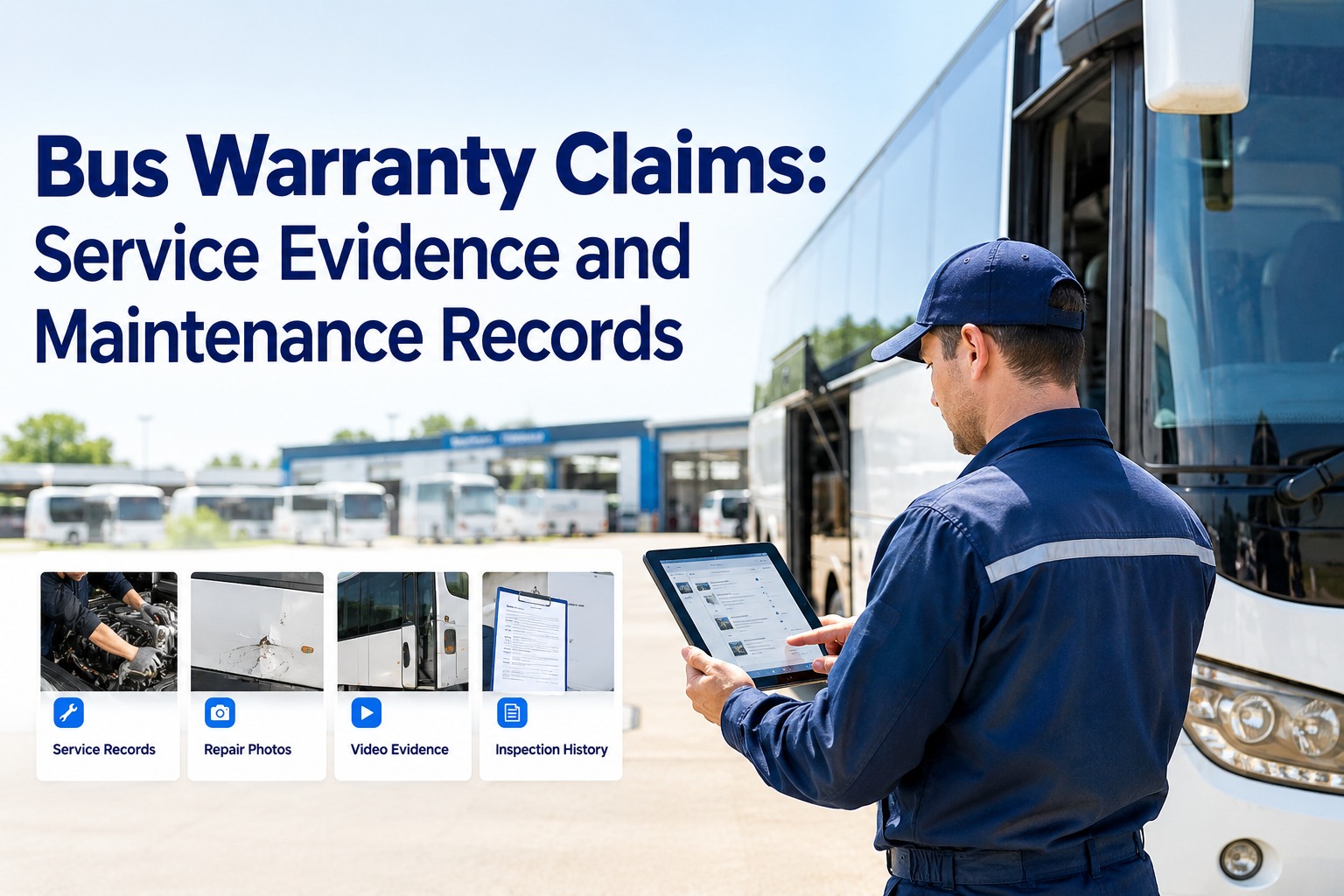
A well-documented bus warranty claim should show the vehicle's service history, the relevant defect, the inspection or diagnosis, the repair performed, the parts used, and any supporting evidence the manufacturer requires. Get that chain in one place tied to the right bus and a claim is a submission; leave it scattered across systems and it becomes an argument you often lose.
Bus Warranty Claims: Service Evidence and Maintenance Records
Warranty money is won or lost on documentation. The fleets that get reimbursed are the ones who can show, on demand, exactly what happened to a bus and when.
Updated September 2026 · Warranty terms vary by OEM; this is a practical guide, not legal advice.Warranty claims fail on paperwork far more often than on the merits. The repair was legitimate, the part was covered — but the fleet cannot produce the record the manufacturer asks for, so the claim stalls or gets denied and the cost lands on the district. The fix is knowing what a strong claim actually needs and having it ready before you submit.
What a well-documented claim shows
Service history
Proof the bus was maintained on schedule, so the manufacturer cannot point to neglect as the cause of failure.
The defect & diagnosis
What went wrong and how it was determined — the symptom, the inspection or diagnostic finding, dated.
The repair performed
What was actually done to fix it, by whom, and when, with the work order that governed the job.
Parts used
The parts consumed on the repair, matched to the claim, so the covered component is clearly identified.
Supporting evidence
Photos, and a video clip where useful, showing the failed component and the completed repair, where the OEM requires it.
The exact mix depends on the manufacturer and the warranty programme — more on that below — but these five are the backbone of nearly every claim. A fleet that can produce all five for any bus, quickly, is a fleet that gets reimbursed. Talk to our team about claim-ready records on every bus
The asset timeline that makes it provable
Each of those five pieces is only convincing in context — the manufacturer wants to see the sequence, not five loose documents. A unified asset timeline puts every event on one bus in chronological order, so the story reads itself: this was inspected, this was found, this was fixed, with this part and here is the proof.
Periodic inspection
Bus 22 passes its scheduled inspection — the maintained-on-schedule baseline a claim rests on.
Defect reported
A transmission fault flagged on a driver check and confirmed by a camera clip of the symptom under load.
Work order opened
The defect becomes a work order tied to bus 22, with the diagnosis recorded by the technician.
Repair & parts
Covered component replaced, parts logged to the job, before-and-after photos attached.
Claim submitted
The whole chain exports as the claim package — history, defect, diagnosis, repair, parts, evidence, in order.
That is the difference a timeline makes. Instead of assembling a claim from four systems the night before a deadline, you retrieve one chronological record that already tells the story the manufacturer needs to approve it. Start free and put every bus on one asset timeline
OEM warranty terms are not federal regulations
This distinction trips up fleets constantly, so it is worth stating plainly: the documentation a manufacturer requires to approve a warranty claim is set by the OEM and the specific warranty programme — not by federal regulation. Federal maintenance rules and warranty rules are two different things, and following one does not automatically satisfy the other.
49 CFR 396.3 covers systematic inspection, repair, and maintenance and the records that go with it. 49 CFR 396.17 covers periodic inspection requirements. These govern keeping the bus safe and keeping maintenance records — and good records here also happen to support a claim.
But neither regulation guarantees or requires any particular warranty outcome.
The manufacturer sets what a valid claim must include — which records, which evidence, what timelines, what pre-authorization. This varies by OEM, by component, and by programme, and it is the standard your claim is actually judged against.
Always follow the applicable OEM warranty terms, not federal rules, when preparing a claim.
So the practical rule is to maintain the bus to the federal standard because you must, and to document to the OEM's warranty standard because that is what gets the claim paid. A unified record helps with both at once, but they are separate requirements. Talk to our team about matching records to your OEM terms
Same repair, two outcomes: a worked claim
Concrete numbers show what documentation is worth. Two fleets do the identical covered transmission repair on a bus — call it a $6,000 job. The only difference is what each can produce when the OEM asks. Watch where the money goes.
Same repair, same part, same coverage — a $6,000 swing decided entirely by documentation. Multiply that across a fleet's worth of covered repairs in a year and the cost of scattered records stops being an inconvenience and becomes a budget line. Start free and stop losing claims to missing records
Why claims fall apart: three systems, no single story
The root cause of a weak claim is almost always the same: the evidence exists, but it is spread across systems that do not talk. Maintenance records are in the shop tool, camera footage is in the vendor platform, and management runs its own reports — so when a claim needs the full picture, no one can establish what happened to the bus and when without stitching three sources together by hand.
BusCMMS is an AI-native, hardware-agnostic bus fleet operations platform that closes that gap. It connects the MDVR or AI camera events you already capture — no rip-and-replace — to maintenance records, so inspections, defects, work orders, repairs, parts, and camera events all land on one chronological asset timeline. Technicians attach photos and clips to the work order as they repair, and when a claim is submitted the full service evidence is retrieved from one place instead of assembled from three. The result is a claim that reads as one connected story, backed by evidence the OEM can verify. Talk to our team about connecting your cameras and records
Talk to the BusCMMS team about a pilot on ten buses
See how a unified asset timeline connects inspections, defects, work orders, repairs, parts, and your existing camera events — so warranty claims are retrieved, not reconstructed. Hardware-agnostic, no rip-and-replace. Start with a pilot on ten buses and prove it on your own fleet.
Hardware-agnostic · Works with your existing cameras · One asset timeline per bus
Frequently asked questions
What documentation does a bus warranty claim need?
A well-documented bus warranty claim generally shows the vehicle's service history, the relevant defect, the inspection or diagnosis that identified it, the repair performed, the parts used, and any supporting evidence such as photos or video that the manufacturer requires. Together these establish that the bus was properly maintained, that a covered component failed, and that a legitimate repair was carried out. The precise requirements vary by manufacturer and warranty programme, so the safest approach is to follow the applicable OEM terms and keep all of these elements connected to the correct bus so they can be produced quickly when the claim is submitted.
Do federal regulations set warranty claim requirements?
No. Warranty documentation requirements are set by the manufacturer and the specific warranty programme, not by federal regulation. 49 CFR 396.3 governs systematic inspection, repair, and maintenance and the associated records, and 49 CFR 396.17 governs periodic inspection requirements — these keep vehicles safe and maintenance documented, and good records here often support a claim, but neither regulation guarantees or requires any particular warranty outcome. When preparing a claim, follow the applicable OEM warranty terms; treat the federal rules as separate maintenance obligations rather than as warranty rules.
How does an asset timeline strengthen a claim?
An asset timeline places every event on a single bus — inspections, defects, work orders, repairs, parts, and camera events — in chronological order on one record. That matters because a manufacturer wants to see the sequence, not a handful of disconnected documents: the bus was inspected and maintained, a defect appeared, it was diagnosed, it was repaired with a specific part, and here is the evidence. A timeline lets you retrieve that whole story at once instead of assembling it from separate systems under a deadline, which both speeds submission and makes the claim more convincing because the chain is complete and internally consistent.
Why do warranty claims get denied even when the repair was covered?
Most often because the fleet cannot produce the documentation the manufacturer requires, not because the repair was invalid. If service history is incomplete, the diagnosis was never clearly recorded, photos were not taken, or parts are reconstructed from memory, the claim lacks the proof the OEM needs to approve it — and the cost falls back on the fleet. The failure is usually that evidence is scattered across a maintenance system, a camera platform, and separate reports, so no single, verifiable story can be assembled. Keeping records connected on one asset timeline addresses this directly by making the complete evidence retrievable when the claim is filed.
Do we need to replace our cameras to connect footage to claims?
No. BusCMMS is hardware-agnostic and is designed to connect the MDVR or AI camera events you already capture to your maintenance records, without a rip-and-replace deployment. Relevant camera events link to the correct bus and sit on the same asset timeline as inspections, work orders, repairs, and parts, and technicians can attach photos and clips to a work order during the repair. When a warranty claim is submitted, the supporting footage and service evidence are retrieved from the same connected record, using your existing camera hardware rather than a new system.