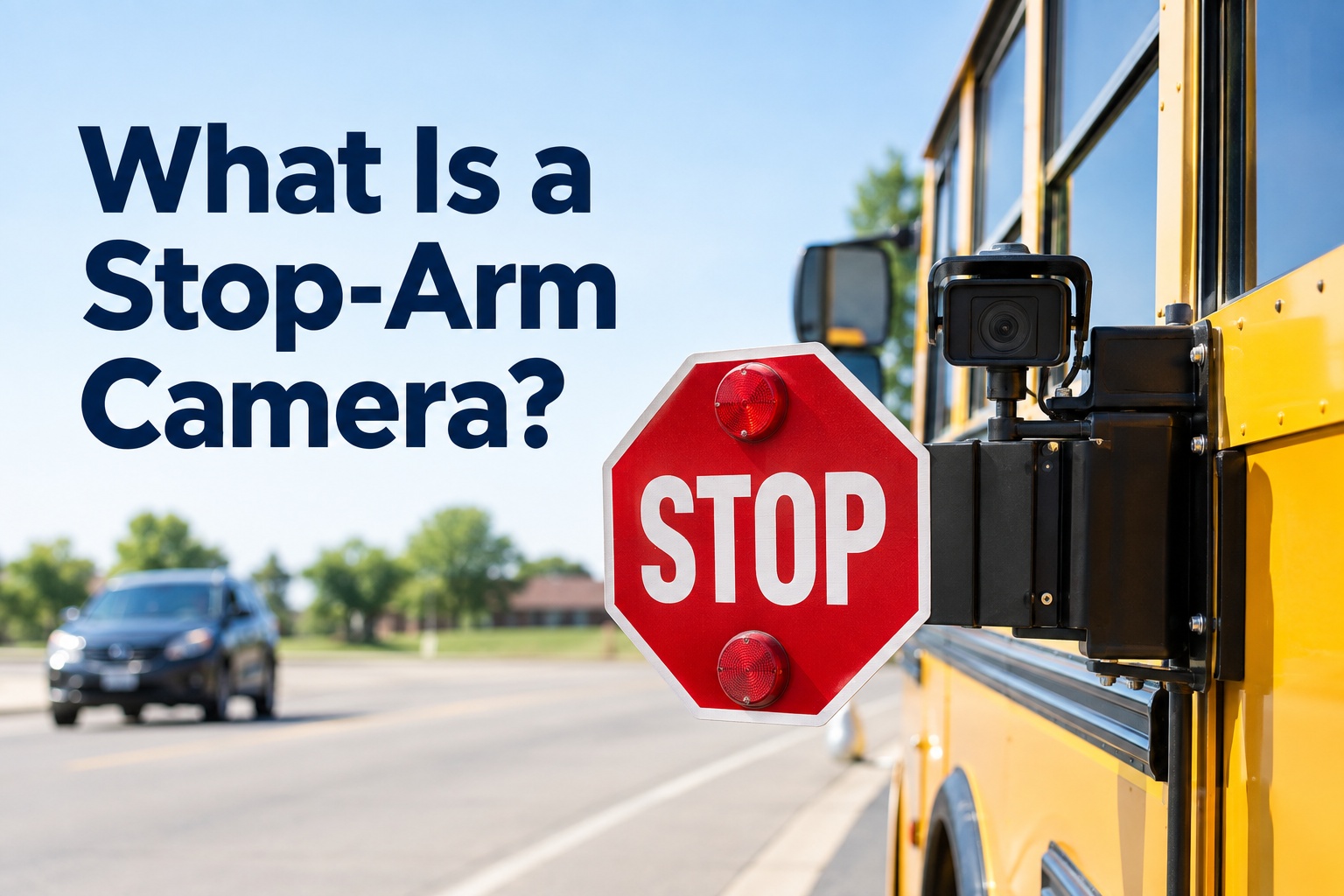
Every school day, drivers blow past stopped buses with the red lights flashing and the stop arm out — the exact moment kids are stepping into the road. National surveys of bus drivers have counted tens of thousands of illegal passes in a single day. For years the only "evidence" was a driver trying to catch a plate number in a side mirror while also watching a first-grader cross. A stop-arm camera is what finally puts that on the record: it sees the pass, catches the vehicle, and hands you time-stamped proof instead of a shaken driver's best guess.
What Is a Stop-Arm Camera?
How school bus cameras detect illegal passing, capture usable evidence, and connect video events to safer fleet operations
- AutoTriggered by stop arm
- ~20%Of a fleet often enough
- StateRules vary widely
- License plateWhere legally & technically available
- Date & timeTimestamp on the incident
- GPS locationWhich stop, which street
- Stop-arm statusProof lights & arm were active
What Is a Stop-Arm Camera, in Plain Terms?
A stop-arm camera is a camera system mounted on or near a school bus that records vehicles passing the bus while its stop arm is extended and its warning lights are flashing. It exists to do one job the human driver can't reliably do in the moment: capture clear, time-stamped evidence of a motorist illegally passing a stopped bus — the single most dangerous thing that happens around a school bus, because it happens exactly when children are in the road.
What makes it different from a camera that just films everything is the trigger. A stop-arm camera activates when the stop arm deploys and the red lights come on — automatically, without the driver having to press anything or point a phone. If a vehicle passes during that window, the system records it. That automatic, event-based logic is the whole point: the driver stays focused on the kids, and the camera handles the evidence.
One practical note that surprises people: you often don't need one on every bus. Because the highest-risk passes cluster on specific routes and stops, many districts outfit a portion of the fleet — sometimes only around 20% — and move or target cameras toward problem routes. It's a safety tool first, and the evidence it produces only matters if it connects to a real follow-up. Seeing how those events land in your records is worth a look at how video events connect with safety and maintenance records.
How a Stop-Arm Camera System Works
Behind that "it records illegal passers" description is a precise sequence. Knowing it tells you what separates an enforcement-grade system from a camera that just happened to film a car going by.
- 1
Stop-arm deployment is detected
The system senses when the stop arm extends and the red warning lights activate — the legal window in which passing a bus is illegal.
- 2
Cameras trigger automatically
No driver action needed. When a vehicle enters the danger zone during that window, the cameras capture it — front and rear plate views on better systems.
- 3
The vehicle and data are recorded
The passing vehicle, its plate where available, the bus ID, plus date, time, GPS location, and proof the stop arm and lights were active all get captured together.
- 4
The event is reviewed
A person — often a law enforcement officer or trained technician, depending on the jurisdiction — reviews the clip and confirms whether a violation occurred.
- 5
Enforcement or documentation follows
Where a program supports it, a confirmed violation leads to a mailed citation to the vehicle owner. Even without enforcement, the clip is documented evidence.
The review step is where honesty matters: a stop-arm camera doesn't write tickets by itself. It captures the evidence; a human confirms the violation; and the enforcement process — if there is one — runs on your state and locality's rules. That human-in-the-loop design is exactly why the evidence quality has to be good enough to hold up. If you want the captured events organized against each bus instead of sitting in a vendor portal, that's worth starting free to see how events organize per bus.
Stop-Arm Camera vs. Dash Cam, MDVR, Rear Camera, and Telematics
These all involve cameras on a bus, so they blur together fast — but a stop-arm camera has a specific, narrow job the others don't do. Here's the clean separation.
The through-line: a stop-arm camera is defined by when it records and what it's built to capture — the illegal-passing moment, with plate and proof of stop-arm status — not by being just another lens on the bus. Some of these other terms describe general cameras, some describe the recorder, and some describe the software around them. A well-built system uses several together: cameras feeding an MDVR, GPS from telematics, and stop-arm logic tying the enforcement moment to all of it. Consolidating those into one record is worth a demo to see them side by side.
What Fleets Use a Stop-Arm Camera For
The value shows up in specific situations that put students and drivers at risk — and that generate real follow-up. Here's where it earns its place.
Illegal passing investigations
The core job: capturing motorists who blow past a stopped bus so the incident can be reviewed and acted on.
Evidence collection
Time-stamped, GPS-tagged footage with plate and stop-arm status — the package a review or citation process needs.
Driver & community safety
The visible deterrent effect: cameras encourage safer driving around buses, protecting kids and drivers alike.
Incident review
When a near-miss or complaint comes in, the footage answers what happened instead of leaving it to memory.
Enforcement support
Where local programs allow it, clear evidence supports law enforcement or a trained-technician review process.
Hot-spot targeting
Data on where passes happen most helps you move cameras to problem routes and inform safety measures.
Notice that most of these end in an action — a review, a citation, a route change, a safety report. The camera captures the moment; someone still has to route it to the right process. That handoff, from raw event to documented outcome, is where a program either works or becomes footage nobody uses.
State Rules Vary — a Lot
Here's the part fleets most need to get right: there is no single federal regulation that universally requires stop-arm cameras. Whether automated enforcement is even allowed — and exactly how it works — is governed by state and local law, and those rules differ meaningfully from one place to the next.
- Whether automated enforcement is authorized. Some states have passed laws permitting camera-based citations; others allow the footage only as evidence handed to police, and some have no enabling statute at all.
- What the system must capture. Statutes often specify the required elements — commonly the plate, an identifiable image, and proof the warning devices were active — and those requirements differ by state.
- Who reviews and issues. Some programs require a sworn officer; others allow a trained technician. The notice and citation process is defined locally.
- Notices, penalties, and evidence handling. Fine amounts, how quickly a citation must be mailed, owner-liability rules, and how long evidence is retained all vary by jurisdiction.
Because of all that, the honest advice is: confirm your own state and locality's statutes before you build a program around automated enforcement. What's legal and routine in one state may not be authorized in the next, and evidence-handling rules aren't something to guess at. If your program does run enforcement, you'll want every event, its review status, and its retention clock documented in one place — which is squarely a records problem you can book a demo to see solved per bus.
Why Truck Camera Specs Fail on a School Bus
A common and costly mistake is treating a stop-arm camera like a generic fleet camera — grabbing trucking specifications and assuming they transfer. They don't, because the job is completely different. A truck dash cam films the highway ahead. A stop-arm camera has to catch a fast-moving plate, in any weather, at the curbside, at the precise moment a bus is loading children. Every one of these details decides whether the evidence is usable or worthless.
The same principle explains why generic fleet software fails bus fleets: tools built for trucking or manufacturing don't understand stop arms, loading zones, and student-safety workflows. A stop-arm camera has to be specified for school bus conditions from the start — and the system that manages its events should be too. You can start free with a platform built for buses rather than a retrofit.
A Real Scenario: From Illegal Pass to Documented Event
Here's how a stop-arm event actually moves through a well-run district — and why the camera is only half the story. Follow Bus #16 through one morning.
Bus #16 stops on Maple Ave, deploys the stop arm, and flashes its red lights to load two students. A sedan passes on the left without slowing.
The stop-arm camera triggers automatically, capturing the sedan, its plate, the bus ID, the timestamp, the GPS location, and proof the arm and lights were active.
A reviewer pulls the event by bus, time, and route, confirms a clear violation, and routes it to the local enforcement process per the district's program.
Reviewing the clip, the reviewer also notices the stop-arm light looked dim. Because the event sits on #16's asset record, they open a work order to check the stop-arm lamp — right from the event.
That's the difference between a stop-arm camera that just records and one wired into operations. The event was identified by vehicle, time, and route in minutes and routed to enforcement — and the same review surfaced a maintenance defect (a dim warning lamp that could undermine the next case) that became a tracked work order. The camera captured the evidence; the connection to safety and maintenance workflows is what turned it into a documented, resolved event. That's exactly what fleets see when they see how BusCMMS connects video events with safety and maintenance records.
Stop-Arm Camera at a Glance
A one-screen reference for the transportation director presenting this to a school board or safety committee.
| What it is | A camera system on or near a school bus that records vehicles illegally passing while the stop arm and lights are active |
|---|---|
| Trigger | Automatic — activates on stop-arm deployment and warning lights, no driver action |
| Typically captures | Passing vehicle, license plate (where available), bus ID, date, time, GPS location, stop-arm status |
| Review | Human review — law enforcement officer or trained technician, per local rules |
| Enforcement | Varies by state and locality; no single federal mandate requires stop-arm cameras |
| Key quality factors | Placement, trigger logic, resolution, plate visibility, night and weather performance |
| Fleet coverage | Often only a portion of the fleet; cameras can be targeted to problem routes |
| Best-fit fleets | School districts and school bus contractors |
Where BusCMMS Fits: Events That Become Records
A stop-arm camera captures the moment. What happens next — review, enforcement, and the maintenance that keeps the system credible — is where most programs get messy, with events in a vendor portal, maintenance in another system, and nothing tied together. That's the gap BusCMMS closes.
That's the role BusCMMS plays. BusCMMS isn't a camera vendor — it's the AI-native bus fleet operations platform that connects camera events, inspections, safety records, and maintenance workflows to the same bus asset record. Critically, it works with the MDVR and AI camera systems you already run, so there's no rip-and-replace. A stop-arm event, a DVIR defect, an inspection note, and the work order that resolves it all land on one chronological timeline per bus, with AI helping surface the events and defects that actually matter. The stop arm that keeps flagging dim, the camera that keeps losing signal — those become maintenance tickets before they undermine a case, not after.
The Bottom Line on Stop-Arm Cameras
So, what is a stop-arm camera? It's a school bus camera system that automatically records vehicles illegally passing a stopped bus — capturing the passing vehicle, the plate where available, the bus ID, and the date, time, location, and stop-arm status — so a dangerous, split-second event becomes documented evidence instead of a driver's shaky recollection. It's triggered by the stop arm, reviewed by a human, and governed by rules that vary widely from state to state.
The districts that get real value from a stop-arm camera aren't the ones with the most cameras — they're the ones who connect every event to a review, an enforcement process, and the maintenance that keeps the evidence credible. That connection between camera events, safety records, and maintenance is the whole point, and it's exactly the gap BusCMMS was built to close — working with the hardware you already own. If you'd like to see stop-arm events, inspections, and work orders living on one bus record instead of scattered across portals, see how BusCMMS connects video events with bus safety and maintenance records.
What is a stop-arm camera in simple terms?
A stop-arm camera is a camera system mounted on or near a school bus that records vehicles passing the bus while its stop arm is extended and its warning lights are flashing. It activates automatically when the stop arm deploys, so the driver doesn't have to do anything, and it captures the illegal-passing moment as time-stamped evidence. Its whole purpose is to document the most dangerous thing that happens around a school bus, illegal passing while children are boarding or exiting, without pulling the driver's attention away from the students.
What does a stop-arm camera capture?
An enforcement-grade stop-arm camera typically captures the passing vehicle, its license plate where legally and technically available, the bus identification, the date and time, the GPS location, and proof that the stop arm and warning lights were active during the pass. Many systems record both front and rear plate views. The exact required elements depend on your state's statute, but the goal is a complete evidence package that a reviewer can use to confirm a violation.
How is a stop-arm camera different from a dash cam or MDVR?
A standard dash cam films the road ahead continuously for general review, while a stop-arm camera is event-triggered by stop-arm deployment and purpose-built to capture illegal passers and their plates. An MDVR is the central recorder that stores footage from many cameras, so a stop-arm camera can feed into an MDVR, but the MDVR itself isn't the enforcement logic. A rear camera is a backup aid, and video telematics is the software platform that ties clips to GPS and vehicle data. A stop-arm camera is defined by when it records and what it's built to capture.
Are stop-arm cameras required by law?
There is no single federal regulation that universally requires stop-arm cameras on school buses. Whether automated enforcement is allowed, and exactly how it works, is governed by state and local law, and those rules vary widely. Some states have passed laws permitting camera-based citations, some allow the footage only as evidence handed to police, and others have no enabling statute. Requirements for what the system must capture, who reviews violations, how citations are issued, penalty amounts, and evidence retention all differ by jurisdiction, so confirm your own state and locality's rules before building an enforcement program.
Do we need a stop-arm camera on every bus?
Often not. Because illegal passing tends to cluster on specific routes and stops, many districts equip only a portion of the fleet, sometimes around 20 percent, and target or move cameras toward problem routes. This keeps costs down while still capturing the highest-risk locations, and the data on where passes happen most can help you decide where coverage matters. The right number depends on your routes, your risk hot-spots, and your budget rather than a one-camera-per-bus assumption.