A 40-foot transit bus needs the length of a basketball court to stop from highway speed. It has blind spots a pickup truck driver would never imagine — a right-side A-pillar that can hide an entire crosswalk full of kids, a rear quarter where a cyclist simply disappears. Now ask that bus to make a tight right turn through a downtown intersection at 7 a.m. with pedestrians on three corners. That's the daily reality ADAS on a bus is built for — and it's exactly why bus ADAS can't just be truck ADAS with the badge swapped.
What Is ADAS on a Bus?
How advanced driver assistance systems use cameras and sensors to help bus drivers spot hazards — and where their limits really are
- AssistsNever replaces the driver
- OutwardWatches road & hazards
- Bus-specNot truck-spec
- ForwardCollision & pedestrian warning
- SidesBlind-spot monitoring
- LaneLane departure alerts
- DistanceFollowing-distance alerts
What Is ADAS on a Bus, in Plain Terms?
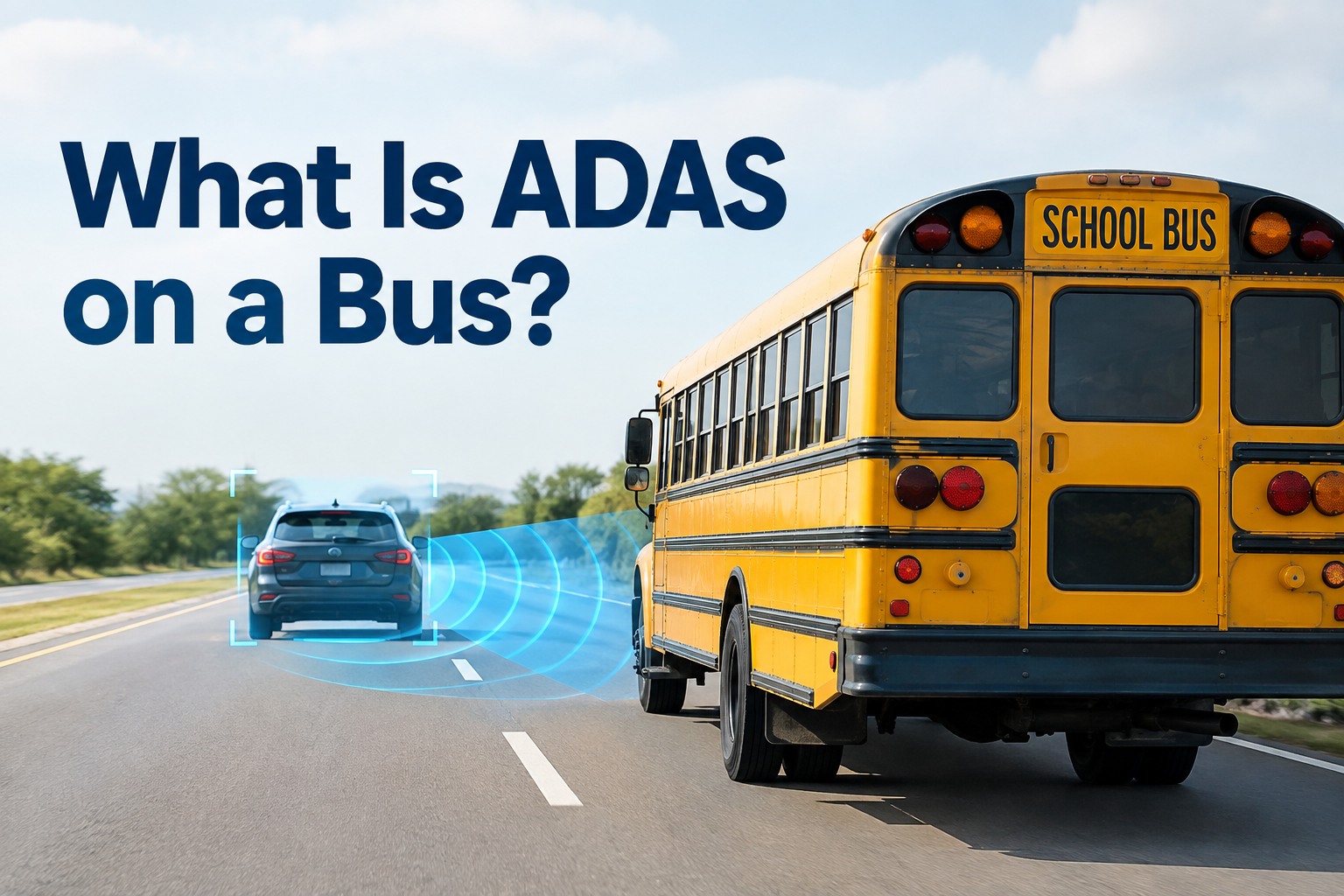
ADAS on a bus — advanced driver assistance systems — is technology that uses cameras, radar, and other vehicle data to help the driver identify and respond to hazards around the bus. It watches the road and the space around the vehicle, and when it spots a risk the driver might miss — a pedestrian stepping off a curb, a car in the blind spot, the bus drifting out of its lane — it warns the driver in time to react. On some buses, where the feature is supported, it can even apply automatic emergency braking as a last-resort backstop.
The word that matters most in that definition is help. ADAS assists the driver; it does not replace the driver. This isn't self-driving, and treating it that way is how fleets get into trouble. Your driver is still fully responsible for the bus — ADAS just gives them a wider, faster set of eyes on the hazards that a large vehicle's size and blind spots make genuinely hard to catch.
For school, transit, and charter fleets, that assist is worth a lot precisely because buses are difficult vehicles. Long stopping distances, wide turning paths, and significant blind spots mean the margin for a missed hazard is thin and the stakes — children, riders with disabilities, elderly passengers — are high. If you're weighing whether ADAS earns its place in your fleet, the practical questions come down to what it catches and how you act on what it flags. That second part is where you can talk to our team about a pilot on ten buses.
Common Bus ADAS Features, and What Each One Does
"ADAS" isn't one feature — it's an umbrella over several. Here are the ones that show up most on buses and what each actually watches for.
Forward Collision Warning
Alerts the driver when the bus is closing on the vehicle ahead too fast to stop safely — critical given a bus's long stopping distance.
Pedestrian Detection
Flags people in the bus's path or turning arc — the single highest-stakes hazard around a loading zone or a busy intersection.
Blind-Spot Monitoring
Watches the wide side and rear zones a bus mirror can't fully cover, warning of a car, cyclist, or pedestrian before a lane change or turn.
Lane Departure Warning
Signals when the bus drifts out of its lane without a turn signal — an early tell for distraction or fatigue on a long route.
Following-Distance Alerts
Warns when the bus is tailgating, prompting the driver to open up the gap a heavy vehicle needs to stop.
Automatic Emergency Braking
Where supported, applies the brakes if a collision is imminent and the driver hasn't reacted. A backstop — not a feature to rely on.
Notice that most of these are warnings, not actions. That's by design: ADAS keeps the human in the loop and hands them earlier, better information. Automatic emergency braking is the exception, and even there it's a last resort, not a reason for the driver to disengage.
ADAS vs. DMS vs. Video Telematics vs. Autonomous Driving
These terms get used interchangeably, and they shouldn't be. Each looks in a different direction and does a different job. Getting them straight saves you from buying one thinking it does the work of another.
Watches the road & surroundings
Warns the driver about collisions, pedestrians, blind spots, and lane drift. Assists driving; driver stays in control.
Watches the driver
Cab-facing AI reads fatigue, distraction, and phone use. Points inward at the person, not outward at the road.
Records synced events
Ties camera footage to GPS and vehicle data for review. Documents what happened; doesn't warn in real time.
Replaces the driver
The vehicle drives itself. ADAS is not this — it assists a human driver who remains fully responsible.
The cleanest mental model: ADAS looks out at hazards, a DMS looks in at the driver, video telematics records the result, and autonomous driving takes over entirely. Many fleets run ADAS and a DMS together — outward and inward coverage — which is powerful, and also where you end up with events landing in multiple systems. Consolidating those onto one bus record is worth a short demo to see side by side.
Why Bus ADAS Isn't Truck ADAS: The Big-Vehicle Problem
This is the mistake that quietly wrecks ADAS rollouts: a fleet copies truck ADAS specifications and bolts them onto buses without accounting for how differently a bus operates. A long-haul truck spends its life on highways at steady speed. A city transit bus spends its life stopping every few blocks, threading tight turns, and loading passengers curbside. Those are not the same hazard profile, and ADAS tuned for one misfires on the other.
That last point is the killer. If a system throws constant false alerts because it was tuned for highway driving, drivers stop trusting it — and an ignored warning is worse than no warning. Bus ADAS has to be specified for bus operating conditions from the start. The same principle, incidentally, is why generic fleet software fails bus fleets: tools built for trucking or manufacturing don't understand curbside stops, stop arms, and passenger loading. You can start free with a platform built for buses from day one instead of a retrofit.
What ADAS Can and Cannot Do
Set expectations honestly and your drivers will trust the system. Oversell it and the first false alert erodes their confidence. Here's the straight read.
What It Can Do
- Warn earlier than a driver can react alone
- Cover blind spots mirrors physically can't
- Flag pedestrians and lane drift in real time
- Apply emergency braking as a last resort (where supported)
- Build a record of near-misses worth coaching on
What It Cannot Do
- Drive the bus — the driver is always responsible
- See reliably through heavy rain, snow, fog, or glare
- Work if cameras are dirty, blocked, or out of calibration
- Eliminate false alerts entirely
- Perform the same across every vendor and every feature
Two operational realities sit underneath that right column. First, ADAS depends on maintenance — a mud-covered sensor or a windshield camera knocked out of calibration is a system that's quietly not working. Second, weather and visibility genuinely limit what any camera or radar can see, and no amount of marketing changes that. Both are reasons ADAS belongs inside a maintenance and inspection routine, not treated as a set-and-forget box.
Installation, Calibration, Training, and Upkeep
The technology is only as good as the rollout around it. Four things decide whether ADAS delivers or gathers dust.
- 1
Camera & sensor placement
Positioned for a bus's geometry — its blind spots, its turning sweep — not copied from a truck template. Placement is where bus-specific design shows up first.
- 2
Calibration
Cameras and radar must be calibrated correctly — and recalibrated after a windshield replacement or body work. An uncalibrated system warns at the wrong moment or not at all.
- 3
Driver training
Drivers need to know what each alert means, what to do, and what the system won't catch. Untrained drivers either over-trust the tech or tune it out.
- 4
Ongoing upkeep
Clean lenses, working sensors, and current software. This is a recurring maintenance item — which means it belongs in your inspection and PM workflow.
That fourth step is exactly why ADAS and your maintenance system shouldn't live apart. A blocked or miscalibrated sensor is a defect like any other — it should show up on an inspection, generate a work order, and get tracked to repair. When ADAS upkeep lives inside the same routine as brakes and tires, the system actually stays working. Fleets that want that tied together tend to book a demo to see sensor upkeep tracked alongside PM.
Transit Safety Rules and the ADAS Question
Let's be accurate, because this is where fleets get misled. There is no single federal regulation that universally requires ADAS on every bus. What does exist — for FTA-funded transit agencies — is a safety framework that ADAS can fit into, and that's a different thing.
ADAS isn't mandated by this rule — but pedestrian and collision hazards are exactly the kind of risk an agency assesses under it, and a driver-assistance system can be one of the mitigations it chooses to document.
So the honest framing is this: if you run an FTA-funded transit agency, your Safety Risk Management process under §673.25 is where ADAS naturally enters the conversation — not as a checkbox someone forces on you, but as a candidate mitigation for hazards you've already identified. For school districts and charter operators, the driver is under FMCSA-style responsibility rather than PTASP, so ADAS is a safety choice, not a mandate. Either way, if you deploy it, you'll want the events and the upkeep documented — which is squarely a records problem. You can talk to our team about a ten-bus pilot to see how that documentation comes together.
A Real Scenario: From ADAS Alert to Work Order
Definitions are one thing; here's how an ADAS event actually plays out when it's connected to the rest of your operation. Follow Bus #31 through one morning.
Bus #31's forward-collision warning fires repeatedly on an open stretch where nothing's ahead. The driver notes it and finishes the route safely.
Your safety lead reviews the flagged events. The pattern — false forward warnings on clear road — points to a sensor problem, not a driving problem.
Because the ADAS event sits on #31's asset record next to its inspections and maintenance, the lead opens a work order to check the front sensor for dirt, damage, or calibration drift — right from the event.
The shop finds a road-film-covered radar unit, cleans and recalibrates it, and closes the work order on #31's timeline. The false alerts stop — and the driver's trust in the system is restored.
That's the whole point of connecting ADAS to a maintenance workflow. The alert didn't just fire into the void — it surfaced a real defect, became a tracked work order, and got fixed before the driver started ignoring warnings that might one day be real. A false-alert pattern is a maintenance signal; treating it as one keeps the safety system credible.
Bus ADAS at a Glance
A one-screen reference for the transportation director presenting this to a board or safety committee.
| What it is | Advanced driver assistance tech using cameras and sensors to help the driver spot and respond to hazards |
|---|---|
| Direction | Outward — watches the road and area around the bus |
| Core role | Assists the driver — never replaces the driver |
| Common features | Forward collision warning, pedestrian detection, blind-spot monitoring, lane departure, following-distance alerts, AEB where supported |
| Bus-specific need | Tuned for long stopping distance, wide turns, and large blind spots — not copied from truck specs |
| Main limits | Weather/visibility, dirty or miscalibrated sensors, false alerts, vendor variation |
| Upkeep | Placement, calibration, driver training, ongoing sensor maintenance |
| Transit rule context | Fits Safety Risk Management under 49 CFR §673.25 (PTASP); not a universal ADAS mandate |
| Best-fit fleets | School districts, transit agencies, charter and campus shuttle operators |
Where BusCMMS Fits: Alerts That Become Actions
BusCMMS isn't an ADAS vendor — it's the AI-native bus fleet operations platform that connects vehicle events, inspections, safety records, and maintenance workflows on the same bus asset record. Whatever ADAS hardware you run, BusCMMS is the layer where an alert stops being a blip on a dashboard and becomes a tracked action.
That's the pattern BusCMMS is built for. An ADAS event, a DVIR defect, an inspection note, and the work order that resolves it all land on one chronological timeline per bus, and AI helps surface the events and defects that actually matter instead of leaving them scattered across separate portals. A false-collision-warning pattern becomes a sensor work order. A calibration-due reminder becomes a PM task. The safety system and the maintenance system stop being two islands. That's the difference between owning ADAS and running a fleet that uses it well.
The Bottom Line on ADAS for Buses
So, what is ADAS on a bus? It's camera- and sensor-based technology that helps the driver catch hazards a large vehicle makes hard to see — forward collisions, pedestrians, blind-spot traffic, lane drift — and warns them in time to react. It assists the driver, it never replaces them, and it only works when it's specified for bus conditions rather than borrowed from truck specs, and kept in calibration through real maintenance.
The fleets that get value from ADAS aren't the ones with the most sensors — they're the ones who route every alert and every upkeep task into a workflow, so a false warning becomes a fixed sensor and a real warning stays trusted. That connection between safety events and maintenance is the whole game, and it's exactly the gap BusCMMS was built to close. If you'd like to see ADAS events, inspections, and work orders living on one bus record instead of scattered across systems, talk to our team about a pilot on ten buses and bring the setup you already have.
What is ADAS on a bus in simple terms?
ADAS on a bus, short for advanced driver assistance systems, is technology that uses cameras, radar, and other vehicle data to help the driver spot and respond to hazards around the bus. It warns the driver about things like a pedestrian in the path, a vehicle in the blind spot, or the bus drifting out of its lane, and on some buses it can apply automatic emergency braking as a last resort. The key point is that it assists the driver — it does not drive the bus or replace the driver's responsibility.
What are the most common bus ADAS features?
The features you'll see most on buses are forward collision warning, pedestrian detection, blind-spot monitoring, lane departure warning, following-distance alerts, and, where supported, automatic emergency braking. Most of these are warnings that give the driver earlier information to react to, rather than actions the system takes on its own. Automatic emergency braking is the exception, and even then it's a backstop for when a collision is imminent and the driver hasn't reacted — not a feature to rely on.
How is ADAS different from a driver monitoring system?
They look in opposite directions. ADAS looks outward at the road and surroundings, warning the driver about hazards like collisions, pedestrians, and lane drift. A driver monitoring system (DMS) looks inward at the driver, using a cab-facing camera to detect fatigue, distraction, and phone use. Many fleets run both together for full coverage, but they solve different problems: ADAS is about what's happening around the bus, and a DMS is about the condition of the person driving it.
Why can't a bus just use truck ADAS?
Because buses operate very differently. A bus has a much longer stopping distance, wide turning paths that sweep the rear across crosswalks and bike lanes, and large blind spots — and city buses stop constantly amid dense pedestrian traffic. ADAS tuned for a highway truck alerts at the wrong thresholds and generates false alarms in stop-and-go bus service, which trains drivers to ignore it. Bus ADAS needs sensor placement and alert thresholds designed for bus geometry and duty cycles, not copied from truck specifications.
Is ADAS legally required on buses?
There is no single federal regulation that universally requires ADAS on every bus. For FTA-funded transit agencies, the Public Transportation Agency Safety Plan rule at 49 CFR 673.25 requires a Safety Risk Management process — identifying hazards, assessing their risk, and putting mitigations in place — and a driver-assistance system can be one mitigation an agency documents for pedestrian or collision hazards. For school districts and charter operators, ADAS is generally a safety choice rather than a mandate. Either way, if you deploy it, you'll want the events and sensor upkeep documented.