It's 6:15 a.m. on a Thursday and your longest route driver is on hour two of a split shift she'll finish twelve hours later. She's fine — until she isn't. Her eyes close for a second and a half at a rail crossing, her head dips, and she catches herself. Nobody sees it. There's no crash, no report, nothing in a file. That near-miss simply evaporates. A driver monitoring system is the thing that would have caught it — a quiet alert in the cab the moment her eyelids lingered too long, and a flag in your back office before the next stop.
What Is a Driver Monitoring System?
How cab-facing AI reads fatigue, distraction, and phone use on your buses — and what it can and can't actually detect
- Real-timeIn-cab alerting
- AnalyzesNot just records
- Cab-facingCamera position
- Eyelid closureMicrosleeps & drowsiness
- Head poseNodding & head drift
- Gaze directionEyes off the road
- Phone postureHand-to-ear, device tilt
What Is a Driver Monitoring System, in Plain Terms?
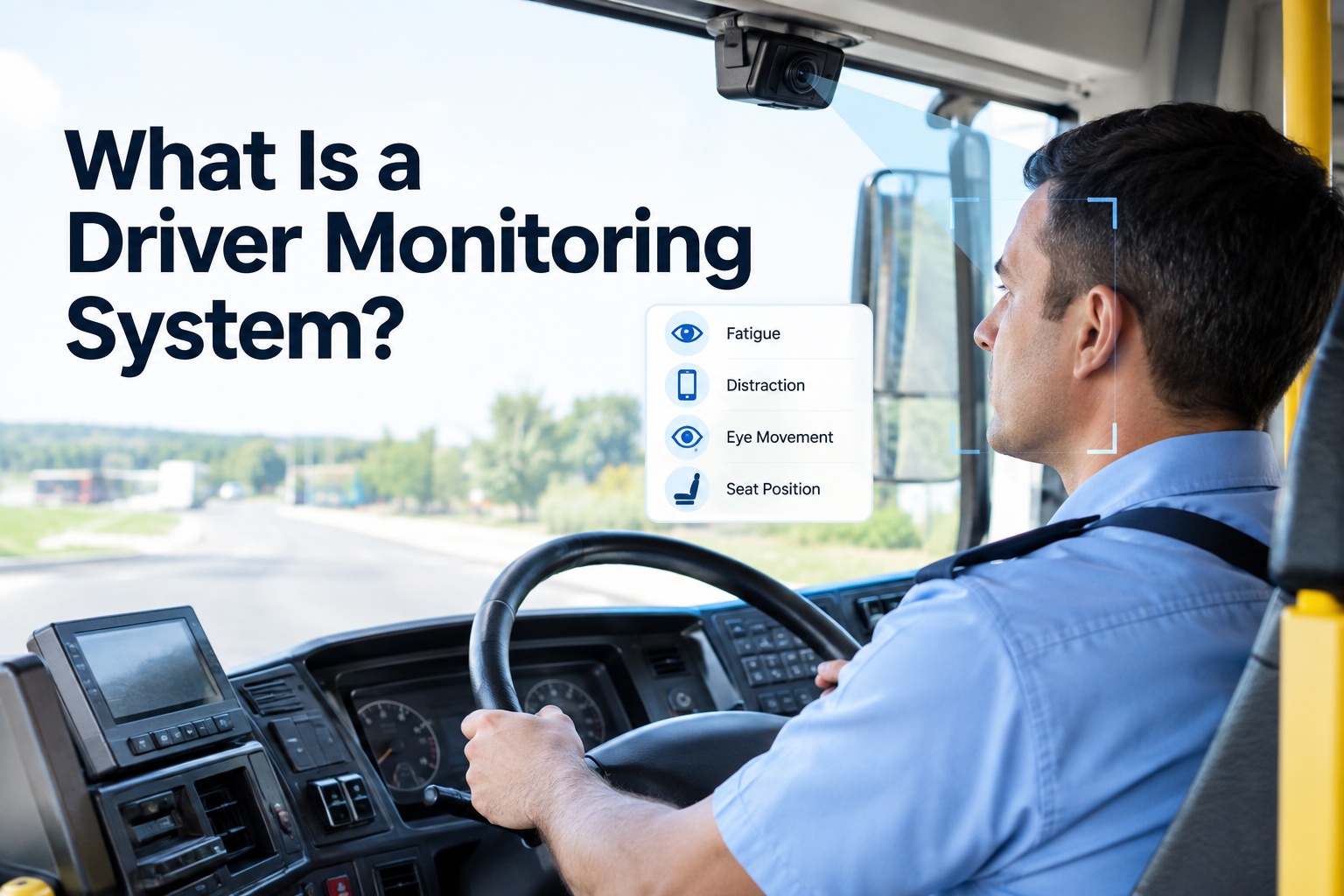
A driver monitoring system, or DMS, is a camera- and AI-based safety technology that watches the driver — not the road — and detects conditions like distraction, drowsiness, phone use, and other unsafe driving cues in real time. A small cab-facing camera reads the driver's face and posture frame by frame, and when the AI spots a risky pattern, it fires an alert in the cab and logs the event for your safety team to review later.
The key word is detects. Older approaches were reactive — you found out about a fatigue problem by reading an accident report after the fact. A DMS is built to catch the signal before the crash, in the window where it still matters. Fatigue in particular doesn't flip like a switch; it builds and broadcasts for a while through eyelid closure, head nods, and gaze drift, and that's exactly what the camera is trained to see.
For a bus fleet, that shifts the whole safety conversation. When your passengers are children, riders with disabilities, or elderly commuters, a drowsy driver isn't an abstract statistic — it's the one event you can't afford. The practical payoff is that a near-miss which used to vanish now becomes a coaching moment and a documented record. If you want to see how those recorded events tie back to the specific bus and its history, you can book a walkthrough of the platform that connects them.
How a Bus Driver Monitoring System Actually Works
Behind the alert is a fairly precise sequence. Understanding it helps you separate a real DMS from a camera someone slapped a "smart" label on.
- 1
The cab-facing camera scans continuously
A high-definition, inward-facing lens tracks the driver's line of sight, head position, and eye state throughout the shift — not just when something goes wrong.
- 2
AI reads facial landmarks and posture
Computer-vision models map facial geometry, hand position, and head angle to build a continuous attention picture — distinguishing a normal glance from a genuine deviation.
- 3
It measures against a threshold
Fatigue systems often use eyelid-closure duration (the PERCLOS metric); distraction fires when gaze leaves the road longer than a calibrated interval. Cross the line, and it's an event.
- 4
Alert in the cab, record to the office
The driver gets an immediate audible or visual warning to refocus. The event — a short clip and the data around it — uploads for back-office review and coaching.
That fourth step is where a DMS stops being a gadget and becomes an operations tool. The in-cab alert protects the current trip; the recorded event builds the coaching library and the documentation trail. One helps the driver right now, the other helps your safety program over the year.
DMS vs. Dash Cam vs. Video Telematics vs. GPS
This is the confusion that trips up most buying committees, and it's worth getting straight before anyone signs a purchase order. These four things overlap but do genuinely different jobs.
Watches the vehicle's location
Where the bus is, its speed, idle time, and route. No camera, no view of the driver.
Records the road ahead
Captures footage for after-the-fact review. Records, but doesn't analyze or alert in real time.
Syncs video + GPS + vehicle data
Ties a clip to location and engine data into one event record. Context-rich, but road- and vehicle-focused.
Analyzes the driver's behavior
Cab-facing AI reads fatigue, distraction, and phone use, and alerts in real time — before an incident, not after.
The clean way to remember it: GPS and dash cams look outward, a DMS looks inward at the person driving. Video telematics is the connective tissue that can carry a DMS event alongside road footage and location. Many modern fleets run several of these together, which is powerful — and also exactly where the dashboard-sprawl headache begins. If your safety events already live in two or three portals, seeing them consolidated onto one bus record in a quick demo is worth twenty minutes.
The Bus Use Cases That Actually Move the Needle
A driver monitoring system earns its keep in a handful of specific, everyday situations on a bus route — not in vague "safety." Here's where it does real work.
Fatigue & drowsiness
Split shifts and early routes make bus driving uniquely tiring. A DMS catches eyelid closure and head nods before a microsleep becomes a lane drift.
Phone use
Detected by posture — arm elevation, head tilt, device angle — not by reading the screen. The alert lands while the phone's still in hand.
Distraction
Eyes off the forward road too long triggers an event. Useful on stop-heavy routes where attention naturally splits between mirrors, kids, and traffic.
Incident investigation
When something happens, the driver-facing record shows what the driver was doing — objective evidence that protects the good ones as often as it flags a problem.
Coaching & improvement
Repeated event patterns feed a coaching queue. Trends across a driver or a route turn one-off warnings into a real training program.
Seat-belt compliance
Where the system supports it, a DMS can flag an unbelted driver — though this capability varies by vendor and isn't universal.
Notice how many of these end in a follow-up: a coaching session, an investigation, a training note. That's the tell. A DMS generates events; someone still has to route them to the right place and close the loop. That handoff — from safety flag to documented action — is where fleets either build a real program or let alerts pile up unread.
What a DMS Can and Cannot Detect
Honest expectations prevent buyer's remorse. A DMS is genuinely capable, but it estimates observable cues — it doesn't read minds, and its accuracy depends on conditions. Capabilities also vary widely by vendor, so "has a DMS" doesn't mean two systems do the same things.
Typically Detects Well
- Prolonged eyelid closure and microsleeps
- Head nodding and head drift
- Gaze leaving the forward road
- Phone-use posture and hand position
- Driver absence from the seat
Struggles With / Can't Do
- Sunglasses, low light, or an obstructed lens
- Facial coverings or unusual seating position
- Knowing why a driver is tired or distracted
- Guaranteeing a driver is fit to drive
- Features one vendor has but another doesn't
The right-hand column isn't a reason to skip a DMS — it's a reason to write realistic policy around one. The system flags observable risk; a human still makes the judgment call. Treating a DMS alert as a coaching input rather than an automatic verdict is what keeps drivers on your side instead of feeling surveilled.
Privacy, Audio, Retention, and Consent
This is the part that stalls more DMS rollouts than the technology ever does, so handle it up front. A cab-facing camera pointed at an employee raises real questions, and there is no single federal law that governs every DMS deployment — requirements depend heavily on your state and your policies.
- Onboard audio. Some systems record audio, which is where state consent laws bite hardest. Several states require all-party consent to record audio — confirm your state's rule before enabling microphones.
- Video retention. Decide how long clips are kept, who can access them, and when they age out. Set this as written policy, not an afterthought.
- Employee policy. Tell drivers what's monitored, how footage is used, and how it feeds coaching. Transparency turns a "spy cam" into an accepted safety tool.
- State consent requirements. Recording and monitoring rules vary by state. Don't assume one policy fits every terminal if you operate across state lines.
One note specific to school transportation: FERPA considerations only come into play when a recording actually captures student-related education records — for example, footage that identifies a specific student tied to a disciplinary or educational matter. A driver-facing DMS pointed at the cab generally isn't creating student education records, but if your interior cameras and DMS footage overlap, loop in whoever owns FERPA compliance in your district before you set retention and access rules. When your policies are settled, having the footage, the consent status, and the follow-up all documented in one place makes audits far less painful — you can start free and see how those records stay organized per bus.
A Real Scenario: From AI Event to Maintenance Follow-Up
Here's where a DMS stops being a standalone safety box and becomes part of how you run the fleet. Walk through one morning on Bus #14.
The DMS on Bus #14 flags a distraction event — the driver's gaze left the road for several seconds approaching a stop. An in-cab alert sounds; the driver refocuses.
Your safety lead reviews the clip. The driver wasn't on a phone — she was glancing repeatedly at a dashboard warning light. Not a coaching issue. A vehicle issue.
Because the DMS event sits on the same bus record as maintenance, the safety lead opens a work order for #14's warning light right from the event — no separate system, no lost note.
The shop clears the fault, the work order closes on #14's timeline, and the distraction pattern disappears. The safety flag and the repair are one connected thread.
That's the difference between a DMS that only generates alerts and one that's wired into operations. The safety event surfaced a maintenance problem, and because both lived on the same bus asset record, the fix happened instead of a clip getting filed and forgotten. Fleets that want that loop closed usually book a demo to see camera events and work orders on one record.
Driver Monitoring System at a Glance
A one-screen reference for the transportation director explaining a DMS to a board or safety committee.
| What it is | A camera- and AI-based system that monitors driver behavior and condition in real time |
|---|---|
| Camera position | Cab-facing (inward, at the driver) — not the road ahead |
| Core function | Analyzes behavior and alerts — not just records |
| Common detections | Drowsiness, distraction, phone use, head drift, driver absence |
| Key metric | Eyelid closure (PERCLOS) for fatigue; gaze-off-road interval for distraction |
| Alert types | In-cab audible/visual warning + recorded event for back-office review |
| Main limits | Sunglasses, low light, obstruction; capabilities vary by vendor |
| Privacy planning | Audio consent (state-dependent), retention policy, employee notice |
| Best-fit fleets | School districts, transit agencies, charter and campus shuttle operators |
"Isn't a DMS Just a Driver-Facing Camera?" — and Where BusCMMS Fits
The single most common objection deserves a direct answer: no. A driver-facing camera records the cab. A driver monitoring system analyzes what it sees, in real time, and acts on it. The camera gives you footage you have to go looking through after something bad happens. The DMS gives you an alert while there's still time to prevent it, plus a structured event your team can actually coach on. Same lens, completely different value — the intelligence is in the analysis, not the recording.
That's the philosophy behind where BusCMMS sits. BusCMMS isn't a camera vendor — it's the AI-native bus fleet operations platform that brings camera events and maintenance workflows together on the same bus asset record. Keep the DMS hardware you choose. BusCMMS is the layer where a fatigue flag, a distraction event, a DVIR, and the work order it triggers all land on one chronological timeline per bus, and where AI helps surface the defects and safety events that actually matter instead of leaving them scattered across portals. That's what turns a wall of alerts into a safety and maintenance program you can run.
The Bottom Line on Driver Monitoring Systems
So, what is a driver monitoring system for a bus fleet? It's cab-facing AI that reads fatigue, distraction, and phone use in real time, alerts the driver before an incident, and hands your safety team a documented event to coach on — fundamentally different from a camera that just records. It shines on split-shift fatigue, phone use, distraction, and incident review, but it has real limits and real privacy homework, and its capabilities vary by vendor.
The fleets that get value from a driver monitoring system aren't the ones with the fanciest camera — they're the ones who route every event to a follow-up and connect safety flags to maintenance and coaching in one place. That connection is the whole point, and it's exactly the gap BusCMMS was built to close. If you're ready to see DMS events, safety flags, and maintenance records living on one bus timeline instead of three portals, book a walkthrough and bring the setup you already have.
What is a driver monitoring system in simple terms?
A driver monitoring system (DMS) is a camera- and AI-based safety technology that watches the driver rather than the road, detecting conditions like drowsiness, distraction, and phone use in real time. A cab-facing camera reads the driver's eyes, head position, and posture, and when the AI spots a risky pattern it alerts the driver in the cab and logs the event for review. For bus fleets, it catches near-misses that would otherwise go unrecorded and turns them into coaching moments.
Is a driver monitoring system just a driver-facing camera?
No. A driver-facing camera only records footage you review after the fact. A driver monitoring system actively analyzes what it sees in real time, measuring signals like eyelid closure and gaze direction against thresholds, and fires an alert the moment behavior crosses the line. The difference is analysis versus recording: a camera gives you evidence to search through later, while a DMS gives you a warning while there's still time to prevent an incident, plus a structured event your team can coach on.
What can a bus DMS detect, and what can't it?
A DMS typically detects prolonged eyelid closure and microsleeps, head nodding, gaze leaving the road, phone-use posture, and driver absence from the seat. It struggles with sunglasses, low light, an obstructed lens, or unusual seating positions, and capabilities vary by vendor, so two systems may detect different things. Importantly, a DMS estimates observable cues — it doesn't know why a driver is tired and can't guarantee a driver is fit to drive. Treat its flags as coaching input, not automatic verdicts.
What are the privacy and consent considerations for DMS in buses?
There is no single federal law governing all DMS deployments — requirements depend on your state and your policies. The biggest issues are onboard audio, which triggers state consent laws (several states require all-party consent to record audio), video retention (how long clips are kept and who can access them), and clear employee policy so drivers know what's monitored. If you operate across state lines, monitoring rules can differ by state. Set retention, access, and consent as written policy before rollout.
Does FERPA apply to school bus driver monitoring footage?
FERPA considerations only come into play when footage actually captures student-related education records — for example, a recording that identifies a specific student tied to a disciplinary or educational matter. A driver-facing DMS pointed at the cab generally isn't creating student education records. But if your interior student cameras and DMS footage overlap, involve whoever owns FERPA compliance in your district before finalizing retention and access rules, since student privacy obligations are separate from driver monitoring.