Renewal season blindsides most bus fleet owners — premiums spike, carriers non-renew, and brokers hand you the same package as last year. The fleets that consistently lower costs treat renewal as a year-round process, not a 30-day scramble. Sign Up Free and start building the documentation trail that changes your underwriting story today.
Your Insurance Renewal Doesn't Have to Cost More This Year
BusCMMS gives fleet owners the loss-run records, CSA score data, and telematics documentation that move the needle with underwriters.
Why Most Bus Fleets Overpay at Renewal
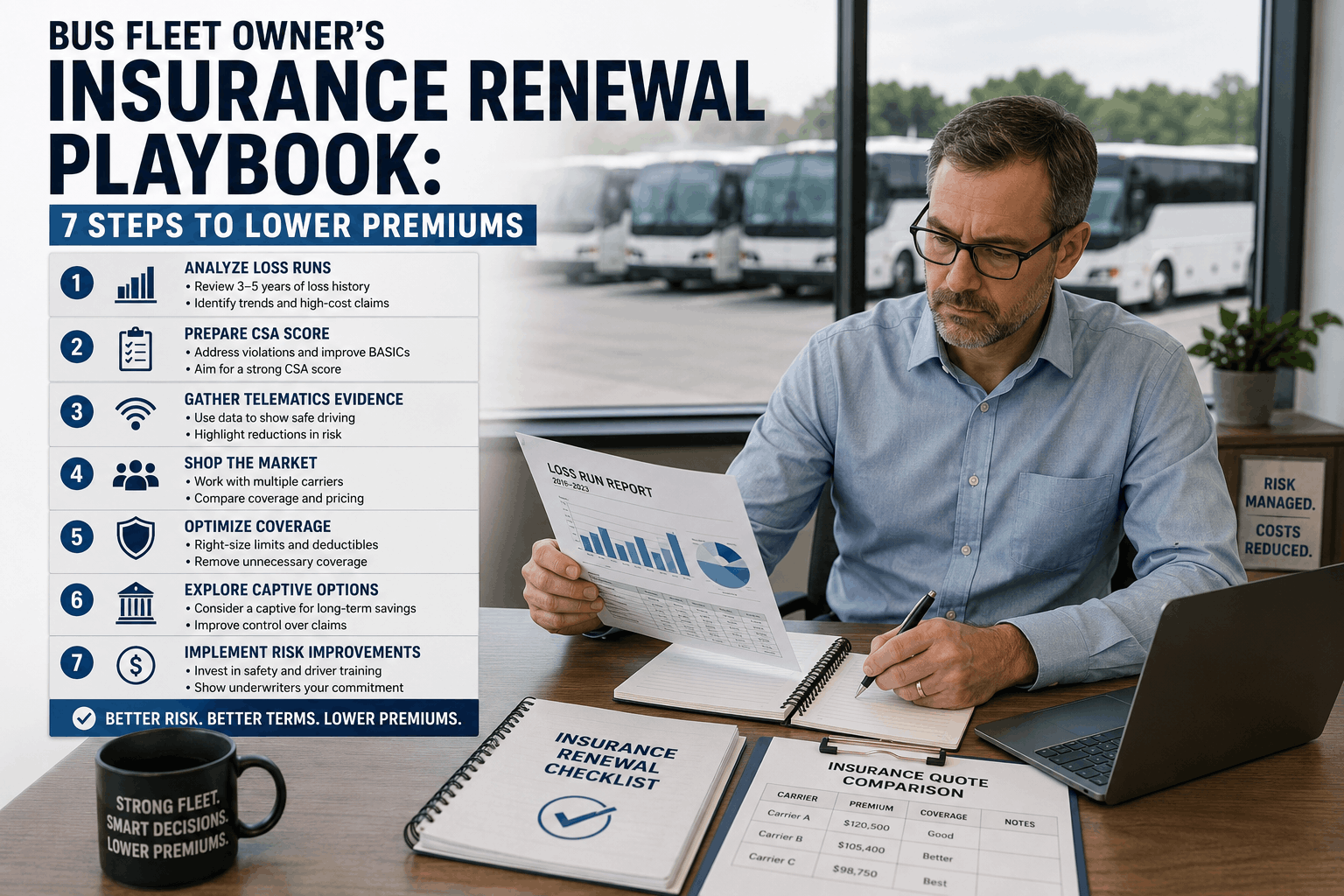
Commercial bus insurance is priced on perceived risk — and if you cannot prove your risk profile has improved, underwriters default to industry averages, which are rising. Fleets running structured safety programs, documented driver coaching, and clean telematics data routinely out-negotiate peers with identical vehicle counts. The 7-step playbook below gives you the same leverage. Start your free trial and capture the data carriers actually reward.
Step 1
Pull Your Loss Runs Early
Request 5-year loss runs from your current carrier 120 days before expiry. Clean loss history is your single strongest negotiating asset — get it in writing and verify every claim code before submission.
Step 2
Analyze Your CSA Score Trends
Log into FMCSA's SMS portal and download your BASIC percentile ranks. Underwriters weight Unsafe Driving and HOS Compliance heavily. Any percentile above 65 triggers manual review — know yours before your broker does.
Step 3
Package Your Telematics Evidence
Export 12 months of hard-braking, speeding, and distraction events from your telematics platform. Carriers offering usage-based pricing need this data formatted by driver, route, and vehicle — not just a summary PDF.
Step 4
Audit Driver Qualification Files
Every DQF gap — missing MVR, expired medical certificate, incomplete pre-employment drug screen — is an underwriting red flag. Complete an internal DQF audit and document remediation steps before submission.
Step 5
Shop at Least Three Specialty Carriers
General commercial auto carriers rarely understand bus operations. Submit your risk package to specialists: carriers focused on charter, transit, or school bus markets who have actuarial models built around your vehicle class.
Step 6
Evaluate Captive and Group Programs
Fleets above 20 vehicles may qualify for group captives or risk retention groups — structures where underwriting profit stays in your pocket rather than a carrier's. Evaluate total cost of risk, not just quoted premium.
Step 7: Track Every KPI That Underwriters Score
The final step is ongoing — building a live dashboard your broker can share with underwriters as evidence of continuous improvement. The metrics below are the ones that directly influence your loss cost multiplier and EPLI exposure. Sign Up Free to automate this reporting inside BusCMMS.
Frequency Rate Highest Weight
Claims per million miles driven. Underwriters benchmark this against fleet class averages. A frequency rate below 2.0 for charter/motorcoach operations qualifies for preferred pricing tiers with most specialty carriers. Document every near-miss in BusCMMS to show proactive risk management.
Severity Ratio
Average cost per claim over 5 years. High-severity single events can spike your loss ratio more than multiple small claims. Document rapid emergency response and subrogation recovery to demonstrate active severity management.
Driver MVR Score Distribution
The percentage of drivers with zero moving violations in the past 36 months. Submit a distribution chart — not just a count — showing the proportion of your fleet operating in clean, preferred, and standard tiers to allow carrier segmentation pricing.
PM Compliance Rate
Percentage of preventive maintenance events completed on schedule. Carriers increasingly request maintenance records as evidence of vehicle fitness. A compliance rate above 95% signals operational discipline and reduces mechanical failure liability exposure.
Drug & Alcohol Testing Compliance
Random selection percentage, post-accident test completion rate, and return-to-duty documentation. Any gap in FMCSA-mandated testing triggers carrier concern. Submit your third-party TPA's compliance report alongside your renewal package.
Training Hours Per Driver
Annual safety and defensive driving training hours per CDL holder. Carriers offering training credits typically require a minimum of 8 hours annually with certified instructors. Document completion dates, curricula, and instructor credentials in your submission.
Carrier Comparison: What to Evaluate Beyond Premium
Scroll for more →
| Evaluation Factor | Why It Matters | Questions to Ask | BusCMMS Helps |
|---|---|---|---|
| Claims Handling Speed | Slow claims = longer vehicle downtime = lost revenue | Average days to first contact? Dedicated adjuster? | Incident documentation exports |
| Loss Control Services | Free safety resources offset premium cost | On-site audits? Driver training resources? Portal tools? | Safety KPI dashboards |
| Telematics Integration | Usage-based pricing requires data sharing | Which platforms accepted? Data format requirements? | Telematics data export |
| Subrogation Capability | Strong subrogation recoveries reduce net loss cost | Recovery rate on at-fault third-party claims? | Accident documentation logs |
| Captive Eligibility | Profit participation lowers 5-year total cost | Minimum fleet size? Loss ratio thresholds? | Multi-year loss trend reports |
Build a Renewal Package That Speaks Underwriter Language
Underwriters approve hundreds of fleet submissions annually. The ones that get preferred pricing share a common trait: they lead with data, not narrative. Your submission package should open with a one-page executive summary of your fleet's loss history, safety program, and improvement trajectory — then attach 12 months of supporting records. BusCMMS automates the generation of every supporting document described in this playbook.
Loss Run Reports
5-year formatted loss history ready for carrier submission
Safety KPI Dashboard
Live metrics matching underwriter scoring criteria
Driver Compliance Logs
MVR, DQF, training hours exportable by driver or fleet
PM Compliance Records
Scheduled vs completed maintenance audit trail
Implementation Timeline: 120 Days to Renewal
01
Day 120 – Pull Loss Runs
Request 5-year loss runs from your current carrier in writing. Verify every claim code, reserve amount, and status. Dispute any inaccurate entries immediately — corrections take 30–60 days to process.
02
Day 90 – Safety Audit
Conduct an internal safety audit covering DQF completeness, PM compliance records, driver training logs, and telematics data quality. Document all findings and remediation actions with dates.
03
Day 75 – Broker Selection
If shopping carriers, select a broker specializing in commercial bus operations by day 75. Provide them your complete risk package — loss runs, safety program summary, fleet schedule, and 12-month telematics export.
04
Day 45 – Quote Analysis
Receive and compare quotes. Evaluate beyond premium: claims service rating, loss control resources, telematics acceptance, and captive eligibility. Score each carrier against your weighted criteria matrix.
05
Day 30 – Negotiation
Use competing quotes as leverage. Present any safety improvements since your last renewal — new training programs, telematics deployment, PM compliance increases — as evidence of risk reduction deserving credit.
06
Day 0 – Bind and Document
Bind coverage and immediately begin documenting your current-year safety metrics. The data you capture today is your negotiating ammunition at next renewal. Start BusCMMS free to automate this from day one.
Frequently Asked Questions
How far in advance should I start the insurance renewal process?
Begin 120 days before your policy expiry date. This gives you time to pull and verify loss runs, conduct an internal safety audit, engage multiple brokers, and negotiate from a position of strength rather than deadline pressure.
What is a CSA score and how does it affect my insurance premium?
The CSA (Compliance, Safety, Accountability) program assigns BASIC percentile rankings to motor carriers based on inspection violations and crash data. Underwriters use these scores to benchmark your risk profile — high percentiles in Unsafe Driving or Vehicle Maintenance typically trigger manual review and higher premiums.
Can telematics data actually lower my fleet insurance premium?
Yes. Multiple specialty commercial auto carriers now offer usage-based pricing programs that credit fleets with documented low hard-braking, speeding, and distraction events. The key is having 12 months of clean data formatted to the carrier's specifications — not just a summary report.
What is a group captive and is it right for my fleet?
A group captive is a risk-sharing structure where multiple fleets pool their premium into a shared insurance company they collectively own. Underwriting profits stay within the group rather than going to a commercial carrier. Generally appropriate for fleets with 20+ vehicles, a 3-year clean loss history, and willingness to invest in ongoing safety program management.
How does BusCMMS help with insurance renewal preparation?
BusCMMS automates the capture and formatting of the exact records underwriters request: PM compliance logs, driver qualification file status, incident documentation, and safety training records. The platform generates exportable reports in formats accepted by major commercial bus insurance carriers.
Stop Overpaying at Every Renewal Cycle
BusCMMS fleet owners go into renewal with documented loss history, clean compliance records, and telematics evidence — the three things that separate preferred pricing from standard rates.