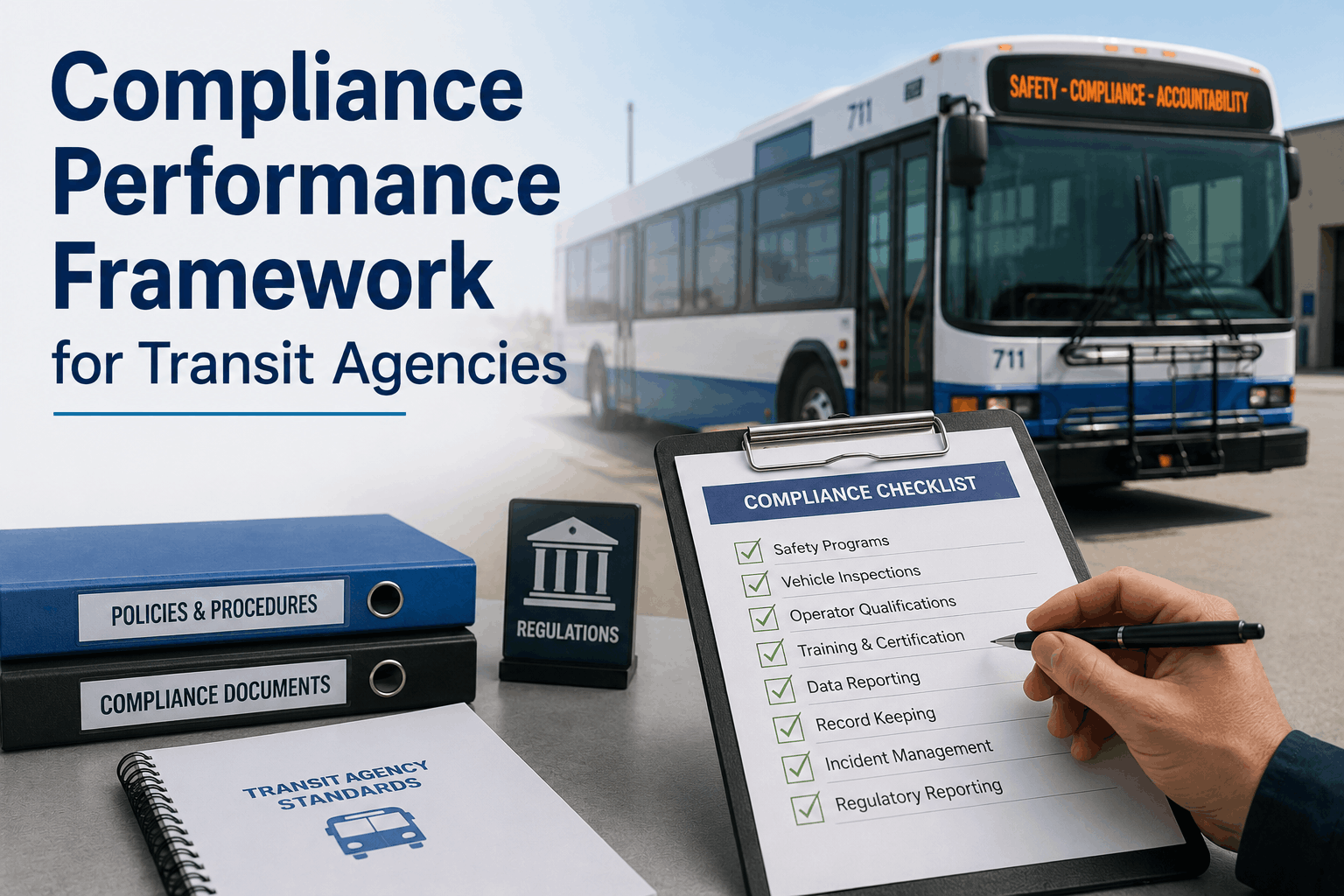
The Federal Motor Carrier Safety Administration (FMCSA) and Federal Transit Administration (FTA) maintain overlapping compliance frameworks that bus fleet operators must navigate simultaneously. A single transit agency receiving Section 5307 or 5339 federal funding operates under federal DOT regulations (49 CFR 396 for vehicle maintenance and inspection), FTA asset management requirements (asset tracking, documentation, reporting), ADA accessibility mandates (wheelchair lift inspection, accessible seating verification), state-specific transit regulations (which vary by state), and local franchise requirements set by municipal governments. This complex regulatory landscape creates compliance documentation burden that frustrates transportation directors: a defective bus window creates a DVIR defect entry (FMCSA), an asset condition finding (FTA), and a maintenance work order (internal system). One mechanical issue generates three separate documentation requirements tracked in three separate systems, reported to three separate oversight bodies. Modern compliance software for transit agencies consolidates all three frameworks into unified documentation so a single defect record satisfies FMCSA, FTA, and local oversight simultaneously—reducing compliance burden while increasing audit confidence.
Stay Compliant Across All Regulatory Frameworks Simultaneously
BusCMMS automates compliance tracking for FMCSA 49 CFR 396, FTA asset management, ADA accessibility, and state-specific regulations—eliminating manual document assembly and reducing audit preparation from days to hours.
The Three-Framework Compliance Challenge: FMCSA, FTA, and ADA Requirements
Transit agencies receiving federal funding operate under three distinct compliance regimes that create overlapping, sometimes conflicting requirements. FMCSA regulates vehicle safety and maintenance under commercial motor vehicle standards (49 CFR 390–396). FTA regulates asset management and system safety under federal transit funding conditions (49 CFR Part 625). ADA regulates accessibility for passengers with disabilities under the Americans with Disabilities Act (49 CFR Part 37). Each framework generates separate documentation requirements, separate audit schedules, and separate enforcement mechanisms. An unaddressed DVIR defect in a bus window becomes simultaneously: a federal safety violation (FMCSA), an asset condition finding (FTA), and an ADA accessibility impact (if the window affects passenger egress). Agencies managing compliance manually struggle to coordinate documentation across three frameworks and often discover audit findings revealing gaps in one system while they maintain perfect records in another. The solution is unified compliance infrastructure that treats a single defect record as satisfying all three frameworks, with appropriate documentation retained for each oversight body's audit and retention requirements.
Breaking Down Compliance: FMCSA, FTA, ADA, and State Requirements
Understanding what each compliance framework requires and how they overlap is essential for implementation. The following sections detail specific requirements transit agencies must track for compliance software to manage systematically.
FMCSA 49 CFR 396: Vehicle Maintenance and Inspection Standards
FMCSA regulations require every commercial motor vehicle (including all public transit buses) to maintain a written maintenance program with systematic inspection and repair documentation. Key requirements: annual comprehensive inspection covering 20+ safety components (brakes, steering, lighting, tires, emergency equipment); daily driver vehicle inspection reports (DVIRs) documenting any defects affecting safe operation; 90-day emergency exit and backup alarm inspections specific to buses; three-month DVIR retention with mechanic certification and next-driver acknowledgment; maintenance records retained for vehicle service life plus six months. Electronic DVIRs are fully compliant as of March 23, 2026 (FMCSA-2025-0115). Non-compliance penalties range from $1,500 per finding to $23,048 for operating under an out-of-service order. BusCMMS automates DVIR capture, schedules annual inspections automatically, tracks 90-day bus-specific requirements, and retains all documentation with timestamps and digital signatures for immediate audit access.
FTA 49 CFR Part 625: Asset Management and System Safety
Federal Transit Administration requires grantees (agencies receiving Section 5307, 5339, or other federal transit funding) to maintain a transit asset management (TAM) system documenting all revenue vehicles and support equipment. Key requirements: asset inventory with acquisition dates and depreciation tracking; condition assessment for every bus (rated operational, acceptable, or poor); maintenance history documentation; capital replacement planning based on asset lifecycle and maintenance trends; annual TAM plan update submitted to FTA. FTA audits examine whether agencies are systematically tracking asset condition and making data-driven replacement decisions or simply deferring maintenance indefinitely. BusCMMS integrates with FTA asset management workflows, tracking equipment condition from maintenance records, calculating asset lifecycle costs, and generating the annual TAM plan report required for federal funding compliance.
ADA 49 CFR Part 37: Accessibility and Disability Accommodations
Americans with Disabilities Act requires all public transit operators to maintain accessible fleets and document accessibility maintenance. Key requirements: wheelchair lifts inspected and serviced per manufacturer specifications (typically quarterly); backup power systems for lifts verified weekly; accessible seating and standing areas maintained and free of obstruction; audio and visual stop announcements functional on every vehicle; priority seating clearly marked and maintained; emergency procedures accessible to passengers with disabilities. 2026 UPDATE: ADA now requires timestamped daily wheelchair lift inspection records and preventive maintenance logs with specific measurements. Non-compliance with ADA accessibility requirements can result in federal funding suspension and Department of Justice enforcement action. BusCMMS tracks wheelchair lift inspections, emergency procedure compliance, and accessible seating maintenance with timestamped records for ADA audit documentation.
State-Specific Transit Regulations and Local Franchise Requirements
Beyond federal requirements, states impose additional regulations: California requires 90-day periodic inspections for vehicles over 26,001 lbs GVWR; New York requires specific maintenance intervals for public transit vehicles; Texas has separate school bus regulations distinct from transit buses. Local governments granting transit franchises often add documentation requirements: municipalities may require proof of insurance, safety performance metrics, environmental compliance, and customer safety incident reporting. Private transit operators (motorcoach companies) face additional regulations including passenger manifest requirements, interstate commerce documentation, and commercial liability insurance verification. BusCMMS configures state and local requirements based on jurisdiction, ensures compliance with all applicable frameworks, and generates jurisdiction-specific audit documentation without forcing agencies to maintain separate systems.
Compliance Checklist: Critical Documentation Requirements by Regulatory Body
| Regulatory Requirement | Regulatory Body | Frequency/Timing | Retention Period | Audit Impact if Missing |
|---|---|---|---|---|
| Annual Comprehensive Inspection | FMCSA 396.17 | Every 12 months minimum | 14 months from inspection date | Out-of-service order possible; $15,000+ fines |
| Daily DVIR (Driver Vehicle Inspection Report) | FMCSA 396.11 | End of each operating day | 3 months with mechanic certification & next-driver acknowledgment | $1,584/day × up to 10 days = $15,840 maximum penalty |
| Emergency Exit & Backup Alarm Inspection (Buses) | FMCSA 396.3 | Every 90 days | 14 months | Bus removed from service; $1,500–$15,000 fine |
| Maintenance Records & Work Order Documentation | FMCSA 396.3 | Ongoing as maintenance performed | Service life + 6 months after removal from service | Incomplete records create audit findings; fines $1,000–$5,000 |
| Transit Asset Management (TAM) Plan | FTA 49 CFR 625 | Annual update required | Retained indefinitely; submitted to FTA annually | Federal funding suspension; loss of Section 5307/5339 eligibility |
| Asset Condition Assessment | FTA 49 CFR 625 | Every bus assessed annually minimum | 3 years minimum retention | FTA audit finding; questioned costs on capital grants |
| Wheelchair Lift Inspection & Maintenance | ADA 49 CFR 37 (2026 Update) | Daily inspection; quarterly PM minimum | 12 months timestamped records with measurements | Bus removed from service; DOJ enforcement action possible |
| Electronic DVIR (if transitioning from paper) | FMCSA 396.11 (2026 Update) | Effective March 23, 2026; phased adoption acceptable | Digital storage acceptable for 3-month DVIR retention | Full compliance with electronic DVIRs; no penalties for digital transition |
Compliance Automation: 5-Component Framework for Unified Documentation
Modern compliance software consolidates FMCSA, FTA, ADA, and state requirements into five interdependent components that feed a single compliance documentation hub. When properly configured, a single defect record satisfies all overlapping requirements simultaneously.
Component 1: Unified Defect and Maintenance Tracking
A DVIR defect in a bus backup camera becomes simultaneously: a FMCSA vehicle defect (federal safety requirement), an FTA asset condition finding (asset management), and an ADA accessibility impact (emergency egress system). BusCMMS captures the defect once with multi-framework tagging: DVIR category (safety-critical), FTA category (asset condition), ADA category (accessibility). The single defect record generates automated work order assignment, FTA asset condition status update, and compliance status notification to all three oversight bodies' requirement tracking systems.
Component 2: Automated Compliance Calendar and Deadline Management
Compliance requirements operate on different cycles: annual inspections (FMCSA), 90-day emergency exit checks (FMCSA), quarterly wheelchair lift service (ADA), annual TAM plan updates (FTA), and state-specific periodic inspections. BusCMMS maintains a master compliance calendar that flags deadlines for every requirement across every bus, generates work orders automatically for upcoming due dates, and alerts compliance officers 30 days before deadline. This eliminates the manual spreadsheet tracking that creates missed deadlines.
Component 3: Audit-Ready Documentation with Digital Signatures
FMCSA requires DVIR chain of custody with three signatures: driver certification (defect reported), mechanic certification (repaired or deemed unnecessary), and next-driver acknowledgment (reviewed and accepted). BusCMMS captures all three signatures digitally with timestamps, automatically sorting documentation for each bus by retention requirement: 3-month DVIRs tagged separately, annual inspection reports tagged separately, 14-month retention items tracked separately. When federal auditors request records, agencies produce complete audit trail in under 2 hours versus 4–6 days for manual file assembly.
Component 4: Multi-Framework Reporting for Different Oversight Bodies
FMCSA auditors want to see DVIR compliance and inspection history. FTA wants to see asset condition trending and TAM plan execution. ADA compliance officers want to see wheelchair lift maintenance records. Local franchise authority wants to see safety performance metrics. BusCMMS generates separate audit reports tailored to each oversight body's requirements—FMCSA report focuses on maintenance records and inspection compliance; FTA report focuses on asset condition and capital planning; ADA report focuses on accessibility maintenance; local report focuses on operational safety metrics.
Component 5: Predictive Compliance Gap Detection
Predictive analytics identify compliance risk before audits find violations: if a bus's annual inspection due date is approaching and the work order hasn't been scheduled, the system flags it 30 days in advance. If emergency exit 90-day inspections are clustering in a way that creates documentation risk, the system alerts compliance officers. If a bus hasn't had a DVIR filed for three consecutive days (indicating a driver-reporting issue), the system flags the pattern. This proactive detection prevents compliance surprises that become audit findings.
Frequently Asked Questions: Transit Compliance Framework
What is the difference between FMCSA and FTA compliance requirements for transit buses?
FMCSA (DOT) regulates vehicle safety and maintenance under commercial motor vehicle standards. FTA regulates asset management and system safety for federal transit funding recipients. Both apply to transit agencies receiving federal funding, creating overlapping documentation requirements.
What are the penalties for FMCSA compliance violations in 2026?
FMCSA penalties range from $1,500 per violation to $23,048 for operating under an out-of-service order. Missing DVIR documentation costs $1,584 per day (up to $15,846 maximum). Compliance violations also trigger CSA (Carrier Safety Assessment) scoring that affects insurance rates and federal funding eligibility.
Are electronic DVIRs acceptable for federal audits in 2026?
Yes. FMCSA's February 2026 final rule (FMCSA-2025-0115, effective March 23, 2026) explicitly authorizes electronic DVIRs. Digital signatures, mobile submission, and cloud storage are fully compliant with FMCSA requirements.
What compliance documentation must transit agencies maintain for federal audits?
FMCSA requires: annual inspections (14-month retention), DVIRs (3-month retention with complete signature chain), emergency exit inspections every 90 days (14-month retention), maintenance records (service life + 6 months). FTA requires annual TAM plan and asset condition assessments (3-year retention minimum). Agencies receiving Section 5307/5339 funding must maintain all documentation.
How does ADA compliance affect transit bus maintenance scheduling?
ADA requires wheelchair lift inspections daily and preventive maintenance quarterly (at minimum). 2026 updates require timestamped records with specific measurements. Non-compliance with ADA accessibility requirements can trigger bus removal from service and DOJ enforcement action.
Can a single bus maintenance record satisfy FMCSA, FTA, and ADA requirements simultaneously?
Yes, with proper tagging and documentation. BusCMMS tags each defect and maintenance record with applicable compliance frameworks (FMCSA, FTA, ADA, state), automatically generating framework-specific audit reports from unified maintenance records.
What happens if a transit agency fails an FTA audit for asset management compliance?
FTA audit findings on asset management can result in questioned costs on capital grants, reduced future funding eligibility, or mandatory remediation plans. Agencies must demonstrate systematic asset condition tracking and data-driven replacement planning.
How long does it take to prepare for a federal DOT or FTA compliance audit?
With unified compliance documentation: under 2 hours. With manual systems: 4–6 days. The difference is whether documentation is systematically retained and indexed (automated) or scattered across paper files and email (manual assembly).
We were juggling three separate compliance systems for FMCSA, FTA, and ADA. An FTA auditor found gaps in our asset condition documentation that our maintenance system had correct—they just weren't connected. BusCMMS unified everything. Same defect, all three compliance frameworks satisfied. Our last audit took 90 minutes instead of 4 days.
Consolidate Compliance Across All Regulatory Frameworks
BusCMMS unifies FMCSA, FTA, ADA, and state compliance requirements into single documentation hub—reducing audit prep time from days to hours and eliminating compliance gaps that create federal findings.