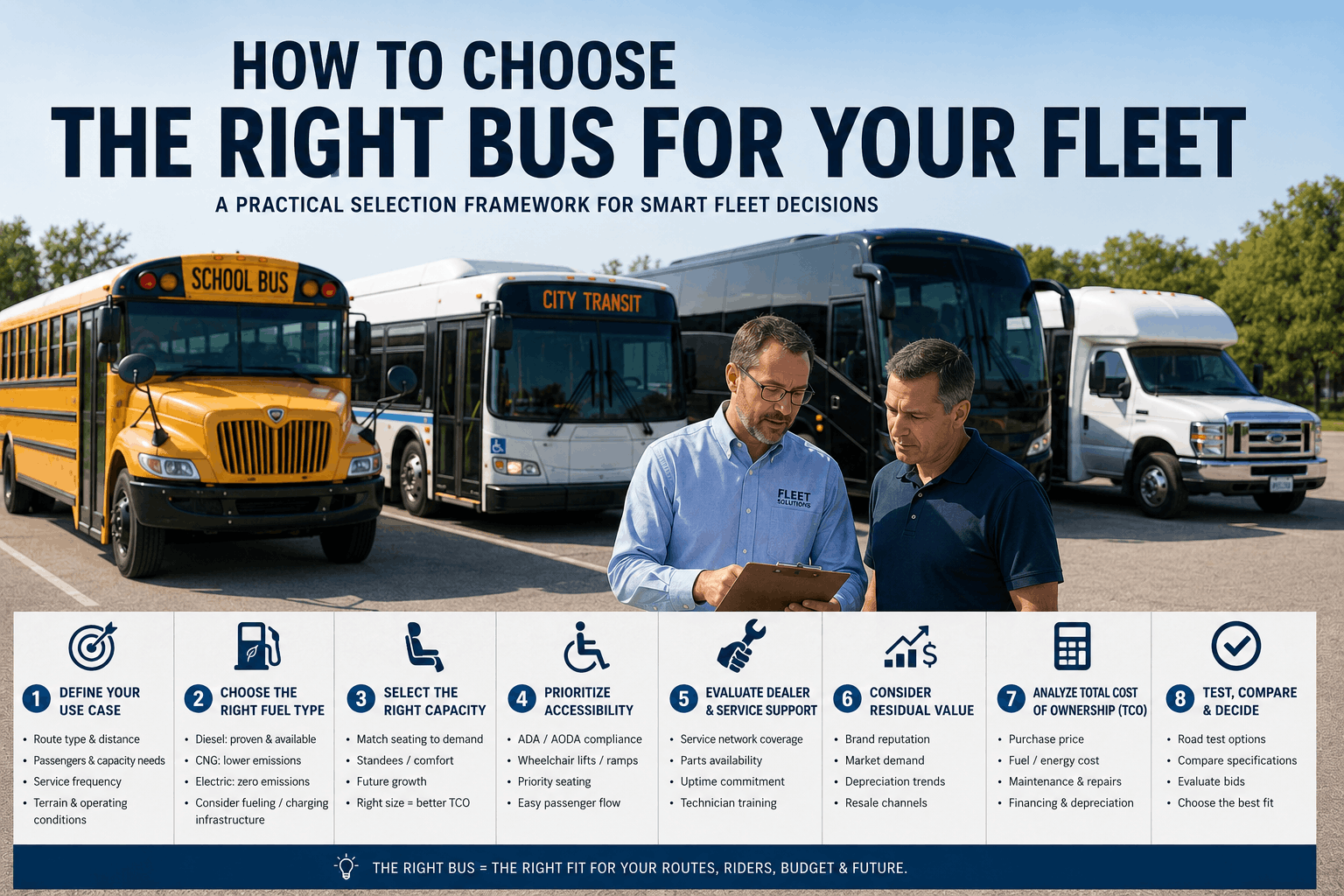
Choosing the right bus for your fleet is one of the most consequential decisions a transportation operator can make. The vehicle you select will impact your operating costs, driver satisfaction, passenger experience, and maintenance burden for a decade or more. With an expanding range of fuel types, body configurations, and technology options, the bus procurement process has become increasingly complex. This guide provides a structured framework for bus selection, covering use case analysis, fuel type evaluation, capacity planning, accessibility requirements, dealer support assessment, residual value projections, and total cost of ownership (TCO) modeling. Fleet operators who apply this disciplined approach to bus selection avoid costly mismatches and build a fleet that delivers reliable service, efficient operation, and long-term value.
Choose the Right Bus for Your Fleet with Confidence
BusCMSS helps fleet operators evaluate TCO, track vehicle performance, and manage maintenance — ensuring your bus selection delivers long-term value and operational reliability.
Key Factors in Choosing the Right Bus for Your Fleet
Selecting the optimal bus involves evaluating multiple interconnected factors that influence performance, cost, and operational suitability. The following framework organizes these factors into six critical categories that every fleet operator should assess during the procurement process. By systematically evaluating each dimension, operators can make informed decisions that align with their specific service requirements and financial constraints.
Use Case and Application
Define how the bus will be used — transit, school, motorcoach, shuttle, or paratransit. Consider route length, average speed, passenger demographics, and operating environment. Each use case demands specific vehicle characteristics.
Fuel Type and Propulsion System
Evaluate diesel, gasoline, propane, CNG, electric, or hybrid options based on fuel availability, operating cost, range, and environmental regulations. Fuel choice affects TCO, maintenance, and sustainability goals.
Passenger Capacity and Interior Layout
Match vehicle capacity to route demand and service type. Consider seating configuration, standing room, and wheelchair positions. Oversizing increases purchase cost and fuel consumption; undersizing reduces service quality.
Accessibility and ADA Compliance
Ensure the bus meets ADA requirements for wheelchair lifts, ramps, securement systems, and priority seating. Accessibility features must align with your passenger demographic and regulatory obligations.
Dealer Support and Parts Availability
Assess the manufacturer's dealer network, service availability, and parts distribution. Reliable dealer support reduces downtime and ensures access to qualified technicians for warranty and repair work.
Residual Value and Total Cost of Ownership
Model TCO including purchase price, fuel, maintenance, financing, and resale value. Higher residual value can offset higher upfront costs. Use lifecycle cost analysis to compare vehicles.
Bus Selection Framework: Step-by-Step Decision Process
Making an informed bus selection requires a disciplined, step-by-step process that gathers data, applies analytical models, and engages stakeholders. The following steps provide a roadmap for navigating the bus selection journey from initial requirements definition through final procurement decision.
Define Operational Requirements
Needs Assessment
Document the specific service requirements including passenger volume, route type, operating hours, and environmental conditions. Identify any special needs such as accessibility, cargo, or tour guide provisions. Establish performance targets for reliability, fuel efficiency, and passenger comfort.
Activity
Stakeholder interviews, route analysis
Deliverable
Requirements document
Timeline
2-4 weeks
Conduct Total Cost of Ownership Analysis
Financial Modeling
Build a TCO model that captures purchase price, fuel costs, maintenance expenses, financing, insurance, and resale value over the expected service life. Compare multiple vehicle options using equal lifecycle assumptions. Use sensitivity analysis to test key cost drivers.
Activity
Cost modeling, scenario analysis
Deliverable
Lifecycle cost comparison
Timeline
3-6 weeks
Evaluate Fuel and Propulsion Options
Technology Selection
Compare fuel types based on availability, cost stability, infrastructure needs, and regulatory compliance. Consider electric charging or CNG fueling infrastructure requirements. Assess range, refueling time, and payload implications for each propulsion option.
Activity
Fuel availability assessment, cost analysis
Deliverable
Propulsion recommendation
Timeline
2-4 weeks
Assess Manufacturer and Dealer Support
Supply Chain Evaluation
Evaluate manufacturer reputation, warranty terms, and dealer network coverage. Assess parts availability, technician training programs, and after-sales support. Request references from existing fleet operators with similar use cases.
Activity
Dealer interviews, reference checks
Deliverable
Support evaluation scorecard
Timeline
2-3 weeks
Conduct In-Person Demonstrations and Trials
Validation Phase
Arrange demonstration drives and, where possible, extended trial periods. Involve drivers, mechanics, and operations managers in the evaluation. Test the vehicle on actual routes with typical passenger loads. Collect feedback on handling, comfort, maintenance access, and visibility.
Activity
Demo drives, trial runs
Deliverable
Operator feedback report
Timeline
2-6 weeks
Make Selection and Plan for Implementation
Decision and Transition
Apply a weighted decision model to compare all candidate vehicles across technical, operational, financial, and support criteria. Prepare a business case for the preferred choice. Develop an implementation plan covering purchase, delivery, driver training, and integration with maintenance systems.
Activity
Decision matrix, implementation plan
Deliverable
Final recommendation
Timeline
2-4 weeks
Bus Selection Decision Framework: Visual Overview
The following chart illustrates the relative importance of each bus selection factor based on operator surveys and fleet industry analysis. Use this visual guide to calibrate your own prioritization and ensure you are weighting factors appropriately for your specific operational context.
Total Cost of Ownership
High
Use Case Fit
High
Dealer Support and Parts
Medium
Fuel Type Availability
Medium
Residual Value
Medium
Accessibility Features
Variable
Bus Selection Decision Matrix
The following matrix summarizes key evaluation criteria and provides a scoring framework to compare candidate vehicles. Use the rating scale (1-5) to assess each vehicle against your specific requirements and establish weighted scores for final ranking.
| Evaluation Criteria | Weight | Rating (1-5) | Weighted Score | Data Source |
|---|---|---|---|---|
| Total Cost of Ownership | 30% | — | — | TCO model, fleet data |
| Use Case Fit | 25% | — | — | Route analysis, operator feedback |
| Dealer Support and Service | 15% | — | — | Dealer reference, parts availability |
| Fuel Type and Propulsion | 12% | — | — | Fuel cost, infrastructure, range |
| Residual Value | 10% | — | — | Market depreciation data |
| Accessibility Compliance | 8% | — | — | ADA regulations, passenger needs |
How BusCMSS Supports Bus Selection and Fleet Planning
BusCMSS provides fleet operators with the data and analytics needed to support bus selection decisions. The platform tracks vehicle performance, maintenance costs, and reliability metrics across existing fleet assets, enabling operators to identify which vehicle types and configurations deliver the best operational and financial outcomes. By centralizing fleet data, BusCMSS helps operators validate bus selection assumptions with real-world performance evidence and optimize future procurement decisions.
Vehicle Performance Analytics
BusCMSS tracks fuel consumption, maintenance costs, and uptime by vehicle type — providing empirical data to validate TCO models and support bus selection decisions.
Maintenance Cost Benchmarking
BusCMSS compares maintenance costs across vehicle models, identifying which configurations offer lower operating costs and better reliability over the service life.
Fleet Lifecycle Planning
BusCMSS provides visibility into vehicle age, mileage, and maintenance history — supporting replacement planning and optimal fleet composition decisions.
Data-Driven Procurement Justification
BusCMSS generates reports that demonstrate the business case for bus selection decisions — supporting internal approval processes and funding requests.
Bus Selection Implementation Steps
Define Your Requirements and Constraints
Document passenger capacity needs, route characteristics, fuel availability, regulatory requirements, and budgetary limits. Use a structured format to ensure all criteria are captured.
Build a Total Cost of Ownership Model
Create a lifecycle cost model incorporating purchase price, fuel, maintenance, and resale. Compare multiple candidates using consistent assumptions.
Research Fuel and Propulsion Technologies
Evaluate fuel options based on local availability, cost trends, and infrastructure. Consider total cost implications and sustainability targets.
Contact Dealer Networks and Check References
Reach out to multiple dealers, request service agreements, and contact existing customers to verify support quality and parts availability.
Arrange Test Drives and Operator Evaluations
Schedule demonstrations with drivers, mechanics, and operations staff. Use a standard evaluation form to capture consistent feedback across candidates.
Score and Select the Best Option
Apply the decision matrix, calculate weighted scores, and select the bus that best balances technical fit, TCO, and support. Prepare a final business case. Book Demo to see BusCMSS's fleet management tools.
Frequently Asked Questions
What is the most important factor when choosing a bus?
Total cost of ownership is generally the most significant factor, as it captures purchase price, fuel, maintenance, and resale value over the vehicle's life. However, use case fit is equally critical — a bus that does not match operational requirements will underperform regardless of cost efficiency.
How do I compare electric buses with diesel buses?
Compare total cost of ownership over 10-12 years, factoring in purchase premium, charging infrastructure cost, fuel savings, maintenance savings, and available incentives. Electric buses have higher upfront costs but lower operating costs. Analyze route range to ensure adequate battery capacity.
What is the typical service life of a bus?
Heavy-duty transit buses typically have a 12-year service life, school buses 15-18 years, and motorcoaches 15-20 years, depending on usage and maintenance. Use these benchmarks for TCO analysis and replacement planning.
Can BusCMSS help with bus selection?
Yes, BusCMSS provides data on vehicle performance, maintenance costs, and reliability across your existing fleet — enabling you to make informed comparisons and validate procurement decisions with empirical evidence.
How do I evaluate dealer support?
Assess dealer proximity, parts stock, technician certifications, warranty terms, and after-hours support. Contact existing fleet customers to verify service quality, response times, and parts availability before making your selection.
Select the Perfect Bus for Your Fleet
BusCMSS gives you the data, analytics, and management tools to make informed bus selection decisions — optimizing TCO, reliability, and operational fit for your fleet.