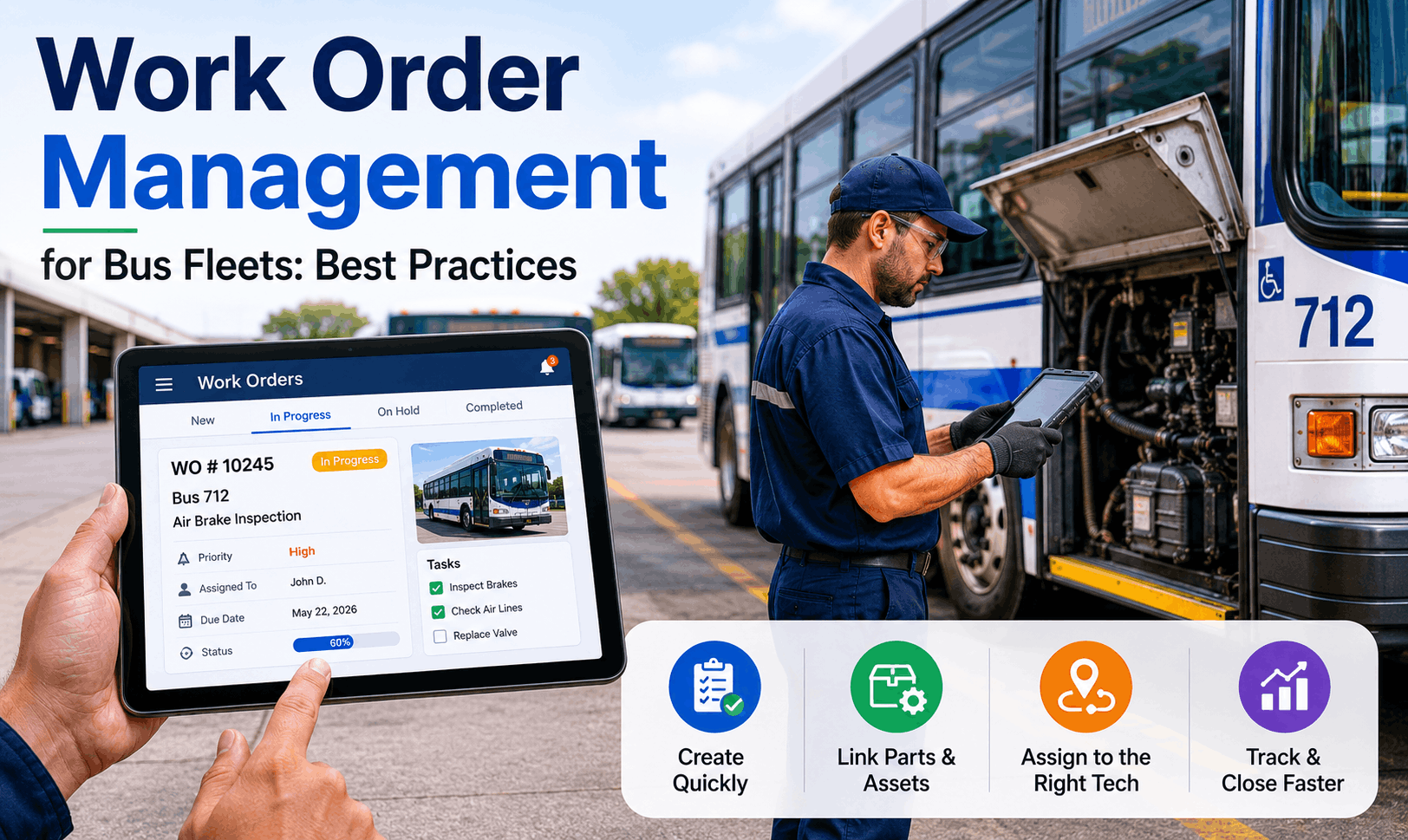
Work order management sits at the heart of every successful bus fleet maintenance operation. When a driver submits a defect report for a faulty brake chamber or a leaking air line, the speed and accuracy of your work order system determines whether that bus returns to service in hours or remains stranded for days. In 2026, American transit agencies are abandoning paper-based work orders and fragmented spreadsheets for digital workflows that automatically route repairs to the right technician, link parts inventory in real time, and close the critical gap between defect detection and completed repair. This comprehensive guide explores the best practices for work order management across school bus fleets, municipal transit systems, and private motorcoach operators. Learn how to structure your maintenance workflow from inspection to completion, reduce vehicle downtime by 40 percent, and build audit-ready repair histories that satisfy FMCSA and FTA compliance requirements.
Work Order Management 2026
Work Order Management for Bus Fleets: Best Practices
Streamline bus fleet work orders with digital workflows, parts linking, and technician routing that close the gap between defect and repair across American transit operations.
Why Work Order Management Matters for US Bus Fleets
Every hour a bus sits idle waiting for repair coordination costs American transit agencies an average of $450 in lost service revenue and idle labor. Traditional paper-based work orders create invisible bottlenecks that extend vehicle downtime unnecessarily. A driver writes a defect on a clipboard log, a supervisor transcribes it into a spreadsheet, a parts clerk manually checks inventory, and a technician finally receives a work order hours after the original defect was reported. Digital work order management eliminates these handoff delays by connecting every stakeholder in a single real-time workflow. The result is faster repairs, higher fleet availability, and complete visibility into maintenance costs across your entire American bus operation.
40%
Downtime Reduction
25%
Labor Efficiency Gain
100%
Audit Trail Completeness
Seven Best Practices for Work Order Management
Implementing an effective work order system requires more than just software. These seven best practices represent the standard for American transit agencies that consistently achieve high fleet availability and maintenance cost control.
1
Digitize Defect Intake at the Source
Equip drivers with mobile apps to report defects with photos and voice notes immediately upon completing their routes across your US operation.
2
Automate Work Order Creation
Configure your CMMS to generate work orders automatically from driver defect reports and scheduled preventive maintenance triggers for American fleets.
3
Link Parts Inventory Directly
Connect work orders to live parts counts so technicians see real-time availability and automatically reserve components for their assigned repairs.
4
Implement Technician Routing Logic
Route work orders based on technician skills, current workload, and certification levels to optimize shop throughput across American garages.
5
Enable Mobile Technician Access
Provide tablets or mobile devices so mechanics can view work orders, log labor hours, and close tasks from anywhere in the shop bay.
6
Capture Repair Documentation
Require technicians to attach photos, parts receipts, and service notes before closing any work order in your US fleet system.
7
Build Dashboard Visibility
Create management dashboards showing open work orders, aging repairs, technician productivity, and completion trends across your American operation.
Work Order Lifecycle: From Defect to Completion
Understanding the complete lifecycle of a work order helps fleet managers identify bottlenecks and optimize each stage. A well-designed digital workflow transforms this lifecycle from a fragmented manual process into a seamless automated pipeline for American transit agencies.
Lifecycle Stage
Manual Process
Digital Workflow
Defect Detection
Driver writes on clipboard
Driver submits via mobile app with photo
Work Order Creation
Supervisor transcribes hours later
System generates instantly
Parts Verification
Clerk manually checks shelf
Real-time inventory lookup
Technician Assignment
Manager finds available mechanic
Auto-routing based on skills
Repair Execution
Paper log, no time tracking
Mobile app with start/stop timer
Quality Verification
Supervisor inspects, no record
Digital sign-off with checklist
Documentation
Paper filed, hard to retrieve
Cloud storage, searchable history
Work Order KPIs Every US Fleet Should Track
Measuring work order performance is essential for continuous improvement. These key performance indicators represent industry benchmarks for American bus fleets of all sizes, from small school districts to large municipal transit authorities.
Work Order Cycle Time
Under 48 Hours
First-Time Fix Rate
Above 85 Percent
PM Compliance Rate
Above 95 Percent
Open Work Order Aging
Under 7 Days
Labor Hours per Work Order
Tracked per Asset
Parts Cost per Work Order
Tracked per Asset
Common Work Order Management Mistakes
Even experienced fleet maintenance teams fall into patterns that degrade work order efficiency. Recognizing these common mistakes helps American transit agencies avoid costly workflow bottlenecks.
Mistake 1: Using Spreadsheets for Work Order Tracking
Spreadsheets cannot enforce completion requirements, track technician time automatically, or generate audit trails. Work orders get lost, forgotten, or duplicated across American shops.
Mistake 2: No Parts-to-Work Order Linking
When parts are not tied to specific work orders, cost tracking becomes impossible. Fleets cannot calculate true repair costs or justify parts purchases for US DOT compliance.
Mistake 3: Delayed Work Order Entry
Waiting hours or days to enter work orders creates information gaps, duplicate repairs, and lost defect history that undermines maintenance planning for American fleets.
Mistake 4: No Technician Feedback Loop
Without capturing technician notes and repair photos, work orders become sterile records that provide no learning value for future maintenance on US bus fleets.
Implementation Roadmap: Moving to Digital Work Orders
Phase 1
Audit Current Work Order Process
Map your existing workflow from defect detection to repair completion. Identify bottlenecks, handoff delays, and documentation gaps across your American transit operation.
Phase 2
Select and Configure CMMS Work Order Module
Deploy BusCMMS work order management with custom status flows, technician skill routing, and parts inventory integration for your US fleet requirements.
Phase 3
Train Staff on Digital Workflows
Provide role-based training for drivers submitting defects, technicians using mobile apps, and managers reviewing dashboards across your American shop floor.
Phase 4
Measure and Optimize Performance
Track work order KPIs, gather technician feedback, and continuously refine workflows to reduce cycle times and improve compliance for US transit agencies.
Frequently Asked Questions About Work Order Management
What is the difference between a work order and a maintenance request?
A maintenance request is a defect report from a driver, while a work order is the formal document authorizing repair work in American fleet operations.
How long should a work order stay open for routine bus maintenance?
Most American bus fleets target work order completion within 48 hours for routine maintenance and 24 hours for safety-critical repairs.
Can work orders be created automatically from preventive maintenance schedules?
Yes, modern CMMS platforms like BusCMMS generate PM work orders automatically based on mileage, engine hours, or calendar intervals for US fleets.
How do digital work orders help with FMCSA and DOT compliance?
Digital work orders create timestamped, uneditable audit trails that satisfy FMCSA recordkeeping requirements for American bus fleets.
What information should every work order include for bus maintenance?
Every work order should include asset identification, defect description, parts used, labor hours, technician name, and completion timestamp for US compliance.
Can technicians access work orders offline in the shop?
BusCMMS mobile apps work offline, allowing technicians to view and update work orders without internet access in American garages.
How does work order management integrate with parts inventory?
Work orders automatically deduct parts from inventory when closed, ensuring accurate stock levels and cost tracking for US transit agencies.
What is the typical ROI for digital work order management?
American bus fleets typically achieve full ROI within 6 to 9 months through reduced downtime and improved labor efficiency with BusCMMS.