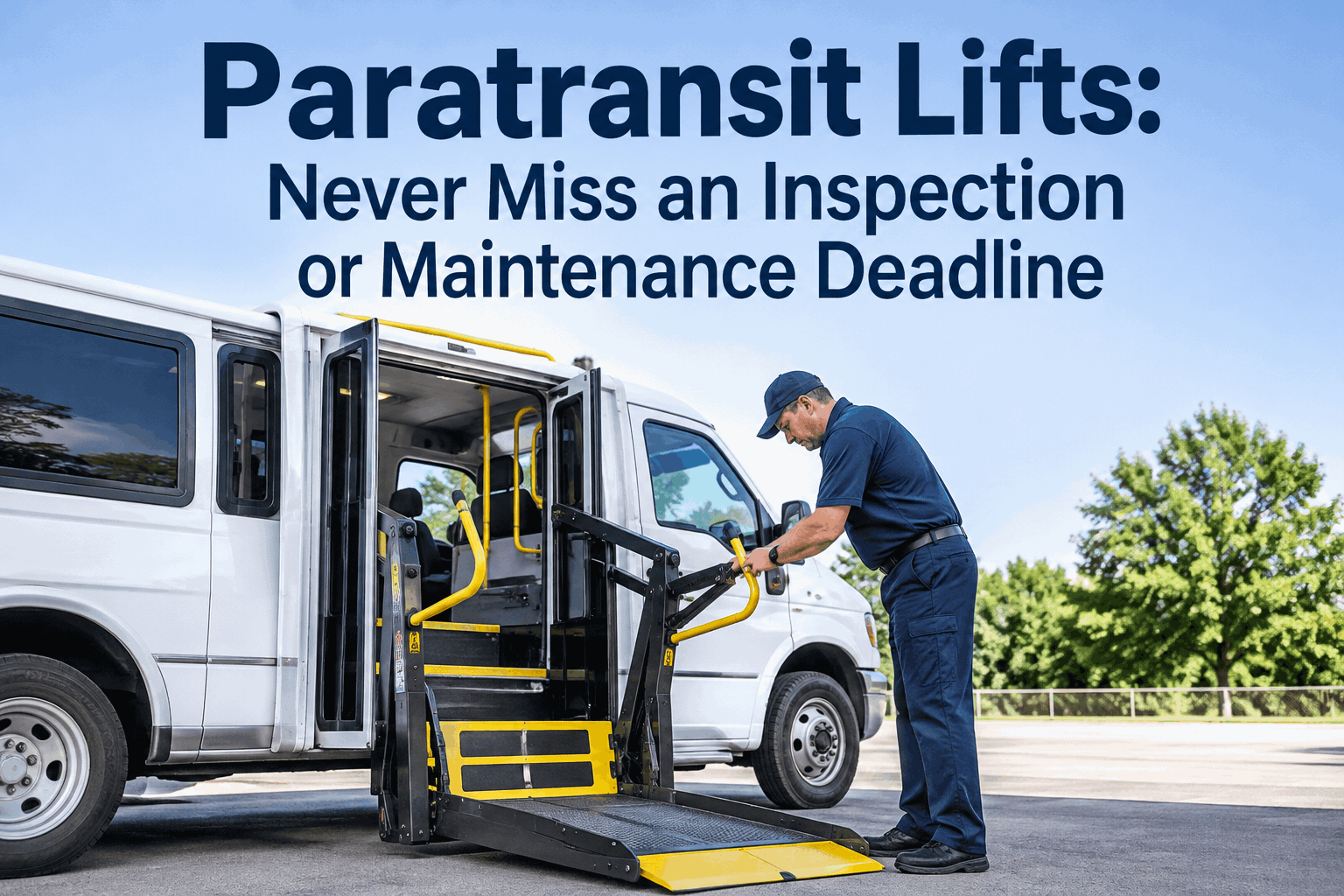
A wheelchair lift that won't deploy at the curb isn't a maintenance ticket you can slot into next week. Under federal accessibility rules it's a civil-rights failure the moment a rider is left behind. This paratransit lift inspection guide shows how to make the daily check happen, get it logged, and keep a record that survives an FTA review. See how a lift check gets captured in a BusCMMS demo.
Paratransit Lift Inspections: Never Miss a Check, a Fix, or a Record
The regulators don't grade you on whether a lift broke. They grade you on whether you had a system that would have caught it, acted fast when it failed, and can prove both. That system is three linked steps — and it only works if every step leaves a timestamp.
“Regular and frequent” is the standard — not one magic interval
Here's where a lot of fleets trip up. The rule most people quote — 49 CFR 37.161 — doesn't literally order you to cycle every lift every day. It requires a system of regular and frequent checks sufficient to determine whether lifts are actually operative. Daily cycling at pre-trip is how most transit and paratransit agencies meet that bar in practice, because it's the simplest way to be “sufficient.” But the thing being audited is your system, not a date on a calendar.
That's why a pre-loaded wheelchair-lift DVIR in a BusCMMS demo matters more than a generic checklist: the lift is already a line item on the pre-trip form, so layer A produces a timestamped record automatically, and layer B rides on the same PM engine that schedules the rest of the bus.
Daily cycle vs. deeper PM — two clocks running at once
Picture a year on one lift. The operator cycle runs on a daily beat you can't see individually but that has to be unbroken. The shop PM lands a handful of times, on the manufacturer's interval. Both have to show up in the record — a gap in either is a finding waiting to happen.
The failure clock: what a dead lift triggers before the next run
A failed lift isn't the emergency — a failed lift with no documented response is. The moment a cycle test or a road call flags an inoperative lift, a defined sequence has to fire. Where it lands depends on one question: can you cover the affected riders with another accessible vehicle or alternate service?
Section 37.163 gives public entities a narrow out: if there's no spare accessible vehicle, you can keep a bus with an inoperative lift in service for no more than five days (smaller operators get a bit more latitude) — but the duty to repair and the duty to accommodate stranded riders don't pause. Miss the paperwork on any of that and a single bad day becomes an audit finding — which is exactly the trail BusCMMS builds for you automatically.
The paratransit lift inspection checklist that keeps you review-ready
Print this, or better, make it the form your drivers and shop actually tap through. The first four are the ones a reviewer homes in on — miss them and the rest won't save you.
- CRITICALCycle every lift at pre-trip — and log the resultDeploy, bear weight, stow. A pass is a record; a fail is a work order. “I checked it” with no timestamp is worth nothing in a review.
- CRITICALRepair inoperative lifts before the next service dayDocument the failure, the alternate service provided, and the fix. If you used the no-spare exception, log the start date so you can prove you stayed inside the window.
- CRITICALKeep the daily-cycle records retained and retrievableAn FTA reviewer can ask for months of history on demand. Paper in a binder that's “around somewhere” is the gap that turns into a finding.
- CRITICALRun lift PM on the manufacturer's intervalHydraulic fluid, cables, interlocks, platform and barrier wear, control sequencing — scheduled, not reactive. Tie it to the bus PM so it never slips.
- PLANTrack securement systems and ramps alongside the liftStraps, retractors, and ramp slip resistance are part of the accessible-features duty too — not just the lift mechanism.
- PLANTrend repeat failures by vehicleA lift that fails twice a quarter is telling you something the daily pass/fail hides. Catch the pattern before it becomes a stranded rider.
Same lifts, very different lift availability
Two fleets can run identical buses and land miles apart on lift availability — because the method of checking and recording is what actually moves the number. These bands are directional, drawn from the pattern BusCMMS sees across its fleets, not a published survey.
The jump from the amber bar to the green one isn't new hardware — it's catching fades early, closing work orders fast, and never losing the proof. That's the exact gap a 15-minute BusCMMS demo is built to show. For transit agencies managing this across a mixed fleet, the passenger transit fleet management tools pull lift records into the same dashboard as PTASP and NTD reporting.
What a reviewer gets handed, two ways
The difference between passing and scrambling usually isn't the maintenance — it's whether the record exists in a form someone can hand over in minutes.
Swipe sideways to see all columns →
“The lift either cycled this morning or it didn't. What I lived in fear of wasn't the broken lift — it was a reviewer asking for ninety days of checks and me not being able to put my hands on them. Now it's a filter and an export.”
What to lock in before your next service day
Paratransit lift inspection questions, answered
Does federal law require cycling the wheelchair lift every single day?
Not word-for-word. 49 CFR 37.161 requires a system of regular, frequent checks sufficient to tell whether lifts are operative. Daily cycling at pre-trip is how most agencies meet that standard, because it's the simplest way to be “sufficient.”
What happens if a lift fails while the bus is in service?
You provide alternate service to affected riders and repair the lift before the next service day. If no spare accessible vehicle exists, a narrow exception lets the bus run up to five days — but the repair and accommodation duties still apply, and all of it must be documented.
How long do I need to keep lift inspection records?
Keep them long enough to cover an FTA compliance review, which can request an extended history on demand. The safe practice is a retained, retrievable record of every daily cycle and every PM — BusCMMS keeps them exportable by vehicle and date range.
Is the daily cycle check the same as preventive maintenance?
No. The daily cycle is a quick operator test that the lift deploys and stows. PM is deeper shop work — fluid, cables, interlocks, platform wear — on the manufacturer's interval. You need both, and both in the record.
Can BusCMMS handle lifts on mixed cutaway and low-floor fleets?
Yes. The wheelchair-lift check is a pre-loaded DVIR line item for every accessible vehicle, and you can set a different lift PM interval per vehicle type while the daily cycle stays identical across the fleet.
Make every lift check count — and provable
Paratransit lift inspection comes down to three linked habits: cycle it, log it, and act fast when it fails — with a record that holds up afterward. Do that and 95%+ lift availability and a clean ADA review stop being luck and start being the default. BusCMMS makes the record a by-product of the daily routine instead of a separate scramble, with implementation in the weeks-not-months range transit budgets can actually approve. Start by watching the daily cycle get captured in a quick BusCMMS demo, or load your lift-equipped vehicles free and see the trail build itself.