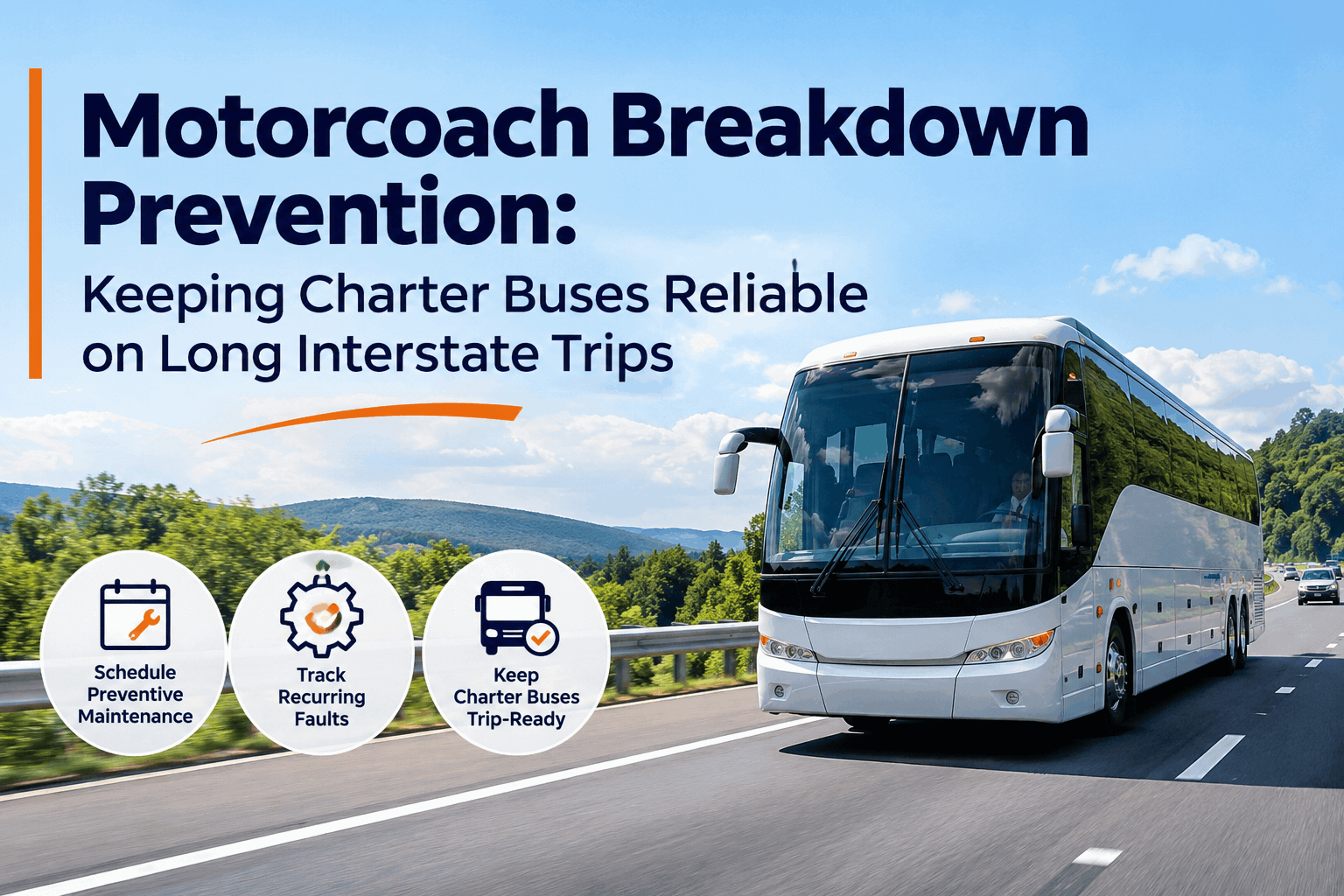
A coach loses coolant pressure 280 miles into a 400-mile charter, 50 passengers aboard, the nearest company shop three hours behind you. That's the failure that defines a charter operation — not the one in your own yard. Motorcoach breakdown prevention is really about killing the far-from-home failure before the wheels ever turn. See how BusCMMS catches it early in a quick demo.
Motorcoach Breakdown Prevention: Keeping Charter Buses Reliable on Long Interstate Trips
The same failure costs you very differently depending on where it happens. In your yard it's a work order. Two hundred miles out on an interstate it's a tow, a mobile mechanic at road rates, a stranded group, and a charter you may never win back. Distance is the multiplier — and the only way to beat it is to catch the fault before departure.
Most interstate breakdowns were predictable — the signs were in your own records
A coach rarely fails without warning. The alternator that quit at mile 280 had been throwing a low-voltage note for three services. The cooling system that let go had a slow weep logged twice and deferred twice. The problem usually isn't that nobody saw it — it's that the sign sat in a paper log nobody connected before the trip. Reliable motorcoach breakdown prevention starts by reading the history you already have.
BusCMMS surfaces all three automatically — a recurring-fault view in a demo shows which coaches keep repeating the same defect, so the pattern gets fixed in the shop instead of discovered on the shoulder.
The recurring-fault ladder: three write-ups is a warning, not a coincidence
You don't need predictive AI to see most coming failures — you need to count. The same fault logged again and again is the single most reliable predictor you already own. Here's how a defect escalates when it's tracked versus when it's filed away.
Mileage-based PM is non-negotiable for a high-mileage motorcoach
A charter coach can put on more miles in a month than a city bus does in a season. Calendar-based maintenance that works for a low-mileage shuttle misses badly on a coach running interstate charters — the oil is spent and the belts are worn long before the date on the sticker. Bus fleets widely run mileage-triggered inspection intervals for exactly this reason, with a tiered depth as the miles climb.
The point isn't the exact numbers — it's that the interval triggers on miles driven, not dates passed, and that nobody has to remember it. BusCMMS fires the work order when a coach hits its mileage, so a service is never quietly skipped before a 1,200-mile weekend — and the reminders run themselves.
The pre-trip checklist that stops a long-distance breakdown
A standard daily pre-trip isn't enough before a 400-mile run. Add these before a coach leaves on a long interstate charter — the first four are where far-from-home failures actually start.
- CRITICALClear every open and recurring defect firstPull the coach's fault history. Any item written up more than once, or any deferred "monitor it," gets closed before a long run — not after it strands the trip.
- CRITICALConfirm the coach isn't due or overdue for PMCheck mileage against the next interval. If a 1,000-mile trip would push it past due, service it before departure, not on the road.
- CRITICALCooling, charging, and air systems under loadThe three systems that fail on long highway pulls: coolant level and pressure, alternator output, and air-system build and leak-down. A quick load check beats a tow.
- CRITICALTires for high-speed, high-heat milesTread, pressure, sidewalls, and age. Sustained interstate speed and heat find a weak tire fast — and a blowout with passengers aboard is the failure you can't afford.
- PLANKnow the service network along the routeIf something does happen, minutes matter. Have the on-route service and tow contacts ready before departure, not improvised at the shoulder.
- PLANLog the pre-trip so the record carries forwardA documented departure check feeds the next trip's fault history — the record is how a pattern gets spotted before it repeats.
Why the fault history has to be more than a binder
The warning signs only help if you can see them together. Scattered across paper logs, a repeat fault looks like three unrelated notes. In one history, it's a pattern you act on.
Swipe sideways to see all columns →
That single, searchable history is what turns scattered warnings into a prevented breakdown — and it's the gap a 15-minute BusCMMS demo is built to show.
“We used to find out a coach had a problem when a driver called in from four hundred miles away. Now the repeat faults show up on one screen and we fix them in the shop. We haven't had a stranded charter in over a year — and that reputation is what gets us rebooked.”
What to lock in before your next long charter season
Motorcoach breakdown prevention questions, answered
Why does a breakdown cost more on a long trip than at home?
Distance adds a tow at road rates, a mobile mechanic, a stranded group, and often a substitute coach — on top of the repair itself. The same fault that's a routine work order in your yard becomes a multi-thousand-dollar crisis far from base.
Should motorcoach PM be based on miles or on a calendar?
Miles, for a high-mileage coach. A charter bus can run more miles in weeks than a low-use vehicle does in a year, so calendar intervals leave oil, belts, and brakes worn long before the date. Bus fleets widely use mileage-triggered intervals around 6,000 miles for the light check.
How do I predict a breakdown without telematics or AI?
Count your own repeat faults. The same defect written up two or three times on one coach is the most reliable warning you have. BusCMMS flags that repetition automatically so it's fixed in the shop, not on the road.
What should I check before a long interstate charter?
Clear every open and recurring defect, confirm the coach isn't due or overdue for PM, and load-check the cooling, charging, air, and tire systems that fail on long highway pulls. Then make the go/no-go call on that data, not a hunch.
How does BusCMMS help prevent motorcoach breakdowns?
It schedules PM by mileage, flags recurring defects on each coach, opens repair work orders, and keeps the full maintenance history in one place — so the warning signs get caught before departure instead of discovered on the shoulder.
Catch it in the shop, not on the shoulder
Motorcoach breakdown prevention comes down to one idea: the failure you catch before departure never becomes the crisis that strands 50 passengers 300 miles from home. Read the fault history, schedule PM by the mile, act on the defect that keeps repeating, and the far-from-home breakdown stops happening — and the reliability reputation that gets you rebooked takes care of itself. BusCMMS makes that discipline the default, with mileage-based scheduling and a full coach history in weeks, not months. Start by seeing it on your fleet in a quick BusCMMS demo, or load your coaches free and build the history from today's pre-trip.