Hour three of a full charter, and a smell drifts up the aisle from the back. Fifty passengers notice at once, and there's nowhere to pull over. Motorcoach restroom maintenance makes sure that moment never happens — and it comes down to one question: when was the holding tank last serviced? See how BusCMMS keeps the answer on record in a quick demo.
The Motorcoach Restroom: Keeping It Clean, Fresh and Odor-Free on Long Charters
Onboard odor isn't bad luck — it's a serviced-late holding tank, a blocked vent, or a skipped restock. Federal rules even require a passenger-coach restroom to be kept "free of offensive odor." Get the servicing on a schedule and the smell never starts. Here's where it comes from, and how a tracked service cycle shuts it down.
Onboard restroom odor has three sources — and all three are schedulable
A smell in the cabin feels like a mystery when it happens, but it almost never is. Charter restroom odor traces to a short list of causes, and every one of them is a maintenance task that was missed or came due. Name the source and you can put it on a schedule — that's the whole of motorcoach restroom maintenance.
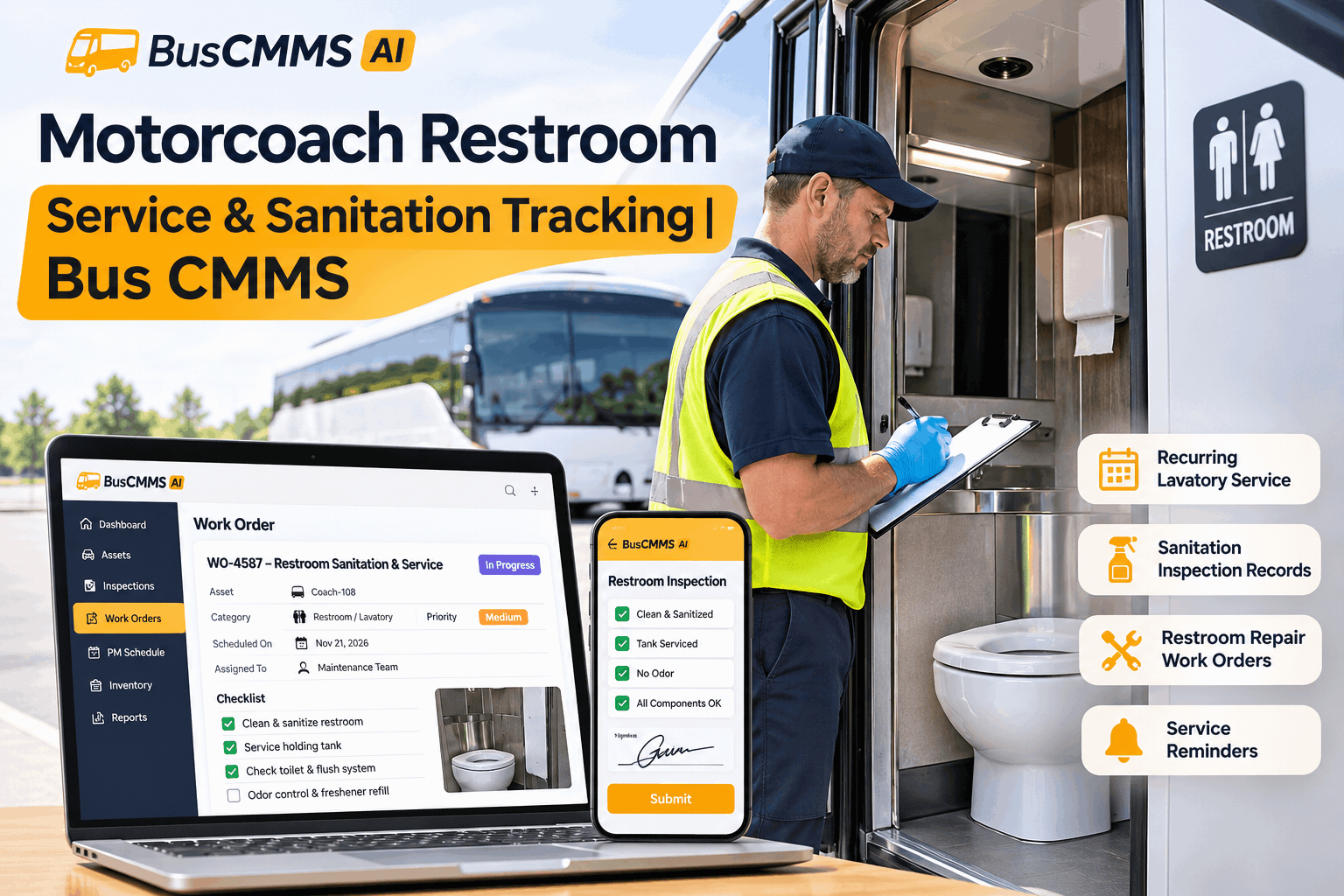
Because all three sources are tasks, not accidents, they belong on a maintenance system — a lavatory service schedule in a BusCMMS demo turns "did anyone dump the tank?" into a logged, reminded, never-missed task.
The quick turn and the deep service — two cycles that keep it fresh
Restroom sanitation runs on two clocks. There's the fast turn after every trip, and the deeper tank service on a mileage-or-usage interval. Miss either and odor creeps in. Here's how they interleave across a week of charters.
What a complete lavatory service looks like — and why it has to be logged
Most charter operations already run an overnight wash crew. The gap isn't effort — it's consistency and proof. When the restroom service is a defined, recorded sequence instead of whatever the tired crew member remembers at 2 a.m., odor stops being a gamble. These four steps are the backbone of it.
That last step is the one paper loses. In BusCMMS the service closes as a timestamped record on the specific coach, so a dispatcher can see at a glance which lavatories are current and which coach got skipped — no more guessing at the yard gate.
The restroom-readiness checklist to run before a long booking
Before a coach rolls on a multi-hour charter, the restroom gets its own go/no-go check — not a glance, a confirmation. The first four are the ones that turn into an aisle-clearing complaint if they're missed.
- CRITICALHolding tank dumped, flushed, and treatedThe single most important item. Confirm the tank was serviced since the last heavy-use trip — a late tank is the odor you can't fix on the road.
- CRITICALVent and exhaust fan moving airA quick check that the vent isn't blocked and the fan runs. Without it, even a freshly serviced tank can push odor back into the cabin.
- CRITICALWater, flush, and no leaksFlush works, fresh-water supply is full, and there's no drip under the unit. A failed flush on a full coach is an out-of-service restroom within an hour.
- CRITICALFully stocked: paper, soap, sanitizerCount it, don't assume it. Running out of the basics two hours into a tour is the easiest complaint to prevent and the most common one to miss.
- PLANSurfaces disinfected and dryHigh-touch points cleaned, floor dry, no residue. Passengers read a clean restroom as a clean operation.
- PLANService logged against this coachRecord it so the next dispatcher knows it's current and a recurring problem on one unit becomes visible instead of a surprise.
Why "I think it got done" isn't a sanitation record
A restroom service that lives in a crew member's memory disappears the moment they go home. On a tracked system it's a timestamped record tied to a coach — which is what turns a one-off complaint into a pattern you can fix.
Swipe sideways to see all columns →
That searchable service history is what separates a consistently fresh fleet from a lucky one — and it's exactly what a 15-minute BusCMMS demo is built to show.
“One odor complaint on a church group's return trip and I was fielding calls for a week. Turned out the tank hadn't been flushed in three charters because nobody logged it. Now the service is scheduled by usage and signed off on every coach — and I haven't had a restroom complaint since.”
What to lock in before your next long-haul booking
Motorcoach restroom maintenance questions, answered
What causes odor in a motorcoach restroom?
Almost always one of three things: a holding tank that wasn't dumped and flushed on schedule, a blocked or failed vent that traps odor in the cabin, or skipped cleaning and restock. All three are maintenance tasks you can schedule.
How often should the holding tank be serviced?
Base it on usage, not just the calendar. A heavy-use charter can fill the tank well before a date-based interval, so dump, flush, and treat it whenever usage says it's due. BusCMMS can trigger that service on usage automatically.
Is there a legal requirement for onboard restroom odor?
Yes. Federal regulations for passenger-carrying vehicles require the onboard restroom to be kept free of offensive odor. A documented sanitation schedule is how you meet that standard and show you did.
What belongs in a complete restroom service?
Dump, flush, and treat the tank; disinfect every surface; restock paper, soap, and sanitizer; confirm the vent moves air; and log the service against that coach. The record is what proves the work was done.
How does BusCMMS help with restroom sanitation?
It schedules recurring lavatory service by usage, records each sanitation check, opens work orders for restroom repairs, and keeps the service history per coach — so a serviced-late tank never meets a full charter.
Keep it fresh on schedule, not by luck
Motorcoach restroom maintenance comes down to treating odor as what it is: a scheduling problem with three known sources. Dump and flush the tank on usage, keep the vent clear, restock and disinfect every turn, and log it against the coach — and the mid-trip smell that costs you a booking simply stops happening. BusCMMS makes that discipline the default, with usage-based lavatory scheduling and a full sanitation record in weeks, not months. Start by seeing it on your fleet in a quick BusCMMS demo, or load your coaches free and schedule your first service today.