A Blue Bird Vision rolls into your shop and everything feels standard -- Cummins B6.7, Allison 2500, Bendix ESP -- until you need a specific chassis part or file a warranty claim. That is when the Vision's proprietary chassis, its own multiplex electrical system, and Blue Bird's dealer-only parts network make maintenance distinctive from any IC Bus CE or Thomas Built C2 in your fleet. If you operate Vision buses, book a 20-minute demo to see how BusCMMS ships with Vision inspection items and Blue Bird dealer coordination pre-loaded on day one.
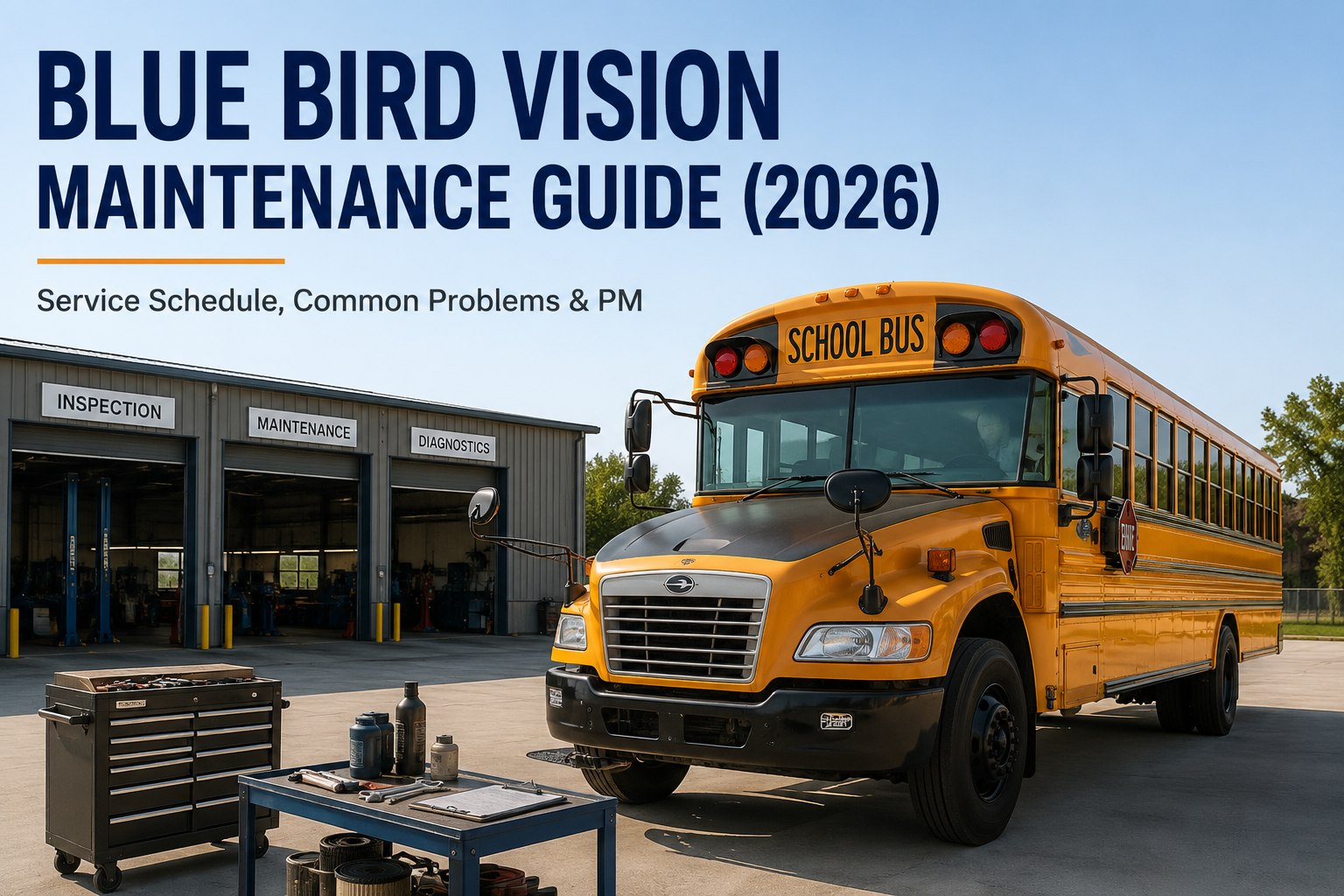
Blue Bird Vision Maintenance Guide (Body, Chassis, Cummins B6.7)
Everything a bus shop needs for the Type C school bus built on Blue Bird's proprietary chassis with multi-fuel powertrain options and integrated multiplex electrical
- ChassisBlue Bird Proprietary50K psi steel frame rails
- LayoutFR / Cowled Type CFront engine, rear drive
- Primary EngineCummins B6.7200-260 hp diesel
- TransmissionAllison PTS 2500/30005- or 6-speed automatic
- GVWRUp to 33,000 lb169-280 in wheelbase
- Capacity36 to 78 paxDepends on wheelbase
- Safety StackBendix ESP + E-Z LightMultiplex integrated
- Warranty5 yr / 100K miCummins B6.7 + Allison
The Blue Bird Proprietary Frame & Running Gear
The Vision was the first cowled-chassis school bus built on a chassis that Blue Bird designed and manufactures itself -- which matters for parts sourcing every time you order a frame-mounted component.
Ladder Frame Rails
50,000 psi steel, 10-1/8" tall x 3" flange x 5/16" thick. Huck-Spin fasteners on all permanent frame fixtures -- Blue Bird rebuilds require the right rivet tool, not shop bolts.
12,000 lb Front
8,000 lb parabolic springs standard. 10,000 lb optional. Inspect at every PM for cracked leaves, worn bushings, and loose U-bolts -- school bus severe duty punishes front suspension.
17,000-21,000 lb Rear
2-stage leaf springs standard, air ride optional. Rating scales with wheelbase. Air-ride variants add height-control valve and dryer PM tasks that leaf-sprung buses do not have.
Hydraulic Disc + 4-Wheel ABS
Hydraulic disc with anti-lock standard. Air brake system optional on longer wheelbase Vision builds. Bleed procedure and reservoir spec differ between the two -- confirm build sheet before service.
On the proprietary chassis question: a Blue Bird frame rail or crossmember has to come through a Blue Bird dealer channel, not off the shelf at a general truck parts warehouse. That's an operational reality you plan for. Book a demo to see how BusCMMS tracks Blue Bird-channel parts lead times per bus.
Vision Body & Safety Equipment Inspection Zones
Six body zones every Vision PM should cover. Miss any zone and either a driver DVIR flags it later or a state inspector does.
Zone A Roof & Emergency Exits
One-piece roof bow system. Roof escape hatch operation. Rear emergency door with ajar buzzer. All emergency exits must open under 30 lbs of force per FMVSS.
Zone B Front Door & Cross Arm
27" electric entry door with exterior release. Electric operated front crossing arm. Side stop-sign arm. All three interlock with the E-Z Light system.
Zone C Warning & Marker Lights
8-way halogen warning lights (or LED on newer builds). LED side and directional lights. E-Z Light Check System routes any failed lamp to a dash indicator.
Zone D Mirrors & Backup Camera
Electric heated exterior mirrors on most builds. Integrated backup camera (standard from 2018 model year). Verify alignment and lens clarity every PM.
Zone E Seats & Interior
Padded vinyl bench seats up to 71-78 passenger. Grey rubber HD flooring. 77" headroom. Inspect seat mounts, anchors, and floor for wear and corrosion at joints.
Zone F Rear Heater & HVAC
Rear heater with shutoff valve. Cabin HVAC. Verify blower operation, shutoff valve function, and no coolant leaks at rear connection points every PM.
The Vision shares body components and inspection procedures with the Blue Bird All American line -- so if your fleet runs both, tech training and parts inventory overlap significantly. Sign up free and load Vision-specific DVIR and PM checklists on every bus.
Three Vision Fuel Variants, Three Maintenance Realities
The Vision ships with three powertrain options today. Each one changes your shop's PM workload, parts inventory, and technician training in meaningful ways.
Cummins B6.7
- Power: 200-260 hp
- Trans: Allison PTS 2500 / 3000
- Warranty: 5 yr / 100K mi (engine + trans)
- Emissions: DPF + EGR + DEF/SCR
- PM reality: Severe-duty 12K mi oil interval on school bus routes
The most common Vision powertrain since 2006. Full aftertreatment stack means DPF regen management is a daily reality. See our companion Cummins B6.7 maintenance guide for engine-specific PM.
Ford 7.3L Godzilla V8
- Power: 350 hp gas (typical)
- Trans: Ford 6R140 6-speed auto
- Fuel options: Gasoline, propane (ROUSH), CNG
- Emissions: No DPF, no DEF, no SCR
- PM reality: Simpler aftertreatment, more frequent oil changes
Propane and gas variants ship without diesel aftertreatment -- no DPF failed regens, no DEF quality faults. Fleet operators report roughly 15 cents per mile fuel savings on propane routes under 150 miles per day.
Vision Electric
- Battery: 194 kWh Li-Ion NMC
- Propulsion: Cummins PowerDrive 7000
- Motor: TM4 SUMO with integrated telematics
- Range: Up to 150 mi per charge
- PM reality: HV certification required, no engine oil, no aftertreatment
Zero-emission variant with a 33,000-lb GVWR. Level 2 recharge in ~8 hours, Level 3 DCFC in ~2 hours. HV-certified technicians required for any work above the 12V system.
Fleet operators running Vision buses across two or three fuel types on the same yard need their CMMS to keep each variant's PM schedule, parts inventory, and technician certifications separated. Book a demo to see mixed-fuel Vision fleets managed on one dashboard.
Multiplex Module, E-Z Light Check, and Bendix ESP
The Vision runs a multiplex electrical architecture that ties safety equipment, warning lights, and stability control together. When the module misbehaves, multiple systems misbehave with it.
Multiplex Control Module
The central computer that manages warning lights, stop-arm actuation, cross-arm deployment, door interlocks, and cabin systems. Software updates come through Blue Bird dealer channels.
E-Z Light Check System
Blue Bird's diagnostic layer for warning-light integrity. A failed 8-way lamp shows up on the dash instead of only being caught during the next pre-trip DVIR.
Bendix ESP Stability Control
Full stability system standard on Vision builds. Fault codes clear through standard OBD tools but require Bendix-specific diagnostics for advanced calibrations.
Integrated Backup Camera
Standard on newer builds. Wired through the multiplex module, so a camera failure sometimes points upstream to a module fault, not a camera fault.
Multiplex electrical is one of the Vision's real strengths compared to older harness-based buses -- fewer wiring points, cleaner diagnostics -- but when the module has an issue, the failure symptoms are broad and easy to misdiagnose as component failures. Book a demo to see how BusCMMS logs Vision fault code patterns per module.
Getting Vision Parts & Service Right
The Vision's operational profile depends heavily on which dealer channels you have access to. Rural and semi-rural districts feel this more than metro districts.
- What it covers: Proprietary chassis parts, body panels, multiplex modules, warranty claims, software updates
- Network: Regional Blue Bird dealers only -- Central States Bus, Rush Truck Centers, MacAllister, Ross Bus, and others by region
- Trade-off: Dedicated bus expertise but density is lower than truck dealers -- rural fleets may drive 100+ miles to the nearest Blue Bird dealer
- What it covers: B6.7 engine parts, warranty claims, INSITE diagnostics, aftertreatment components
- Network: Cummins service network with 3,500+ locations across North America
- Trade-off: Broader coverage means faster engine service, but only for engine and engine-controlled systems -- not body or chassis
The practical implication for shop planning: a Cummins B6.7 injector failure gets same-day parts through Cummins. A cracked front cowl or multiplex module replacement goes through the Blue Bird dealer channel, and lead times vary meaningfully by region. Tracking dealer-channel parts orders and warranty claims separately is what keeps a Vision fleet's downtime predictable. Book a demo to see dealer-channel PM and parts tracking on a Vision fleet.
Running a Blue Bird Vision Fleet in BusCMMS
BusCMMS ships with Vision-specific configuration on day one. No consultant, no custom setup fee, no six weeks of configuration.
Vision-specific pre-trip inspection forms with all six body zones, E-Z Light checks, stop-arm and cross-arm verification, and Bendix ESP status pre-loaded.
Cummins B6.7 severe-duty intervals applied automatically to Vision diesel builds. Ford 7.3L and Vision Electric ship with their own respective PM schedules.
Blue Bird dealer-channel parts orders tracked separately from Cummins-channel and general aftermarket parts, with lead-time history per dealer.
Recall status tracked per VIN. When Transport Canada 2024067 or a similar advisory hits, every affected bus in your fleet surfaces in one report.
Vision-specific warranty entries: 5 yr / 100K on B6.7, 5 yr unlimited on Allison PTS 2500, Blue Bird body warranties, multiplex module coverage.
Fleet-wide reporting: Vision cost per mile, Vision uptime, Vision fault code patterns, Vision dealer service turnaround. All broken out by make and model.
Every Blue Bird Vision in service today has a maintenance profile the fleet manager already understands intuitively. The gap is between that understanding and having it captured on a system that surfaces expiring warranties, upcoming PMs, and open recalls before the buses leave the yard. Sign up free and load every Vision in your fleet in under an hour.
Is the Blue Bird Vision a front-engine or rear-engine bus?
The Blue Bird Vision is a front-engine Type C conventional school bus with a cowled-chassis layout -- FR (front engine, rear-wheel drive). Blue Bird's rear-engine model is the All American RE, a different Type D transit-style bus. The Vision was Blue Bird's first Type C school bus built on a proprietary chassis that Blue Bird designs and manufactures itself, in production since 2003 at Fort Valley, Georgia.
What engines are available in the Blue Bird Vision?
The current Vision ships with three powertrain options: the Cummins B6.7 diesel (200 to 260 hp, paired with Allison PTS 2500 or 3000 transmission), the Ford 7.3L "Godzilla" V8 for gasoline, propane, and CNG (paired with the Ford 6R140 6-speed automatic), and the Vision Electric with a 194 kWh Li-Ion NMC battery pack, Cummins PowerDrive 7000 propulsion system, and TM4 SUMO electric motor. The diesel Cummins B6.7 has been the primary powertrain since 2006 and remains the most common Vision in fleet service today.
What are the most common Blue Bird Vision maintenance issues?
Most Vision issues fall into three categories. First, the Cummins B6.7 aftertreatment stack -- DPF regen failures, EGR cooler cracks, DEF and NOx sensor faults typical of any EPA 2010+ diesel on severe school bus duty. Second, Vision-specific multiplex electrical issues -- the 2023-2024 Vision had a recall (Transport Canada 2024067) covering a module software condition that could reset warning lights and retract the stop-sign arm without warning. Third, body wear at high-cycle interfaces -- front entry door mechanism, cross-arm and stop-arm actuators, and rear emergency door hinges from repeated daily use.
Where do I get Blue Bird Vision parts and service?
Blue Bird sells parts and service through authorized Blue Bird dealers only -- not the general truck-dealer network. Regional dealers include Central States Bus, Rush Truck Centers, MacAllister Transportation, Ross Bus, and Dynamic Specialty Vehicles depending on your area. Proprietary chassis parts, body panels, multiplex modules, and warranty work all go through this dealer channel. Cummins B6.7 engine parts and warranty work can go through the wider Cummins service network instead. Rural districts should plan for longer parts lead times on Blue Bird-channel items than metro districts.
How long does a Blue Bird Vision last with proper maintenance?
Diesel Vision buses running the Cummins B6.7 with proper severe-duty PM discipline routinely reach 400,000+ miles and 15+ years of service. The Blue Bird chassis and body are engineered for that lifespan, and the Cummins B6.7 will comfortably match it when serviced correctly. Fleets that fall short of that mileage almost always share the same failures: missed severe-duty oil intervals, ignored coolant chemistry testing, and untreated DPF issues that eventually damage the turbo and injectors. Vision Electric service life is projected at similar durations but with different failure modes centered on battery pack degradation and HV components.