You've got a Blue Bird Vision on the lot with a Cummins B6.7 pushing 180,000 miles. The driver just parked it with a check-engine light and the third regen-in-progress warning of the week. The service manual PM interval says oil change every 20,000 miles, but city stop-and-go school bus duty puts it closer to 12,000. Nobody in your shop is quite sure which interval actually applies to this bus -- and that gap between manufacturer default and real bus duty cycle is exactly where B6.7 fleets bleed money and reliability. If you run school buses or shuttles powered by the Cummins B6.7 or its ISB6.7 predecessor, book a 20-minute demo to see how BusCMMS adjusts PM intervals for real bus duty cycles instead of one-size-fits-all defaults.
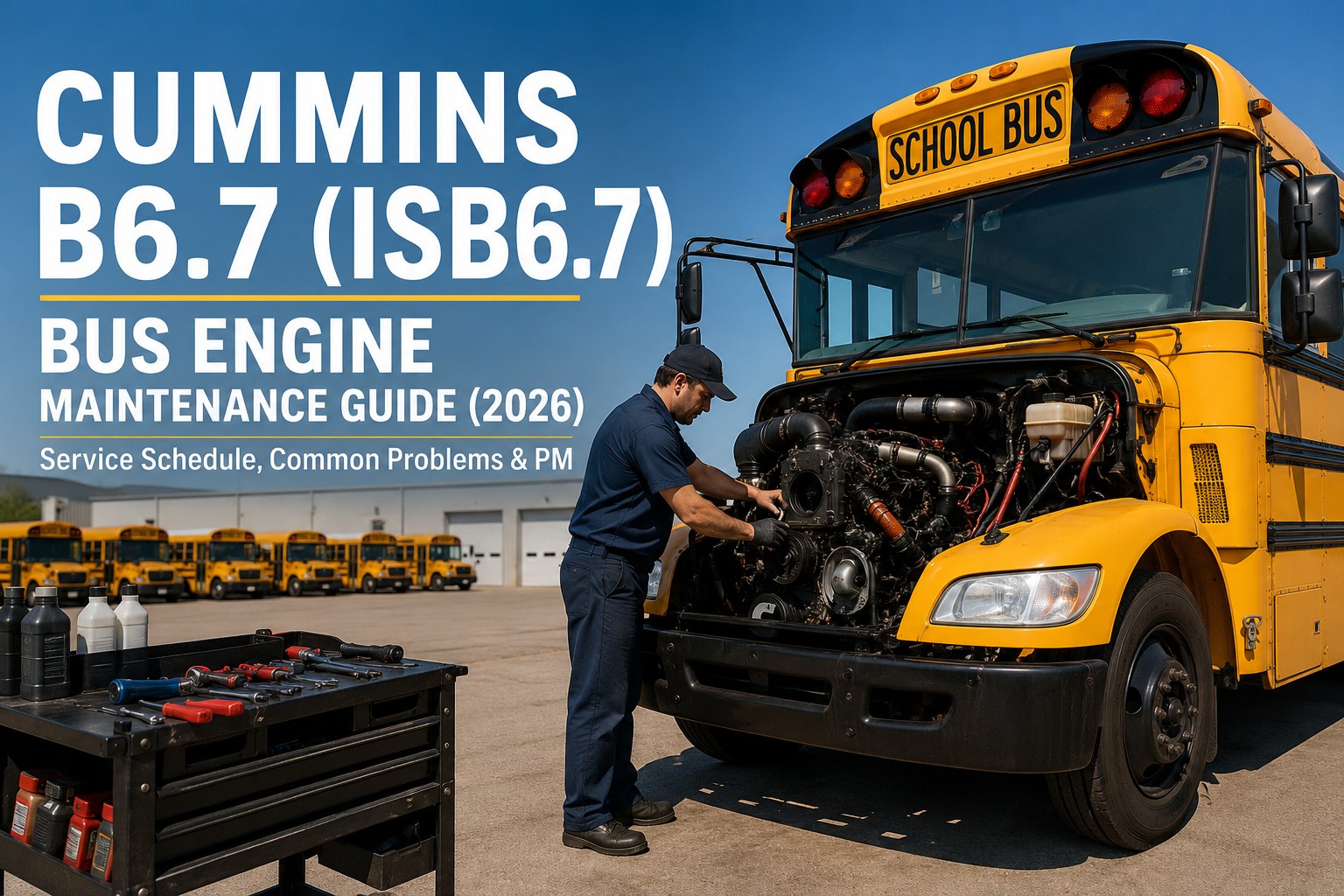
Cummins B6.7 (ISB6.7) Bus Engine Maintenance Guide (2026)
Service schedule, common problems, and PM every bus shop needs to keep the B6.7 running past 400,000 miles
- 12K mibus severe-duty oil
- $2K-$4.5KDPF replacement
- 400K+ milife with proper PM
Cummins B6.7 Engine at a Glance: What You're Working With
The Cummins B6.7 is the same core engine platform as the ISB6.7 -- Cummins renamed it in 2017 with only minor updates to the ECM and aftertreatment calibration. If your fleet has IC Bus CE Series school buses built from 2014 to 2017, they run the ISB6.7. From 2017 onward, they run the B6.7. Same 6.7L inline-6 architecture, same maintenance philosophy, same weak points.
Architecture
- Displacement6.7L Inline-6
- Fuel SystemHPCR Common Rail
- TurbochargerVGT (Variable Geometry)
- Emissions StackDPF + EGR + DEF/SCR
- ECM GenerationsCM2150D to CM2450
Bus Application
- Power (bus)220 to 300 hp
- Torque (bus)520 to 660 lb-ft
- TransmissionAllison PTS 2500 auto
- First Bus UseIC Bus CE, 2014
- Service Ceiling400,000+ miles
The B6.7 gets called reliable and it earns that reputation -- but the qualifier that always follows is "with proper maintenance." The underlying block, crank, and rotating assembly are exceptionally durable. Almost every B6.7 problem that shows up in the shop traces back to the emissions equipment bolted onto it, not the engine core itself. Fleet managers who understand that distinction get 400K-mile buses. Fleet managers who don't get expensive premature repowers. Book a demo to see how BusCMMS tracks aftertreatment health per bus in real time.
Which Buses Use the Cummins B6.7 / ISB6.7
If you're on this page, you're probably running one of these buses -- or evaluating a used one for purchase. Here's where the B6.7 lives in the North American bus market as of 2026.
IC Bus CE Series
Type C school busISB6.7 years2014-2017
B6.7 years2017-present
Power range200-300 hp
Blue Bird Vision
Type C school busEngineB6.7 standard diesel
Common HP220-260 hp
Fleet dutyRoute + activity
Thomas Built Saf-T-Liner C2
Type C school busEngine optionCummins B6.7
Common HP220-260 hp
Fleet dutySchool district routes
Shuttle & Cutaway Buses
Various OEMsChassisFord F-550, Freightliner S2
Engine optionB6.7 on select builds
Fleet dutyAirport, hotel, university
Across all of these applications, the maintenance requirements are functionally identical -- the engine doesn't care whether it's pushing a Type C school bus down a rural district route or a hotel shuttle across an airport loop. What changes is the duty cycle, and that changes the interval math. Sign up free to set B6.7-specific PM schedules for every bus in your fleet.
Cummins B6.7 Preventive Maintenance Schedule for Bus Duty
Cummins publishes standard PM intervals assuming normal duty cycle. Bus duty is not normal duty. Constant cold starts, short routes, extensive idling, and stop-and-go operation put the B6.7 in what Cummins classifies as severe service. That shortens most intervals significantly. Here's the practical maintenance calendar for a bus fleet running the B6.7.
- Daily
Pre-Trip DVIR + Fluid Check
Oil level, coolant level, DEF level, visual leak check. Check for regen warnings or dash codes before the bus leaves the yard. Two-minute inspection prevents six-figure engine damage.
- 12K mi
Oil & Oil Filter Change (Severe Duty)
Cummins-approved 15W-40 CK-4 diesel oil. School bus and transit duty falls under severe service. Standard 20K interval only applies to highway-cycle buses like intercity coaches.
- 15K mi
Air Filter Inspection
Inspect at every oil change. Replace when restriction indicator triggers or annually, whichever comes first. Dusty rural routes shorten this interval significantly.
- 30K mi
Fuel Filter Replacement (Primary + Secondary)
Cummins updated the standard interval to 60K miles for highway duty on newer B6.7 builds, but severe bus duty still calls for 30K. Water separator drain check monthly.
- 50K mi
Coolant SCA/DCA Test + Top-Off
Test supplemental coolant additive level. Extended Life Coolant (ELC) can go longer between flushes, but only if SCA/DCA stays in spec. Neglecting this destroys liners and water pumps.
- 100K mi
DEF Pump Filter + NOx Sensor Check
DEF supply pump filter replacement. Inspect DEF quality with a refractometer. Check NOx sensor freeze-frame data for drift patterns before they trigger a derate.
- 150K mi
Valve Lash Adjustment
Per Cummins service bulletin for the ECM generation. Skip this and you'll see uneven wear patterns, injector cup issues, and eventual head problems.
- 200K+ mi
DPF Ash Cleaning
Ash accumulates in the DPF over time regardless of active regen cycles. Ash cleaning by a certified shop resets the filter for another cycle. Skip it and you buy a $2K-$4.5K replacement.
Every one of these intervals moves depending on your specific duty cycle -- a rural route district with long stretches at highway speed treats the engine gentler than an urban district with 30-second stops. For a deeper look at how duty cycle changes oil intervals specifically, see our companion guide on bus engine oil change intervals by engine type and duty cycle. Book a demo to see how BusCMMS auto-adjusts each PM interval based on real bus operating data.
Fluids, Filters & Capacities Reference
Wrong oil, wrong coolant, wrong DEF -- any one of these mistakes turns a routine PM into a warranty-voiding, engine-damaging problem. Here's the quick reference every B6.7 bus shop should print and hang on the wall.
- Spec15W-40 CK-4 or CJ-4 diesel
- Capacity~19 qt (standard bus pan)
- FilterFleetguard LF or equivalent
- SpecELC per Cummins CES 14603
- Capacity~7-8 gal (varies by chassis)
- SCA/DCATest at every oil change
- SpecISO 22241 (32.5% urea)
- Tank~10 gal (bus applications)
- Refill triggerBelow 25% dash indicator
- FuelUltra-Low Sulfur Diesel #2
- Primary filterFleetguard FS series
- Secondary filterFleetguard FF series
Two rules that will save you money: never top off DEF with tap water even in an emergency (it destroys the SCR), and never mix conventional green coolant with ELC even for a top-off (the additive packages fight each other and drop out of solution). If you cannot verify what's already in the system, drain and refill with fresh ELC. Book a demo to see how BusCMMS logs every fluid and filter batch used across the fleet for warranty documentation.
Common Cummins B6.7 Problems Every Bus Shop Should Know
The B6.7 has predictable weak points. Every one of the top five failures shows up in the shop with roughly the same symptom pattern, and every one has a repair cost range that's worth knowing before you approve the work. These are the failures you will encounter.
DPF Clogging & Failed Regen
$2,000-$4,500Symptom: Constant regen warnings, reduced power, eventual limp mode. Common on stop-and-go school bus duty.
Root cause: Short routes never let the DPF reach regen temperature. Soot builds faster than passive regen can clear it.
Fix: Forced parked regen first. If pressure doesn't clear, ash cleaning ($300-$700) or full replacement.
EGR Cooler Crack & Coolant Leak
$1,200-$2,500Symptom: White smoke from exhaust, coolant loss with no visible external leak, sweet smell at tailpipe.
Root cause: Thermal cycling on stop-and-go duty stresses the cooler core. Often misdiagnosed as head gasket failure.
Fix: Pressure-test cooling system to confirm. Replace EGR cooler and inspect intake for coolant contamination.
EGR Valve Carbon Fouling
$400-$900Symptom: Fault code 3383 (EGR data valid but out of range), rough idle, reduced throttle response.
Root cause: Carbon buildup on the EGR valve seat. Common on short-route buses where the intake never fully clears.
Fix: Manual clean if caught early. Replace if valve fails to seat correctly after cleaning.
DEF System / NOx Sensor Faults
$400-$1,500+Symptom: SPN 3226, SPN 3868, or escalating derate to 5 mph limp mode. Multiple codes often fire together.
Root cause: NOx sensor drift, DEF quality out of spec, or dosing pump failure. Cold weather worsens all three.
Fix: Verify DEF quality with refractometer. Replace outlet NOx sensor first (most common). Rarely a pump replacement.
VGT Turbo Actuator Failure
$800-$2,000Symptom: Loss of boost, sluggish acceleration, turbo vane position fault code.
Root cause: Carbon fouling on VGT vanes or actuator motor failure. Accelerated by soot from failed regen cycles.
Fix: Command 0% and 100% vane sweep with scan tool. Clean vanes if seized. Replace actuator if motor failed.
Four of these five top failures trace back to the same underlying issue: short-route bus duty prevents the emissions system from operating in the temperature and load window it was designed for. Aggressive PM on the DPF, EGR, and DEF systems delays every one of them. Book a demo to see how BusCMMS tracks aftertreatment fault patterns per bus.
The Duty Cycle Reality: Why Bus Intervals Are Not Truck Intervals
Cummins publishes one PM schedule assuming a normal duty cycle. That schedule assumes a truck driving highway miles at steady load. A school bus running four short routes a day with 30-second stops and long idles at pickup points is running the engine harder than a highway truck at cruise. Here's what that means for oil change intervals specifically.
A CMMS that tracks operating hours, idle time, and mileage together lets you set the right interval per bus instead of running every unit on the same generic schedule. The fleet that runs school buses on the highway coach interval kills a DPF every 150K miles. The fleet that runs highway coaches on the school bus interval throws away perfectly good oil every 12K miles. Duty-cycle-aware PM saves both.
The Bottom Line on Cummins B6.7 Bus Engine Maintenance
The single biggest reliability factor across every B6.7 fleet we track is PM discipline. Not scan tools. Not tuner boxes. Not replacement parts brand. It's whether the shop actually hits every interval on every bus, has the history to prove it during warranty claims, and can spot the pattern when one bus starts throwing aftertreatment codes faster than the rest of the fleet. That is what a bus-specific CMMS does that a spreadsheet or a generic fleet tool cannot. Sign up free and start tracking every B6.7 in your fleet on the right PM schedule today.
How often should I change oil on a Cummins B6.7 in a school bus?
For school bus duty, plan on 12,000 miles between oil changes. Cummins classifies stop-and-go city driving, frequent cold starts, and extensive idling as severe duty, which reduces the standard 20,000-mile interval by roughly 40%. Highway coaches and long-route buses can run the full 20K, but school buses on district routes should not. Newer 2021+ B6.7 medium-duty builds bumped the standard interval to 30,000 miles for highway duty, but severe-duty bus applications still fall in the 12K-15K range. Always use CK-4 or CJ-4 rated 15W-40 diesel oil.
What's the difference between Cummins ISB6.7 and Cummins B6.7?
They are the same core engine platform. Cummins renamed the ISB6.7 to B6.7 in 2017 as part of an emissions certification and ECM update -- the block, crankshaft, rotating assembly, and fuel system are identical. What changed was the ECM generation (moved from CM2350 to CM2350A / CM2450), aftertreatment calibration, and some minor sensor updates. Maintenance procedures, service intervals, and common failure points are functionally identical between the ISB6.7 (2014-2016 bus applications) and the B6.7 (2017-present bus applications). Your parts catalog and PM schedule work for both.
What are the most common Cummins B6.7 bus engine problems?
The five most common failures in shop-visit frequency are DPF clogging from failed regens ($2,000-$4,500 replacement), EGR cooler cracks causing coolant leaks ($1,200-$2,500), EGR valve carbon fouling ($400-$900), DEF system and NOx sensor faults (variable, $400-$1,500+), and VGT turbo actuator failures ($800-$2,000). Four out of five trace back to aftertreatment equipment struggling with short-route bus duty cycles. The underlying B6.7 engine block itself is exceptionally durable -- almost every failure that shows up in the shop involves the emissions system, not the core engine.
How long does the DPF last on a Cummins B6.7 school bus engine?
DPF service life varies dramatically with duty cycle. School bus severe duty typically sees ash cleaning required at 150,000-250,000 miles and full replacement at 300,000-400,000 miles. Highway coach duty can push those intervals 50% longer. Fleets that consistently allow forced parked regens when soot load climbs, replace fuel filters on schedule, and track NOx sensor drift patterns can extend DPF life significantly. Fleets that ignore regen warnings and let failed regens compound will see DPF replacement as early as 100,000 miles.
Can a Cummins B6.7 reach 400,000 miles in school bus service?
Yes, and many do. The B6.7 block, crank, and rotating assembly are engineered for 400,000+ miles under proper maintenance. Fleets that consistently hit severe-duty PM intervals, address aftertreatment issues proactively, keep SCA/DCA additives in spec, and use quality fuel and fluids routinely see B6.7 buses reach 400K+ before major overhaul. The engines that fall short almost always share the same three failures: missed oil intervals leading to bearing wear, ignored coolant chemistry leading to liner cavitation, and untreated DPF issues that eventually damage the turbo and injectors.