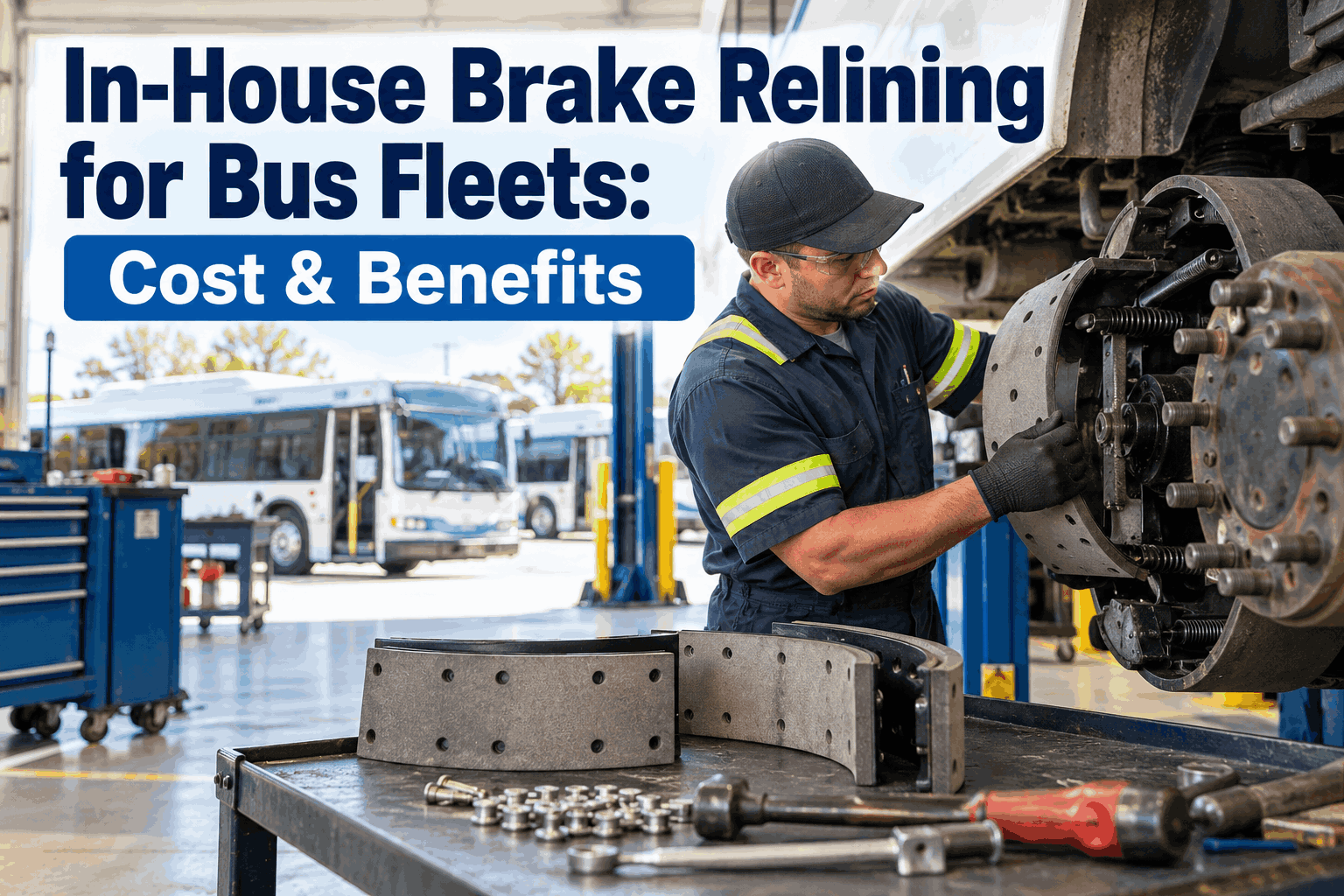
Every quarter the brake invoices land on your desk and the same thought crosses your mind: we do enough of these that we could probably be doing them ourselves. Between the per-job cost, the days a bus sits waiting at an outside shop, and the scheduling headaches, outsourcing brake relines starts to feel like money and control walking out the door. In-house brake relining can absolutely pay off — but only when the volume, the true costs, and the safety bar all line up. This is how to run that decision on numbers instead of frustration.
In-House Brake Relining for Bus Fleets
Bringing brake relining in-house can cut cost and downtime — or sink money into equipment you don't run enough. Here's the volume math, the true costs, and the safety bar that decide it.
Why Fleets Look at Bringing Brake Work In-House
The pull toward an in-house brake program almost always starts with the same three frustrations. None of them is imaginary — outsourcing brake relines genuinely costs money, time, and control — but each one has to be weighed honestly against what insourcing actually takes, or you trade one set of problems for a more expensive set.
Per-Job Cost Adds Up
Each outsourced reline carries the vendor's labor, overhead, and margin. Across a fleet doing dozens of brake jobs a year, that markup compounds into a number that starts looking like a machine and a trained tech.
Turnaround & Downtime
A bus sent out for brake work is a bus off its route until it comes back. Vendor scheduling, transport, and queue time can turn a half-day job into days of lost availability you don't control.
Quality You Can't See
When brakes are relined off-site, you're trusting someone else's standard on a safety-critical system. If quality varies between vendors or jobs, you find out on the road, not in your shop.
Scheduling Around a Vendor
Your PM plan bends to the vendor's calendar instead of your routes. Bringing the work in-house means relines happen on your schedule, slotted around service demands you actually know.
The honest counterweight is that an in-house brake program isn't free control — it's a real investment in equipment, training, space, and a safety responsibility you now own outright. That's exactly why in-house brake relining is a strategy question, not a gut call: the frustrations are real, but so are the costs of solving them the wrong way. This is a specific case of the broader maintenance insource-versus-outsource decision every fleet faces, sharpened by the fact that brakes carry both heavy equipment costs and the highest safety stakes on the bus. The way to settle it is to put real numbers against each factor. Book a demo to see your brake-job volume and cost in one view.
The True Cost of an In-House Brake Program
The mistake fleets make is comparing the vendor invoice to just the parts and labor of doing it themselves. The real comparison has to include everything an in-house program actually carries — the up-front and the ongoing. Get all of it on the table before you decide, or the savings you projected quietly evaporate into costs you didn't count.
Equipment & Tooling
The up-front capital — relining or shoe-bonding equipment, brake lathes, presses, and specialty tools. This is the fixed cost the whole break-even turns on, and it doesn't shrink if you run few jobs.
Labor & Training
A tech's time per reline plus the training to do brake work to standard. Brakes aren't a job to learn on the fly — the labor cost includes building and keeping real competence.
Shop Space & Setup
A dedicated bay and safe area for brake work, dust control, and storage for shoes, drums, and linings. Space you commit here is space not doing other work.
Materials & Compliance
Linings, hardware, and consumables per job, plus the cost of doing it compliantly — proper disposal, safety practices, and the documentation a brake job on a passenger bus demands.
Once all four are on the table, the shape of the decision becomes clear: an in-house program front-loads a large fixed cost (equipment, training, space) in exchange for a much lower cost per reline afterward. Outsourcing has almost no fixed cost but a higher price every single job. That's a classic fixed-versus-variable tradeoff, and it means the answer depends entirely on how many relines you do — which is the break-even. Understanding where your brake spend sits inside your overall budget helps frame the stakes, and our bus maintenance cost breakdown shows where brake work typically lands. Sign up free and pull your true per-job brake cost.
The Break-Even: When Volume Justifies In-House Brake Relining
The whole decision reduces to one calculation: at your annual brake-job volume, does the per-job savings of doing it in-house ever pay back the fixed investment? Here's how to work it, step by step, with your own numbers.
Count Your Annual Brake Volume
Pull how many brake relines your fleet actually does per year from your maintenance history. This single number is the biggest driver of the decision — and it's the one most fleets estimate instead of measure.
Nail Down Both Per-Job Costs
Get the true outsourced cost per reline (invoice plus the downtime it causes) and the projected in-house cost per reline (labor plus materials, without the fixed costs). The gap between them is your per-job savings.
Total the Fixed Investment
Add up equipment, tooling, training, and setup — the one-time and annual fixed costs of standing up the program. This is what the per-job savings have to pay back before insourcing is truly cheaper.
Find the Break-Even Volume
Divide the fixed investment by the per-job savings to get the number of relines needed to break even each year. If your actual volume clears that comfortably, in-house wins; if it's close or below, keep outsourcing.
The logic is simple but the inputs are where fleets go wrong. Two numbers get fudged most: annual volume (guessed, not counted) and the true outsourced cost (the invoice is remembered, but the downtime cost of a bus waiting at a vendor is left out, which understates outsourcing's real price). Both errors push you toward the wrong answer, and both are fixable by pulling actuals from your maintenance records rather than working from memory. A fleet that does a high, steady volume of brake work usually finds in-house pays back quickly; one with sporadic, low volume rarely does. The math doesn't care about your frustration with the vendor — only about the numbers. Book a walkthrough to build your brake break-even on real fleet data.
Quality & Safety: The Non-Negotiables
Even when the break-even says yes, in-house brake relining carries a condition the math doesn't capture: you're taking ownership of a safety-critical system on a bus that carries children or passengers. The savings only count if the quality holds. Before you commit, be honest about whether you can meet these bars — because a cheaper reline that fails is the most expensive outcome of all.
Certified, Trained Technicians
Brake work on a passenger bus needs techs trained and competent to do it to spec — not learning as they go. If you can't staff that reliably, the in-house case collapses on safety alone.
A Standard Procedure, Every Time
Torque specs, lining specs, and a road test on every job, documented. Consistency is what makes in-house quality equal or beat a vendor's — and what holds up in a DOT inspection.
Quality Tracking After the Job
Watch the repeat-failure rate on brakes you reline yourself. If in-house relines start coming back, you need to know immediately — on a safety system, quality drift can't go unnoticed.
The reassuring news is that in-house can meet or exceed vendor quality — often you'll care more about your own buses than an outside shop churning through volume — but only if you build the discipline in from day one and measure it. The trap is assuming quality will be fine and finding out otherwise through a brake failure on a route. That's why the quality bar and the tracking that enforces it aren't optional add-ons to the decision; on brakes, they're part of the decision itself. If you can't commit to certified techs, a documented standard, and ongoing quality tracking, the honest answer is to keep the work outsourced no matter what the break-even says. Sign up free and track brake-reline quality from the first job.
The Data That Makes and Monitors the Decision
Every input to this decision — volume, cost per job, downtime, and post-decision quality — is data your fleet either has or should be capturing. That's why analytics and reporting is what turns in-house brake relining from a hunch into a business case you can defend and then verify. BusCMMS supplies the numbers going in and watches the results coming out.
-
Brake-Job Volume Reporting
See exactly how many brake relines your fleet does per year, by bus and route — the single biggest break-even input, measured instead of guessed.
-
True Cost Per Job
Roll up labor, parts, and downtime into a real cost per brake job — so the outsourced-versus-in-house comparison uses actuals, not the sticker price alone.
-
Downtime Tracking
Capture how long buses sit waiting on brake work, in-house or out — the hidden cost of outsourcing that a fair break-even has to include.
-
Repeat-Failure Monitoring
After you insource, watch the brake repeat-failure rate to prove quality held — the safety guardrail on the whole decision, tracked automatically.
-
Standardized Brake Work Orders
Build torque specs, lining specs, and a road-test sign-off into every brake work order, so in-house quality is consistent and documented for compliance.
-
Before-and-After Savings
Compare brake cost per mile before and after insourcing, so you can prove the program delivered the savings the break-even promised — or catch it if it didn't.
The pattern is that this decision is bracketed by data on both ends: you need numbers to make the call, and numbers to confirm it worked. Skip the first and you're guessing; skip the second and you'll never know whether the program actually paid off or quietly cost you on quality. Because BusCMMS is purpose-built for buses, it already tracks brake work against the specific safety-critical components and the DVIR items tied to them, so the volume and quality picture is accurate rather than buried in generic repair categories. That turns in-house brake relining from a leap of faith into a measured, reversible decision — and typically it's live in two to four weeks.
A Maintenance Manager's Take
That's the decision done right: the frustration was real, but the numbers were what justified the investment — and the quality tracking was what made owning a safety-critical job responsible instead of risky. The vendor annoyance got him looking; the data got him to the right answer.
The Bottom Line on In-House Brake Relining
In-house brake relining is a make-versus-buy decision that pays off for the right fleet and backfires for the wrong one — and the only way to tell them apart is the numbers. Count your true annual brake volume, nail down both the real outsourced cost (including downtime) and the projected in-house cost, total the fixed investment in equipment, training, and space, and find the break-even volume that investment requires. If your steady volume clears it comfortably, insourcing can cut cost and give you back control of turnaround and quality. But brakes carry a condition ordinary cost math doesn't: they're a safety-critical system on a bus full of passengers, so the savings only count if you can staff certified techs, hold a documented standard on every job, and track repeat failures to prove quality held. Meet that bar and clear the break-even, and in-house brake relining is a smart, defensible move; miss either one and outsourcing is the responsible answer no matter how the invoices feel. Run it on data, decide with confidence, and keep measuring so you know it worked. Book a walkthrough to build your in-house brake case on real numbers.