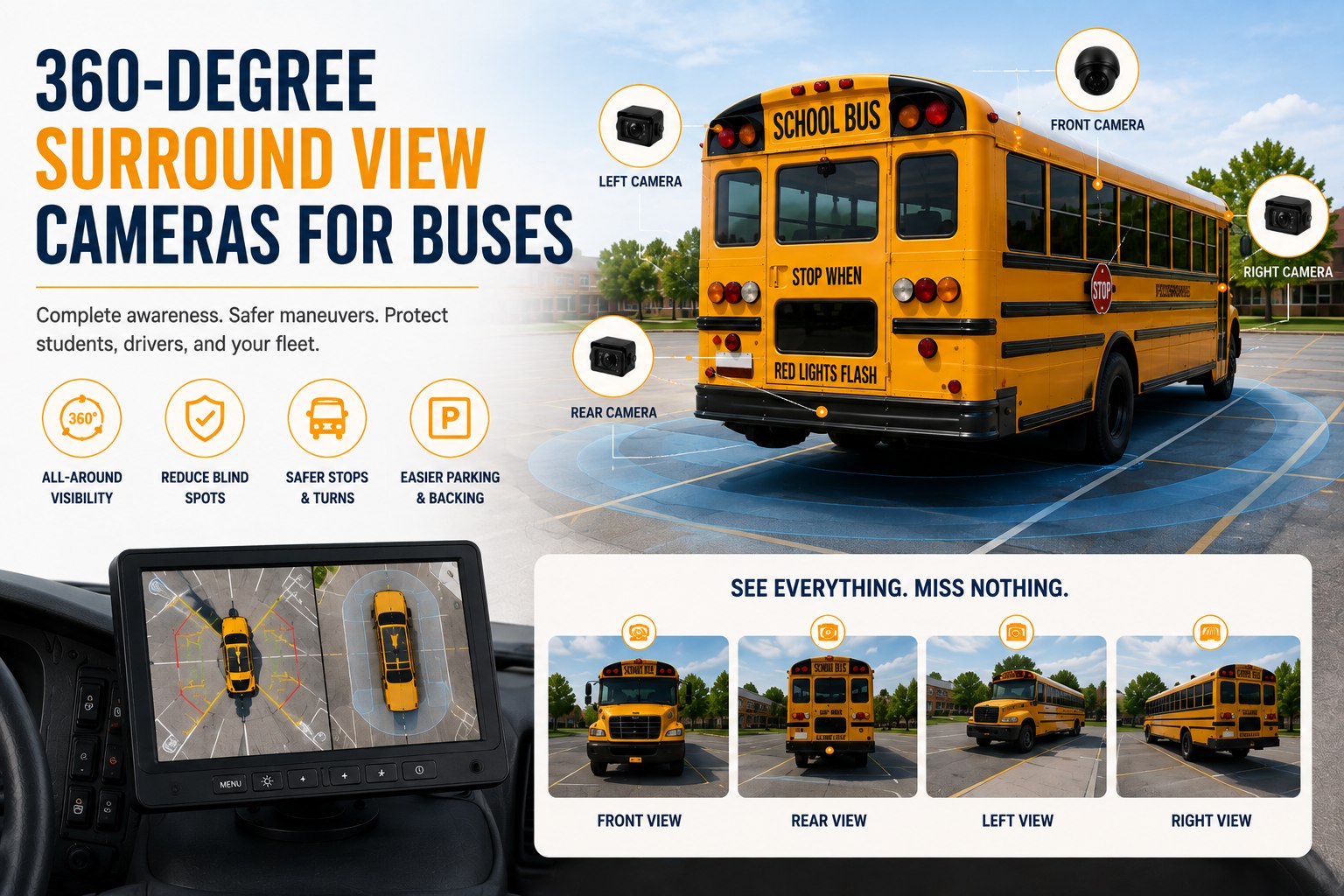
Six wide-angle lenses around a 40-foot bus, stitched into one bird's-eye view on a single dash monitor — that's the entire idea behind a 360-degree surround view camera system, and it solves a problem mirrors physically can't: showing the driver what is directly beside and behind the bus at the same time, not one mirror-check at a time. The data on where illegal passes actually happen is what makes this worth the install cost. See a 360 feed tied to a DVIR record in BusCMMS → book a demo.
360-Degree Surround View Cameras for Buses
How the feeds stitch into one view, where calibration goes wrong on a long wheelbase, and the specific blind spot this system exists to close.
How Four to Six Feeds Become One Bird's-Eye View
The stitching software is doing more work than the lenses.
Each wide-angle lens captures a distorted, fisheye-style feed of its own zone. The stitching software corrects that distortion, aligns the overlapping edges between adjacent cameras, and renders the combined result as a single top-down composite centered on the bus — as if a camera were floating directly above the roof. No single federal mandate governs 360-degree camera systems on buses; the compliance bar here is 49 CFR 396 maintenance record requirements and district policy, which means this is a voluntary safety investment evaluated purely on whether it solves a real operational problem, not a regulation to check off.
Raw wide-angle feeds
Each lens outputs a fisheye-distorted view of its zone, overlapping slightly with its neighbors.
Distortion correction
Software flattens the fisheye curve on each feed so straight lines on the ground read as straight on screen.
Edge alignment
Overlapping zones between adjacent cameras are matched and blended so there's no visible seam or gap.
Composite bird's-eye view
The final rendered view shows the full bus perimeter from directly above, updated in real time.
Why the Right Side Is the Blind Spot That Actually Matters
Most illegal passes happen on the left. The right side is where the trend is getting worse.
More than 90% of illegal school bus passes happen on the left side of the bus, which is why left-side stop-arm coverage gets most of the attention. But right-side passes — the ones that cross directly in front of the loading door, where students are actually boarding or exiting — rose from a 2.15% pre-pandemic average to 3.02% afterward (School Bus Fleet analysis of NASDPTS data, September 2025). That's a smaller share of total violations, but it's the share happening exactly where a passing vehicle is most dangerous, and it's moving in the wrong direction.
A 360 system's right-side and door-zone coverage isn't a nice-to-have add-on — it's the specific camera position addressing the exact trend moving the wrong direction. See right-side and door-zone coverage explained on a demo →
Calibration on a Long Wheelbase: Where It Goes Wrong
A composite view calibrated for a 30-foot bus doesn't automatically work on a 40-foot one.
Stitching software needs to know the exact dimensions and camera mounting positions of the specific vehicle it's on to render an accurate composite. On a longer wheelbase — a full-size Type C or D bus versus a shorter Type A — the overlap zones between side cameras shift, and a calibration profile copied from a shorter bus can produce a visibly warped or misaligned seam right where a driver most needs a clean view: near the rear wheels and the loading door. This isn't a one-time setup step to rush through during a bulk install; each bus's specific dimensions need their own calibration pass, verified visually before the system goes into service.
Wheelbase and mounting height differences shift where stitching seams land.
This is the zone most likely to show a misalignment on a long-wheelbase bus.
A gap here defeats the exact right-side coverage the system exists to provide.
Yard Maneuvering: Where a 360 View Earns Its Keep Daily
Not just an incident-review tool — a daily maneuvering aid at a crowded depot.
Outside of loading-zone safety, a 360 composite view is genuinely useful every single day at a depot with tight bus spacing. Threading a 40-foot bus between two parked units, backing into a covered bay, or navigating a narrow yard entrance are all maneuvers where a driver checking multiple mirrors one at a time misses what a single composite view shows at a glance. That daily utility is worth factoring into the cost justification alongside the safety case — it's not a system that only pays off during a rare incident review.
The Failure That Shows Up After the Cameras Are Already Installed
Six lenses recording nothing is worse than one lens recording reliably.
Here's the objection worth naming directly: a 360 system has more points of failure than a single camera — six lenses, six cable runs, six things that can fail independently. Installed fleet-wide but never health-monitored, it's common to find roughly a third of a fleet's units with at least one dead or degraded feed by the time someone checks, usually discovered during an incident review rather than a routine check. A composite view missing one of its six feeds doesn't fail gracefully — it produces a visible black wedge or distorted gap exactly where that camera's zone should be.
The fix is treating camera health as a scheduled maintenance item, not something discovered by accident. A system that flags a degraded feed automatically, the same way it flags a mechanical fault code, catches the failure before it matters instead of after. See how automated health monitoring works inside a bus-specific maintenance platform.
A Scenario From a Real Bus Operation
One flagged event, three connected records, no manual assembly required.
A transit agency running 44 buses installed six-camera surround view systems fleet-wide, motivated primarily by yard-maneuvering safety at a tight depot. Within the first quarter, the right-side camera on one bus captured a vehicle passing the loading door during an active stop — the clip, timestamp, and location attached automatically to that bus's DVIR record, the same driver's daily log, and a compliance file the agency could hand directly to local law enforcement without manually pulling footage from a separate portal. What started as a maneuvering aid became the evidence source for an actual stop-arm violation referral, with zero extra steps required to assemble the packet.
We bought the 360 system for backing up in a tight yard, honestly — the safety case for stop-arm coverage was secondary in my head at the time. Then a right-side pass got caught on camera in our second month, and the whole compliance packet — clip, DVIR, driver log — was just already sitting there together. I didn't have to build anything. That's when I understood what we'd actually bought.
Not sure which of your six camera feeds are actually still recording? That's the first thing worth checking. Talk to the team about a camera health audit →
Quick Spec Reference
Scannable on a phone during a vendor call.
| Spec | What to actually check |
|---|---|
| Camera count | 4 for shorter buses; 6 for long-wheelbase Type C/D with dedicated rear-wheel coverage |
| Calibration | Per-vehicle, not copied across bus models — verify visually at the rear-wheel and door seams |
| Right-side/door coverage | Confirm no visible gap in the composite view at the loading door zone |
| Health monitoring | Automated per-feed alerts, not a manual visual check schedule |
| Compliance integration | Clips should attach to DVIR, work order, and driver record automatically |
| Regulation status | No federal mandate; governed by 49 CFR 396 records and district policy |
Frequently Asked Questions
How do 360-degree bus cameras combine multiple feeds into one view?
Four to six wide-angle cameras positioned around the bus perimeter each capture a distorted, fisheye-style feed. Stitching software corrects that distortion, aligns the overlapping edges between adjacent camera zones, and renders a single top-down composite view centered on the bus, updated in real time.
Is there a federal requirement for 360-degree camera systems on school buses?
No single federal mandate governs 360-degree camera systems on buses. The compliance bar for bus records is set by 49 CFR 396 maintenance requirements and district policy, meaning adoption is a voluntary safety investment decision made at the fleet level.
Why does right-side camera coverage matter if most violations happen on the left?
More than 90% of illegal school bus passes happen on the left side, but right-side passes — which cross directly in front of the loading door where students board and exit — rose from a 2.15% pre-pandemic average to 3.02% afterward (School Bus Fleet analysis of NASDPTS data, September 2025). That smaller share is happening exactly where a passing vehicle poses the most direct risk to students, and the trend is moving in the wrong direction.
Why does calibration matter more on a long-wheelbase bus?
Stitching software needs the exact dimensions and camera mounting positions of the specific vehicle to render an accurate composite. A calibration profile copied from a shorter bus model can produce a warped or misaligned seam on a longer wheelbase, particularly near the rear wheels and loading door, which is why each bus needs its own calibration pass rather than a bulk setup applied across different models.
What's the biggest risk with a multi-camera 360 system compared to a single camera?
More cameras mean more points of failure. Without automated health monitoring, it's common to find roughly a third of a fleet's units with at least one degraded or dead feed by the time someone checks, usually discovered during an incident review rather than routine maintenance. A missing feed produces a visible gap in the composite view exactly where that camera's zone should be.