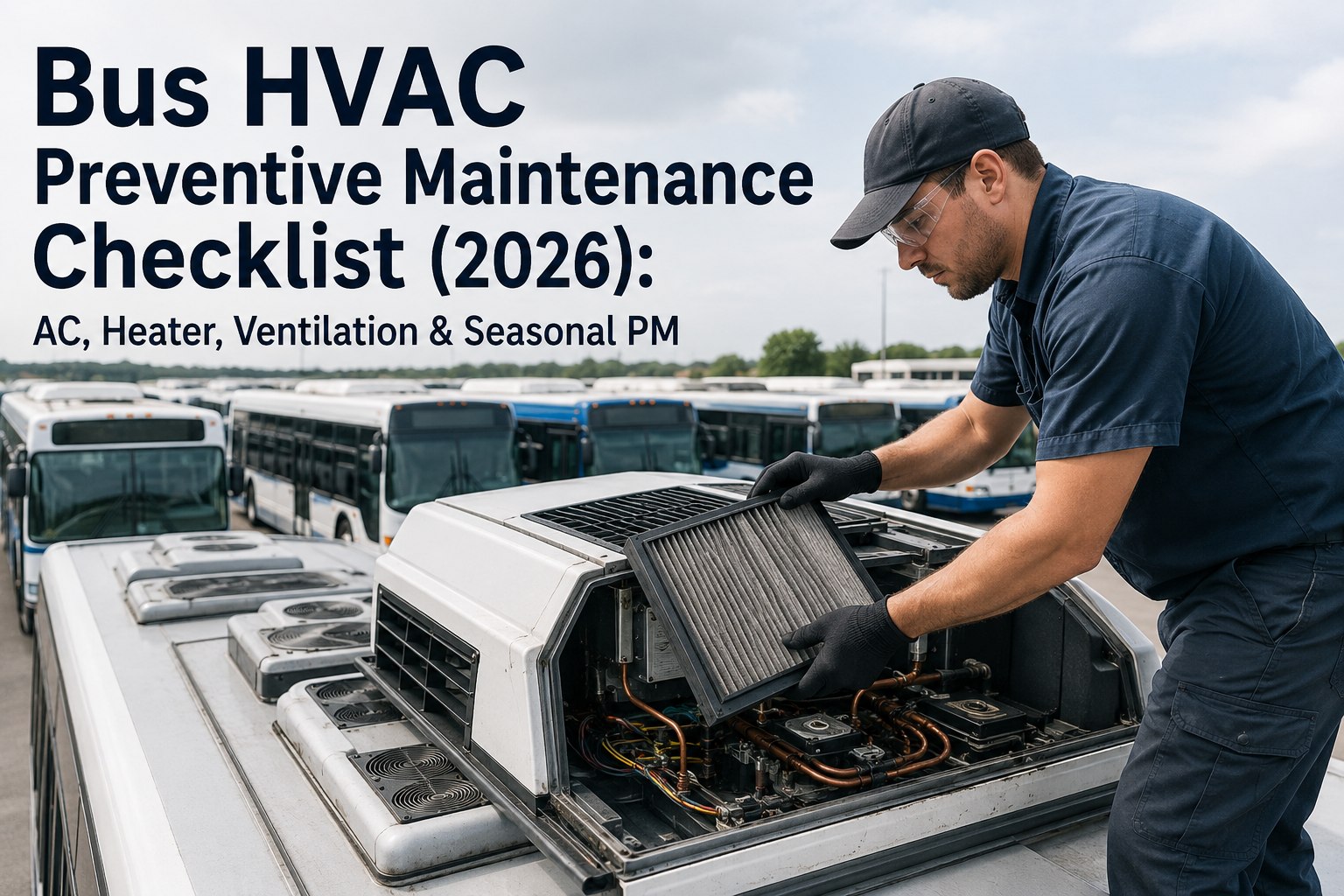
It is 94 degrees on a Wednesday in June, and Bus Route 14 just pulled up to the middle school with warm air blowing from the AC vents. Forty middle schoolers with backpacks are about to spend 25 minutes in a rolling greenhouse. Three skipped HVAC checks last October caused this. This guide gives you the free bus HVAC preventive maintenance checklist to prevent that call from happening to your fleet.
Bus HVAC Preventive Maintenance Checklist
AC, heater, ventilation, refrigerant, and seasonal PM -- ready for tomorrow's shop workflow
- 6HVAC subsystems
- 2Seasonal PMs / year
- 40°-50°FTarget vent temp
- Cabin Temp72°FOK
- Vent Discharge46°FOK
- Refrigerant PSI225/45OK
- Filter Life3,200 miLOW
- Blower Draw14.5AOK
Why HVAC Failures Cost More Than the Repair Bill
HVAC is the one system on a bus where a failure creates a direct passenger experience -- and a direct parent phone call. A dead engine strands the bus in a yard. A dead AC strands 40 kids in 95-degree heat for the whole route. A dead heater in January leaves them shivering for an hour. The invoice for the repair is only part of the cost. Everything downstream of that failure is where the real damage lives.
- CALLS
Parent Phone Calls Multiply
One 90-degree route with broken AC generates 15-30 parent calls to the transportation office. HVAC complaints are the #1 driver of complaint tickets.
- HEALTH
Kids Get Sick or Hurt
Heat exhaustion in summer buses. Cold exposure in winter buses. Students with asthma or medical conditions are most vulnerable. Not a theoretical risk.
- ADA
ADA Compliance Exposure
Passengers with medical needs (respiratory, cardiac, temperature-sensitive) have accommodation rights. Non-functional HVAC crosses into ADA territory fast.
- $$$
Peak-Season Repair Premium
AC repair on August 15th costs 2-3x what the same work costs in April. Shop backlogs, refrigerant shortages, and rush labor drive the bill up.
A working HVAC system is not a comfort feature on a bus. It is a safety system, a compliance system, and a reputation system all wired together. Preventive maintenance is the only cheap way to keep it running. Book a demo to see how BusCMMS tracks seasonal HVAC PM per bus automatically.
The 6 HVAC Subsystems Every Bus PM Program Covers
A bus HVAC system is not one component. It is six interconnected subsystems sharing electrical power, coolant, and refrigerant. Each one fails differently and each one demands its own PM interval. Skip any subsystem and passenger comfort disappears.
1. Air Conditioning
Compressor, condenser, evaporator, expansion valve, receiver-dryer. The high-pressure and low-pressure circuits that produce cooling.
2. Heating System
Heater core, coolant hoses, water control valve, heater boost pump (transit buses). Uses engine coolant to warm cabin air.
3. Ventilation & Blower
Blower motor, resistor pack, fan speed switch, ducts, and vents. Moves conditioned air through the cabin.
4. Filtration & Air Quality
Cabin air filter, fresh air intake, recirculation flap. Cleans incoming air; prevents pollen, dust, and exhaust ingestion.
5. Controls & Sensors
Thermostat, mode switches, temperature sensors, control module. Modern buses run electronic climate control with fault codes.
6. Refrigerant Circuit
R-134a, R-1234yf, or R-407c refrigerant charge; service ports, hoses, seals. Requires EPA-certified technician for service.
Each subsystem has its own failure modes, PM intervals, and diagnostic tests. A CMMS built for buses ships with all six pre-loaded per vehicle configuration. Book a demo to see all 6 HVAC subsystems tracked per bus.
The Comfort-Impact Inspection Checklist
This is the checklist your techs actually use. Each card is one HVAC inspection point with the season it matters most, the passenger comfort loss when it fails, the exact check procedure, and the pass criterion. Print them, laminate them, hand them to every tech -- or load them into a digital DVIR so failed checks feed straight into work orders.
Cabin Air Filter
Visual inspection + airflow measurement at register vents (should feel unrestricted).
Filter clean, no visible debris blocking pleats; airflow within 5% of baseline.
Blower Motor + Resistor Pack
Amperage draw test at all speed settings; listen for bearing whine or wobble.
Amp draw within OEM spec; fan operates smoothly at all 3-4 speeds; no unusual noise.
Refrigerant Charge + Pressures
Connect gauge set. Measure high-side and low-side pressures. Test for leaks with electronic sniffer or UV dye.
Pressures within OEM range for ambient temperature; vent discharge 40-50°F; no detectable leaks.
Condenser Coil + Airflow
Visual inspection for bugs, debris, and bent fins. Compressed-air clean from inside out. Verify fan operation.
Coil fins clean and straight; condenser fan spins freely; no leaks at joints or hoses.
Heater Core + Coolant Loop
Coolant flush and refill. Verify heater hoses hot when engine warm. Vent discharge temperature test.
Vent discharge 140-160°F when engine at operating temperature; no leaks at heater core, hoses, or water valve.
Defrost + Windshield Clearing
Defrost mode function test. Timer test: fogged windshield should clear within 60-90 seconds.
Windshield clears in under 90 seconds; both defrost registers push air at full blower speed with hot output.
Six checks. Six comfort-critical systems. Tracked per bus at the right season, every year, without fail. Anything less and you lose passengers, and lose the confidence of parents and drivers when the system breaks in the extreme weather it was supposed to be ready for. Sign up free and load these HVAC checks into a digital DVIR your techs can run from a tablet.
Seasonal PM Matrix: When Each Task Belongs
HVAC maintenance follows the seasons. Year-round checks catch daily wear. Pre-summer prep (April-May) gets the AC ready before it needs to work hard. Pre-winter prep (September-October) gets the heater and defrost ready before the first cold snap. Get the seasonal timing wrong and every task costs more.
| Task | Year-Round | Pre-Summer | Pre-Winter |
|---|---|---|---|
| Cabin filter change | |||
| Blower motor amp test | |||
| Vent discharge temp check | |||
| Refrigerant leak + pressure test | |||
| AC compressor cycle test | |||
| Condenser coil clean | |||
| Heater core + coolant check | |||
| Water valve operation | |||
| Defrost function test | |||
| Control panel + sensor test |
Seasonal timing is where paper systems break down. A shop foreman who knows Bus 12 needs pre-summer AC service in April but is running behind on May 1st will delay it -- and it will never happen. A CMMS ships that inspection as a scheduled work order in April and follows up until it closes. Book a demo to see seasonal HVAC PM triggers running live on a fleet dashboard.
6 Passenger Complaints and What They Actually Mean
Drivers report HVAC problems in the words passengers use. "Bus is too hot." "Heater is not working." "Air smells weird." Behind each complaint is a specific mechanical or electrical failure. Learning to translate the complaint into the fault cuts diagnostic time in half.
- 01"AC blows warm air"USUALLY MEANSLow refrigerant charge (leak), failed compressor clutch, clogged condenser, or stuck expansion valve.START WITHRefrigerant pressure test; then compressor clutch engagement check; then condenser inspection.
- 02"Heater takes forever to warm up"USUALLY MEANSAir trapped in coolant, low coolant level, stuck-open thermostat, or failing water valve.START WITHCoolant level and burp lines; verify thermostat opens correctly; test water valve operation.
- 03"Air only comes out at high fan speed"USUALLY MEANSFailed blower resistor pack. Lower speeds route power through the resistor; only high speed bypasses it.START WITHAccess blower resistor pack; test continuity across each resistor step; replace if any step is open.
- 04"Musty smell when AC turns on"USUALLY MEANSMold or bacteria growing on the evaporator core. Water collects on cold coil; if drain is clogged, mold grows.START WITHCheck evaporator drain for clog; treat with evaporator cleaner; replace cabin filter.
- 05"Defroster does not clear windshield"USUALLY MEANSBlend door stuck (routes air away from defrost vents), low coolant, or failed blower on defrost mode.START WITHVerify airflow at defrost vents; check coolant temperature; test blend-door actuator.
- 06"Loud whining or scraping from HVAC"USUALLY MEANSBlower motor bearing failure or debris (leaves, small item) trapped in the blower cage.START WITHRemove blower motor; inspect for debris; test bearings by spinning by hand; replace if wobble or noise.
Each complaint on a DVIR should open a work order the same day, with the driver's exact wording preserved. Vague complaints ("HVAC not working") lose 40% of their diagnostic value by the time they reach the shop. Specific complaints ("AC blows warm, high side pressure is 350") solve themselves. Book a demo to see driver HVAC complaints route to work orders with full detail.
Refrigerant Service: What Every Fleet Manager Should Know
Refrigerant service is the one HVAC task that requires EPA certification. Section 609 of the Clean Air Act mandates that anyone servicing motor vehicle air conditioning systems must be certified. Refrigerant recovery, recharge, and leak repair on your fleet legally requires either an in-house certified tech or an outside vendor. Three refrigerants dominate modern bus fleets.
R-134a
Older fleetsStandard for buses built 1994-2020. Still widely available. Being phased out slowly but not banned.
R-1234yf
Newer busesLow global warming potential; standard on new vehicles since 2021. Much more expensive per pound. Different service equipment.
R-407c
Transit rooftop ACUsed in large rooftop transit-bus AC units. Blend refrigerant requiring specific handling procedures.
Track refrigerant type per bus in your CMMS. Mixing refrigerants destroys AC systems. Log every recharge with amount, technician certification, and date -- both EPA compliance and warranty documentation require it. Book a demo to see refrigerant type and service history tracked per bus.
How BusCMMS Automates Seasonal HVAC PM
HVAC PM is the seasonal task most likely to slip through the cracks. Every fleet manager knows they should service AC before summer and heat before winter. Few can prove exactly which buses got the service, which techs performed it, and which ones are still open the week before extreme weather hits. A bus-specific CMMS solves all three problems.
Seasonal PM Triggers
Pre-summer and pre-winter HVAC services auto-generated as work orders per bus in April and October.
DVIR Comfort Complaints
Driver reports "AC blowing warm" or "heater cold" become open work orders with full detail preserved.
Vent Temperature Trending
Log AC discharge temps over time. Rising trend catches marginal cooling before summer failure.
Refrigerant Log per Bus
Track type, quantity, technician certification, and date for every recharge. EPA compliance built in.
Warranty Documentation
Complete HVAC service history per VIN for AC compressor, evaporator, and rooftop-unit warranty claims.
Peak-Season Readiness Report
Board-ready summary of HVAC PM status the week before summer or winter starts. Nothing slips.
BusCMMS reports fleets running seasonal HVAC PM through its platform reduce peak-season HVAC road calls by 50-70%, based on customer-reported outcomes. Fewer parent phone calls, fewer emergency shop visits, and fewer $1,500 rush repairs on July 15th. Book a demo to see HVAC seasonal automation for your fleet size.
The Bottom Line on Bus HVAC Maintenance
HVAC maintenance is the checklist your fleet cannot afford to run on paper. The seasons do not wait. Extreme weather does not check whether you got around to the pre-summer service. The only reliable way to make sure every bus is ready when the temperature spikes is a system that schedules the work, tracks the completion, and flags the failures per bus before the passengers do. That is what BusCMMS was built to run.
How often should bus HVAC preventive maintenance be performed?
Bus HVAC PM runs on three schedules. Year-round checks (cabin filter, blower motor amp test, vent temperature) happen at every scheduled PM interval. Pre-summer PM (refrigerant pressure and leak test, AC compressor cycle, condenser cleaning) happens annually in April or May before hot weather. Pre-winter PM (heater core, coolant loop, water valve, defrost function) happens annually in September or October before cold weather. Missing seasonal timing is the most common way HVAC fails.
What temperature should bus AC vents blow?
Properly functioning bus AC should discharge air at 40-50 degrees Fahrenheit at the register vents when running under normal conditions (75-85F ambient, engine at operating temperature, blower on high). Discharge above 55F indicates a problem: low refrigerant, marginal compressor performance, clogged evaporator, or restricted airflow. For heat, vent discharge should reach 140-160F when engine is fully warmed up. Vent temperatures should be measured and logged at each PM to catch marginal performance before failure.
Does bus HVAC service require special certification?
Yes for refrigerant work. Section 609 of the Clean Air Act requires anyone servicing motor vehicle air conditioning systems (including buses) to hold EPA Section 609 certification. This applies to refrigerant recovery, recharge, and leak repair. Other HVAC tasks (blower motor, cabin filter, heater core, ducts, controls) do not require EPA certification. Fleets either train an in-house tech through an approved program or use an outside vendor with certified technicians for refrigerant work.
What is the most common cause of bus AC failure?
Refrigerant leaks are the single most common cause of bus AC failure, followed by clogged condenser coils, failed compressor clutches, and cabin filter restrictions. Leaks develop slowly at hose connections, evaporator core seams, and compressor shaft seals -- especially after years of vibration. A bus with declining AC performance almost always has a slow refrigerant leak somewhere in the system. Annual leak testing with electronic sniffer or UV dye catches these before summer.
How does BusCMMS help manage HVAC preventive maintenance?
BusCMMS ships with HVAC PM templates pre-loaded for year-round, pre-summer, and pre-winter service on school bus, transit, and charter fleets. Seasonal PM triggers auto-generate work orders in April and October. Driver DVIR complaints like "AC blowing warm" or "heater cold" become open work orders with full detail preserved. Vent discharge temperatures log per bus over time to catch marginal cooling before failure. Refrigerant type, quantity, and technician certification track per bus for EPA compliance and warranty documentation. Peak-season readiness reports run one click before summer or winter begins.