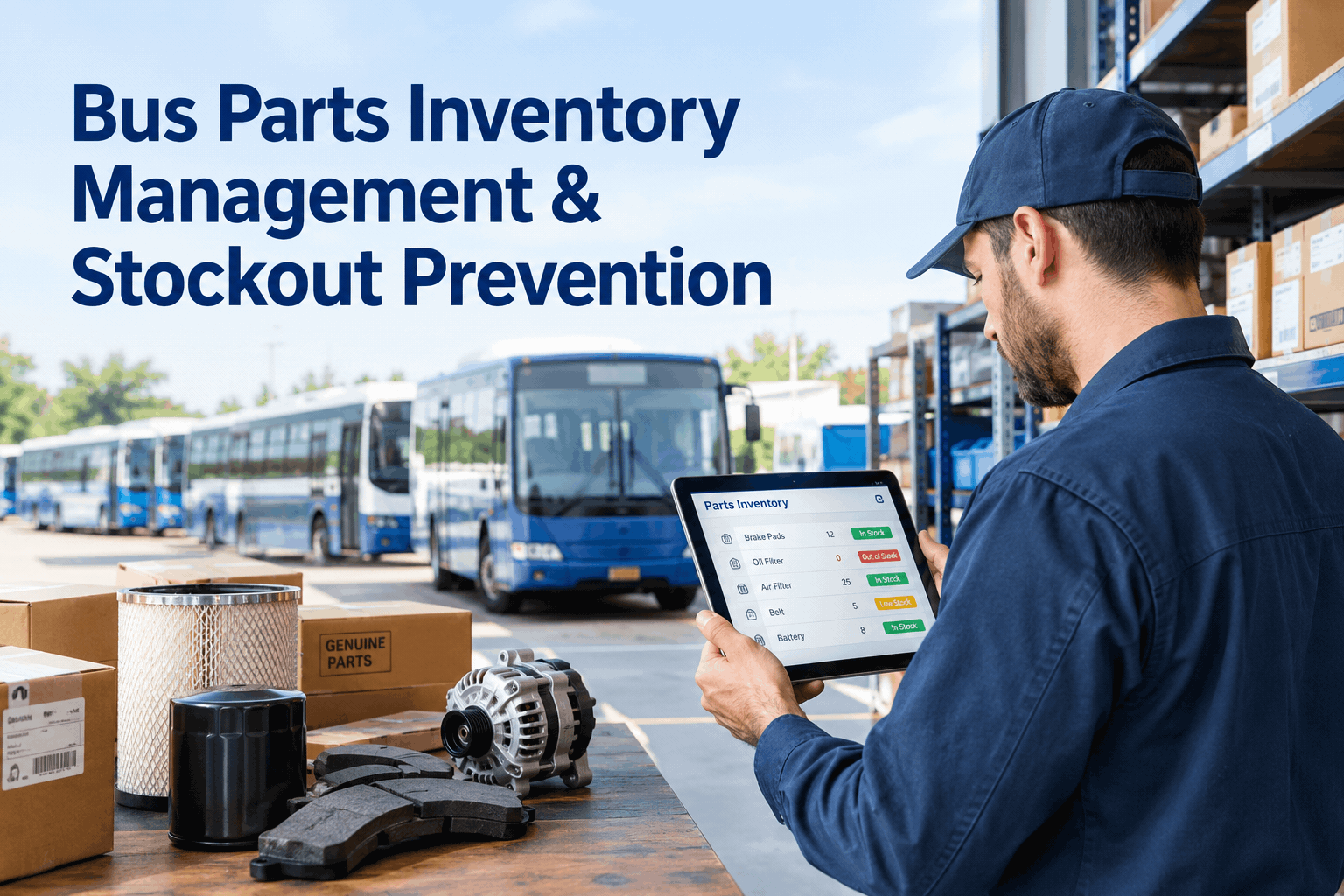
Bus parts inventory management goes wrong in one familiar moment: a bus is up on the lift, the fix is simple, and the part isn't on the shelf. Now a route is short a bus and you're paying rush freight to get moving. You can see how reorder-point alerts keep that shelf stocked in a demo before the next part runs out.
Bus Parts Inventory Management and Stockout Prevention
A reorder point is the whole game: the stock level where you order more, set so the part lands before the shelf hits zero. Done right, the bus never waits on a part.
What a Parts Stockout Really Costs a Bus Fleet
A missing part is never just the price of the part. On a bus fleet, the shelf being empty sets off a chain of costs that dwarfs what a spare would have cost to keep on hand.
A bus sits, a route goes short
A thirty-dollar part can hold a bus out of service for days. On a tight roster that means a doubled route, a sub bus, or students left waiting at the stop.
Rush freight and premium pricing
The part you didn't stock now has to arrive overnight, often at a markup, from whichever supplier can ship fastest — not the one with the best price.
Overstock hides on the other end
Overcorrecting means shelves full of parts you rarely use, cash tied up, and filters quietly expiring in a box — the opposite problem, same root cause.
Both failures — the empty shelf and the overflowing one — come from the same gap: no reorder point tied to how fast each part actually gets used. You can start a free account and get your shelf counts in order.
The Reorder Point: The Number That Prevents Stockouts
A reorder point is simple math, and it's the core of bus spare parts inventory. It's the stock level low enough to trigger an order, but high enough that what's left covers you until the new stock lands. Three inputs set it.
A part used twice a day with a six-day lead time needs twelve on hand just to cover the wait — plus a safety buffer. Guessing at that number is how shelves run dry. You can start a free account and set reorder points from your own usage.
Not Every Part Deserves the Same Attention
You can't carry deep stock on everything, and you don't need to. Sort your bus spare parts inventory by how badly a stockout hurts, and put your tightest reorder discipline where a missing part parks a bus.
Route-stoppers — stock hard
Parts a bus can't run without: brake chambers, air dryers, alternators, starters, belts, wiper motors. A stockout here is a parked bus. Tight reorder points, real safety stock.
PM consumables — stock steady
High-volume predictable items: oil and air filters, wiper blades, lamps, fittings. Demand is knowable from the PM schedule, so reorder points can run lean but never empty.
Rare & low-impact — order on demand
Seldom-used or non-critical parts where a short wait doesn't stop a route. Carry little or none; order when a job calls for it rather than tying up shelf space.
The A-parts are a short list for most fleets — and they're where nearly all your stockout pain lives. Book a demo to see your parts sorted by stockout impact.
Why Bus Parts Demand Is Easier to Forecast Than You Think
Here's the advantage a bus fleet has: your preventive maintenance is scheduled, so most of your parts demand is already on the calendar. When PM is tied to mileage and engine hours, the parts those services consume are predictable weeks out.
Swipe sideways to see all three columns.
When the PM schedule and the parts list live in the same system, upcoming services pull the parts they need into the reorder math automatically. You can book a demo to see PM-driven parts planning on your fleet.
Guessing vs Reorder-Driven: The Difference on the Shelf
The gap between a shop that runs out of parts and one that doesn't isn't luck or budget — it's whether the shelf is managed by memory or by a reorder point. The same year looks very different on each track.
Same part, same budget — the reorder-driven track just never lets it hit zero. The shelf runs itself instead of surprising you.
Your Stockout Prevention Checklist
If your parts room runs on a clipboard and memory today, here's the order of moves that closes the most stockout risk fastest. The first three turn the shelf from reactive to managed.
- Count what you have and what you useYou can't set a reorder point without real on-hand counts and usage history. This is the foundation everything else sits on.FIRST
- Set reorder points on your A-parts firstThe route-stoppers earn the tightest discipline. Usage times lead time, plus a safety buffer sized to your supplier's reliability.FIRST
- Turn on low-stock alertsThe reorder point only helps if it tells someone. An automatic alert at the trigger level beats a weekly shelf walk every time.FIRST
- Tie parts to work orders and PMWhen a job pulls parts, usage updates on its own and upcoming PM pre-loads demand — no separate parts log to keep.THEN
- Review min/max as usage shiftsAn aging fleet burns more of some parts. Revisit reorder points each season so they track reality, not last year's numbers.THEN
The first three are a weekend of setup. The last two are where a bus-built system keeps the numbers honest without extra work from you.
How BusCMMS Handles Bus Parts Inventory Management
BusCMMS keeps the parts room in step with the shop: reorder points from real usage, auto-reorder alerts before the shelf runs low, and parts tied to work orders so inventory updates itself as jobs close.
Auto-reorder alerts
A reorder point on every part, with a low-stock alert before you run out — no weekly shelf walk, no mid-repair surprise.
No duplicate orders
The system flags a part already on order, so two people don't buy the same alternator twice and tie up cash on a shelf.
Parts tied to work orders
Every part pulled for a job updates inventory automatically, and upcoming PM pre-loads the parts it will consume.
BusCMMS reports bus fleets cutting maintenance costs by 25–35% within a year once parts and work orders run on one system — company-reported figures from its own customer base, not independently audited, but a fair picture of what ending the stockout-and-overstock cycle is worth. See where parts fit in the complete guide to what a bus CMMS does.
A Parts Manager's Take
Key Takeaways on Bus Parts Inventory Management
Stockouts aren't bad luck — they're an unmanaged shelf. A reorder point tied to real usage, tightest on the parts that park a bus, is the whole fix. Four things to carry out of this.
The reorder point is the fix
Usage times lead time, plus safety stock — the number that fires an order in time.
Stock hardest on route-stoppers
A short list of A-parts causes most of the pain. Guard those first.
PM makes demand predictable
Scheduled services put most parts demand on the calendar weeks ahead.
Let the system watch the shelf
Alerts and work-order-linked usage keep inventory honest without a parts log.
Done right, bus parts inventory management is quiet: reorder points fire orders before the shelf runs dry, PM pulls its own parts into the plan, and the bus never waits on a thirty-dollar part. Set the points, watch the A-list, and the stockouts stop.