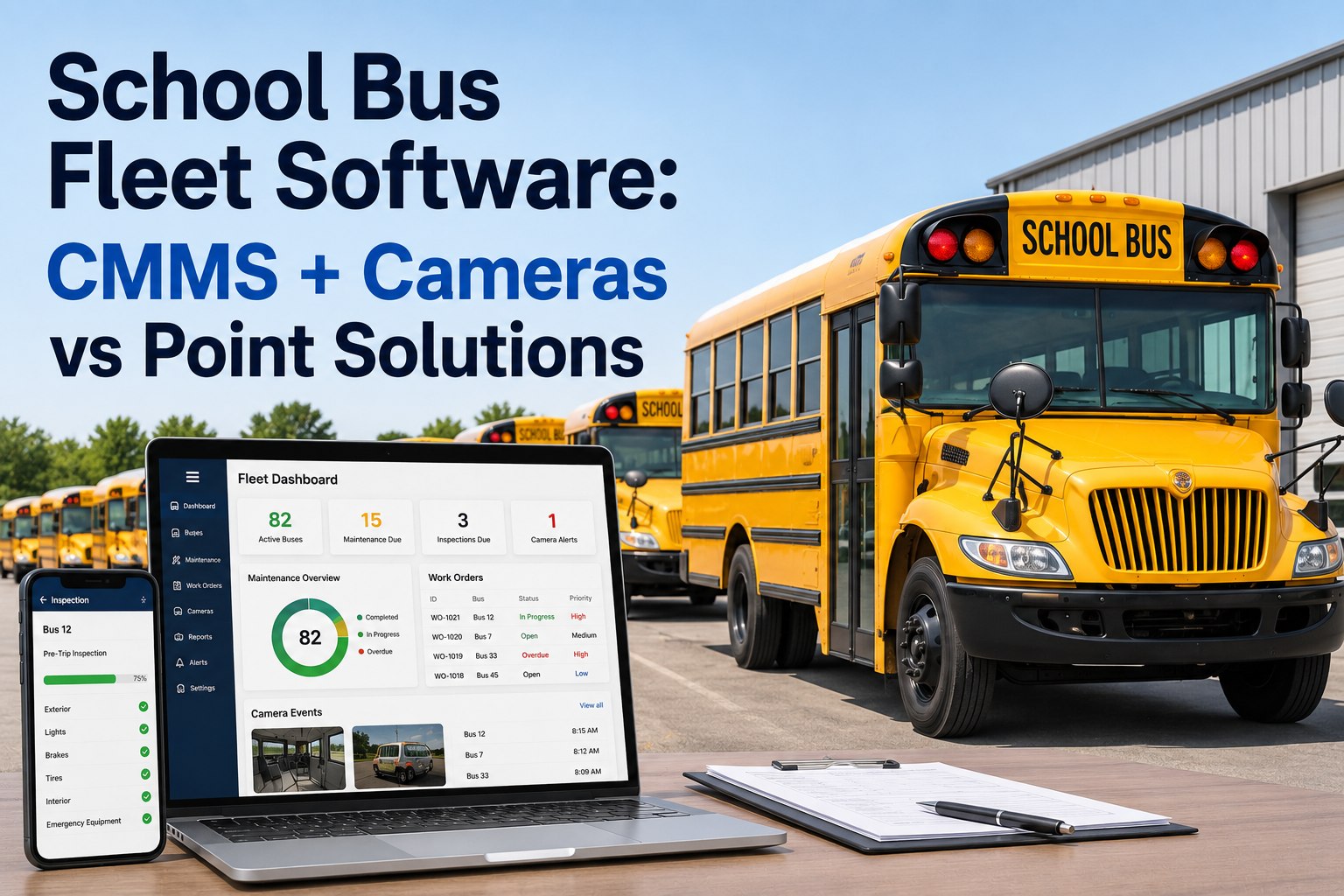
The right school bus fleet software architecture — one integrated CMMS-plus-cameras platform, or several best-of-breed point solutions — depends on how many separate systems your operation is already running, whether their workflows actually need to share data, and whether the total cost of the fragmented stack is worth what best-of-breed depth is buying you. Both architectures work when correctly applied. This 2026 guide walks the honest tradeoffs, gives you a worked cost ledger for a 100-bus district (with clearly labeled illustrative numbers), and hands you the evaluation framework transportation directors, superintendents, and CFOs can defend in a school board meeting. Book a walkthrough to work the framework against your specific fleet.
School Bus Fleet Software: CMMS + Cameras vs Point Solutions
Compare integrated bus fleet software with separate camera, maintenance, inspection, and telematics point solutions across licensing, integrations, workflows, and true total cost — then decide which architecture actually fits your district.
- 1-2Consolidated
- 3-4Manageable
- 5-6Fragmented
- 7+High Overhead
What Is a Fleet Point Solution?
A fleet point solution is a piece of software built to do one thing well — cameras, telematics, preventive maintenance, work orders, inspections, parts inventory, fuel tracking, driver records — typically sold by a specialist vendor focused on that single function. Each point solution has its own license, contract, login, admin panel, data model, and support relationship. An integrated bus fleet software platform, by contrast, holds many of these functions together on one platform sharing one bus record. Neither shape is automatically better. The question is which shape fits your operation.
Point Solution Stack
- Camera / MDVR vendor
- Video management platform
- Telematics / GPS provider
- Maintenance / CMMS software
- Inspection / DVIR app
- Parts inventory system
Integrated Platform
- Camera events on the bus record
- Video attached to defects
- Telematics feeds ingested
- Maintenance and work orders
- Digital DVIR meeting FMCSA rule
- Parts tied to work order lines
Six separate systems isn’t an exaggeration — it’s the average district shape once you tally everything used by transportation, maintenance, and administration together. Some districts run more: driver records, fuel systems, incident documentation, and state reporting tools can add three or four additional platforms depending on state and local requirements. The question isn’t whether point solutions or an integrated bus fleet software platform is philosophically superior. The question is whether the specific fragmentation cost of the stack you’re running today is worth the specialized depth each vendor brings. Book a walkthrough to see the integrated shape on a real bus record.
The Fragmentation Cost Ledger — 100 Buses, Worked Example
Here’s a worked total-cost-of-ownership example for a 100-bus school district running four separate point solutions (maintenance, inspection, telematics, camera platform) versus consolidating maintenance-plus-inspection-plus-camera-event workflow onto one integrated bus fleet software platform. The per-bus figures below are illustrative anchors for the modeling exercise — not vendor quotes and not market prices. Actual pricing varies significantly by vendor, contract term, and district. Use this as a framework to plug in your own numbers.
- ANNUAL COST CATEGORY4 POINT SOLUTIONS1 INTEGRATED
- Software licenses~$720~$420
- Implementation (year 1)~$180~$60
- Integration / API work~$140$0
- Duplicate data entry (admin hours)~$220~$40
- Training across systems~$90~$30
- Multi-vendor support contracts~$150~$50
- Renewal / price increases~$130~$40
- ILLUSTRATIVE TOTAL /BUS/YR~$1,630~$640
The rows to pay close attention to are integration/API work and duplicate data entry — these are the categories most districts underestimate when they build a fragmented stack. Each integration between two point solutions costs implementation time and ongoing maintenance. Every workflow that requires the same data entered twice costs administrative labor hours that don’t appear on any invoice. Model both explicitly. A cost-of-ownership comparison that only counts software subscription fees will always favor point solutions on paper and mislead the decision. Book a walkthrough to model your specific fragmentation cost.
When Each Architecture Actually Wins
This is the section most fleet software comparison articles skip and it’s the reason most of those articles are useless to actual buyers. Point solutions genuinely win in real scenarios. Integrated platforms genuinely win in others. A district director trying to make a defensible decision needs both sides on the table honestly.
Point Solutions Win When…
- An existing best-of-breed camera or telematics contract has years remaining and can’t be terminated
- One specific function needs specialized depth an integrated platform can’t match — state-specific reporting quirks, unusual hardware, niche compliance
- The district already has strong integration muscle in-house and can maintain APIs between systems
- Procurement rules require separate RFPs per function — consolidation isn’t administratively possible
- Vendor concentration risk is a formal policy concern the board has documented
Integrated Platforms Win When…
- Maintenance and inspection data need to connect naturally — defects flow to work orders, work orders close on inspection
- Camera events need to attach to a bus record alongside DVIRs, defects, and PM history
- Managers need unified reporting across safety, maintenance, and fleet availability without exporting to spreadsheets
- Technicians and drivers should learn one interface, not four
- Administrators want simpler user management, one contract, and one renewal cycle to negotiate
A district that ticks two or three points on the left column should be careful about consolidating. A district that ticks three or four on the right column has a real case for looking at an integrated platform seriously. Most districts sit somewhere in the middle — and that’s exactly where the pilot framework in the next section becomes essential. Sign up free to see the integrated model on your own operation.
The Single-Vendor Risk Question — Eight Things to Ask Any Consolidation Vendor
The strongest objection to consolidating school bus fleet software onto one platform is legitimate: vendor lock-in, weaker functionality in a specific category, migration difficulty if the relationship sours, and dependence on one product roadmap. Any integrated platform vendor asking you to consolidate should be able to answer these eight questions clearly, in writing, before you sign.
- 01
Data ownership
Who owns the data your fleet generates in the platform — is it explicitly the district in the contract?
- 02
API access
Is there a documented API? What data is exposed? Is API access included in the base license or an add-on?
- 03
Data export
Can you export everything — inspections, work orders, camera events, defects, PM history — in standard formats at any time?
- 04
Contract termination
What are the notice periods, early termination costs, and data retention terms if the relationship ends?
- 05
Uptime SLA
What’s the guaranteed uptime? What are the remedies if it’s missed? What’s the incident notification protocol?
- 06
Hardware compatibility
Is the platform hardware-agnostic? Can it ingest events from your existing MDVR, camera, and telematics investments?
- 07
Implementation support
What’s included in onboarding — data migration, training, dedicated implementation manager?
- 08
Roadmap transparency
How is the roadmap shared with customers? Is there a customer advisory input mechanism?
A vendor that answers all eight clearly and in writing has done the work of making single-vendor concentration a manageable risk instead of a permanent one. A vendor that hedges on data ownership, export, or contract termination is telling you something important about the future relationship. Add these questions to the RFP and score every consolidation candidate against them. Book a walkthrough to see how BusCMMS answers each of these directly.
Baseline Before You Pilot — The Most Common Fleet Software Failure
Districts that run a fleet software pilot without establishing baseline metrics can’t actually tell whether the pilot succeeded — they can only tell whether it felt better. Whether you’re piloting an integrated bus fleet software platform or a point solution replacement, measure the current state on these dimensions before the pilot starts. Then measure the same dimensions during and after.
- PM compliance ratePercentage of scheduled preventive maintenance completed on time, per bus
- Repeat repair rateHow often the same defect returns within 30 days on the same bus
- Inspection completion ratePre-trip DVIRs actually completed and submitted, not just started
- Technician admin hoursHours per week technicians spend on paperwork versus turning wrenches
- Fleet downtimeBuses out of service on weekdays and the reason each was out
- Work order cycle timeAverage hours from work order open to close for standard repairs
- Missed defects rateDefects caught on second inspection that should have been caught on first
- Software and license spendAll fleet-related subscriptions and their renewal dates in one document
- Reporting effortHours per month spent building reports from spreadsheets across systems
Nine metrics is achievable in a two-week baseline exercise. Districts that skip this step end up in the classic pilot outcome: the transportation director likes the new platform, the CFO can’t justify why, and the decision defaults to the incumbent because there’s no data to point to. Do the baseline. It changes the conversation from “this feels better” to “PM compliance went from 71% to 92%, admin hours dropped 8 per week, and cycle time cut in half.” That’s a board conversation. Book a walkthrough to build your baseline framework.
A Transportation Director on the Consolidation Decision
Two things worth noting in that quote. First, consolidation wasn’t all-or-nothing — the existing telematics contract stayed in place while the rest moved. Second, the board approval came from the ledger, not the demo. That’s the pattern that gets these decisions through. Feature comparisons persuade transportation directors. Cost ledgers persuade the people transportation directors report to. BusCMMS reports serving more than 5,000 bus fleets with customers reporting approximately 30% lower annual maintenance costs and an average four-month payback — figures published by BusCMMS from its own customer base rather than independently verified industry averages. Whether those specific outcomes apply to your fleet is exactly what a properly baselined pilot answers. Book a walkthrough to see the platform serving fleets like yours.
District Fleet Software Evaluation Checklist
Nine questions worth taking through your next fleet software evaluation, whether you’re shopping point solutions, integrated platforms, or both against each other.
How many systems do you count today?
Cameras, telematics, CMMS, inspections, parts, fuel, driver records, incident systems — list every one with its renewal date.
Which workflows actually cross systems?
Defect to work order, camera event to inspection, PM to parts — the crossings are where fragmentation hurts most.
What’s the true fully-loaded cost?
Licenses plus implementation plus integrations plus admin hours plus renewal escalations — not just the invoice line.
Do vendors answer the eight risk questions?
Data ownership, API, export, termination, SLA, hardware compatibility, implementation support, roadmap — in writing.
Have you baselined nine metrics?
PM compliance, repeat repairs, inspection completion, admin hours, downtime, cycle time, missed defects, spend, reporting effort.
Are current contracts terminable?
If not, the consolidation math changes — a phased approach aligned to renewal windows is often the only clean path.
Is the pilot on real buses?
Ten buses running actual routes, not a sandbox demo. Feature videos don’t survive contact with morning route pressure.
Does the ledger persuade the CFO?
The board conversation lives in the cost ledger and the metric deltas, not the feature comparison. Build the ledger first.
Does implementation align with school calendar?
Summer or winter break for cutover. Mid-year rollouts during AM route pressure is the failure mode to avoid every time.
This page is fleet-management and software buyer guidance — not legal or procurement advice. No single federal mandate requires a district to use an integrated CMMS-plus-camera platform; where applicable, reference 49 CFR Part 396 along with state and district-specific requirements. BusCMMS-reported outcome figures cited above (5,000+ bus fleets served, approximately 30% lower annual maintenance costs, average four-month payback) are published by BusCMMS from its own customer base and are not independently verified industry averages. Verify current vendor specifications, contract terms, and regulatory requirements directly with each provider and with counsel before making a purchasing decision. Book a walkthrough to work the checklist against BusCMMS live.
What is a fleet point solution?
A fleet point solution is a piece of software built to do one specific fleet function well — cameras, telematics, preventive maintenance, work orders, inspections, parts inventory, fuel tracking, or driver records — typically sold by a specialist vendor focused on that single function. Each point solution has its own license, contract, login, admin panel, data model, and support relationship. Point solutions can provide strong best-of-breed depth in their function but generate integration and administrative overhead when a district accumulates several of them for one fleet.
Should a school district use one fleet platform or multiple point solutions?
Neither approach is automatically correct. Separate camera and maintenance point solutions work well when a district already has strong contracts on either system, when specialized functionality requires best-of-breed depth, or when procurement rules require separate RFPs per function. An integrated platform tends to make more sense when maintenance and inspection data need to connect naturally, when camera events should attach to bus records alongside DVIRs and defects, when unified reporting is needed across safety and maintenance, or when administrators want one contract and one renewal cycle. Count your current systems, model the true fragmentation cost, then decide.
How much does school bus fleet software cost?
School bus fleet software pricing varies substantially based on architecture, functions included, and district size. Point solution stacks price per function — separate line items for cameras, telematics, maintenance, inspections, and other systems — while integrated platforms typically price per bus with more functions bundled. A meaningful cost comparison requires the full total-cost-of-ownership picture, not just sticker prices: software licenses, implementation, integration and API work, duplicate data entry, multi-vendor support contracts, training across systems, and annual renewal escalations. Once these are included, an integrated platform can be substantially cheaper for districts running four or more separate fleet systems. Model your specific ledger before assuming either direction, and verify current pricing directly with each vendor.
What should a school district evaluate when buying fleet software?
Evaluate at minimum: system count and current vendor list with renewal dates, which workflows actually cross systems and where the fragmentation hurts, true fully-loaded total cost (not just invoice lines), vendor answers to the eight risk questions (data ownership, API access, data export, contract termination, SLA, hardware compatibility, implementation support, roadmap transparency), baseline metrics on nine operational dimensions before piloting, terminability of current contracts, whether the pilot runs on real buses with real routes, whether the cost ledger will persuade the CFO, and alignment of implementation with the school calendar.
What are the risks of using one vendor for all school bus fleet software?
The legitimate risks are vendor lock-in, potentially weaker functionality in a specific category compared to a best-of-breed specialist, migration difficulty if the relationship ends, and dependence on one product roadmap. These risks are manageable when the vendor answers the eight risk questions clearly and in writing: documented data ownership, functional API access, complete data export in standard formats, clear contract termination terms, guaranteed uptime with remedies, hardware-agnostic integration, structured implementation support, and transparent roadmap communication. A vendor that hedges on any of these signals higher long-term risk that a district should factor into the consolidation decision.