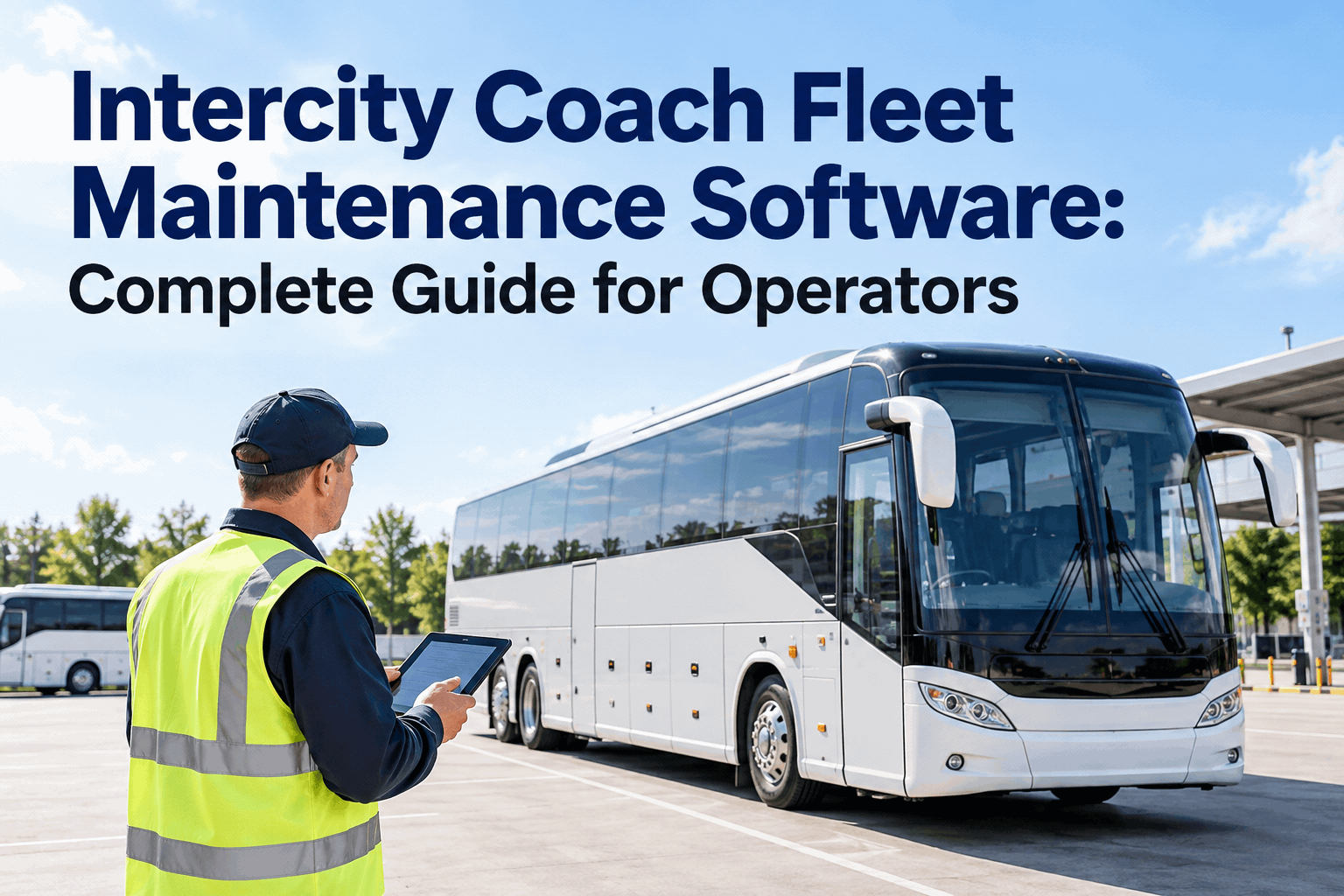
The worst call an intercity dispatcher gets is the one from a coach 200 miles out with a dead air compressor and 50 passengers aboard — no shop nearby, a rescue coach an hour away, and a day of connections blown. Intercity coach fleet maintenance software exists to make that call rare, by catching the fault at the depot before the run instead of on the interstate. You can see how it works in a short demo.
Intercity Coach Fleet Maintenance Software: Complete Guide for Operators
Long-haul coaches rack up highway miles far from the home shop, which makes the roadside breakdown the failure you plan your whole maintenance program around. Here is how purpose-built software keeps coaches reliable, FMCSA-compliant, and off the shoulder.
Why Intercity Coach Maintenance Is Its Own Problem
A city bus comes home to the yard every night. An intercity coach might be three states away, so the whole maintenance philosophy flips: you cannot fix it there, so you have to make sure it never breaks there. High mileage, long routes, FMCSA oversight and revenue-critical comfort systems all pile onto a vehicle you only see between runs.
High miles, fast intervals
A coach can cover a city bus's monthly mileage in a few days. PM intervals arrive quickly and relentlessly, so mileage-based scheduling is not optional — it is the backbone.
FMCSA is always watching
Interstate coaches run under FMCSA Part 396, which requires a systematic inspection and maintenance program with records. A gap in the paper trail is a violation, not an oversight.
Comfort systems are revenue
A dead HVAC, a broken lavatory or no WiFi on a six-hour run is a refund and a bad review. On a coach, passenger-comfort systems are maintenance items that affect the bottom line.
The coach you cannot inspect tonight is running a 300-mile route tomorrow — everything has to be caught before it rolls out, because out there, it is already too late.
Mileage Drives the PM Clock, Not the Calendar
On an intercity fleet, a coach can be approaching its next major service weeks after its last one, simply because it never stops moving. Scheduling PM by the calendar misses this entirely. The software has to track every coach against its mileage interval and flag it before it is overdue, not after.
Set intervals by mileage, let telematics feed the odometer in automatically, and the system tells you a coach is due before dispatch puts it on a long run. You can create a free account and set up your first mileage-based PM in an afternoon.
What FMCSA Part 396 Actually Requires
Operators often think FMCSA hands them a maintenance schedule. It does not. Part 396 requires a systematic inspection, repair and maintenance program — but it leaves the intervals to you, the carrier, and then expects the records to prove you followed your own program. That is exactly the gap a CMMS fills: it holds the program you set and the proof that you ran it.
Because the intervals are yours to set, the carriers that pass audits cleanly are the ones whose program lives in a system, not a binder. You can book a demo and see your 396 records build themselves as the work gets done.
The Intercity Coach Inspection Checklist
A motorcoach pre-trip covers the safety-critical running gear plus the systems that make a long ride bearable. These are the items that keep a coach legal, reliable and comfortable on a route far from help.
- Air brakes & air systemAir compressor, lines, tanks and brake adjustment — the system that most often strands a coach on the road. Checked first, every trip.EVERY TRIP
- Tires, wheels & treadHighway speeds and heavy loads punish tires. Pressure, tread and wheel security on every position before a long run.EVERY TRIP
- HVAC, lavatory & comfort systemsClimate control, the onboard restroom, reclining seats and WiFi — the revenue-affecting systems a long-haul passenger notices immediately.INSPECT
- Doors, lifts, lights & emergency exitsEntry doors, wheelchair lift, all lights, and emergency exits and equipment — the compliance and safety items a DOT inspector checks first.EVERY TRIP
- Logged as a DVIR with signatureEvery pre- and post-trip recorded as a proper DVIR, so the Part 396 trail is complete and a flagged defect opens a work order automatically.RECORD
The defect a driver mentions but never writes down is the one that fails at highway speed. A digital DVIR turns that remark into a tracked repair.
What Intercity Coach Fleet Maintenance Software Should Do
The job is to keep high-mileage coaches reliable and compliant on routes where there is no second chance. BusCMMS is built for buses from day one, so you configure it around your coaches and your FMCSA program rather than forcing a generic tool to understand either — you can spin up a free account and add your first coach to try it.
Mileage-based PM scheduling
Set intervals by odometer and calendar, fed automatically from telematics, so every coach flags for service before a long run — not after it is already overdue.
Telematics fault codes to work orders
Pre-built connectors pull engine and system fault codes from a coach on the road and open a work order the moment something trends wrong, so you act before it fails.
DVIRs & FMCSA-ready records
Digital pre- and post-trip DVIRs, the annual inspection tracked, and a complete Part 396 record exportable on demand — the program and the proof in one place.
Availability & cost dashboards
See which coaches are ready to dispatch, plus cost per mile, MTBF and road-call trends — the numbers that tell you whether your program is actually working.
Availability, cost-reduction and rollout figures above are BusCMMS's own reported results from its customer data, not independently audited benchmarks.
A Motorcoach Maintenance Director's Take
Key Takeaways on Intercity Coach Fleet Maintenance Software
Choosing intercity coach fleet maintenance software comes down to one reality: the breakdown you fear happens where you cannot reach it, so everything is about prevention and proof. Four things to carry into the decision.
Prevent it at the depot
You cannot fix a coach 200 miles out, so the whole program is about catching it before it rolls.
Schedule by mileage
Coaches hit intervals in weeks. Mileage-based PM, fed by telematics, is the backbone, not the calendar.
FMCSA 396 is yours to run
The reg requires a systematic program and records but lets you set the intervals — so hold both in a system.
Comfort systems count
HVAC, lavatory and WiFi are revenue items on a long run — maintain them like the brakes.
Run your intercity coach fleet maintenance software around the long route and the FMCSA program, and the road calls fall, the audits get boring, and the coaches keep their schedules. The quickest way to judge the fit is to see it mapped to your own routes in a demo, or read the complete guide to what a bus CMMS does first. The coaches are the easy part — keeping them on schedule is the win.