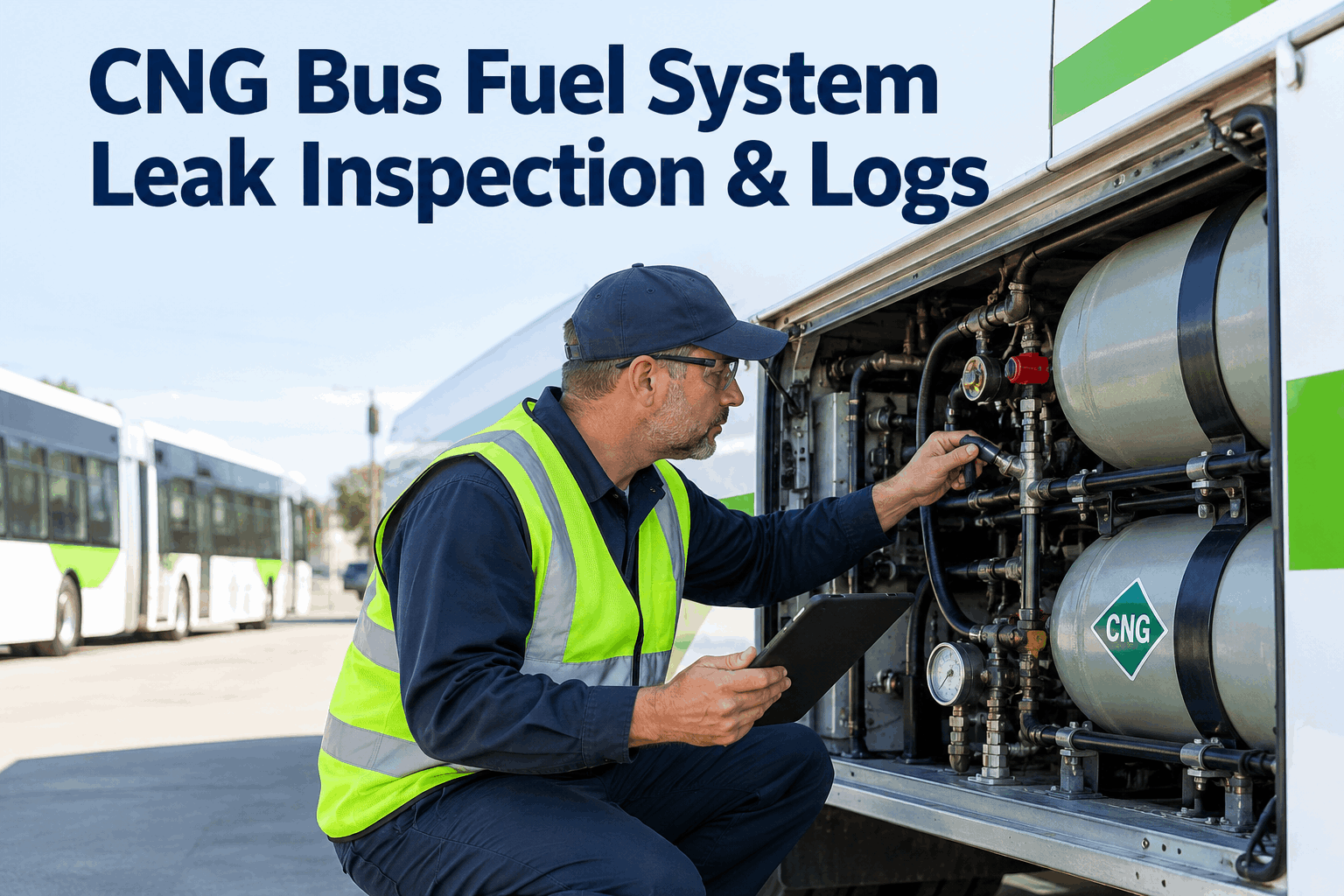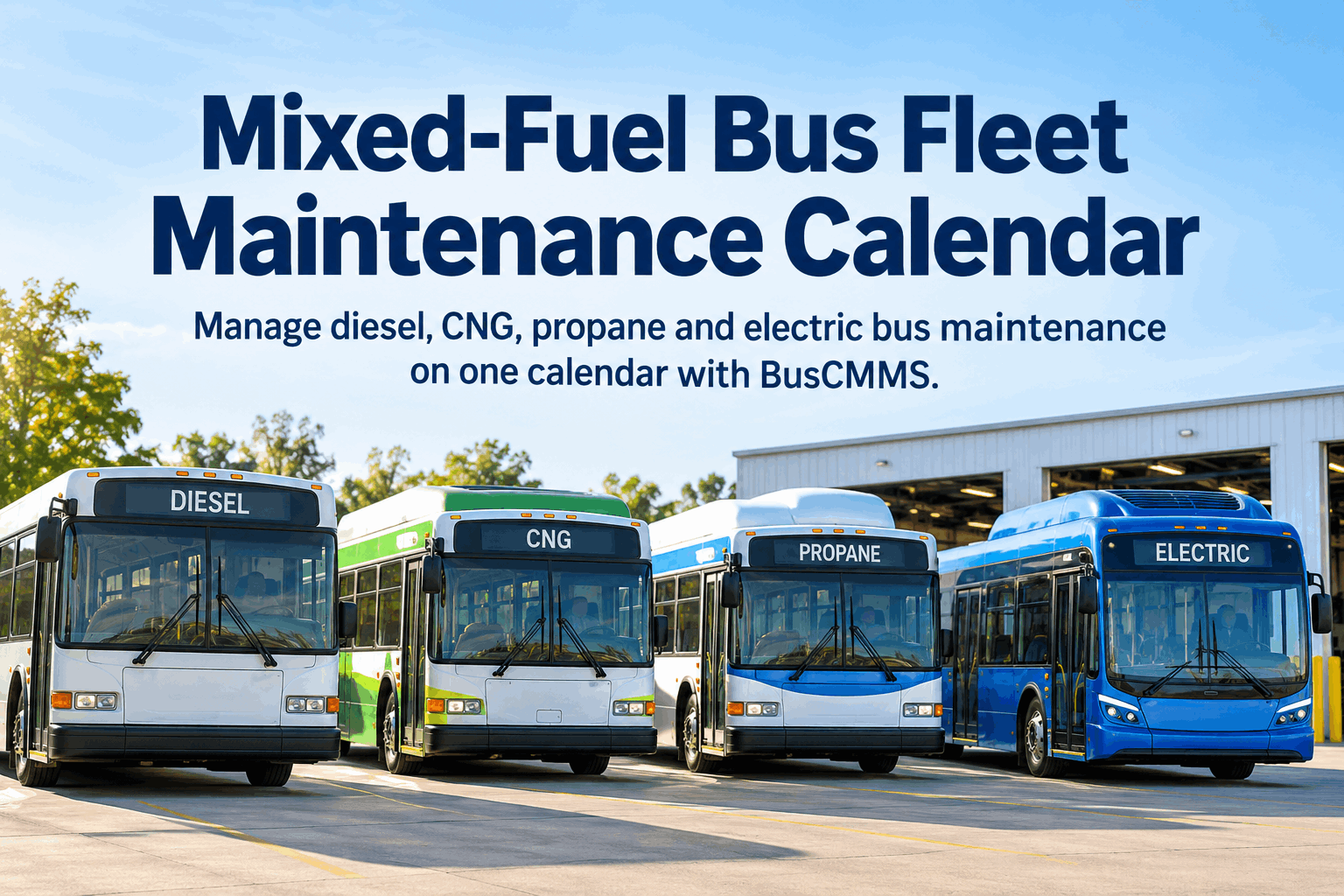
Your diesel buses want an oil change this week, two CNG buses are due for a leak inspection, and the new electric buses are on a schedule nobody has quite written down. Four fuel types, four PM rhythms, four spreadsheets that do not talk. You can see how a mixed-fuel fleet runs every PM schedule on one calendar.
The Mixed-Fuel Bus Fleet Maintenance Calendar: Four Fuel Types, One Dashboard
Diesel, CNG, propane, and electric buses each need a different preventive maintenance schedule — different tasks, different intervals, different safety checks. Run them in separate spreadsheets and something always slips. Run them on one fuel-aware calendar and the whole fleet stays on schedule at a glance.
Why Each Fuel Type Needs Its Own PM Schedule
The reason a mixed fleet is hard to schedule is simple: the four fuels barely share a maintenance list. A diesel bus lives on oil and emissions work; an electric bus has almost none of that but adds high-voltage safety steps. CNG and propane each carry fuel-system checks the others never see. Here is what actually lands on each fuel's calendar.
✓ on the schedule ~ reduced or conditional — not applicable. Electric buses skip oil and emissions entirely but add high-voltage work, and regenerative braking stretches their brake and tire intervals.
Read across any row and you can see why one PM template cannot cover the fleet. A calendar that treats every bus the same will either over-service the electric buses or under-service the diesels — you need one that knows the fuel. You can start free and set fuel-specific PM for every bus.
Different Fuels, Different Maintenance Load
It is not just which tasks differ — it is how many. Diesel carries the heaviest scheduled-PM load; electric the lightest, though it trades engine work for high-voltage safety steps. Planning a mixed fleet means budgeting shop time against each fuel's real demand, not a flat average.
Relative scheduled-PM load is illustrative and based on the task differences above — your real cadence depends on duty cycle, OEM intervals, and mileage. The point holds regardless: the four fuels do not share a workload, so they cannot share a schedule.
From Four Spreadsheets to One Calendar
Most mixed fleets manage this with a tab per fuel — or worse, a different person for each. The problem is not the spreadsheets; it is that nothing connects them, so no one sees the whole week at once and the clashes only show up when two buses need the same bay.
That single view is the difference between reacting to whatever is overdue and planning the week before it starts. You can book a demo and see all four fuels on one calendar.
How BusCMMS Runs a Mixed-Fuel PM Calendar
Managing four fuel types on one dashboard is not about cramming four spreadsheets into one tab — it is about the system knowing what each bus needs and when. Four things make that work.
Fuel-specific PM templates
Each bus is set to its fuel type and inherits the right PM tasks and intervals out of the box — diesel oil service, CNG leak checks, electric high-voltage steps — so nobody builds a schedule from scratch.
One calendar, every bus
All four fuels appear on a single PM calendar, so you see the whole fleet's week at once and catch the day three buses are due in the same bay before it becomes a scramble.
Mileage, hours, or date triggers
PM fires on whatever fits the bus — mileage for a highway coach, engine hours for an idle-heavy route, a calendar date for an annual safety check — so every fuel is serviced on its real wear.
Fleet-wide availability in view
Because every PM is planned instead of reactive, you keep more buses on the road — the availability number that matters whether a route runs on diesel or a battery.
The result is a mixed fleet that feels like one fleet to manage, not four — which is the whole promise of a bus-specific CMMS over a generic tool bent to fit. It is worth seeing on your own mix of buses in a short walkthrough of the mixed-fuel calendar.
We went from all-diesel to a mix in about three years, and our scheduling never caught up — I had a diesel spreadsheet, a CNG binder, and the electric buses living in someone's head. The first month everything was on one calendar, I found two PMs that had been quietly overdue since spring. Seeing all four fuels in one view is the thing I did not know I was missing.
Mixed-Fuel PM Scheduling: The Short Version
Each fuel needs its own schedule
Diesel, CNG, propane, and electric barely share a PM list — one template cannot cover the fleet.
The loads are different too
Diesel carries the most scheduled work, electric the least — but electric adds high-voltage safety steps.
Separate spreadsheets hide the clashes
Four disconnected logs mean no one sees the whole week, and overdue PMs slip through the gaps.
One fuel-aware calendar fixes it
Set each bus to its fuel, trigger PM by mileage, hours, or date, and plan the whole fleet in one view.
A mixed-fuel fleet does not have to be four maintenance programs taped together. Put every fuel's PM on one calendar, let the system carry the rules for each, and your diesel, CNG, propane, and electric buses finally run on one plan instead of four. That is how a growing fleet adds fuel types without adding chaos — and keeps availability high across all of them. You can start free and bring your whole fleet onto one calendar.
Mixed-Fuel Fleet Maintenance: Common Questions
How do you schedule maintenance for a mixed-fuel bus fleet?
You schedule by fuel type, not by one fleet-wide template. Each fuel — diesel, CNG, propane, electric — gets its own PM tasks and intervals, and the cleanest way to manage all of them is a single fuel-aware calendar where every bus is set to its fuel and inherits the right schedule. That lets you see the whole fleet's upcoming work in one view, trigger each PM by mileage, engine hours, or date, and avoid the clashes that happen when four separate spreadsheets do not talk to each other.
How is electric bus PM different from diesel?
Electric buses drop a large share of diesel's scheduled work — no oil changes, no fuel filters, no emissions or DPF service — because an electric drivetrain has a tiny fraction of a diesel engine's parts. In exchange they add high-voltage battery service, which requires safely disabling the pack before work. Regenerative braking also extends brake and tire life, so those intervals stretch. Shared items like coolant, HVAC, steering, and the 12-volt system stay similar. The net is fewer engine-side PMs but new electrical-safety ones.
What extra maintenance do CNG and propane buses need?
On top of the normal engine, brake, and chassis work, CNG and propane buses carry fuel-system safety maintenance the other fuels do not. That means regular leak inspections of the high-pressure system — cylinders, valves, regulators, lines — using a gas detector, plus service of fuel locks and regulators. CNG buses also follow periodic cylinder inspection requirements. These fuel-specific checks are exactly the items that get missed when a mixed fleet runs on a single generic PM template.
Can one system handle all four fuel types?
Yes — that is exactly what a bus-specific CMMS like BusCMMS is built for. Each bus is tagged with its fuel type and inherits the correct PM template, and all of them appear on one calendar so you plan diesel, CNG, propane, and electric work together. A generic fleet tool can store the buses, but it does not ship with bus-and-fuel-specific logic, so you end up rebuilding each schedule by hand. The value of a purpose-built system is that the fuel differences are handled for you from day one.
What happens if I just use one PM schedule for the whole fleet?
You end up both over- and under-servicing. A one-size schedule will send electric buses in for oil changes they do not need and skip the leak checks CNG and propane buses must have, while diesels on a stretched interval wear faster than the plan assumes. You also lose the safety-critical fuel-specific items that regulators expect documented. Matching the schedule to each fuel — on one calendar so nothing is hidden — is what keeps the fleet both compliant and available.