A propane bus pulls up to fuel and the dispenser attendant waves it off — the tank's requalification date has lapsed, and nobody can legally fill it. A bus you can't fuel is a route you can't run. Book a demo of inspection-date tracking to see how a propane bus tank inspection stays on schedule, per bus.
PROPANE AUTOGAS TANK COMPLIANCE
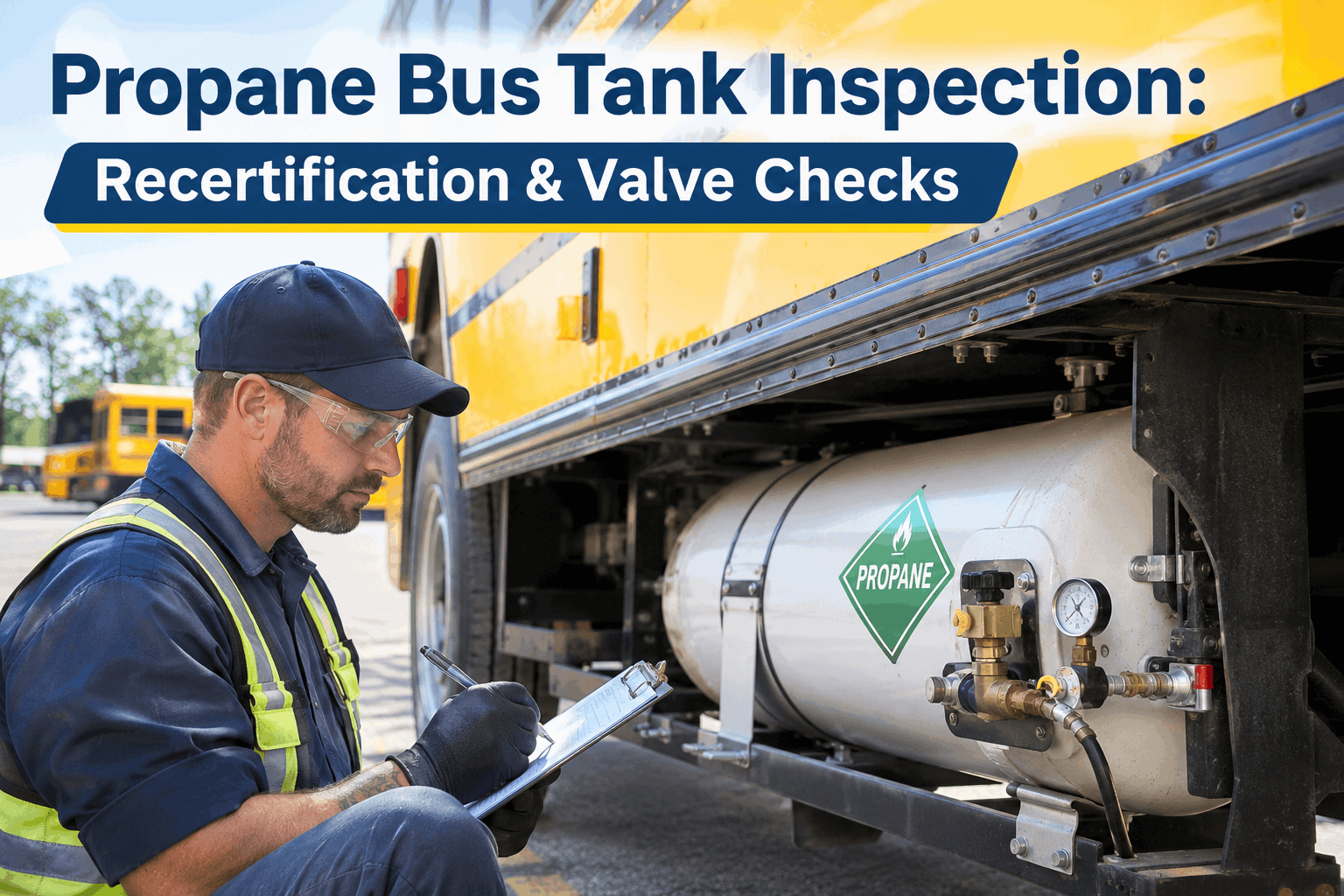
Propane Bus Tank Inspection: Recertification & Valve Checks
A propane bus tank inspection runs on a clock you can't afford to miss. Here is the DOT requalification schedule, the valve and relief-device checks that go with it, and how to track every date so no bus gets turned away at the pump.
12 yrto first DOT requalification after manufacture
5 yrcycle after that by visual inspection (7 yr by pressure test)
0fills allowed on an overdue tank
01 · KNOW YOUR TANK
DOT cylinder or ASME tank? The answer sets your schedule
Before you track a single date, know which tank you have — because the recertification rules split hard here. Getting this wrong means either a missed requalification or a schedule you never needed.
DOT cylinder
On the federal requalification clock: first at 12 years, then every 5 (visual) or 7 (pressure test)
Carries a stamped requalifier ID and month/year of requalification
Overdue means it cannot legally be refilled — the bus is grounded
Requalified by a DOT-approved facility with a RIN
ASME tank (permanently installed)
Generally not subject to periodic DOT recertification once in service
Permanently installed ASME containers on a vehicle fall outside DOT inspection requirements
Still needs a visual integrity inspection — rust, damage, valve condition
Data/saddle plate must be present and legible to keep its pedigree
Confirm your tank type and read its data plate against 49 CFR 180.205, NFPA 58, and your OEM documentation — a lost or illegible plate means a tank that has lost its pedigree.
Tank and valve inspection: what a tech actually looks at
A propane bus tank inspection is more than reading a date. Whether it's a formal requalification or a routine visual, these are the items that decide whether the tank keeps its certification — and the valve checks that ride along with it.
ItemWhat to checkFails / out of service if
Tank bodyDents, bulges, cuts, cracks, rust and pitting (especially the bottom)Detrimental corrosion, or any dent, bulge, cut or crack
Collar, footring, valve coverPresent, secure, undamaged, protecting the valveMissing or damaged collar, footring, or valve cover
Service & fill valvesStraight, undamaged, no seepage; manual shutoff is a real shutoffLeaking or defective valve — or a check valve used as a manual shutoff
Pressure relief device (PRV)Intact, correct, within service interval; serviced per standardLeaking or defective relief device
Data plate & requal dateLegible plate, requalifier ID and month/year stamp readablePlate missing or illegible, or the tank is overdue for requalification
Swipe sideways to see all columns.
Servicing a PRV isn't a glance — it means disassembly, internal inspection, refurbishing, parts replacement, testing, and recertification. Those tasks belong on a schedule, which is where a free inspection tracker keeps each one from slipping.
03 · THE CHECKLIST
The propane tank inspection checklist to run every time
Run this before a tank gets filled or a bus goes back on a route. As a digital inspection, a failed item becomes a work order instead of a note that gets lost between shifts.
Requalification date current, not overdueAn overdue DOT cylinder can't legally be refilled. Confirm the stamped requal date is within its period before the bus fuels.
CRITICAL
Valve and relief device leak-freeA leaking or defective valve or PRV is an automatic out-of-service. Check for seepage and damage every inspection.
CRITICAL
Data plate present and legibleA missing or unreadable plate means the tank has lost its pedigree. Confirm the requalifier ID and date stamp are readable.
CRITICAL
Tank body free of damage and corrosionScan for dents, bulges, cuts, cracks, and rust — especially the bottom. Detrimental corrosion is a reject condition.
PLAN
Collar, footring, valve cover intactThese guard the valve. Missing or damaged protective hardware pulls the tank out of service.
PLAN
Inspection logged with a dated recordA signed, dated record per bus turns the next audit or fill-station question into a quick lookup, not a scramble.
PLAN
On paper these drift and dates get missed. As a demo of digital tank inspections shows, a failed line auto-creates a corrective work order and timestamps the record.
04 · THE RED LINES
Reject conditions: when a tank comes out of service
These are the findings that stop a tank cold — no fill, no route, until it's corrected or replaced. Train every tech to treat any one of them as a hard stop, and capture each one in a free digital inspection so the bus can't quietly return to service.
Any one of these = out of service
Overdue requalificationLeaking or defective valveLeaking or defective PRVDents, bulges, cuts, cracksDetrimental rust or pittingMissing collar / footring / coverMissing or illegible data plateCheck valve used as manual shutoff
1 datemissed is a bus off the road the morning you need it
"The tank itself almost never fails — what fails is the calendar. Miss a requal date and the station won't fill it, so now I'm short a bus on a Monday. Tracking those dates per tank is the whole game; the inspection is the easy part."
— School bus shop foreman, propane autogas fleet
05 · THE SYSTEM
How BusCMMS keeps tank inspections on schedule
BusCMMS is built for bus fleets, not adapted from trucking software. For a propane fleet, it turns the requalification clock into a tracked due date, the inspection into a digital form, and every finding into a work order and a dated record.
Inspection-date schedulingLog each tank's requal and PRV-service dates once; the next due date is flagged before it lapses, per bus.
Digital inspections & findingsRun the tank and valve checklist on a device; a failed item is documented with the finding, not left on a clipboard.
Corrective work ordersAn out-of-service finding spawns a work order and assigns the fix, so the bus doesn't quietly go back on a route.
Service-record historyEvery inspection and repair timestamped per tank — pull the full history in seconds for an audit or a fill-station question.
However many propane buses you run, the dates and records stay in one place. Book a walkthrough and we will set your tank requalification schedule up by bus.
06 · THE RECAP
Key takeaways for your propane bus tank inspection
1
Know DOT vs ASME firstThe tank type sets the schedule — DOT cylinders run the requal clock, ASME tanks need visual integrity checks.
2
12 then every 5DOT cylinders requalify first at 12 years, then every 5 by visual inspection — and an overdue tank can't be filled.
3
The valve rides alongA leaking or defective valve or PRV is a hard stop every bit as much as a bad tank body or an overdue date.
4
The calendar is the riskTanks rarely fail; dates get missed. Tracking requal dates per bus is what keeps the fleet fueling.
Propane bus tank inspection FAQs
How often does a propane bus tank need recertification?
A DOT cylinder is first requalified 12 years after manufacture, then every 5 years by visual inspection (or 7 years by pressure test). Permanently installed ASME tanks generally aren't on this DOT clock but still need visual integrity checks.
What happens if a propane tank's requalification is overdue?
An overdue DOT cylinder cannot legally be refilled, so the bus is effectively grounded until the tank is requalified by a DOT-approved facility. That is why tracking the date beats discovering it at the pump.
What valve checks are part of a propane tank inspection?
Service and fill valves should be straight, undamaged, and leak-free, and the pressure relief device intact and within its service interval. A leaking or defective valve or PRV is an automatic out-of-service condition.
What makes a propane tank fail inspection?
Dents, bulges, cuts, cracks, detrimental rust or pitting, a missing or damaged collar, footring or valve cover, a leaking valve or relief device, a missing or illegible data plate, or an overdue requalification all pull a tank out of service.
How does BusCMMS help with propane tank inspections?
It schedules tank and valve inspections by due date, runs the checklist as a digital form, turns findings into corrective work orders, and keeps a dated service record per tank. You can pull a full history in seconds for an audit.